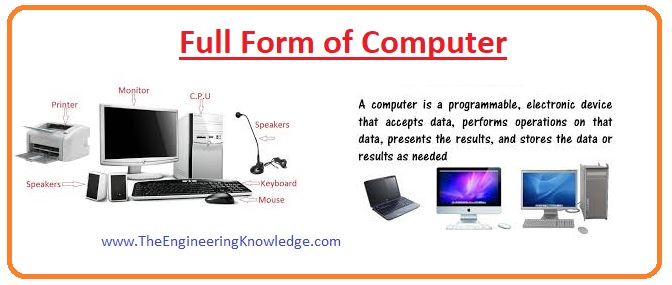
Hello, friends, I hope all of you are having fun in your life. In today’s tutorial, we will have a look at the full form of “computer,” its parts, types, and applications. The full form of a computer is a common operating machine purposely used for technological and educational research. Nowadays the computer has become very common for us from our houses to schools, colleges, universities, industries, shopping centers, laboratories, etc. The computer is being used. With the invention of the computer, our mathematical calculation and data processing have become very easy and less time-consuming.
Before the invention of the computer, it was very difficult to solve complex calculations, but now in a few seconds, we can get our desired results. The invention of the internet and its common use increased the importance of computers and their reliability. Now we can send messages and mail from one part of the world to another part within a few seconds. Now the size of a computer is also reduced. Firstly, it was available only in desktops, but now different types, such as laptops, tablets, etc., are constructed that can be carried from one place to another. This facility was not available on the previous desktop computer. In this post, we will have a look at its working, parts types, applications, and some related parameters. So let’s get started with the full form of “computer.”
Full form of Computer
- The word computer was derived from the word compute, which means to calculate. Computer stands for a common operating machine purposely used for technological and educational research.
- It is an electronic instrument or device that processes raw material or data into information or in our desired output. Processing any data provided to the computer program.
- There are main parts of the computer and numerous subparts; the first main part is the control unit (CU) and the second is the arithmetic logic unit (ALU).
- ALU performs the arithmetic and logic operations on the computer.
- CU controls the operation sequences according to stored data or information in the memory unit.
- Charles Babbage is known as the father of the computer he designed the first mechanical computer known as an Analytical Engine.
Classifications of Computer
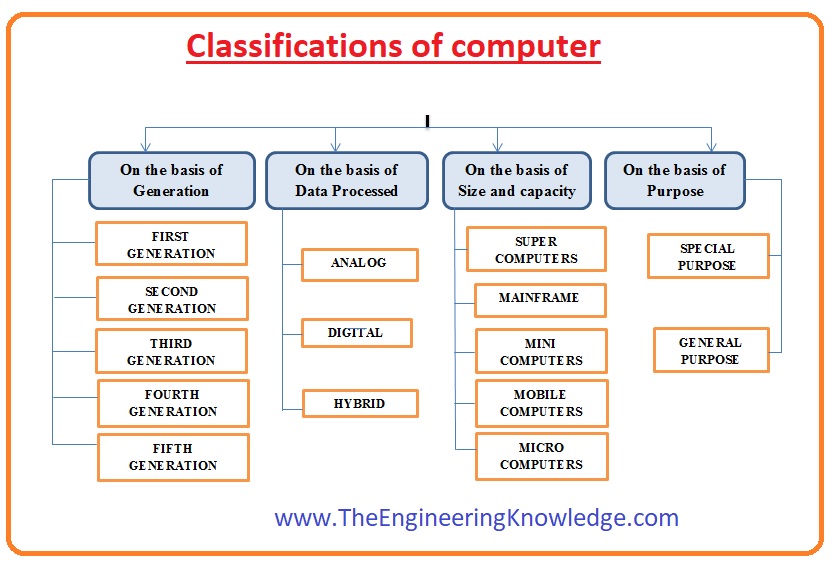
Computer Categorization based on Generation
There are five types of computer classification according to their generations; all these generations are defined here in detail.
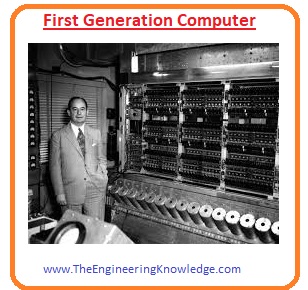
First Generation (1940 to 1956)
First-generation computers were designed and used from 1940 to 1956; the size of these computers was almost equal to your room.
In these computers, vacuum tubes were used to manage different circuits, and for storage of data, magnetic drums were used.
To provide input data to these computers, punched cards were used, and the language used in this machine was binary machine code.
The computers manufactured in the first generation were the Atanasoff-Berry computer (ABC), the IBM 650, and the electronic discrete variable computer (EDVAC).
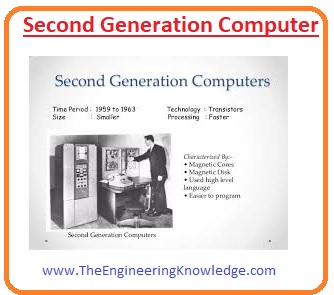
Second Generation Computer (1956 to 1963)
- The 2nd generation computer was invented in the year from 1956 to 1963 and in these computers, instead of vacuum tubes, transistors were used.
- To store data, magnetic tape tapes were installed; the assembly language used in these computers was BAL, and input data providing the punched card were used.
- With the use of a transistor, heat produced due to the vacuum tube was lessened and the efficiency of the computer increased as compared to the first generation.
- In this generation, the computers used were the Universal Automatic Computer (UNIVAC) IBM 1400 and IBM7094, IBM 7090.
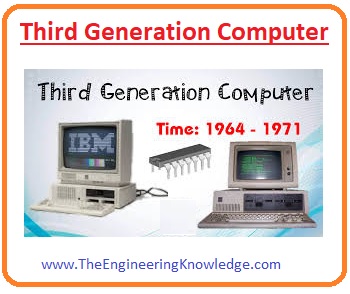
Third Generation Computer (1964 to 1971)
The 3rd generation computers were manufactured from the year 1964 to 1971. In these computers, transistors were replaced with integrated circuits that reduced the size of the computer.
For data storage, MOS (metal-oxide-semiconductor) memory was used.
These computers gave a new boost to the computer industry due to their lower cost and high speed compared to previously used computers.
In these computers, keyboards used for input, data processing, and output were shown on monitors, and the languages used were FORTRAN, C, and common business-oriented languages (COBOL).
Examples of these computers are the IBM 360 and IBM 370 series.
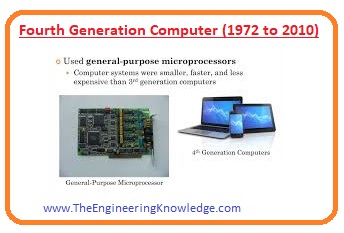
Fourth Generation Computer (1972 to 2010)
- The 4thgeneration of computers was constructed from 1972 to 2010 in these computers with ICs, microprocessors, and VLSI and for data storage, RAM and ROM were installed.
- The languages used in this computer were C and C+++.
- In this time interval, the common use of the internet also increased the use of computers in every industry.
- Examples of this generation of computers are Apple’s Macintosh and IBM’s PC.
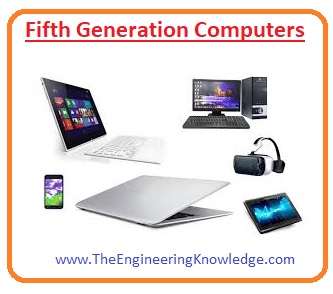
Fifth Generation Computer (2010 to Beyond)
- The 5th generation computers consist of more than one processor, uses large-scale integrated chips and are based on artificial intelligence.
Computer Categorization on basis of Data Handling
- There are three main categories of computers based on the technology used that are listed here.
- Digital Computer
- Analog Computer
- Hybrid Computer
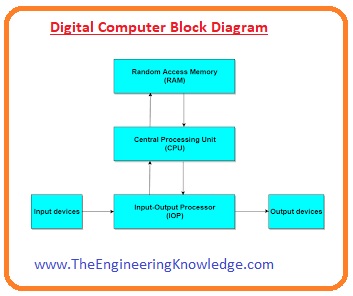
Digital Computer
- The digital computer performs numerous mathematical operations. The word ” digital ” in the name of the computer tells that the data and information of this computer are represented in the form of a variable.
Analog Computer
- This type of computer uses continuously variable factors such as mechanical, electric, and hydraulic quantities to process data.
Hybrid Computer
- It is a type of computer that has operating features of both digital and analog computers.
- It is used in such an environment where a large number of calculations are performed and where hybrid computers are preferred.
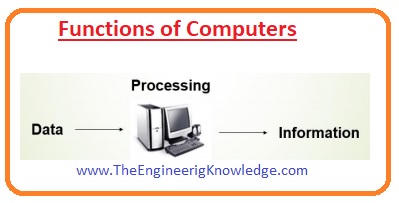
Functions of Computers
- This is a list of the functions performed by the computer.
- First, get data from input devices.
- Store the data received by the input devices and used them when required.
- Processes the data and makes the required pieces of information.
- Finally produced the output at the output devices.
- With all the performance of these functions, it also controls these functions.
Parts of Computers
- Every type of computer consists of two main parts first one is hardware and the second one is software.
Hardware Parts of Computers
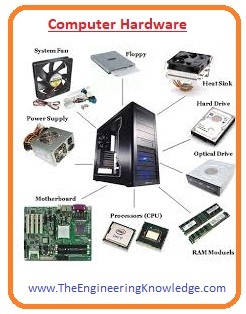
- All physical components and parts of computers that can be touched are the hardware of a computer.
- These parts consist of the mouse, monitors, keyboard, hard drive disk, CPU, etc.
Input Devices
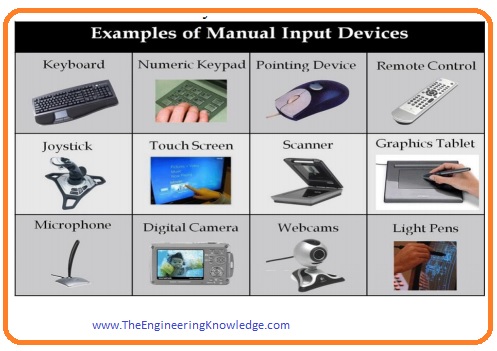
- Such hardware parts of a computer that provide input to the computer called input devices.
- These devices convert humans’ understanding in computer understanding mostly used input devices are mouse and keyboard.
Computer Input Devices
| Keyboard | Graphics Tablets | Joystick |
| Mouse | camera | Gamepad |
| microphone | Pen Input | Electronic pad |
| Touch screen | Video Capture hardware | Electronic whiteboard |
| Scanner | Microphones | Barcode reader |
| webcam | Trackball | Touchpad |
| MIDI Keyboard | Digital Camera |
Computer Central Processing Unit (CPU)
The central processing of a computer is known as the brain of the computer. All functions performed in the computer are controlled by the CPU.
There are 3 main parts of a computer.
ALU
CU
Registers
ALU
In this part of the computer, all logic and arithmetic operations are performed.
Addition, subtraction, multiplication, and division all are arithmetic operations.’
A comparison of numbers, letters, and special characters is a logic operation.
Control Unit
This part of the CPU controls and coordinates with the other parts of the computer.
Registers
The function of registers is to store and execute data very quickly.
Computer Primary Memory
There are 2 main types of primary memory of the computer. The first one is RAM, and the second one is ROM.
RAM:
RAM stands for random access memory; it is a volatile memory used to store data for a short time.
It stores data only while the computer is in an on state. When a computer is off, data will also be removed from this memory.
ROM
ROM stands for read-only memory; it stores data permanently whether a computer is working or not.
Computer Secondary Memory
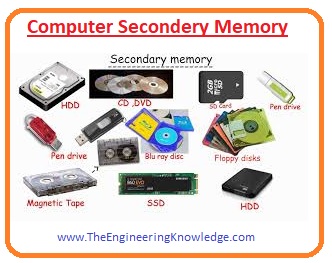
The secondary memory of data retains data and programs permanently till we remove it by ourselves or damage the memory.
Examples of these devices are the hard drive, optical disk, DVD, CD, etc.
Comparison between RAM and Secondary Memory of Computer
| RAM | Hard Disk |
| It is a memory of a computer | It is a storage device |
| It stores data from 500 MB to 6 GB | It can store data larger than RAM 80 GB to 100GB |
| It stores data for small-time interval | It stores data permanently. |
| Data in this device will be lost when power is off. | It retains data on whether power is connected or not. |
| This device consists of chips | It consists of platters |
Computer Output devices
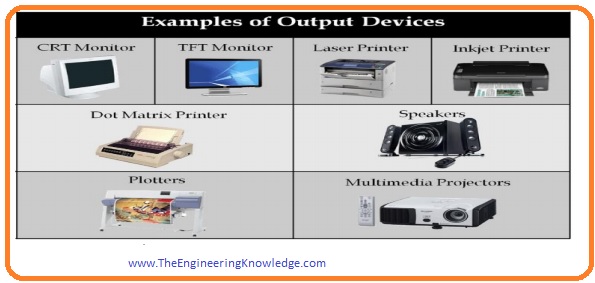
- Such instruments that are part of computer hardware used to show the results processed by the computer on the input are called output devices of computers.
Computer Software
- There are two main types of computer software first one system software and application software.
System Software
- This software of a computer is used to control, integrate, and manage the hardware parts of the computer.
- A Windows-installed computer is an example of system software.
Applications Software
- This software is used in computers to perform specific tasks; examples of this software are Microsoft Office, PowerPoint, spreadsheets, etc.
Difference between Application and System Software
| System Software | Applications Software |
| It is a program used to run the hardware part and other applications of computers. | Application software is like an app that is used to perform a specific task like MS word for writing purposes. |
| Examples of system software are Microsoft Windows, Linux, Unix Mac OSX, DOS | Examples of application software are Opera, Microsoft Word, Microsoft Excel, MySQL, Microsoft PowerPoint, and Adobe Photoshop |
| Normally the operator of the computer does not directly interact with this software this software work in the background. | Computers directly work on the application software, such as we write on the MS Word. |
| System software operation does not depend on the application software | The working of application software depends on system software. |
Read also
- Full Form of WWW, Working, Definition, Features & Applications
- What is DC Current Full Form, Working, Application & Features
- What is CPU: Full Form of CPU, Working, Types, Parts & Applications
- What is RAM: Full Form of RAM, Types, Working, Features & Applications
- Full Form of LCD, Working, Types, Features & Applications
So friends that is the detailed post about the full form of computer I have mentioned every parameter related to this post with a detailed description. If you have any queries and want to add something more in this tutorial ask in comments. See you in the next interesting tutorial. Take care. Have a good day.