

Hello, friends, I hope all of you are having fun in your life. In today’s tutorial, we will have a look at the full form of UPS, its construction, and its applications. UPS is a full form of uninterruptible power supply. This electronic device is a replacement of batteries when there is no input power from the generating system. When some faults occur in the grid station or generation system, normally synchronous generators are used for power generation. Due to some faults in generators, there is no power for our electrical and home devices, but then UPS provides power to the devices.
Nowadays, UPS has become very common in our homes, offices, and different commercial settings to provide power to appliances. There are numerous types of UPSs used according to users’ and appliances’ requirements. In today’s post, we will have a detailed look at its full form, working, construction, applications, installations, and some other related parameters. So let’s get started with the full form of UPS.
Full form of UPS
UPS stands for an uninterruptible power supply that is used to provide power to the load connected in an electrical system when the main supply is off.
The main purpose of this instrument is to maintain the operation of our electrical devices and machines in industries that use continuous power without any interruption.
To store energy in UPS, different types of capacitors are used, such as supercapacitors, batteries, and flywheels.
If we compare the operation of UPS with other power supplies, UPS is better than that because it provides power to the load instantly when the input supply is cut off.
It takes very little time on a battery that is necessary for the operation of different electrical devices.
As an instant power interruption causes serious damage to the hardware of different electronic devices such as a computer and telecommunication instruments, UPS provides protection from such damage.
There are numerous names of UPS, such as flywheel backup, battery backup, and uninterruptible power supply, which are common uses.
The minimum power rating ups are two hundred volt-ampere to a maximum rating of forty-six MVA. 200 VA rating UPS units are used to provide backup power to a single computer.
UPS Circuit Diagram
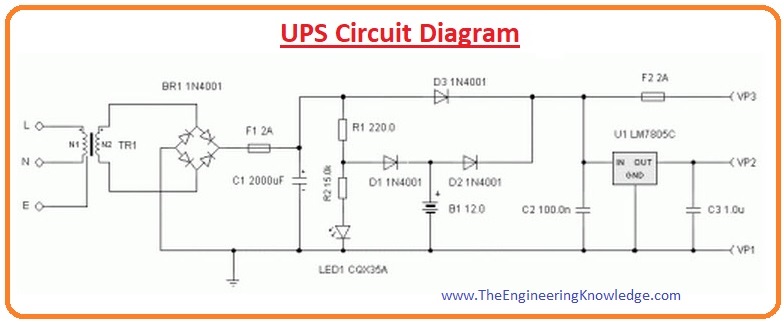
In the given diagram the circuit of UPS is shown at the primary winding of the transformer, 240 volts are provided.
The transformer is step-up and converting 240 into 15 volts. With the secondary of the transformer, the bridge circuit is connected to convert the AC output of the transformer into the DC.
With the bridge, a fuse is attached to provide protection to circuitry from overcurrent flow.
In this circuit, a 7805 IC is used to maintain 15 volts at the output.
Difference Between UPS and an Inverter
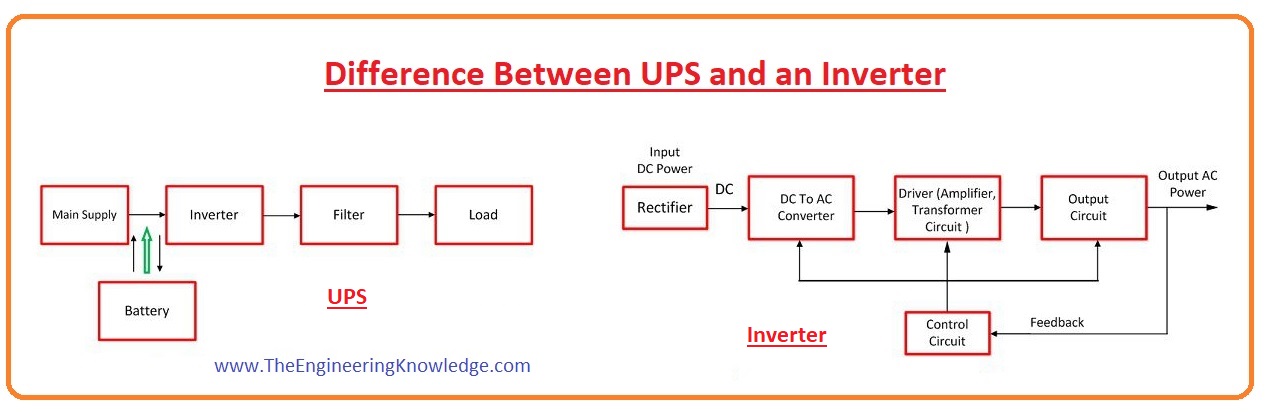
- Now we discuss the difference between UPS and an inverter.
| UPS | Inverter |
| Ups is an instrument that delivers power to the load when the mains supply is off. | While the inverter divides input current into two paths in simple words converts unidirectional current into bidirectional. |
| The main function of ups is to operate like flywheel storage. | Its operation is to transform alternating current into direct current. |
| Its switch over time is less. | It takes some time. |
| Its back up power is electrical. | Its back up power is electronic. |
| There are main 3 types of ups online, offline, and standby. | Its types are grid-tie inverter and stand alone. |
| Ups connected to the appliances to provide power. | The inverter can provide power to both batteries and appliances. |
| Its price is high. | It is less expensive. |
| Its power delivering capacity is for less time interval. | It can provide power for large time intervals. |
| In this device, there is less voltage fluctuation. | But in inverter voltage fluctuation exits. |
| It can use for homes and industries. | It uses only for home appliances. |
Main Components of UPS
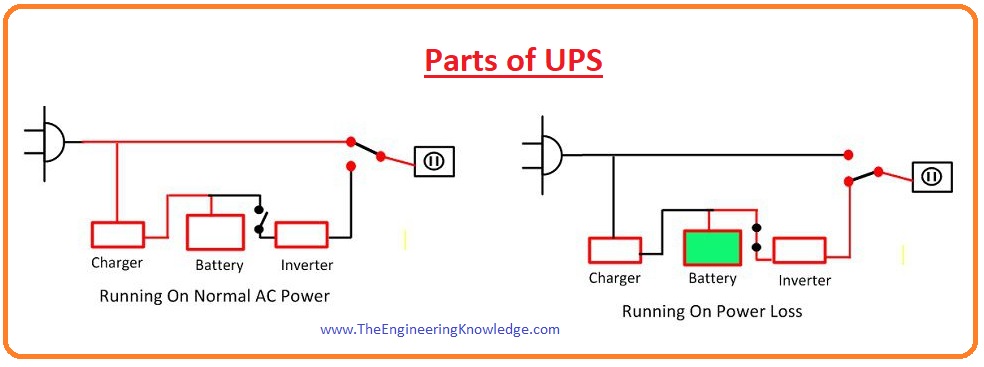
- There are four main components of ups that are described in detail here.
- Rectifier
- Battery
- Inverter
- standby Switch
Rectifier
There are numerous functions performed by the rectifier. The first one is to transform the alternating current into a direct current.
The rectifier DC current delivers the battery to recharge the battery.
It also provides protection to the UPS battery by bearing the surging and overloading on UPS.
UPS Batteries
When the input main supply is providing power to the load, then the battery continues to charge using the main power.
When the input supply is cut off, then the battery provides power to the load and starts operation of the UPS.
Inverter
An inverter is used to convert DC power coming from the battery into AC power to drive the connected load.
Static Bypass Switch
This switch is used to provide protection to the UPS and the connected. Whenever any faults occur in the UPS, then this switch automatically disconnects the load from the UPS and connects with the input supply.
When UPS is repaired, then again connected to the load, as direct power to load is not good as it is not filtered properly, but it is necessary to continue the operation of the load until the UPS starts its operation.
Types of UPS
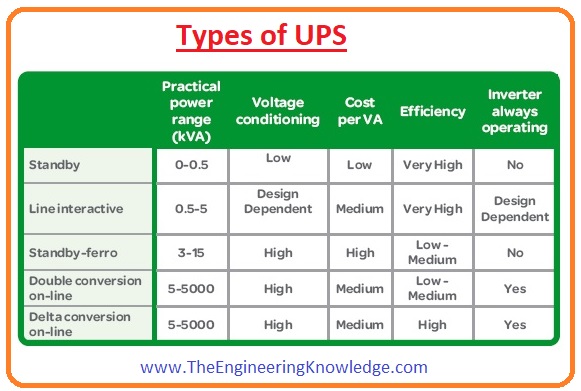
- There are 3 main types of UPS that are described here with the detailed.
- Off-line UPS
- On line UPS
- Line-interactive UPS
Off-Line UPS
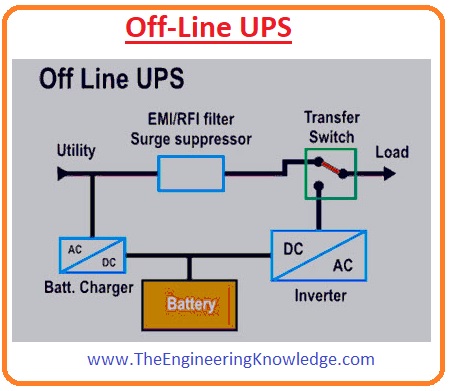
The offline UPS is also known as the standby UPS, and it is mostly used in computers.
The circuit diagram of this UPS is shown below and consists of a battery, an AC-to-DC or DC-to-AC inverter switch, and an LPF (low-pass filter) that minimizes the switching frequency.
From the circuit of these ups, we can observe that these ups will start operation when the input supply is off.
This UPS first converts input AC power to DC and stores it in the battery.
When the input is cut off, the DC voltage of the battery are converted into AC through the inverter and then provided to the load.
This type of UPS is less expensive with back up storage it also provides surge protection.
On-line UPS
This type of UPS used a double conversion method for power transformation. First of all, alternating current is transformed into DC through the rectifier circuitry and recharges the battery.
After that, the output power of the battery that is DC again is transformed into AC and provided to the load.
This type of UPS is normally used for such applications where electric separation is required.
It is also called double conversion because the output of the rectifier directly provides power to the inverter.
If the input supply is off, then the power stored in a battery is provided to the inverter, which is converted to AC and provided to the load through the transfer switch.
When again input power is provided, then power from the rectifier moves to the battery to recharge it.

Line Interactive UPS
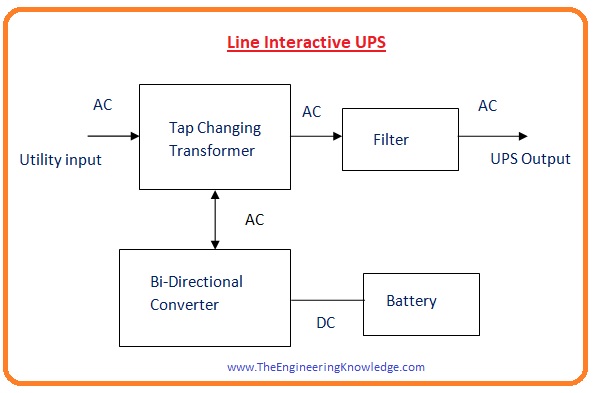
- This type of UPS is mostly used in small commercial offices and departmental stores to run servers.
- In these ups, a special tap-changing transformer is used to regulate the voltage; the tap of the transformer is changed to get the desired voltage.
- The given diagram of this ups is shown below.
Applications of UPS
- These are some applications of ups.
- It is used in homes to run electrical appliances when input supply cut off.
- It is used in different offices and commercial buildings.
- It used in industries to run different machines.
Read also
- Full Form of WWW, Working, Definition, Features & Applications
- What is DC Current Full Form, Working, Application & Features
- What is CPU: Full Form of CPU, Working, Types, Parts & Applications
- What is RAM: Full Form of RAM, Types, Working, Features & Applications
- Full Form of LCD, Working, Types, Features & Applications
So friends that is the detailed post about the full form of ups, in this post I have mentioned each and every parameter related to the ups. If you have any queries about the full form of ups ask in comments. I will solve your queries. See you in the next post.





This is article Can I contact you? Can I write to you directly. It’s so good that i’m going follow you!
Yes of course you can contact us by using our contacts given on contact us page thanks
I simply want to tell you that I am beginner to blogging and absolutely savored you’re website. More than likely I’m going to bookmark your site . You really have superb articles. Regards for revealing your webpage.