
Hi friends, I hope all of you are fine. As you already know, we have started a series of PLC articles. In the last lecture, we discussed a detailed article on plc discrete inputs and outputs. In today’s tutorial, I am going to explain to you a detailed article on analog input and output devices of a PLC.
Previous PLC controllers were restricted to discrete or digital input and output interfacing, which permitted only on- or off-category instruments to be linked with a controller. This restriction implied that the PLC controllers could have only fractional governance of numerous process variables. Nowadays, still, a whole assortment of both separate and analog interfacing is accessible, which will permit the controller to link with any kind of process. So let’s get started with the analog input and output devices of the PLC.
Analog Input and Output Devices of PLC
Previous PLC controllers were restricted to distinct or digital input and output interfaces, which permitted only on- or off-category components to be attached to the PLC.
Discrete inputs and outputs work only for two conditions: the first one is on and the second one is off.
In association, analog components define such physical quantities (these are qualities of any substance defined by some calculations) that have a large no. of numerical values.
Analog inputs/outputs differ from zero to twenty mA (milliamps), four to twenty mA, or zero to ten volts.
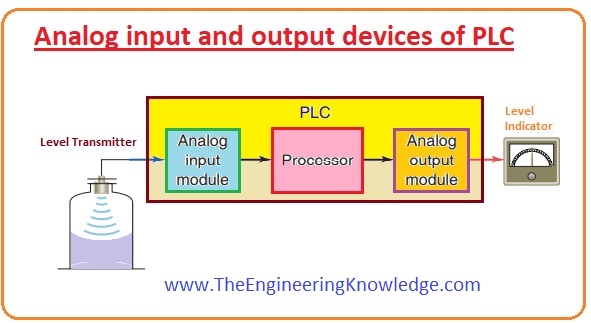
The given diagram shows how PLC analog input/output components are used in gauging and exhibiting the level of liquid in a container.
The analog input interfacing unit comprises the electrical circuit essential to receive an analog voltage/current signal from the level spreader field component.
This input is transformed from an analog to a numerical assessment for the use of the CPU.
The circuit of the analog output devices receives the numerical assessment from the CPU and changes it again to an analog signal that energizes the field container level measuring device.
Analog input units usually have numerous input stations that permit four, eight, or sixteen components to be linked with the PLC.
There are two main kinds of analog input units: voltage-detecting and current-detecting.
Analog sensing devices calculate the variable physical magnitude above a precise range and produce a resultant voltage/current signal.
The physical quantities that can easily be calculated by the PLC analog unit are temperature, force, mass, distance, velocity, and level.
For instance, a sensing device can calculate temperature above a range of zero to five hundred degrees Celsius and output an analog voltage signal, which differs between zero and fifty millivolts.
PLC Temperature Measuring Analog Module
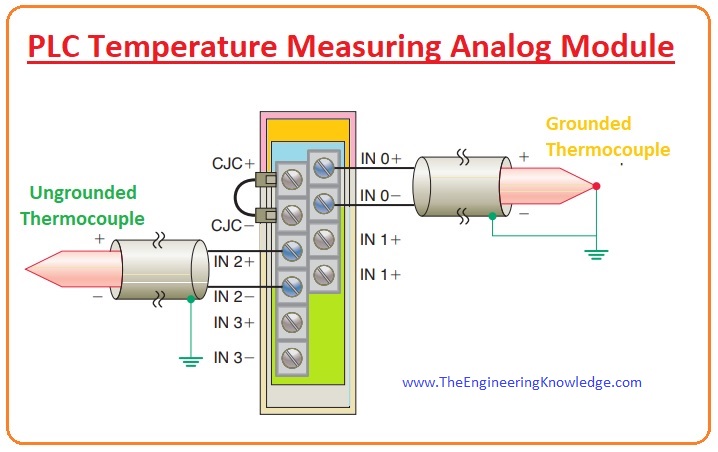
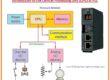
The given diagram shows an example of a voltage-detecting input analog unit used to calculate temperature.
The assembly figure relates to a four-channel analog thermocouple input unit.
A variable direct current (DC) voltage whose value in some mV is directly proportional to the temperature whose value is found is produced by the thermocouple.
This voltage is amplified and converted to digits by the analog input unit and then directed to the CPU on command from a program order.
Due to the lower-value voltage input signal, a wound-protected couple of wires are used in cabling the circuitry to decrease unsolicited electrical noise signals that can occur in the conductive wiring from other cabling.
When we are working on a thermocouple that is not connected with the ground, the protection circuitry should be linked with the ground at the unit’s finishing points.
To get precise interpretations from each of the stations, the temperature difference between the thermocouple cable and the input network should be compensated for.
A (CJC) thermistor is combined with the casing of the unit for this function. Analog-to-digital conversion is done by the analog-to-digital (A/D) converter, which is the main part of the analog input unit.
Analog voltage input units are offered in two categories: the first one is unipolar, and the second one is bipolar.
Unipolar units can receive an input signal that has positive values. For instance, if the field component outputs are zero volts to one hundred ten volts, then the unipolar units will be used.
Bipolar signals fluctuate between an extremely negative point and an extremely positive point.
For instance, if the field components’ outputs are minus ten volts to plus ten volts, a bipolar unit will be used.
The tenacity (resolution) of an analog input network states the minimum alteration in input signal assessment that can be detected and is founded on the number of bits used in the numerical demonstration.
Analog input units should generate a sort of numerical value between an extreme and a minimum value to signify the analog signal above its complete extent.
Applications of Analog Input and Output Devices of PLC
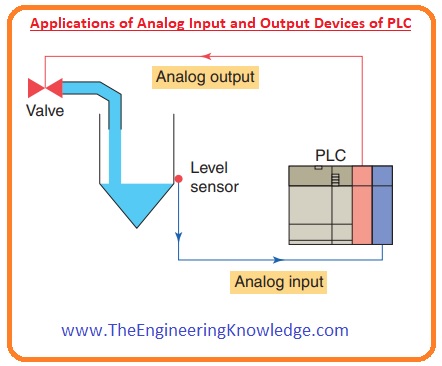
The given diagram explains the practical implementation of the analog input and outputs of devices in the programmable controller logic network.
In given circuitry, the PLC regulates the quantity of liquid in the tank by varying the control valve slowly.
The movement of liquid is governed by the analog output by controlling the valve.
First, the valve is open completely so the liquid in the tank reaches a set point. To obtain a set value, the processor of the PLC sends a signal to the output for the required level of liquid.
Analog output devices for plc
Analog inputs are temperature sensors, oil pressure sensors, weight scales, and CO₂ sensors. The output will be employed to control the power, current, or voltage of sensors.
PLC analog output examples
temperature gauges, water level meters, and control of different other equipment/machinery. are examples of PLC analog output examples.
Analog output examples
solenoid valves, motors, electric heaters, relays, lamps, fans,
PLC analog input and output examples
CO₂ sensors, oil pressure sensors, temperature sensors, and weight scales
FAQs
What are the input and output field devices used in a PLC?
Input devices are sensors and switches that send on and off signals to PLC input ports. Output devices such as contactors, motors, and lights are controlled with PLC output ports to control processes. Common input devices are mechanical switches, proximity switches, photoelectric sensors, and encoders.
What type of analog input is a PLC?
There are two basic types of analog input, voltage and current. The manufacturer can provide a field device for one or both signal types. Then define a matching PLC input module that gets one or both types.
What are analog output and analog input?
Analog input signal, denoted like temperature or level or rate of flow. Analog output signals are variable and can be used for opening the valve to the required state. After that analog signal is explained, it is known how many doors are open or closed.
What are digital input and output in a PLC?
Digital input and output in a PLC are signals to the PLC to get and send. The digital input is a signal obtained by a PLC that can be on or off, such as a switch or sensor. Digital outputs are signals sent by a PLC to controlling devices such as lights or relays.
What are the analog output devices for a PLC?
Analog output signals come with temperature transmitters, thermocouples, pressure transmitters, flow transmitters, level transmitters, etc.
What are the three types of input and output in PLC?
Input or output features of programmable logic controllers have three types: discrete, analog, and network.
Is PLC output AC or DC?
PLC can operate with the use of AC or DC power supplies; each provides different features based on the certain needs of applications.
What is an example of an analog PLC output application?
It is used for controlling the temperature.
It is used in chemical plants for controlling and monitoring pressure.
It is also used to control the speed of the motor.
What are the output devices in a PLC?
Output devices are actuators, lamps, valves, or components that get commands from the PLC and perform different actions on the system. As the solenoid valve can control fluid flow, the relay can switch the motor on or off, or the lamp can also show an error or status.
What is an input device on a PLC?
Common examples of input devices are switches and push buttons. Sensing devices. Limit switches.
What are digital input and analog input in a PLC?
There are two main types of input and output devices, such as analog and digital. Analog devices use continuous signals that can have different magnitudes, like voltage, current, or resistance. Digital devices use discrete signals that come with two states, like on or off, high or low.
I also have uploaded some related articles to plc you read them for further learning.
- Introduction to PLC
- Working of PLC
- Parts of PLC
- Input and Output Section of PLC
- PLC Discrete Input and Output Devices
That is the complete tutorial about analog inputs and output of PLC if you want to know further or have some suggestions for the improvement of this article can ask in the comments. See you in the next tutorial PLC Special Inputs and Outputs.
,


Good info. Lucky me I recently found your blog by chance (stumbleupon).
I have saved it for later!
Hi there, I found your website via Google while looking for a related topic, your website came up, it looks good. I have bookmarked it in my google bookmarks.
I’ve been surfing online more than 2 hours today, yet I never found any interesting article like yours. It will be pretty worth enough for me. In my view, if all web owners and bloggers made good content as you did, the web will be a lot more useful than ever before.
Highly energetic article, I loved that a lot. Will there be a part 2?
yes i have uploaded related articles you can
Highly energetic article, I loved that a lot. Will there be a part 2?
“Great article and right to the point. I don’t know if this is in fact the best place to ask but do you folks have any thoughts on where to get some professional writers? Thank you ??”
Hi there, I discovered your site by means of Google
whilst searching for a comparable topic, your site came
up, it seems great. I have bookmarked it in my google bookmarks.
Hi there, simply turned into alert to your blog through
Google, and located that it’s truly informative.
I’m going to watch out for brussels. I will be grateful
should you continue this in future. Numerous folks might be benefited from your writing.
Cheers!
Good way of telling, and nice post to take facts
regarding my presentation subject, which i am going to deliver in institution of higher
education.
Its like you read my mind! You seem to know a lot about this, like you wrote the book in it or something.
I think that you can do with a few pics to drive the message home a little bit, but instead of that, this is
wonderful blog. An excellent read. I will certainly be back.
My brother suggested I might like this web
site. He was once entirely right. This put up actually made my day.
You cann’t consider simply how so much time I had spent for this information! Thank you!