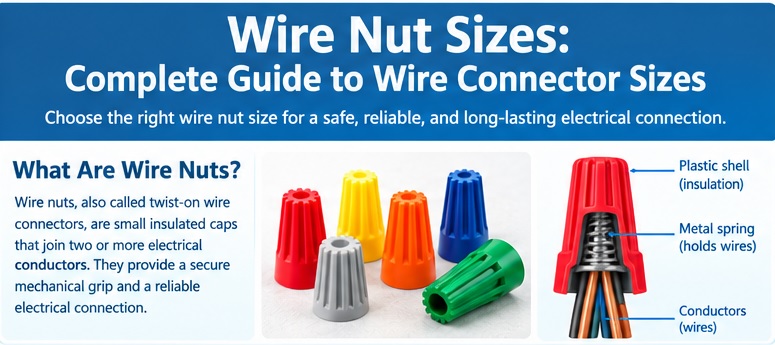
Wire nuts, another name for a twist-on wire connector, make a connection in a certain enclosure. Wire nuts come in different sizes based on wire connections; each has certain features. In this post, we will cover detailed features of wire nut sizes and practical understanding. So let’s get started.
What is a wire nut?
Wire nut: a small threaded cap that connects two or more wires securely. with a strong wire connection in the cap that provides a proper connection for current flow.
Wire nuts are constructed with different materials and have different sizes since they connect different types and wire gauges and are normally part of vehicles and other projects.
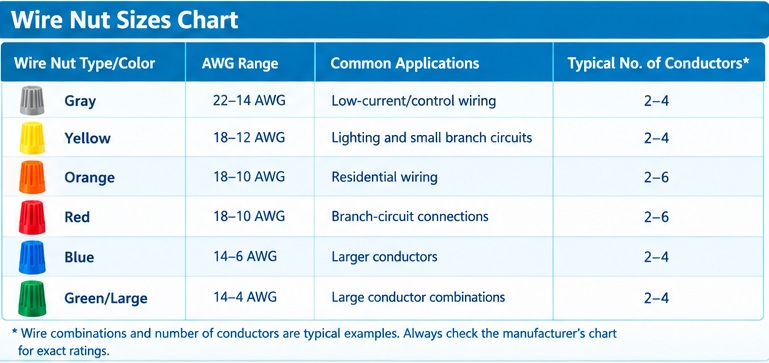
Wire Nut Sizes Chart
| Wire Nut Type/Color | AWG Range | Applications |
| Gray | 22–14 AWG | Low-current/control wiring |
| Yellow | 18–12 AWG | Lighting and small branch circuits |
| Orange | 18–10 AWG | Residential wiring |
| Red | 18–10 AWG | branch-circuit connections |
| Blue | 14–6 AWG | Larger conductors |
| Green/Large | 14–4 AWG | Large conductor combinations |
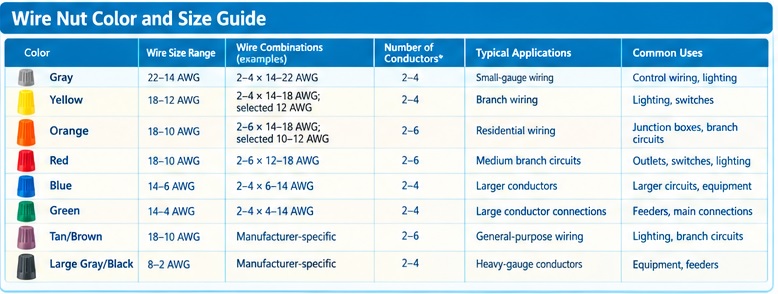
Wire Nut Color and Size Guide
| Wire Nut Color | Wire Size Range | Wire Combinations | Number of Conductors* | Application | Uses |
| Gray | 22–14 AWG | 2–4 × 14–22 AWG | 2–4 | Small-gauge wiring | Control wiring, small lighting, low-current circuits |
| Yellow | 18–12 AWG | 2–4 × 14–18 AWG; selected 12 AWG combinations | 2–4 | Small branch wiring | Lighting, switches, residential wiring |
| Orange | 18–10 AWG | 2–6 × 14–18 AWG; selected 10–12 AWG combinations | 2–6 | residential wiring | Junction boxes, branch circuits |
| Red | 18–10 AWG | 2–6 × 12–18 AWG | 2–6 | Medium branch circuits | Outlets, switches, lighting, junction boxes |
| Blue | 14–6 AWG | 2–4 × 6–14 AWG | 2–4 | Larger conductors | Larger branch circuits, equipment wiring |
| Green | 14–4 AWG | 2–4 × 4–14 AWG | 2–4 | Large conductor connections | Feeders and larger electrical connections |
| Tan/Brown | 18–10 AWG | Manufacturer-specific | 2–6 | General-purpose wiring | Lighting and branch-circuit connections |
| Large Gray/Black | 8–2 AWG | Manufacturer-specific | 2–4 | Heavy-gauge conductors | Equipment and feeder connections |
Wire Nut Size by Wire Gauge
Wire Gauge (AWG) | Conductor Diameter | Wire Nut Size/Color | Number of Wires | Applications |
| 22 AWG | 0.64 mm | Gray | 2–4 | Control circuits, electronics, low-current wiring |
| 20 AWG | 0.81 mm | Gray | 2–4 | Control wiring, signaling |
| 18 AWG | 1.02 mm | Gray/Yellow | 2–4+ | Lighting controls, low-current circuits |
| 16 AWG | 1.29 mm | Yellow | 2–4+ | control circuits, small equipment |
| 14 AWG | 1.63 mm | Yellow/Orange | 2–4+ | 15 A branch circuits, lighting, receptacles |
| 12 AWG | 2.05 mm | Orange/Red | 2–4+ | 20 A branch circuits, receptacles, equipment |
| 10 AWG | 2.59 mm | Orange/Red/Blue | 2–3+ | Larger branch circuits, appliances |
| 8 AWG | 3.26 mm | Blue/Large | 2–3 | Higher-current equipment and feeders |
| 6 AWG | 4.11 mm | Blue/Large | 2–3 | equipment and feeders |
| 4 AWG | 5.19 mm | Green/Large | 2–3 | feeders and equipment |
| 2 AWG | 6.54 mm | Large/Heavy-duty | 2+ | Large feeders and equipment |
Wire Nut Size Chart for Residential Wiring
Residential Application | Wire Gauge | Circuit Rating | Wire Nut Size/Color | Conductors in Connection | Use |
| Lighting circuits | 14 AWG | 15 A | Yellow / Orange | 2–4 | Ceiling lights, wall lights, fixtures |
| Lighting circuits | 12 AWG | 20 A | Orange / Red | 2–4 | Higher-capacity lighting circuits |
| General receptacles | 14 AWG | 15 A | Yellow / Orange | 2–4 | Standard outlets |
| General receptacles | 12 AWG | 20 A | Orange / Red | 2–4 | 20 A receptacle circuits |
| Wall switches | 14 AWG | 15 A | Yellow / Orange | 2–4 | Switch boxes |
| Wall switches | 12 AWG | 20 A | Orange / Red | 2–4 | 20 A branch circuits |
| Ceiling fans | 14 AWG | 15 A | Yellow / Orange | 2–5 | Fan and light connections |
| Ceiling fans | 12 AWG | 20 A | Orange / Red | 2–5 | Larger fan circuits |
| Junction boxes | 14 AWG | 15 A | Yellow / Orange | 2–6+ | Splicing branch circuits |
| Junction boxes | 12 AWG | 20 A | Orange / Red | 2–6+ | Multiple branch-circuit connections |
| Small appliances | 14–12 AWG | 15–20 A | Yellow / Orange / Red | 2–4 | Appliance connections |
| Larger appliances | 10–8 AWG | Depends on load | Red / Blue / Large | 2–3+ | Dedicated appliance circuits |
| HVAC/control wiring | 18–14 AWG | Application dependent | Gray / Yellow | 2–4 | Thermostats and control circuits |
| Doorbells/control circuits | 18–16 AWG | Low voltage | Gray / Yellow | 2–4 | Control and signaling wiring |
| Outdoor wiring | 14–12 AWG | 15–20 A | Listed weather-resistant connector | 2–4 | Outdoor fixtures and equipment |
| Large equipment | 10–6 AWG | Application dependent | Red / Blue / Large | 2–3 | Equipment and higher-current circuits |
Types of Wire Nuts
Standard Wire Nuts
Stranded wire nuts commonly use connectors that are cone-shaped with inner threads. It comes with a color-coded, structured plastic and metallic spring inserted. Standard wire nuts are easy to use, low cost, and part of different wiring projects.
Winged Wire Nuts
These wire nuts come with a wing design that provides strong gripping. So easy to twist for high-gauge wire. These nut types commonly employ tight connections, like high-vibration projects.
High-Temperature Wire Nuts
These nuts are constructed with high-resistance material. so easy to handle in high-temperature conditions, for example, heaters and light fixtures. These wire nuts instead were very high-temperature resistant.
Aluminum to Copper Wire Nuts
These wire nuts are purple in color and are used to connect wires made of aluminum and copper material. A direct connection between copper and aluminum causes overheating and corrosion. These connectors come with an antioxidant compound that avoids oxidation
Wingless Wire Nuts
These wire nuts are the same as standard wire nuts. They easily fit in confined spaces where others are difficult to fit. These are low cost and easily connected at confined locations.
Twist-On Connectors with Hex Heads
This wire nut hexagonal structure is used with a power driver. This nut is part of industries where fast connections are needed. Their hex heads make them speedy connections where bulk connecting is needed.
Inline Splice Connectors
It is a cylindrical design used for two-wire connections. This is best for clean assembly. They are compact in design and for applications where longer functionality is needed
How to Use Wire Nuts Properly
Follow these steps for using wire nuts properly.
First of all, power supply and make a degenerated circuit.
Remove the conductor covering defined in the figure. Configure the conductor ends based on the connector.
For tightening, twist the wire clockwise and tighten to make strong conductor connections.
There is no bare copper exposed. so tug conductors that are properly held
Now put back-splice into the box without applying pressure on the connection.
Wire Nuts vs Push-In Connectors vs Terminal Blocks
| Feature | Wire Nuts | Push-In Connectors | Terminal Blocks |
| Connection | Wires twisted into a spring-loaded connector | Wires inserted into individual ports | Wires are secured with screws, clamps, or spring terminals |
| Installation Speed | Moderate | Fast | Moderate |
| Tools needed | none | none | Screwdriver may be required |
| Wire Range | 18–10 AWG; larger models available | 22–10 AWG, depending on model | Wide range, from small control wires to large conductors |
| Number of Wires | Multiple wires can be connected in one connector | one conductor per port, with multiple ports internally connected | Multiple terminals can be interconnected |
| Solid Wire | supported | supported | Commonly supported |
| Stranded Wire | Supported by selected models | Supported by selected models | supported, depending on terminal |
| Mixed Wire Sizes | Possible if specifically listed | Possible on selected models | Possible with appropriately rated terminals |
| Connection Adjustment | Twist-on connection | Push-in connection | Screw or clamp can normally be adjusted |
| Reusability | connector and condition | connector design | Often reusable |
| Connection Inspection | visual and mechanical | models provide a visible wire-entry/inspection area | easy to inspect |
| Space Requirement | Moderate | compact | space for terminal strip/block |
| Vibration Resistance | Depends on connector design and installation | Spring-clamp models can provide good retention | Depends on screw/clamp design and installation |
| Voltage Rating | Model dependent | Model based | Model dependent |
| Current Rating | Model based | Model | Model dependent |
| Residential Wiring | Very common | common | Less common for basic residential splices |
| Control Panels | Less common | Common in some applications | common |
| Junction Boxes | Common | Common | Common in organized panel installations |
| Maintenance | Simple replacement | Often quick to disconnect | Easy to identify and service |
| Advantage | Simple, inexpensive, and widely used | Fast and convenient wiring | Organized, modular, and easy to service |
| Limitation | Requires proper twisting and sizing | Must use the correct wire type and connector rating | more physical space and may require additional hardware |
| Use | General-purpose electrical splicing | Fast wiring and compact connections | Control panels, distribution, and organized wiring |
How to Select a Wire Nut?
Select a wire nut based on a safe, strong connection. Different factors help to choose a wire nut practically.
Wire Gauge
Wire nuts come with certain ratings for wire gauges. For selecting wire nuts, find the wire gauge we need for the connection.
Confirm the wire nut rating for the gauge range. With ensured wire insulation for support
Number of Wires
The number of wires connected affects wire nut size.
Uses
Practical applications also factor into the wire nut selection.
Standard wire nuts used for indoor applications.
outdoor locations, use waterproof wire nuts since they handle moisture.
Ground wires use green wire nuts and larger wire nuts rated for high amperage current.
Follow the colour code.
Wire nut colour codes show support with wire gauge values and wire number. Select the colour that flows from the features of the project
Follow Electrical Codes and Standards
Check that the wire nut is fulfilling Underwriters Laboratories and the National Electrical Code (NEC) standards.
Connection testing
When the wire nut is installed, properly tug the wire to ensure it is strongly connected to the wire nut. With that check, no copper is exposed to the external wire nut
Wire Nut Applications
Waterproof applications
Standard wire nuts are used at dry locations; for outdoor projects and wet areas, special wire nuts are needed. that are silicone-filled.
High-Temperature Wire Nuts
Different standard plastic twist-on connectors are rated at 105 degrees but depend on the project. High-temperature projects, such as heaters, ovens, and industrial devices, use ceramic connectors that are high-temperature connectors.
Plastic connectors become soft when temperature rises, so they are not preferred for high temperatures
Different metal connections
Standard wire nuts are used for copper conductors, aluminum wire, and copper-to-aluminum splices and are needed for certain connectors for connection. that comes with an antioxidant compound for a strong connection
Industrial devices
Building wiring with a rating of 600 volts twist-on wire connectors. Industries’ high-voltage needed rating 1000-volt connectors.