
Hello, fellows, I hope all of you are enjoying your life. In today’s tutorial, we will have a look at the full form of LED, its working, applications, and uses. The full form of LED is a light-emitting diode. It is a semiconductor diode with 2 leads; the first one is an anode and the second one is a cathode. Nowadays almost every electronic device, whether a computer, mobile, calculator, etc., is used for an indication of different signals. Due to different features and properties, these diodes are preferred to use over older technologies.
Due to its smaller dimensions and less power consumption, it is preferred. Its structure and assembly are almost similar to the normal PN junction, but the difference is the LED emits light. When its positive terminal is attached to the positive terminal of the battery and the negative terminal is the negative point of the battery, it starts to emit light. There are different colors of LED available according to design and structure. In today’s world we will have a look at its full form, working, types, and applications. So let’s get started with the full form of LED.
Full Form of LED
The LED stands for light-emitting diode, which generates radiation of light when a current passes through it.
As we know, any semiconductor material is a combination of electrons and holes; also, an LED is a semiconductor.
So when current is provided at the terminals of the LED, then electrons get energy and combine with holes and emit energy in the shape of light photons.
The colour of the emitted light depends on the energy needed for the electron to move from the ‘N’ side to the ‘P’ side of the material after crossing the band gap.
To emit white light from the LED cover, the semiconductor material is with a sheet of light-emitting phosphor.
In 1962 LEDs were used as the most common element in different electronic devices and emitted infrared light of less intensity.
LEDs emit infrared light cues for remote control of TVs, LED televisions, and different electronic devices at some distance.
When the first white light-emitting diode was manufactured, it produced red light of low intensity.
Currently, different LEDs are available, having different wavelengths of UV, infrared and visible light, providing output of high-intensity light.
Older light-emitting diodes were used only for lamps, indicators, replacing less intense incandescent bulbs and in 7-segment displays.
But nowadays LEDs are coming with high intensity and are used to illuminate a room and your house.
LEDs are now used in different sensing devices and, due to their high switching speed, are used in different communication techniques.
If we compare LED with the older incandescent light, we will come to know that LEDs are less expensive, smaller in size, has a longer operating life, uses less power and has high-speed switching.
There are numerous applications of LEDs, such as headlights of vehicles, signal lights, cameras, mobiles, laptops, medical instruments, and illuminating light.
As we know, light emitted from the laser is monochromatic and coherent, but the light of LED is non-monochromatic and non-coherent.
Difference Between LED and LCD
- Now we compare the LED and LCD and find their differences.

| LED | LCD |
| This is a semiconductor device that releases light when current passes through it. | It is an optical instrument used to show any info in the shape of photos and text. |
| Its full form is Light-emitting diode. | Its full form is a liquid crystal display. |
| There is no need for light on the background of led. | But in this device, a cathode fluorescent lamp is used to deliver background light. |
| Its resolution is high. | Its resolution is less. |
| It uses high power. | It consumes less power |
| Its display area is less. | Its display area is high. |
| Its price is high | Its price is less |
| The material used for its construction is gallium arsenide phosphide. | It is constructed with the liquid crystal and glass electrodes. |
| Its switching is fast. | Its switching speed is slow |
| If it is connected to a direct current source, there will be no effect of dc on it. | While dc will decrease the operating life. |
| It does not use mercury | It uses mercury. |
Working of LED
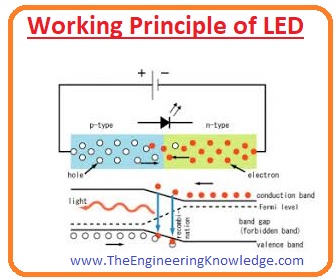
The operation of an LED follows the quantum theory of an atom. According to the quantum theory, when an electron moves from an upper orbit to a lower orbit, it releases energy.
The amount of energy released is equal to the energy gap between 2 orbits around the atom.
As we know, when the positive terminal of the battery is linked with the anode and the negative terminal of the battery with the cathode, the current passes through the diode.
The movement of current is caused by the combination of holes and electrons in the semiconductor material.
The insertion of electrons in the holes tells about the movement of electrons from the conduction band to the valence band by releasing energy.
Due to the movement of electrons, energy is released in the shape of photons of light, and this energy is equal to the forbidden energy gap.
For further understanding, let’s discuss the quantum theory.
Quantum Theory
According to quantum theory, the energy released by the photon of light is equal to a multiple of the frequency of waves and the Planck constant ‘h.’.
E=hf—-(a)
In this equation, ‘h’ is the Planck constant and ‘f’ is the frequency of the light wave emitted.
As we know, v = fλ or c = fλ
If we put the value of f in the equation a, then we have.
E=hc/λ
This equation explains that the wavelength of an emitted wave is in inverse relation with the energy among 2 bandgaps.
In simple words, an LED consists of 4 different layers: the first one is a die, the second one is a substrate, the third one is a phosphor, and the fourth one is a lens.
The first die is a semiconductor material comprised of gallium nitride (GaN), which emits blue light when the input supply is connected with the LED.
Colors other than blue can also get using different phosphor materials.
Types of LED
Numerous types of LEDs are mentioned here in detail.
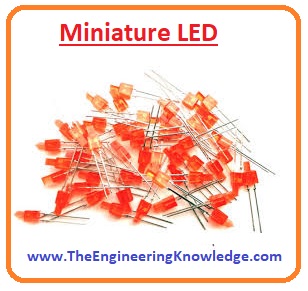
Miniature LED
This category of LED consists of a single die and functions as an indicator; the physical dimensions of these LEDs are two millimeters to eight millimeters.
The packages of these LEDs are through-hole and surface-mounted.
The operating current values for these LEDs are one milliampere to twenty milliamperes.
The physical shape of these LEDs is circular, diamond, flat, or rectangular, with the upper part flat.
The miniature LEDs that emit infrared comprise a black tint to stop visible light and allow infrared radiation to pass.
The light-emitting diodes that operate at five volts and twelve volts are miniature light-emitting diodes and have resistance in series when linked with the five- or twelve-volt power supply.
High-Power LEDs
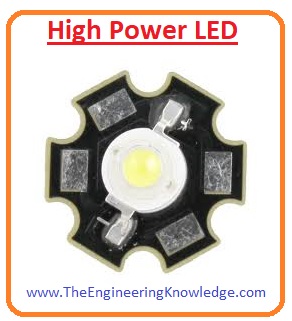
These light-emitting diodes are also known as high-output light-emitting diodes that use currents of hundreds of milliamperes to be larger than one amper.
The light emitted by these LEDs is greater than one thousand lumens.
To avoid damage from overheating, these LEDs are surfaced on the heat sink.
If high-power LEDs get overheated, then they can be damaged within less time.
The brightness provided by the one high-power LED is equal to one incandescent bulb.
AC-Driven LED
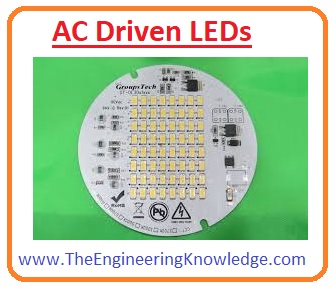
Almost all LEDs operate on DC current, but LEDs constructed with the Seoul semiconductor material can operate on alternating current without any DC converter.
For the first half of the AC cycle, light is released, and the second half remains dark, and this polarity reverses in the second half. The efficiency provided by the high-power light-emitting diode is almost four lumens per watt.
If you want to operate on 220 or 230 volts for high-power LEDs, it very easily connects a large number of LEDs in a series and provides line voltage directly.
Features & Specifications of LED
Now we discuss the features of the LED in detail.
Flashing LED
The flashing light-emitting diodes are used as indicators to get attention. These LEDs are similar to normal LEDs, but they have additional multivibrator circuitry to blink after specific time intervals.
The circuitry of multivibrators in diffused lens light-emitting diodes can be seen easily as a black color spot.
Mostly flashing light-emitting diodes release the light of a single color, but some release lights of more than one color.
Bi-Color LED
The casing of these light-emitting diodes comprises 2 different color light emitters.
There are 2 types of bi-color LEDs; the first category comprises 2 dies attached with the 2 similar leads non-parallel to one another.
When current passes in one direction, it releases light of one color, and when current flows in the opposite direction, it releases light of the second color.
The second category of bi-color comprises 2 dies, each of which has separate LEDs, and a third separate lead to connect with the common anode or cathode. This way, both dies can be regulated separately.
Mostly used bi-color LEDs are red and green; other combinations of color are also available.
RGB Tri-color
The casing of this LED comprises the 3 different LED emitters. Every emitter has its own separate control wire.
There are four wires or leads that are in this lead: one for the common connection of the anode or cathode and three for every color.
• The RGB light-emitting diode comprises the three LEDs in green, blue, and red colors.
Every LED is controlled with a separate lead.
Decorative-Multicolor
This type of LED provides numerous colors through only 2 wires. Color varied internally by changing the input voltage.
Advantages of LED
Now we discuss the advantages of LED in detail. Features & Specifications of LED
Now we discuss the features of the LED in detail.
Flashing LED
The flashing light-emitting diodes are used as indicators to get attention. These LEDs are similar to normal LEDs, but they have additional multivibrator circuitry to blink at specific time intervals.
The circuitry of multivibrators in diffused lens light-emitting diodes can be seen easily as a black color spot.
Mostly flashing light-emitting diodes release the light of a single color, but some release lights of more than one color.
Bi-Color LED
The casing of these light-emitting diodes comprises 2 different color light emitters.
There are 2 types of bi-color LEDs; the first category comprises 2 dies attached with the 2 similar leads non-parallel to one another.
When current passes in one direction, it releases light of one color, and when current flows in the opposite direction, it releases light of the second color.
The second category of bi-color comprises 2 dies, each of which has separate LEDs, and the third separate lead to connect with the common anode or cathode. This way, both dies can be regulated separately.
Mostly used bi-color LEDs are red and green; other combinations of color are also available.
RGB Tri-color
The casing of this LED comprises the 3 different LED emitters. Every emitter has its own separate control wire.
There are four wires or leads that are in this lead: one for the common connection of anode or cathode and three for every color.
• The RGB light-emitting diode comprises three LEDs in green, blue, and red colors.
Each LED is controlled with a separate lead.
Decorative-Multicolor
This type of LED provides numerous colors through only 2 wires. Color varied internally by changing the input voltage.
Advantages of LED
Now we discuss the advantages of LED in detail.
Efficiency:
The intensity of light emitted by the LED is larger than the normal incandescent bulb. The emitted lumens per watt do not depend on the physical dimensions of the LED-like area size, as is the case with a fluorescent light bulb.
Color:
LEDs can produce light of various colors without any special color filter used as for other lighting devices.
So LEDs produce many colors without any extra price.
Size:
The size of the light-emitting diode is very small, almost two millimeters, and can be attached to the PCB board.
Warmup time:
When connected with the input supply, the LED starts illuminating very quickly. Especially red-colored LEDs show complete brightness within some ms.
Lifetime:
The operating life of a light-emitting diode is longer. From almost 35000 to 50000 hours, it operates.
The operating time of a fluorescent bulb is 10,000 to 25,000 hours.
Disadvantages of LED
These are some disadvantages of LEDs that are described here.
Temperature dependence:
The continuous operation and performance of LEDs rely on environmental temperature.
If it operates at a high temperature, it will be damaged for a longer time.
To increase its operating time, a heat absorber is needed. It is required, especially in instruments that are used in medical, vehicle, and military settings.
Voltage sensitivity:
The voltage provided to the LED should be above its threshold voltage, and the current should be less than its rated current value.
Minor variation in the value of voltage will highly affect the current and operating life of the LED.
So current limiting resistance is used in the series of LEDs connected to the supply.
Efficiency Decreases:
With the increase in the current provided, the efficiency of the light-emitting diode decreases.
The increase in the current also increases the heating that reduces the life of the LED.
These factors decrease the use of LEDs for such applications where high current is required.
Use in winter:
As the heat is produced, the LEDs are less as compared to incandescent bulbs, so used in traffic lights can have snow obscuring that causes accidents.
Read also:
- Difference Between LED & Diode
- Introduction to 1N5401 Diode
- Difference between PN Junction Diode and Schottky diode
- What is LED Display?
So, friends that is the detailed tutorial on the full form of LED, I tried my level best to make it simpler and comprehensive for you. If you have any queries and questions about this post ask in comments. I will resolve your queries. See you in the next interesting tutorial. Have a good day.