There is normally interstitial-free (if) steel seen in different vehicles and other projects. This steel type does not have nitrogen or carbon. During manufacturing, titanium and niobium are used for trapping extra nitrogen or carbon. That process enhances the formability and ductility features of steel. With that, we can change shape with easy welding features that help to develop strong devices. In this post, we will cover detailed features and practical applications of interstitial-free steel. So let’s get started.
Important note:
Interstitial-free steel comes with a small quantity of nitrogen as well as carbon. That is easy to bend and make a strong joint. This steel composition is normally used in car parts. Its uniform structure makes its stretching easy without breaking. Its assembly is simple and easily manufactured.
.
Introduction to Interstitial Free Steel
Interstitial-free steel is different than other steel that does not contain a high percentage of carbon or nitrogen between iron atoms. These small atoms known as interstitials. If iron atoms are removed, they make steel soft and designs clean.
The interstitial-free steel term shows a soft steel structure due to the absence of interstitial solute atoms for solid iron lattice strain.
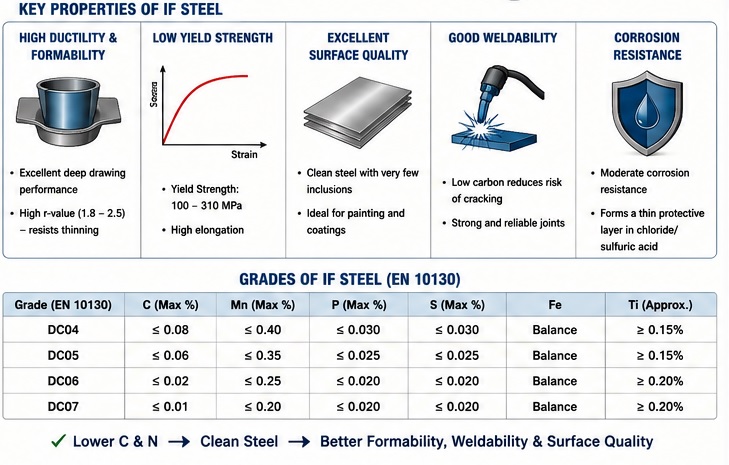
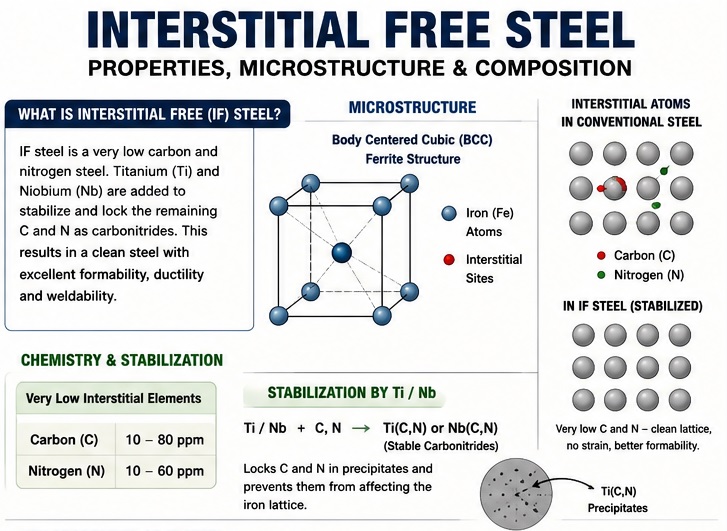
IF, or interstitial-free, steel comes with an interstitial-free, body-centered cubic ferrite structure. This steel comes with lower yield strength, a high plastic strain ratio, high formability, and high strain rate.
An older version of IF steel made with vacuum degassing technology had carbon 40 to 70 ppm and nitrogen (N) 30 to 50 ppm in the 1970s.
With time, some changes were made and niobium (Nb) and/or titanium (Ti) were added in this steel for the stability of interstitial C and N atoms.
This steel has a smaller fraction of precipitates; that’s why it’s called clean steel. The precipitates are short in volume but affect high-frequency features of IF steels.
To minimize carbon and nitrogen levels in liquid steel processed at low temperatures, it is important to show levels in liquid steel processed at low temperatures, showing stabilized features with minor additions of Ti and Nb.
Nb and Ti are strong carbide absorbents; the remaining nitrogen and carbon from the solution of liquid iron then occupy the interstices between solid iron atoms.
IF steel also has an ultra-low carbon component, get with eliminating different gases like nitrogen, hydrogen monoxide, etc., with the steelmaking process through vacuum degassing.
Composition of IF steel
Carbon and Nitrogen
If steel comes with low nitrogen and carbon. The use of titanium or niobium enhances steel components’ carbon and nitrogen stability to prevent these materials from moving in the lattice without affecting the materials’ features.
Clean structure
less quantity of nitrogen and carbon makes a clean structure for enhancing surface quality and also mechanical features
Mechanical Properties
Interstitial-free steel has good ductility and formability. that provide easy bending and reshaping for different applications. Its main mechanical features are
It has a 100-to-310 MPa yield strength, offering ductility for all grades.
It provides high elongation for stretching. Its r-value is 1.8 to 2.5 since a high r-value shows steel does not become thin during deep shaping.
It has less hardness for providing easy shaping and forming.
Corrosion and Heat Resistance
This steel offers moderate corrosion resistance. Testing through chloride and sulfuric acid makes a thin layer that prevents rusting.
It offers corrosion resistance like stainless steels but not like high grades. For some cars, resistance is enough when paint is applied.