The engine comes with different parts, and each performs certain functions. The exhaust manifold is an important part that has a high effect on engine functioning through monitoring the engine consuming fuel and releasing power. In this post, we will discuss the exhaust manifold and related features. So let’s get started.
What Is an Exhaust Manifold?
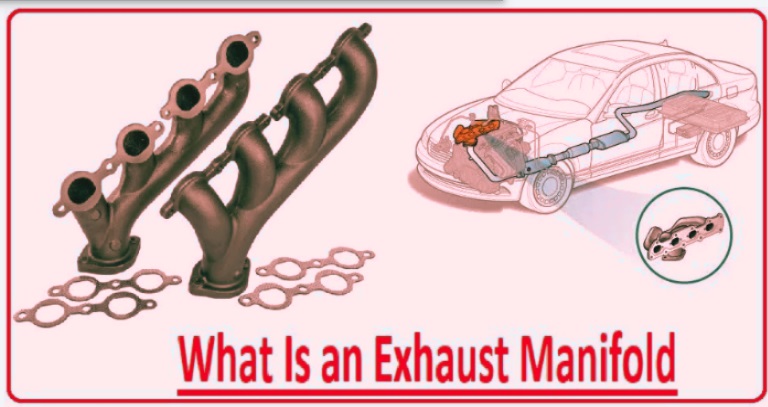
The exhaust manifold is considered an important part of your vehicle’s exhaust system that gets exhaust gases released through engine cylinders and transmits towards the exhaust point. It is like a funnel that directs exhaust gases from the engine to the muffler.
In a diesel engine, normally one exhaust manifold exists, but in an engine where high performance occurs, a dual manifold is used for high power output.
How Exhaust Manifold Works
The exhaust manifold is an important part of an internal combustion engine’s exhaust system. It works to collect exhaust gases and direct them towards the exhaust system for release. The functions of the exhaust manifold involve different steps.
First of all, exhaust gases are collected as the exhaust manifold is close to the cylinder head and receives high-pressure gases generated during the combustion process occurring in the engine cylinders. Each cylinder releases gases through a certain part, and these gases move to the manifold.
When exhaust gases are gathered, the manifold delivers them through runners. runners’ design such that they manage gases coming from cylinders in single flow and release gases effectively from the engine.
The main function of the exhaust manifold is to release gases from the engine and send them toward the exhaust system. It also connects to the catalytic converter, muffler, and tailpipe, where gases are treated and, before release, the noise level is reduced.
The exhaust manifold equalises pressure in the exhaust system. Its design makes the flow of gases between cylinders easy, reduces pressure, and helps the engine work well. Balanced pressures make the engine work effectively and provide proper power output.
The exhaust manifold faces high temperatures due to high gas flow. for this purpose, it’s structured with material that has high heat resistance, for example, cast iron or stainless steel that manages high temperatures. The exhaust manifold comes with heat insulation that controls heat affecting other engine parts
Engine Manifolds types
There are two main types of engine manifolds, each performing certain functions.
Intake manifold
Exhaust manifold
Intake manifold:
The intake manifold is a pipe-based design that has a single input and many outputs. Its other name is inlet manifold. Its main function is to provide fluid movement into the cylinder block through the intake valve. For a diesel engine, the fluid flowing is air, and in a petrol engine, it is an air-fuel mixture.
Intake manifold structure
The intake manifold comes with one input tube and 4 output tubes. So it is employed for a 4-cylinder engine. It’s all output tubes configured with an inlet valve. This controls the movement of air or charge in each cylinder.
Charge is added through the carburetor in a petrol engine, and for a diesel engine, air goes through the air filter. The intake manifold design causes smooth charge or air distribution in cylinders.
For a petrol engine, the intake manifold comes with a high temperature, so the air-fuel mixture does not become condensed. So exhaust gases make the temperature of the intake manifold high. These features help in cold areas.
Materials of intake manifold
The older version of the intake manifold comes with aluminum or cast iron. Some advanced engine types have intake manifold structures treated with thermoplastic material. Multi-cylinder engines use Nylon 6/6 material.
But now plastic intake manifolds are used in Europe. About fifty percent of plastic intake manifolds are used in vehicles in Europe. They are low-cost and lightweight.
How the intake manifold works
When starting an engine, get a charge for petrol engines and air for diesel engines. charge is distributed smoothly over each cylinder where different cylinders exist. Air or charge through air filters goes towards one opening point of the intake manifold and is distributed over connected tubes.
After that, air or charge goes towards the cylinder block with the intake valve.
Exhaust manifold:
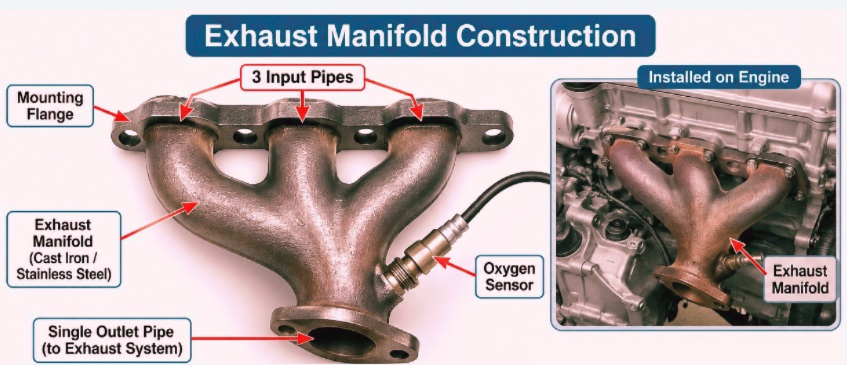
The exhaust manifold comes with different tubes and has many input points with a single output. these opening employed for releasing exhaust gases from the engine with outlet valves. These exhaust gases are carbon and chemical toxins released from the engine towards the exhaust outlet
Exhaust manifold construction
Normally, an exhaust manifold comes with 3 input pipes and a single pipe that is used for a 3-cylinder engine.
The main operation of the exhaust manifold is to collect the exhaust gases released from the cylinder block. Its design reduces the back pressure of exhaust gases. It is connected to the engine block through a gasket to prevent leakage.
During operation, when the exhaust valve opens, exhaust gases go to the exhaust manifold. Each cylinder releases gases towards the exhaust manifold and releases collectively from a single point.
Its structure comes with an oxygen sensor that performs detection of oxygen in exhaust gases. For the petrol engine exhaust manifold, it comes with a heat valve that directs hot gases to the intake manifold, which increases the air-fuel mixture to prevent condensation.
Symptoms of Exhaust Manifold
Different signs show your vehicle’s exhaust manifold; some are explained here
Noises
During functioning, if the engine is generating sound louder, that is due to a leaking exhaust manifold. Due to leakage, gas released from the exhaust system results in a loud, high engine sound.
Bad Fuel Efficiency
Leakage also causes bad fuel efficiency. When you need frequent fuel refills, it means the exhaust manifold is not working well and needs professional repair.
Gases Smell
Damaged exhaust manifold gases are released before converting to less hazardous gases, which have a certain smell and cause environmental pollution.
LOW Acceleration Power
Leaking also causes engine power reduction. If you are facing difficulty during acceleration, consider it. When you face this fault, replace the exhaust manifold.
Engine Light Turns On
The sensor of the car starts working when it detects leakage. If there is a fault, the check engine light will turn on.
Causes of exhaust manifold leaks
There are many causes for manifold leakage.
Manifold gasket damage
Gas flow through the exhaust system is very high, and the car cooling temperature of the exhaust system reduces fast. This heating and cooling results in expansion and contraction of the exhaust system. As a result, the gasket is damaged. The manifold gasket provides sealing in the exhaust system. So it causes gas leaks and access to the car, which causes engine noises and other faults.
Manifold damage
The manifold can be damaged by heating and cooling of the exhaust system. Minor damage to the manifold causes a significant effect on engine starting. Sounds are reduced through metallic expansion from heating. But if cracks are larger, metallic expansion does not cover cracks, causing serious damage to the engine
Manifold bolt damage
A manifold connection with the exhaust system is made with larger bolts, and these bolts can crack or loosen through heating and cooling, causing wear and serious damage. So, damaged manifolds cause holes and leakage of the manifold, where toxic gases flow in opposite directions
Difference Between Exhaust Manifold and Exhaust Header
Read more How Engine Control Units (ECUs) Work and How Tuning Reprograms Them
| Feature | Exhaust Manifold | Exhaust Header |
| Function | Gets exhaust gases from engine cylinders and sends them to the exhaust pipe. | Gets and directs exhaust gases while enhancing exhaust flow and scavenging. |
| Construction | Made from cast iron or cast stainless steel. | from mild steel or stainless steel tubing. |
| Design | Compact design with short, integrated exhaust passages. | Uses individual tubular pipes for each cylinder that merge into a collector. |
| Exhaust Flow | Higher flow resistance due to its compact design. | Designed to reduce flow restriction and improve exhaust gas flow. |
| Back Pressure | Generally produces high exhaust back pressure in performance applications. | Designed to reduce exhaust back pressure in operating conditions. |
| Engine Performance | Reliable factory engine operation. | Can improve engine power and performance when properly designed and matched. |
| Scavenging Effect | Limited scavenging effect in many standard designs. | Helps improve scavenging by using exhaust pulse timing and pressure waves. |
| Material | Cast iron or stainless steel. | Mild steel or stainless steel tubing. |
| Pipe Design | Integrated passages to collect gases from cylinders. | Separate primary pipes that converge into a collector. |
| Heat Resistance | Cast iron offers good heat resistance and durability. | Material thickness, coating, and tubing material determine heat resistance. |
| Weight | Often heavy due to thick cast construction. | Lighter or heavier depending on tubing thickness and design. |
| Installation | Installed as a factory-installed component. | Installed as an aftermarket performance upgrade. |
| Cost | Generally lower replacement cost for standard OEM units. | Expensive due to fabrication, materials, and installation. |
| Maintenance | Durable but may develop cracks or leaks over time. | Develop cracks, flange leaks, or tubing fatigue due to thermal stress. |
| Applications | Standard passenger cars, trucks, and other factory engines. | Performance cars, racing engines, modified vehicles, and some production engines. |
FAQs
What is the difference between an exhaust manifold and headers?
| Exhaust Manifold | Exhaust Headers |
| Standard factory-installed exhaust component. | Aftermarket performance upgrade. |
| Made of cast iron. | Made of mild steel or stainless steel tubing. |
| Compact design to collect exhaust gases. | Individual tubular pipes for each cylinder. |
| For durability, low cost, and space efficiency. | Designed to improve exhaust flow and engine performance. |
| More exhaust flow restriction in performance applications. | Reduce exhaust flow restriction when properly designed. |
| Heavier due to cast construction. | Weight based on material and tubing design. |
| Provides limited exhaust scavenging optimization. | Uses exhaust pulse timing to improve scavenging. |
| Used in stock vehicles. | Used in modified, racing, and performance vehicles. |
Can a cracked exhaust manifold affect car fuel efficiency?
Cracked exhaust manifolds cause external air to affect the oxygen sensors, affecting the air-fuel mixture and causing very low MPG.
Why exhaust manifolds “tick” when the engine is cold?
During cold, metal is damaged, and the flange breaks open, releasing high-pressure gases, resulting in a tick, and when engine temperature increases, metal gets the original design and avoids leakage.
Which material is preferred for a turbocharged exhaust manifold?
321 stainless steel is preferred in high-performance racing cars where high temperatures exist and in heavy-duty applications. SiMo ductile iron is used
Which is repairing or replacing a leaking manifold?
Replacement is preferred due to cast iron’s poor weldability and the heat cycles of the engine, which cause cracking when repaired