A thermistor is a resistive device whose resistance changes with temperature. It is used for temperature monitoring and regulation in industries and laboratories. In this tutorial, we will discuss NTC thermistors in detail and provide practical understanding for different projects. So let’s get started.
What Are NTC Thermistors?
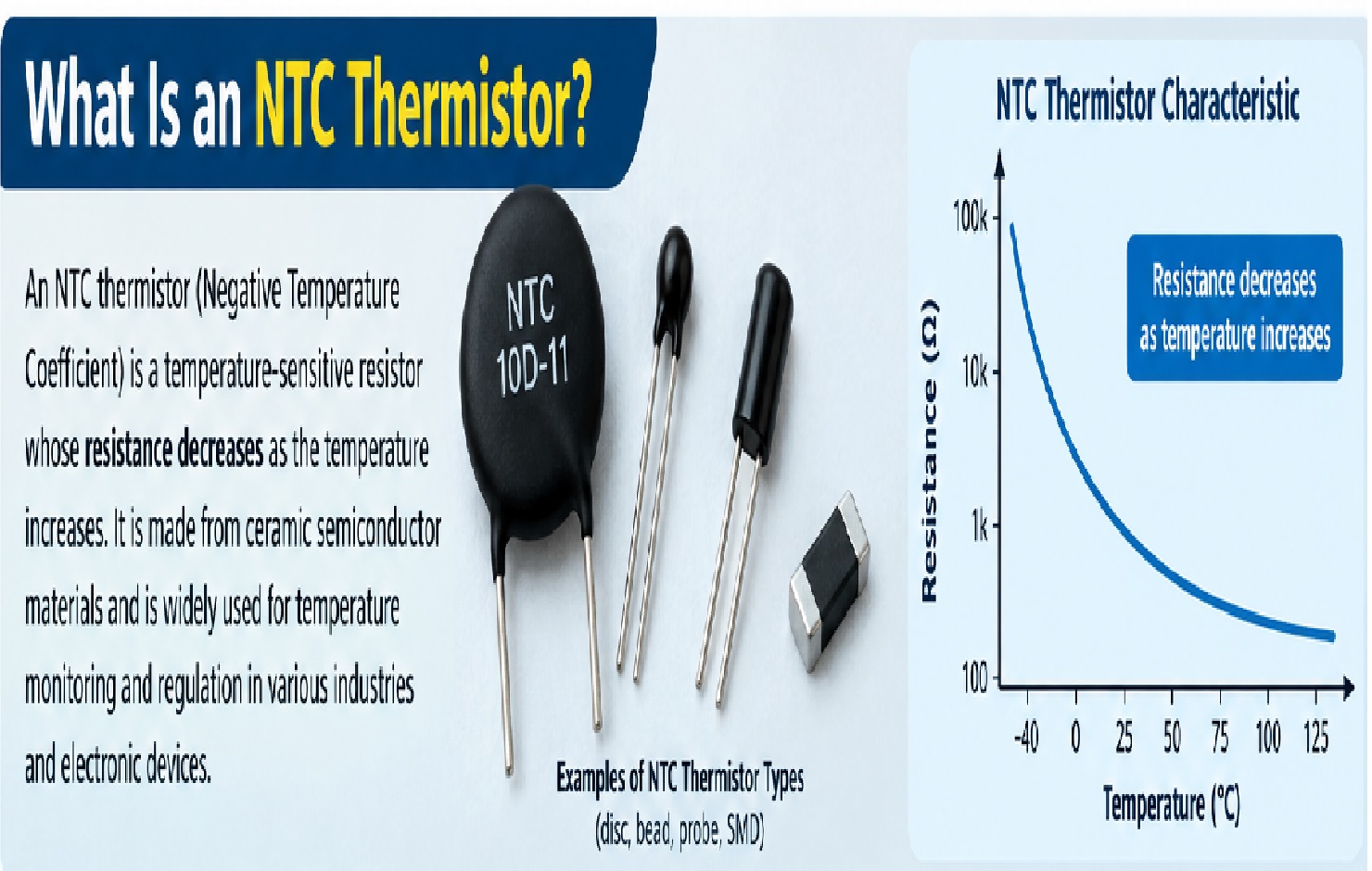
The full form of NTC is negative temperature coefficient, which shows a reverse interaction between resistance and temperature. As temperature increases, resistance reduces. Or, as temperature decreases, resistance increases.
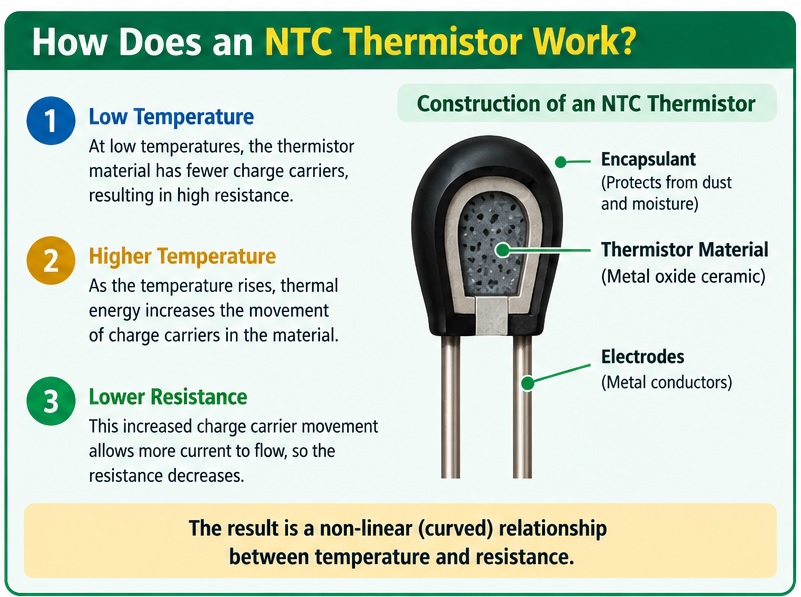
NTC thermistors are ceramic semiconductors constructed by sintering metallic oxide compounds with a temperature range of 1000°C to 1400°C. The accurate construction, composition, and production method of a thermistor affect its features for certain projects
NTC Thermistor Construction
NTC thermistors come with different construction features that are
Thermistor Material
It is a metallic oxide such as nickel, nickel cobalt, or manganese. These materials’ resistances are affected by temperature and help to provide NTC thermistor operation
Electrodes
These are metallic conductors connected to thermistors for a strong connection with external circuits. These conductors are useful for strong signal flow and provide low connecting resistance.
Encapsulant
It is a covering layer and provides protection to the structure from external factors such as dust and moisture stress. This enhances structure strength and provides smooth functioning
NTC Thermistor Working
NTC thermistors are constructed with semiconducting ceramic materials such as metallic oxide components. They work differently compared to metallic structures. In metallic conductor conditions, resistance increases with temperature increases. But the NTC thermistor shows reverse behavior compared to the metallic conductor.
When the temperature is low, the thermistor material shows fewer charge carriers with high resistance. When temperature increases, thermal energy causes movement of charge carriers in the material. As a result, current flow increases and resistance decreases.
This working rule causes NTC thermister functions when temperature varies. It shows a non-uniform relation between temperature and resistance. That means resistance behavior does not decrease linearly with temperature increases but makes a curved graph.
These nonlinear features are important since they affect resistance-to-temperature conversion.
NTC Thermistor Specifications
Different features of NTC are
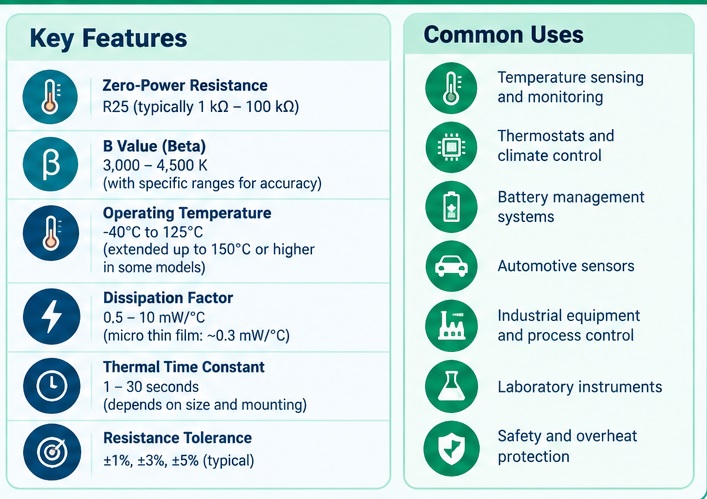
Zero-Power Resistance
Zero-power resistance is denoted as R₂₅, which is defined as the thermistor resistance at a reference temperature such as 25 degrees, calculated at a low power value. These parameters are used as a base for resistance measurements at different temperatures.
| Parameter | Technical Value | Unit |
| Minimum resistance | $1 | kΩ |
| Common resistance | 10 | kΩ |
| Maximum resistance | 100 | kΩ |
| Reference temperature | 25 | °C |
| Resistance tolerance | ±1%, ±3%, ±5% | % |
B Value
B value, another name for Beta constant, with features that show how fast resistance varies according to temperature changes. It is measured through resistance values with 2 temperature points:
B=(ln(R1 )-ln(R2))/(1/T1 -1/T2 )
Normally, the standard B value is 3000K to 5000K. The B value does not have the same value at different temperature conditions but changes. In high-precision projects, the B value has a certain value for certain temperature ranges; for example, B₂₅/₈₅ (25°C to 85°C) or B₀/₅₀ (0°C to 50°C).
| Parameter | Technical Value | Unit |
| Minimum B value | $3,000 | K |
| Common B value | 3,950 | K |
| Maximum typical B value | 4,500 | K |
| Reference temperatures | 25/50 or 25/85 | °C |
| B-value tolerance | ±1% to ±5% | % |
Temperature
Working temperature values exist between the minimum and maximum temperatures where the thermistor works. Some temperature ranges for NTC thermistors are
| Parameter | Technical Value | Unit |
| Minimum operating temperature | −40 | °C |
| Reference temperature | 25 | °C |
| Maximum operating temperature | 125 | °C |
| Extended temperature range (some models) | Up to +150 or higher | °C |
Dissipation Factor
The dissipation factor measuring unit is mW/°C; that means power is needed for increases in the material’s temperature by one centigrade due to self-heating under certain conditions. These factors are important for projects where the thermistor causes high current flow. The normal dissipation factor is 0.5 to 10 mW/°C, and the micro thin film series value is 0.3 mW/°C, and the AT series has ( 3 mW/°C).
| Parameter | Technical Value | Unit |
| Minimum typical value | $1 | mW/°C |
| Common range | 1–5 | mW/°C |
| Maximum typical value | 10 | mW/°C |
Thermal Time Constant
Thermal time constant shows the resistor’s response to temperature variations. Basically, it is the time needed for the thermometer to change 63.2 percent of the net difference between the starting and ending body temperature when faced with a temperature change. time constant is affected by the size, mounting process, and casing.
| Parameter | Technical Value | Unit |
| Fast-response models | 1–5 | s |
| Common range | 5–15 | s |
| Slower-response models | 15–30 | s |
NTC Thermistor vs PTC Thermistor
Technical Feature | NTC Thermistor | PTC Thermistor |
| Temperature coefficient | Negative | Positive |
| Resistance change | Decreases as temperature increases | Increases as temperature increases |
| Resistance at 25°C | 1 kΩ–100 kΩ for sensing types | Ranges from a few ohms to several kΩ or more |
| Temperature coefficient magnitude | around −2% to −6% per °C near room temperature | Varies by material; rise sharply near the transition temperature |
| B value (Beta) | 3,000–4,500 K | not specified using the NTC Beta parameter |
| Operating temperature | −40°C to +125°C; some models ranges | Depends on material and design; some devices operate beyond 125°C |
| Dissipation factor | 0.5–10 mW/°C for many small sensors | Varies widely with size, material, and mounting |
| Thermal time constant | 1–30 s for common designs | Varies by design; can range from seconds to longer |
| Switching behavior | Continuous and nonlinear resistance change | Resistance increase near a rated transition temperature |
| Self-heating response | Resistance falls as the thermistor heats | Resistance rises as the thermistor heats |
| tolerance | ±1%, ±3%, or ±5% resistance tolerance | Depends on type; resistance and switching-temperature tolerances are specified separately |
| Maximum voltage/current | Model-dependent | Model-dependent |
| Power dissipation | Limited by thermal rating and ambient conditions | Limited by rated current, voltage, and thermal characteristics |
| materials | Metal-oxide ceramic compounds | Doped ceramic materials or conductive polymer |
| technical function | Temperature sensing and inrush-current limiting | Overcurrent protection and temperature-triggered control |
| applications | Battery packs, HVAC, thermometers, power supplies | Resettable fuses, motor protection, transformers, degaussing circuits |
Types of NTC Thermistors
There are different types of NTC thermistors; each has certain features and uses.
Bead NTC Thermistors
The bead NTC thermistor comes with a ceramic sensing component that is connected with lead pins. These thermistors are part of projects where high stability and responsiveness are needed. It has a high response time, a stable design, and high accuracy in temperature sensing. According to the design, it works well in high-temperature conditions.It has advantages, but it is fragile compared to other types. Their mounting is difficult and costly for different projects.
Its main uses are in sensors and medical devices
Disc & Chip NTC Thermistors
Disc and chip thermistors are used in vehicles, PCB circuits, and other electronics projects. Chip thermistors come in small SMD packages, and disc thermistors are larger and can handle high power. They are low-cost, easily configured for automated PCB assembly, and come in different resistance values and package sizes.
Their response time is slow compared to bead-type thermistors but less stable compared to glass-covered beads and comes with different temperature values according to the package. Main uses include HVAC temperature controls, vehicles, etc.
Glass-Encapsulated NTC Thermistors
This NTC thermistor provides protection to the sensing component in a sealed glass design. This is helpful for chemical resistance and moisture resistance with a stable design. They work well in harsh conditions and are resistant to moisture. They are best used in high temperatures.
Their common uses are in industry and medical projects
Selecting factors for the right thermistor
To find the proper NTC thermistor for different projects to get high accuracy, space-based features, and cost, follow these factors.
Temperature Range
First of all, check the highest and lowest temperature ranges. Since it helps to get an NTC that is according to your requirements, some examples are
| Application | Temperature Range | General NTC Thermistor Selection |
| Consumer electronics | −40°C to +85°C | Standard NTC thermistor |
| Automotive applications | −40°C to +150°C | High-temperature NTC thermistor |
| Industrial high-temperature applications | Up to +300°C | Specialized high-temperature NTC thermistor |
Accuracy
- Thermistor accuracy is an important factor for getting accurate thermistor readings based on tolerance.
| Application | Required Accuracy | NTC Thermistor |
| General-purpose applications | ±1°C | NTC thermistor with suitable resistance tolerance |
| High-accuracy applications | ±0.1°C to ±0.5°C | NTC thermistor with typically 1% resistance tolerance |
| Ultra-high-precision applications | ±0.05°C | High-precision NTC thermistor with tight resistance and B-value tolerances |
Response Time
- Some applications need fast response for temperature changes; their response time is important
| Application | Response Time | NTC Thermistor Selection |
| Instant temperature measurement | Milliseconds | Small, fast-response NTC thermistor |
| Quick surface temperature measurement | 1–2 seconds | Surface-mount or exposed-bead NTC thermistor |
| General temperature monitoring | 10–15 seconds | Standard NTC thermistor with suitable encapsulation |
Environmental factor
Thermistor has features for handling different environmental conditions such as
| Environment | NTC Thermistor Selection |
| Moisture or immersion | Choose epoxy-coated or waterproof, stainless-steel-encapsulated NTC thermistors. |
| Chemically aggressive environments | Chemically resistant, glass-encapsulated NTC thermistors compatible with the chemicals present. |
| High-vibration environments | Mechanically robust NTC thermistors with secure mounting and strain-relieved leads. |
| Dusty environments | Sealed NTC thermistors with the best ingress protection. |
| High-temperature environments | NTC thermistors with temperature-rated materials and encapsulation. |
Physical Size
- Size and NTC dimensions are also important for practical usage, and before connecting, you must consider accurate dimensions
| Mounting Type | NTC Thermistor Selection |
| Surface-mount applications | Surface-mount NTC thermistors (SMD) |
| Miniaturized designs | Miniature NTC thermistors with compact dimensions |
| Screw-mount applications | Screw-mounted NTC thermistors for secure installation |
| Pipe temperature monitoring | Pipe-mounted NTC thermistors designed for contact with pipe surfaces |
Installation of NTC thermistor
Installation of the NTC thermistor is an important factor that must be done accurately for proper functioning. Follow these points for a strong connection of the NTC thermistor
proper soldering
Soldering is important for proper connection since high heat applied during soldering can damage thermistors. So, proper temperature is needed during soldering, such as
During hand soldering, use a temperature-controlled soldering iron to make short-time connections. Apply heat to the lead, not the thermistor structure, and do not bend the lead close to the body
Low mechanical pressure
The NTC thermistor is a brittle structure, so high mechanical stress can damage it. Set the lead bend away from the body, not to extra-thin thread probes, and do not use PCB flex close to the thermistor
NTC Thermistor Testing
Testing is an important factor for accurate working of thermistor functioning. Some tests performed for accurate working of thermometers are
Resistance Test
For this test, a digital multimeter was used that measures resistance at certain temperatures. When starting this test, check that the thermistor is easy to stabilize, such as
thermistor showing stability at room temperature
Check room temperature with a thermometer.
Thermistor resistance measurements
Compare values with the datasheet for temperature
Now keep the thermistor in cold water at zero degrees and check resistance and confirm with manual details
NTC thermistor calibration
Calibration is best for getting accurate results, such as for applications where high accuracy is needed. For getting required accuracy, different calibration options are used
Single-point
First, check the thermistor at a single known temperature and use an offset. That technique is easy and used for different applications
Two-point
For high-accuracy values, compare to previous check thermistor values with 2 measured temperatures. After that, set the beta value according to these parameters.
Three-point
For high-accuracy results, get thermistor values at 3 known temperatures and get Steinhart-Hart coefficients.
NTC Thermistor vs Other Temperature Sensors
Technical Feature | NTC Thermistor | PTC Thermistor | RTD (Pt100/Pt1000) | Thermocouple | Semiconductor Temperature Sensor | Infrared Temperature Sensor |
| Sensing material | Metal-oxide ceramic | Ceramic or polymer, depending on type | Platinum | Two different metals | Silicon semiconductor | Infrared-sensitive detector |
| Temperature coefficient | Negative (NTC) | Positive (PTC) | Positive | temperature-dependent EMF | Temperature-dependent voltage or current | Temperature-dependent infrared radiation |
| Resistance behavior | Decreases as temperature rises | Increases as temperature rises | Increases linearly | Not primarily resistance-based | IC design | Not resistance-based |
| Resistance at reference temperature | 100 Ω to 1 MΩ at 25°C, depending on model | Model-dependent | 100 Ω (Pt100) or 1,000 Ω (Pt1000) at 0°C | Not applicable | Not applicable | Not applicable |
| Sensitivity | High; commonly several %/°C near room temperature | High near switching temperature for switching types | Moderate | Low voltage output, typically tens of µV/°C | Model-dependent; often mV/°C | Depends on detector and optics |
| accuracy | ±0.1°C to ±1°C for selected, calibrated models | Application-dependent | ±0.1°C to ±1°C, depending on class and range | ±1°C to ±2.5°C for common types, depending on class | ±0.1°C to ±2°C, depending on model | Model-dependent; commonly around ±1°C to ±3°C or more |
| operating range | −50°C to +150°C | Model-dependent; often −50°C to +200°C | −200°C to +600°C or higher | −200°C to +1,800°C, depending on type | −40°C to +125°C | Model-dependent; often −50°C to +1,000°C |
| Response time | under 1–10 seconds for small sensors; assembly-dependent | Milliseconds to seconds, depending on construction | Fractions of a second to several seconds | Milliseconds to seconds | Milliseconds to seconds | Milliseconds to seconds |
| Linearity | Nonlinear | Strongly nonlinear near switching point | Relatively linear | Nonlinear, depending on type | Often linearized internally | Depends on sensor and processing |
| Signal conditioning | Resistance measurement circuit or divider | Resistance monitoring circuit | Constant-current source or resistance bridge | Amplifier and cold-junction compensation | Often integrated into the IC | Signal processing and calibration |
| Long-term stability | Good, but depends on material and operating conditions | Application-dependent | suitable platinum elements | Can drift under high-temperature exposure | Model-dependent | Model- and environment-dependent |
| Power requirement | Passive; measurement current is required | Passive; current is required for monitoring | Passive; excitation current is required | Self-generating sensor signal | Usually requires a supply | requires a supply |
| Self-heating concern | Yes; measurement current can affect readings | Yes | Yes | Generally low, but installation matters | Internal power dissipation may affect readings | Detector and electronics have power requirements |
| output | Resistance in ohms (Ω) | Resistance in ohms (Ω) | Resistance in ohms (Ω) | Voltage in millivolts (mV) | Analog voltage, current, or digital data | Analog, digital, or processed temperature output |
| applications | Battery packs, HVAC, power electronics | Overcurrent protection, motor protection | Industrial process control, laboratories | Furnaces, engines, high-temperature systems | Embedded electronics, computers, IoT | Non-contact industrial and thermal monitoring |
Conclusion
An NTC thermistor is the best low-cost option for measuring temperature. It offers different temperature measurement factors; it is an important component in the medical field and other sectors to find required temperature values. It works well in vehicles for getting through extreme conditions and temperatures.
Frequently Asked Questions
Define an NTC thermistor?
An NTC thermistor is a temperature-sensitive resistor whose resistance reduces when temperature increases, so it has a negative temperature coefficient.
What is the full form of NTC in thermistors?
The full form of NTC is Negative Temperature Coefficient. This shows that thermistor resistance minimises as temperature increases.
How does an NTC thermistor work?
Working of NTC thermistor based on semiconductors, where resistance increases with temperature, reducing. During heating, high charge carriers move in the material, causing current flow
How to select NTC thermistor parts?
Different factors are involved for selecting NTC items, such as beta constant, temperature, R25 resistance, tolerance, package, response time, and environmental protection.
What is the common value of NTC thermistor resistance?
The common resistance is 10 kΩ at 25°C. It has low self-heating, noise immunity, and works with voltage divider circuits.
Does the NTC thermistor have features to measure very fast temperature changes?
The small bead works fast and is noted for fast changes compared to other sensors.
What is the B value of an NTC thermistor?
• The beta constant of the NTC thermistor is a material constant that shows the curve nature of resistance with temperature in degrees Kelvin (K)
How to protect an NTC thermistor from electrical noise?
For this purpose, use accurate grounding, short leads, and filtering circuits.
Can NTC thermistors be connected with long cable runs?
Yes, but it increases resistance for long wires, and it needs shielded cable.
What happens if an NTC thermistor fails?
As a result of failure, resistance increases, which causes incorrect reading.
Are NTC thermistors easy to use with batteries?
Yes, it used to replace batteries and maintain their rating.
Can NTC thermistors be used in water?
Yes, but they need an accurate covering; use a sealed probe or a stainless steel probe before using in water
What is the difference between Beta and Steinhart-Hart equations?
| Feature | Beta Equation | Steinhart-Hart Equation |
| Calibration Points | 2 points | 3 points |
| Accuracy | errors of ±1 °C (plus or minus 1 raised to the power C ±1∘C(worse over wide spans >20∘C20 raised to the composed with power C 20∘C) | High accuracy, ±0.1∘Cplus or minus 0.1 raised to the composed with power C to ±0.15∘Cplus or minus 0.15 raised to the composed with power C |
| Temperature Range | used for narrow or near-room-temperature ranges 0∘C0 raised to the composed with power C to 100∘C100 raised to the composed with power C ) | Wide operational spans -80∘Cnegative 80 raised to the composed with power C to 260∘C260 raised to the composed with power C ) |
| Computational Load | Low | Moderate to high |
| Best Used For | Low-cost consumer gadgets and narrow-band sensing | Precision medical devices, scientific equipment, and industrial controls |
Do NTC thermistors need proper calibration?
Yes, but not always. Different projects use datasheets, but calibration is helpful for high accuracy and is best used in industry.
What are the reasons for NTC thermistor failure?
mechanical stress
broken leads
poor soldering
overcurrent
overheating
moisture ingress,
What is the difference between an NTC thermistor and a thermistor?
A thermistor is temperature-sensitive, and NTC is also a thermistor, but its resistance reduces when temperature increases. PTC thermistor’s resistance increases with temperature