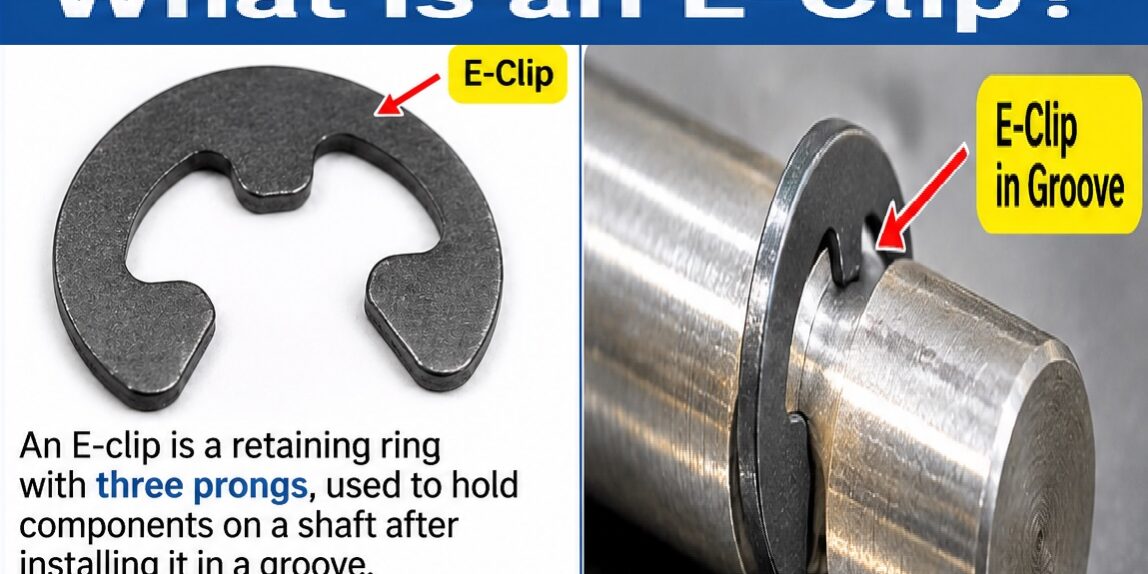
The clip is used to hold different components on a shaft after installing it in a groove. It is a fastener known as an E-ring due to its three-pronged design and is connected to machined grooves with small-diameter tubes and shafts. Its construction material is carbon steel with a phosphate finish. 3 prongs on the clip make a connection to the lower grooves and provide accurate retention. In this post, we will cover the detailed features of the E-clip and relevant features. So let’s get started
What is an E-clip?
An E-clip is a retaining ring made with open ends that connect at a given assembly. These clips connect to shaft radial grooves and holes, providing a strong connection. They are known as E-clips due to their letter E-like design. They commonly employ external clips.
Standard structures come in internal and external types. Internal circlips connect into the hole of the grooves, and external circlips have features for a strong fit on the groove over the external rod. These clips are also used as a replacement for nuts and cotter pins, and their lightweight design makes for a lightweight structure. Their working life is longer.
The E-clip is easily pressed into a machined groove without a certain tool; it does not need a circular shaft, so it has good functioning compared to fasteners, so there is no need for tapping, threading, or certain machines.
Dimension E-clip: highest groove diameter based on the clip made. The dimensions of the E-clip are determined by its free diameter and throat width. Throat width is the opening size, and the external diameter is called the free diameter. These parameters are taken when the clip is in a normal state.
For construction of E-clips, different materials are used, such as carbon steel, copper, and alloy steel, according to corrosion resistance. They are used in machines such as hand tools and complicated aircraft.
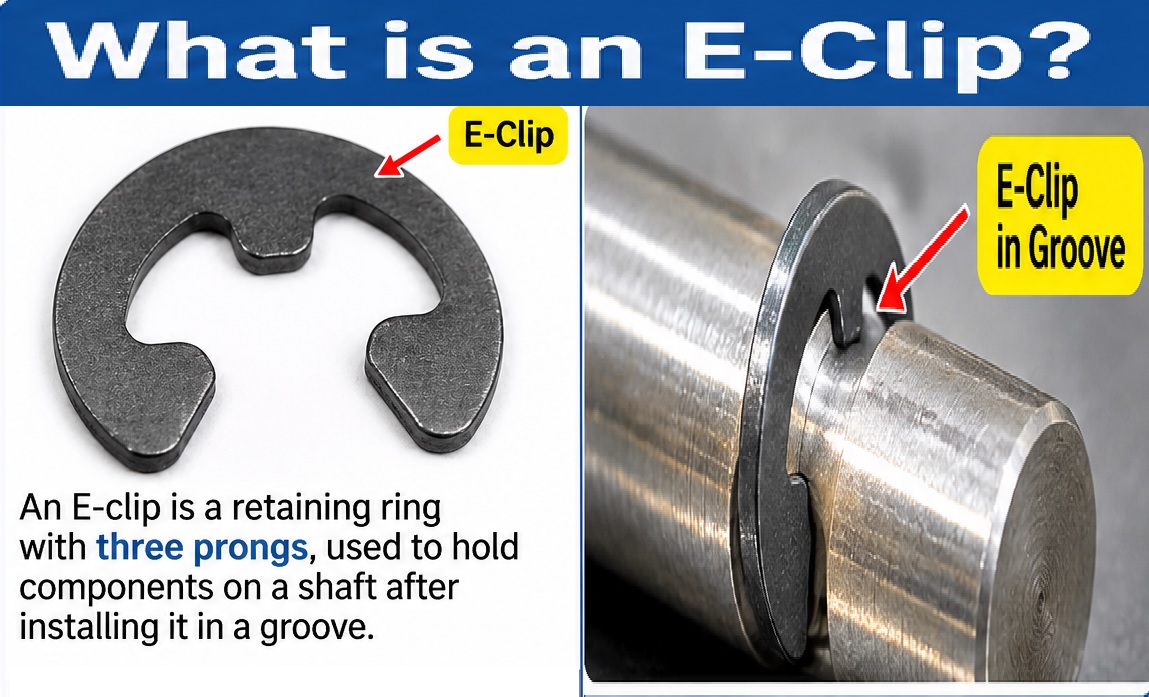
Dimensions of E-clip
Normal E-clip dimensions are the highest groove diameter for which the clip is designed. Other features are neck width and free diameter. The neck width is the dimension of the opening size, and the free diameter is the external diameter. They are calculated when the ring clip has normal conditions
E-Clip Dimensions by Nominal Size
Nominal Size (mm) | Shaft Diameter (mm) | Groove Diameter (mm) | Clip Thickness (mm) | Outside Diameter (mm) |
| 1.2 | 1.4–2.0 | 1.2 | 0.3 | 3 |
| 1.5 | 2.0–2.5 | 1.5 | 0.4 | 4 |
| 1.9 | 2.5–3.0 | 1.9 | 0.5 | 4.5 |
| 2.3 | 3.0–4.0 | 2.3 | 0.6 | 6 |
| 3.2 | 4.0–5.0 | 3.2 | 0.6 | 7 |
| 4 | 5.0–7.0 | 4 | 0.7 | 9 |
| 5 | 6.0–8.0 | 5 | 0.7 | 11 |
| 6 | 7.0–9.0 | 6 | 0.7 | 12 |
| 7 | 8.0–11.0 | 7 | 0.9 | 14 |
| 8 | 9.0–12.0 | 8 | 1 | 16 |
| 10 | 11.0–15.0 | 10 | 1.2 | 20 |
| 12 | 13.0–18.0 | 12 | 1.3 | 23 |
| 15 | 16.0–24.0 | 15 | 1.5 | 29 |
| 19 | 20.0–31.0 | 19 | 1.75 | 37 |
| 24 | 25.0–38.0 | 24 | 2 | 44 |
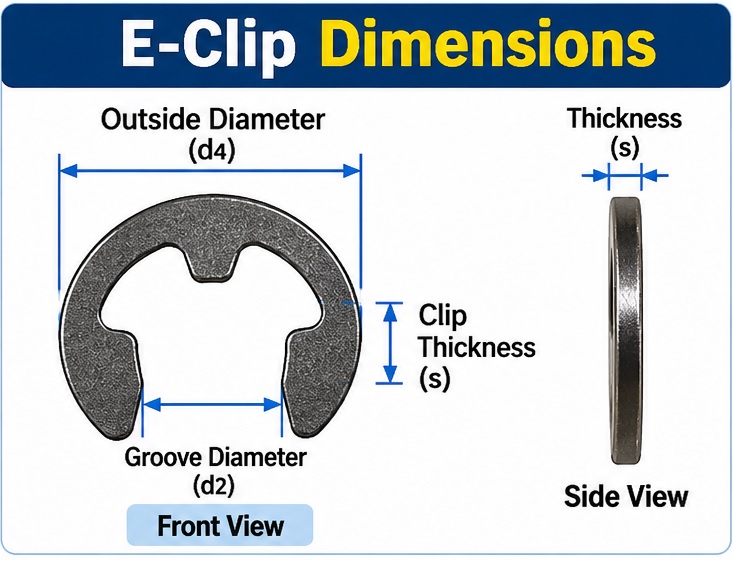
E-clip size chart
| E-Clip Size | Shaft Diameter (d1) | Groove Diameter (d2) | Groove Width (m) | Clip Thickness (s) | Clip Outside Diameter (d4) |
| 0.8 | 1.0–1.4 | 0.8 | 0.24 | 0.2 | 2 |
| 1.2 | 1.4–2.0 | 1.2 | 0.34 | 0.3 | 3 |
| 1.5 | 2.0–2.5 | 1.5 | 0.44 | 0.4 | 4 |
| 1.9 | 2.5–3.0 | 1.9 | 0.54 | 0.5 | 4.5 |
| 2.3 | 3.0–4.0 | 2.3 | 0.64 | 0.6 | 6 |
| 3.2 | 4.0–5.0 | 3.2 | 0.64 | 0.6 | 7 |
| 4 | 5.0–7.0 | 4 | 0.74 | 0.7 | 9 |
| 5 | 6.0–8.0 | 5 | 0.74 | 0.7 | 11 |
| 6 | 7.0–9.0 | 6 | 0.74 | 0.7 | 12 |
| 7 | 8.0–11.0 | 7 | 0.94 | 0.9 | 14 |
| 8 | 9.0–12.0 | 8 | 1.05 | 1 | 16 |
| 9 | 10.0–14.0 | 9 | 1.15 | 1.1 | 18.5 |
| 10 | 11.0–15.0 | 10 | 1.25 | 1.2 | 20 |
| 12 | 13.0–18.0 | 12 | 1.35 | 1.3 | 23 |
| 15 | 16.0–24.0 | 15 | 1.55 | 1.5 | 29 |
| 19 | 20.0–31.0 | 19 | 1.8 | 1.75 | 37 |
| 24 | 25.0–38.0 | 24 | 2.05 | 2 | 44 |
Difference Between Snap Ring & E-Clip
The basic differences between snap rings and E-clips are
Both are small-sized parts used in mechanical projects. They are used to secure components at certain points, but their design and dimensions are different according to use
Snap rings, whose other name is “circular rings,” are constructed with spring steel and have rings. Internal snap rings have features for easy fitting in a groove and a small diameter compared to the shaft.
Snap rings are part of vehicles and the aviation industry and make strong connections between shafts and different components.
E-clips are called retaining rings and come in an E-shape. They are made of spring steel and have two ends that are bent inwardly to form a retaining lip.
E-clips are in inner and outer types and secure shafts, etc
For basic differences, we find that both have different designs and shapes. Snap rings are circular and need a bore for connecting, and E-clips come with a clip assembly and are connected with a retaining lip.
Snap rings are stronger than E-clips and are made with a thick design.
Snap rings are preferred for heavy-duty projects since components are high-load and strong connections are needed. They are part of the transmission in vehicles and industries.
While E-clips are part of light-duty projects where low pressure is involved. so used in small projects and devices
| Feature | Snap Ring | E-Clip |
| Definition | A retaining ring used to secure components on shafts or inside bores | A specific type of retaining ring shaped like the letter E |
| Shape | Circular or C-shaped with an opening | E-shaped with three retaining arms |
| Design | Continuous circular profile with two ends | Three inward-projecting contact points |
| Installation | Installed by expanding or compressing the ring | Usually pressed sideways into a shaft groove |
| Installation tool | Internal or external snap ring pliers | E-clip pliers or a suitable installation tool |
| Mounting position | Available for internal and external mounting | Primarily used on external shafts |
| Contact points | Provides circumferential contact with the groove | Uses three contact points for retention |
| Groove requirement | Requires a compatible circular groove | Requires a specifically designed E-clip groove |
| Axial load capacity | Available for light, medium, and heavy-duty applications, depending on design | Generally used for light to moderate retention applications |
| Removal method | Removed using snap ring pliers | Removed by lifting or prying the clip from the groove |
| Material | Spring steel, stainless steel, and carbon steel | Spring steel and stainless steel |
| Common applications | Bearings, gearboxes, automotive axles, and machinery | Small motors, shafts, gears, and mechanical linkages |
| Main advantage | Available in different designs for a wide range of loads and applications | Compact design and quick installation |
| Main limitation | May require special pliers and sufficient installation clearance | Limited load capacity compared with some heavy-duty retaining rings |
| Standard examples | DIN 471, DIN 472 | DIN 6799 |
How to Remove E Clips?
Different methods used for removing e-clips, such as
E-Clip Remover
With this tool, first set the remover tool with the E-clip, since the E-clip remover has a curved edge. So make a configuration of the tool edge with an E clip and set it with an E clip.
After making alignment of the remover tool and E-clip, apply pressure on the tool to remove it. During this process, use high pressure. After removing the E-clip, put it in the dry position before using it for the next application
Using Pliers
Removing with pliers: set the curved side towards you; using pliers makes it easy to twist and remove the clip with small pressure. Hold the clip with the tip of the pliers. and through holding pliers remove the clip. Normally, needle-nose pliers are used for removing the clip. Some other types of pliers are also used.
Through-holding E-clip puller for releasing the clip: you can set the grip of the E-clip for removing with through pliers.
Screwdriver
A screwdriver is another option for removing E-clips for this purpose; put the screwdriver tip into the groove of the clip. The clip comes with 2 small grooves at the centre point: one on the left and one on the right side. For removing the clip, two grooves are used. Mostly preferred to use a screwdriver with the E-clip dimensions.
During removal, hold a finger on the upper side of the clip. This provides easy gripping of the clip for removal. After that, apply pressure with the screwdriver
E clip vs circlip
| Feature | E-Clip | Circlip |
| Definition | A retaining ring designed like the letter E | A circular retaining ring with an open gap |
| Shape | E-shaped | Circular or C-shaped |
| Design | 3 contact points extend inward | Circular profile with two open ends |
| Installation | Pressed sideways into a shaft groove | Installed by expanding or compressing the ring |
| Installation tool | E-clip installation tool or pliers | Circlip pliers |
| Mounting position | Installed on the exterior of a shaft | Both shaft and bore installation |
| Retention method | Three-point contact with the shaft groove | Circumferential contact with the groove |
| Axial load capacity | Best for light to moderate axial loads | Comes in designs for light to heavy axial loads |
| Groove requirement | Requires a specifically designed E-clip groove | Requires a standardized internal or external groove |
| Removal | Removed by lifting or prying one end | Removed using circlip pliers |
| Space requirement | Relatively little radial space | Requires sufficient space for expansion or compression |
| Material | Spring steel, stainless steel | Spring steel, stainless steel, and other spring materials |
| Common applications | Small motors, gears, linkages, and machinery | Bearings, shafts, transmissions, pumps, and housings |
| advantage | Quick installation and compact design | Strong circumferential retention and versatile mounting |
| limitation | Not for every high-load application | Requires more installation space and appropriate pliers |