An adapter is an electronic component that makes a connection between two unsupported devices for the transmission of data. An AC adapter, also called a power charger, is used for converting AC, or alternating current, from an input outlet to DC that is used for operating different electronic devices, such as computers, phones, and laptops.
In this post, we will cover details of the AC adapter circuit, its working, and related factors. Let’s get started.
What Is an Adapter?
- An adapter is an electronic device that makes a connection between one device or circuit with another for operation. An adapter used to configure different devices, such as video devices, audio, etc.
- A commonly used adapter is a power adapter that transforms the electrical energy of a power supply into a form that supports electronic devices.
- A practical example is that when we charge a phone or laptop, we use a power adapter to convert high AC into low DC that operates devices safely.
- Some devices importantly needed an adapter to get power from the main supply.
What Is an AC Adapter?
- An AC adapter, also known as an AC/DC adapter or power adapter, or wall charger, is an external power supply circuit that comes in an enclosed structure like an AC plug.
- AC adapters provide power to devices that do not get their power supply from the main outlet directly. AC adapters send power to devices that do not get power from the main sources.
- circuit of an external power supply, like the design employed for an internal supply.
- Through using battery-operated devices, an adapter charges the battery and also gives power to devices.
- The adapter has a flexible design and gets power from the 120 VAC main supply or the battery of a car or other vehicle through other adapters.
- Adapters also transmit high-voltage 120 or 240 V main supply to a lower or safe level before moving to load devices.
How Adapters Working
Different electronic components are involved in causing the adapter to work
Transformer
- A transformer is the main component of an adapter that varies the voltage level through step-up or step-down of the input voltage. It’s working based on the electromagnetic induction phenomenon.
- In this process, an AC in the primary winding produces a magnetic field that causes current in the secondary winding through mutual induction.
- Normally, an adapter has a step-down transformer that reduces the high AC voltage of a wall outlet, like 110-120, to DC voltages of 5V or 12V DC used for electronic devices.
Rectifier circuits
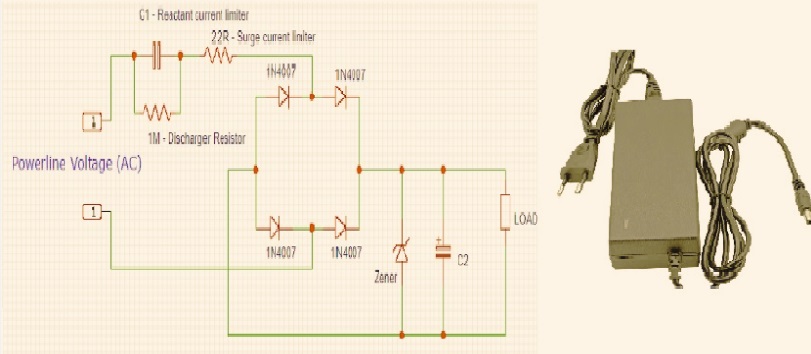
- When the voltage level reduces at the transformer, the next step is to convert AC into DC, since electronic devices operate on DC volts. For AC to DC conversion, a rectifier circuit made with diode connections is used to convert AC to DC.
- • A rectifier comes with one diode circuit and four diode circuits called a bridge rectifier.
- Adapters normally use full wave recrifier for generating a smooth dc output with conversion of both AC cycles.
Filter circuit
- The output we get from the rectifier circuit comes with fluctuations that are removed through the use of different filter circuits.
- A filter circuit made with capacitors that makes a stable DC output. Some adapters come with an adapter for providing a clear signal.
Voltage Regulator
- In the last step, the output voltage is maintained through the voltage regulator circuit according to load demand, which prevents overvoltage or undervoltage.
- Voltage regulations have different types; linear regulator output is steady output with high power dissipation, and the latest switching regulators employ high-frequency switching circuits for efficient power.
AC Adapter Types
There are different types of AC adapters used; each has its own functions and features. Types of adapters are defined based on different features like regulation, input, output, voltage connectors, and mounting.
Regulation
- unregulated linear AC adapter, low cost and simple design, but its input voltage changes according to the load, using the output voltages.
- Regulated linear AC adapters employ a linear regulator for constant output voltage and are less effective than switching adapters.
- Switching regulators are part of the regulated switching AC adapter that provides high efficiency. that is small in size, low in weight, and costly compared to a linear adapter
output
- An AC adapter with a single output comes with one fixed DC output voltage. while multiple-output AC adapters give 2 or more DC output voltages.
input
- The adapter comes with a fixed input used for certain AC input voltage values, like 120V or 230V..
- Auto-switching input AC adapter gets different input voltages from 100 to 240 V automatically.
connector types
- Coaxial connector AC adapters employ cylindrical barrel connectors that are part of laptop circuits.
- USB AC adapter output DC voltage with a USB connector to charge different USB devices
Mounting type
- wall-mount AC adapter connected directly to the wall outlet. The inline AC adapter comes with a separate AC inlet and DC output.
Power Adapters Other Types
USB Adapter
USB adapters come in different design combinations.
USB A Adapter
- Standard regular USB connectors are employed for different computers and charging modules. It transmits power as well as data and features to provide five watts to USB 2.0, and USB 3.0 gets 15 watts.
USB B Adapter
- It is employed for printers and scanners and comes with a larger structure and edge design. It is an older type but is used for some applications.
USB-C Adapter
- It is an advanced USB connector that has reversible design features and provides high power. USB-C has features to provide 100 watts of power, while the data transfer rate is about 40 Gbps, and is also compatible with video transmission.
- Its basic uses are in phones, laptops, and devices where high power is needed.
Travel Adapters
- The travel adapter has compatibility for supporting different outlets and is employed in different regions. These adapters come with interchangeable plug faces, helping to switch between different plugs according to the area where we are traveling.
- The traveler adapter’s main operation is to connect different devices in outlets and not provide voltage conversion. Devices where voltage conversion is needed voltage converter connected with a travel adapter
Ethernet Adapters
Ethernet adapters use power over Ethernet techniques to provide power and data transmission with a single Ethernet cable. This makes simple connections and minimizes the use of different power supplies.
IEEE 802.3af
- It provides 15.4 watts of power through Ethernet cables. It is preferred for modules such as wireless access and IP cameras.
IEEE 802.3at
- It provides power of about 25.5 watts and controls devices with high-power features.
IEEE 802.3bt
- It provides high power in the range of 60 watts to 100 watts, also for high-power devices.
Modular Adapters
- Modular adapters provide flexible operations with interchangeable plug modules and provide application options.
- Interchangeable plug adapters have many plug modules that are configured according to locations. It is employed for international travel for connecting different devices.
- IEC 60320 Adapter Modulator Adapters follow the IEC 60320 standard, which allows power cord connectors connect with different devices.
AC Adapter Circuits
- There are different circuit combinations used for AC adapters.
Half-Wave Rectifier Adapter Circuit
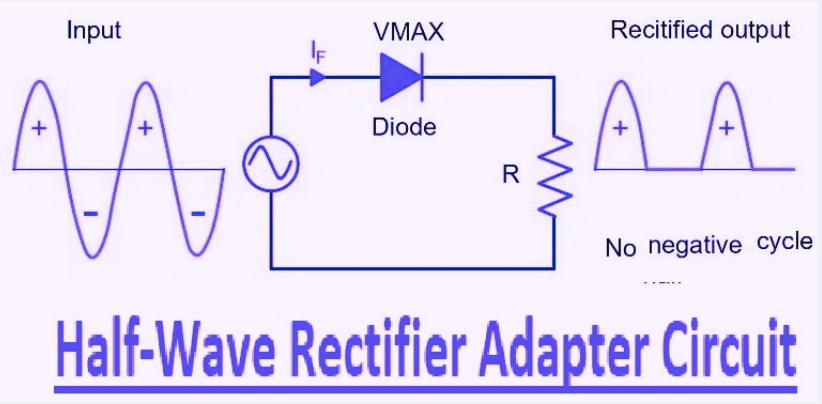
- A half-wave rectifier converts the positive half of the AC cycle to follow the diode and stops the negative cycle of the AC cycle.
- Current flow in the circuit is ten milliseconds and stops for the next ten seconds.
- in halfwave recitifer first half of ac signal is used, so its efficiency is low. It uses a filter circuit for removing pulsating AC and producing a smooth DC voltage.
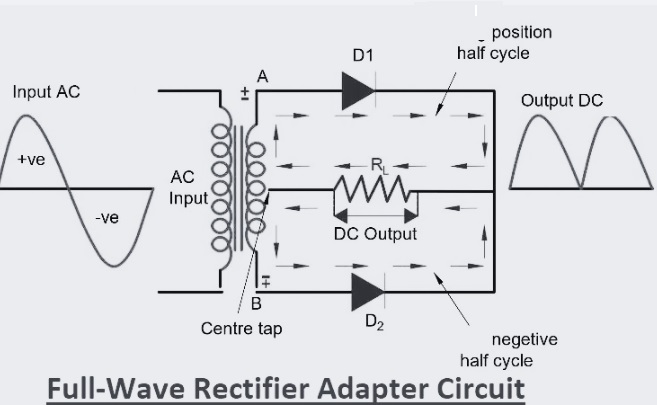
Full-Wave Rectifier Adapter Circuit
- Full-wave adapter circuits come with two full-wave rectifier circuits. The first one is a full-wave bridge rectifier, and the second is a center-tap full-wave rectifier.
- In a full-wave rectifier circuit, usually 2 diodes are used, and 4 diode connections make a bridge-like assembly.
- When an AC signal flows in a circuit, one diode converts the positive half of ac signal into DC, and another diode converts the negative half into DC, and we get a complete AC conversion into DC voltage.
- The AC full-wave rectifier has a higher capacity than a half-wave adapter circuit. A full-wave rectifier adapter circuit provides double the efficiency of a half-wave.
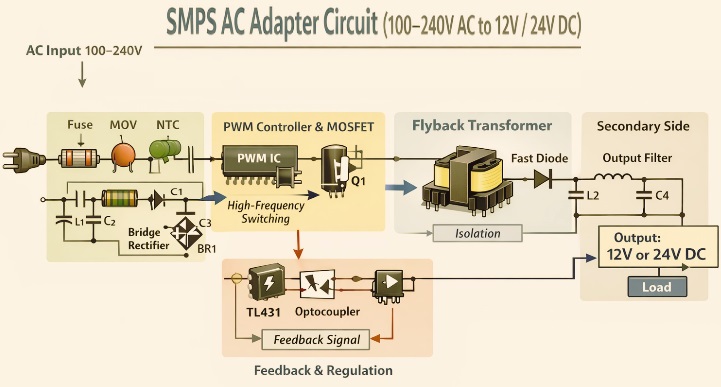
SMPS AC adapters
A switched-mode power supply is an advanced module. This is a compact design that transforms outlet AC power into DC power, like from AC 100 to 240V into 12 or 24 volts, which is used for operating laptop cameras. It causes switching power with high frequency.
Difference between Adapters vs. Battery Chargers
Either adapter and battery chargers look the same but have different features.
Adapter
- An adapter is also called a power adapter. Basically, a power supply converts the AC power of an outlet into DC at a safe level that is used for electronic devices.
- A power adapter is commonly used for devices where batteries do not work well, like routers, PC monitors, etc.
- Some battery-operated devices like tablets, laptops, and phones use power adapters.
- since adapters provide power for devices, charging, and their continuous operation while charging
- But these different features are different from charger charging. The adapter provides power and andcharge batteries at the same time, so it is different from a charger.
Charger
- A charger is a power supply module that recharges rechargeable batteries. Chargers basically transform the AC power of an outlet into DC power for the required voltage and current for charging batteries in a safe way.
- Some advanced devices come with integrated battery-charging circuits and do not need external chargers.
- such as electric vehicles, external batteries like power banks, devices like cameras, and portable gaming devices.
- The battery charger comes with circuits that check the charging process. These circuits protect the circuit from overcharging and overheating and safely charge the battery in a controlled way.
- A common example is a smart charger used to charge a lithium-ion battery to regulate voltage and temperature to avoid damage from overheating due to a faulty charging method.
Adapters vs. Battery Chargers comparison chart made here
| Feature | Adapter | Battery Charger |
| Main function | Give power to a device | battery charging |
| working | voltage/current conversion to a usable level | Controls and manages battery charging |
| Power Flow | powers conneted device | Stores energy in a battery |
| Battery Required | No | Yes |
| Output Control | fixed output | variable current/voltage based on battery demand |
| Example | Laptop adapter, router adapter | Phone charger, rechargeable battery charger |
| Can Charge Batteries? | No | Yes |
| Safety Features | less | Overcharge, overheating, and short-circuit protection |
| Smart Charging | No | Yes |
Factors for Selection: AC Adapter for Device
- For the selection of an accurate AC adapter, it must have the same rating as the device. such as a mobile AC adapter, must be the same as the input voltage, current, and voltage.
- First, check the rated current and voltage rating of the devices from the manual to get the required adapter. Normally, the rating of the AC adapter at the input is more than 100 volts, and the output voltage is less than 20 volts.
- must check the device needed AC or DC adapter since different adapter connections affect devices getting power.
- output power given to the device according to the current rating, since high power causes overvoltage. With that mismatched adapter, power causes overheating and damage to internal circuits.
- Use an adapter that needs low current compared to the device’s current. since it results in overcurrent draw for devices, and the result of overheating of devices
- The AC adapter also has the same polarity as the device input.
FAQs
Does an AC adapter work like a power adapter?
- No, both are different but look the same. Basically, an AC adapter is a power adapter used for converting AC from an outlet into DC that is used for electronic devices. AC adapters commonly provide power to different devices like phones and laptops.
- while power adapters provide power to other devices, since they are also devices. It comes with an AC adapter and DC adapter, converter circuit, transformer, and power supply.
- So an AC adapter is a power adapter type, but not all power adapters are AC adapters.
What is the difference between an AC adapter and a DC adapter?
- • The working of an AC adapter and a DC adapter is the same, but both provide different currents.
- An AC adapter, known as an alternator current converter, covnert ac of a power outlet into DC for operating devices.
- DC adapters get DC power supply from DC sources like batteries and solar panels and give it to devices where DC power is needed.
Is an AC adapter similar to a charger?
- Either they provide power to devices, but they are different. An adapter converts AC to DC and is called a wall adapter or power adapter. It changes voltage and current according to the device’s demand.
- charge used for recharging battery circuits. It controls charging by avoiding overcharging and its effects on the battery.
Why is GaN (gallium nitride) technology used in power adapters?
- Gallium Nitride (GaN) technology makes power adapters small and highly efficient and increases density. operated well for high switching frequency with high energy efficiency.
- It makes the adapter a small size by managing high power outputs. GaN technology makes working efficient since it reduces heat and provides high energy conversion, causing a compact design.
Why is an AC adapter used for a computer?
- A continuous power supply is needed for computer operations. Computers and laptops have AC adapters that fulfill the working voltage and watts.
- If an AC adapter does not exist, the system battery does not charge and chargesandaffects system operations.
Can I use any AC adapter with my computer?
- No, it is not recommended to use an adapter that came with the computer and the model of the computer. Using a faulty, incompatible adapter can damage devices.
How to get the right AC adapter for a device?
- Check the device manufacturer’s manual and get the voltage and wattage required, and choose an AC adapter.
What features should I look for in a quality AC adapter?
- The high-quality AC adapter has a durable structure, makes a connection with devices, and gives stable voltage and watts. With that comes overvoltage and short circuit protection.
What is the working life of an AC adapter?
- working life of an AC adapter based on quality factors, frequency, and storage. Normally, a proper working AC adapter works for three to five years.
How to store unused AC adapters?
- If you are not using an AC adapter, ensure to store it in dry places and safe from harsh conditions and humidity levels; also, avoid corrosion.
Are there any safety measures for using a laptop’s AC adapter?
- Ensure an accurate and supported charger for the laptop model to avoid damage and overcharging. It also avoids damage from fires.
What’s the difference between an AC adapter and a power bank?
- These two devices power electronic devices: an AC adapter connected to a wall outlet transforms AC power into DC power, and a power bank is basically a portable battery that stores DC power and is employed to charge devices.
Can a laptop work without an AC adapter?
- If the laptop comes with a fully charged battery, it can be used without an AC adapter for a short time based on the laptop’s use. But without an AC adapter for a long time, it causes damage to the battery.