Universal joints are the main component of the driveline system that allows for easy handling and vehicle driving. The X-like design on the ends helps U-joints make a connection point that causes the driveshaft to provide lateral and up-down movement. The universal joint also causes the vehicle to easily move on rough, bumpy roads. In this tutorial, we will cover the details of the features of universal joints and related factors. Let’s get started with an introduction to the universal joint.
What is a Universal Joint?
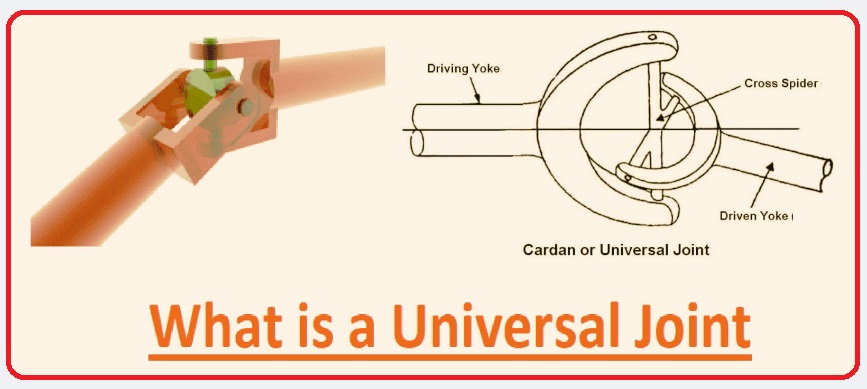
- Universal joint, other name is a U-joint, for applications; it is also called a Cardan joint or hook joint, which is a coupling point whose axes are in an inclined configuration. It works in shafts for transmitting rotary motion.
- It basically transmits rotational energy between shafts that are improperly configured. It’s commonly seen in shafts where rotary motion transmission occurs. Rear-wheel-drive cars use universal joints since in these vehicles the driven axle moves separately in the gearbox.
- A universal joint helps the shaft move with the suspension for transmitting power where the engine and axle are not linear with each other.
- It has a pair of hinges configured close to each other vertically and connected through a cross shaft.
- U-joints also have an X-shaped pivot point. that helps to connect two shafts and move independently at 45 degrees.
- In simple words, U-joints cause the rotation of two shafts freely over two axes at the same time.
- For some applications, a U-joint has 2 x-shaped pivots separate, causing shafts to work for steeper angles of about 90 degrees.
- A universal joint is not a constant velocity joint. If the input shaft is moving with constant velocity, the output shaft faces oscillation. There is the same average velocity, but the output shaft velocity is high or low compared to the average value.
- oscillation of the output shaft based on the nonlinear behavior of the shafts; if the shafts are coaxially working, that means the output shaft is operating with constant velocity.
Universal Joint importance
- Universal joints help drive shaft movement, supporting suspension shaft movement, and causing power transmission when a drive shaft moves in a nonlinear fashion between the wheels and the transmission.
- A drive shaft for a rear-wheel-drive vehicle comes with U-joints at both ends.
- Yokes are also connected with U-joints that cause movement of the driveshaft during vehicle movement on bumpy roads, which affects shaft’s working.
- Front-drive vehicles have two constant velocity joints, but they are different and manage steering variations. For rear-drive vehicles, if you have a damaged U-joint, you will hear a clunking sound during drive gear engagement.
- CV joints produce a clicking sound when damaged in front-drive vehicles. CV joints have rubber layers, and if these rubber protections are damaged, CV joint lubrication is lost due to moisture or dust
Types of Universal Joint
There are 3 main universal joint types, each performing certain operations.
Cross-Type Universal Joint
- This joint comes with 2 Y-design yokes and a crosspiece. One yoke is connected to the driving shaft, and the 2nd is with the driven shaft.
- The cross piece has 4 arms that are configured with both ends of the yokes. cross piece. Each arm also has 4 bearings, which help the yoke move over the trunnion and cause the driving and driven shafts to be at the same angle
Ball Trunnion, Universal Joint
- This U-joint comes with a universal and slip joint assembly. The ball trunnion joint has a ball-shaped head that is connected to one end of the driveshaft.
- cross shaft, presses on this end to make a T design. In the pin, two steel balls are connected strongly. The joint provides rotational movement of the ball and pin.
- Balls move axially, with ball and trunnion joints. The joint assembly is a variable velocity joint.
Constant Velocity, Universal Joint
- In this U-joint, driving and driving shaft movement occur at constant velocity. since two joints work for the same angle.
- For front-wheel drive, these joints are used. Speed changes between the driving and driven shafts cause a difficult steering process and make tires nonuniform.
U-Joints Location
- U-joints exist in vehicle driveshafts that make driveshaft connections with the transmission and differential. Some vehicles have U-joints configured between the front driveshaft and the front differential.
Universal Joint Parts
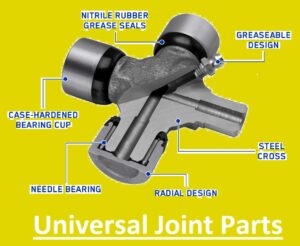
The main parts of universal joints are as
Driving Yoke & Driven Yoke
- U-joints have two types of yokes: one driving yoke and a 2nd driven yoke that make the joint assembly.
Spider
- These yokes are configured through a cross-like structure that is known as a spider. that provide rotation of shafts at different angles.
- A straight connection of the shaft input shaft causes rotation of the cross, and the cross in turn causes output shaft rotation. Both input and output shafts move with the same speed.
What Does a U-Joint Do?
- During movement on uneven terrain and bumps, the differential separately moves from your vehicle; in other words, the differential and transmission are differently configured.
- U-joints help vehicles move easily on rough surfaces through the up-and-down movement of the driveshaft as suspension occurs.
- Other functions of the U-joint include providing continuous power to wheels with free rotation of the driveshaft.
Universal Joint working
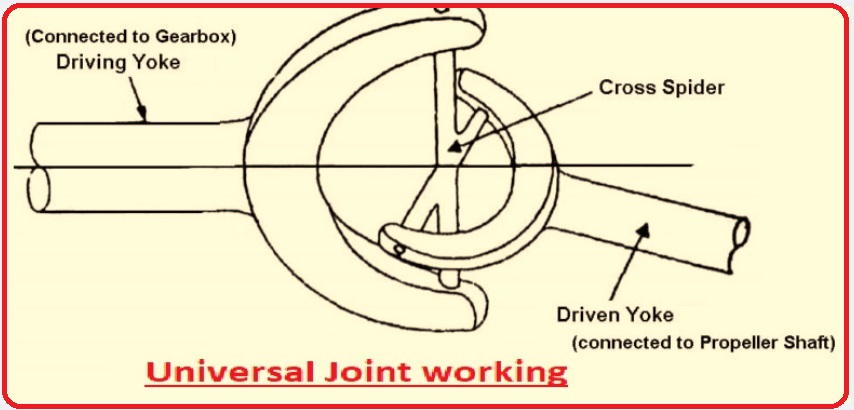
- In the diagram, you see that it has a driving yoke that is connected with the main shaft of the gearbox, and a driven yoke
- As per the above figure, it consists of a driving yoke ‘1’ on one side. This is connected to the main shaft of the propeller shaft.
- These 2 yokes are connected through a cross spider. The spider has 4 arms called trunnions. With rotations of the driving shaft, the driven shaft also moves simultaneously as a result of angular motion through the U-joint.
- Power is transmitted from the gearbox towards the propeller shaft at a certain angle.
- These joints cause a flexible connection between two rigid shafts at a certain angle. which causes power transmission with an angle, and also when the angle varies
Technical specification of a Universal Joint?
Nitrile rubber grease seals
- This component protects from contamination, dust, and debris.
Greaseable layout
- It provides new grease for removing moisture and contamination and preventing their effects.
Case-hardened bearing cup
- Its hardened and cold-forged design makes accurate grounding for durable operation.
Steel cross
- It provides carburized heat treatment through forged assembly and provides high strength.
Needle bearing
- It makes accurate grounding features.
Why Universal Joint used in Vehicles
Rotational Power Transmission
- A universal joint causes the transmission of rotational power between shafts that do not have accurate alignment. That is important for the drivetrain, where power is transmitted from the transmission to the differential.
- Universal joints provide power transmission through managing angle variations that exist at the time of suspension movement and steering.
- In the structure of a rear-wheel-drive vehicle, U-joints are connected at both ends of the driveshaft. that causes rotation of the driveshaft; also, smooth rotation occurs when the rear axle shows up-and-down movement according to the suspension
- Flexible features are important for constant power transmission to wheels in different driving conditions.
Misalignment handling
- U-joints need proper management of misalignment between shafts, which is commonly observed in vehicles. When a vehicle moves on rough terrain, it causes variations between transmission and differential positions.
- U-joints cause this motion with continuous power transfer. Proper angular motion is required for the steering system. U-joints for the steering column cause the connection of the steering wheel with the steering gear. Also, when the steering column angle varies, that is important for safe driving.
Universal Joints Advantages
Power transmission
- • The main benefit of universal joints is that they have features for transmitting power between shafts that are not accurately aligned. This feature works in vehicle designs and handles dynamic movement that exists during normal vehicle working.
- U-joints come with a design that manages angle variations and distances for good vehicle working.
- Flexible power transmission causes good riding features and provides power transfer for complicated drivetrain designs.
Minimizes vibration
- Accurately working U-joints also prevents drivetrain vibrations and noise when working. Smooth power delivery for misaligned shafts and U-joints reduces vibrations and exists for rigid connections.
- Some vehicles, like luxury vehicles, where high vibration reduction is needed, use CV joint assemblies to minimize noise.
Cost-effective
- U-joints are simple in design and low-cost modules for transmitting power for different angles. As compared to CV joints, U-joints are low cost and have easy maintenance.
- In some vehicles, U-joints work well, so they are preferred for accurate working and low-cost design.
CV vs U-Joint
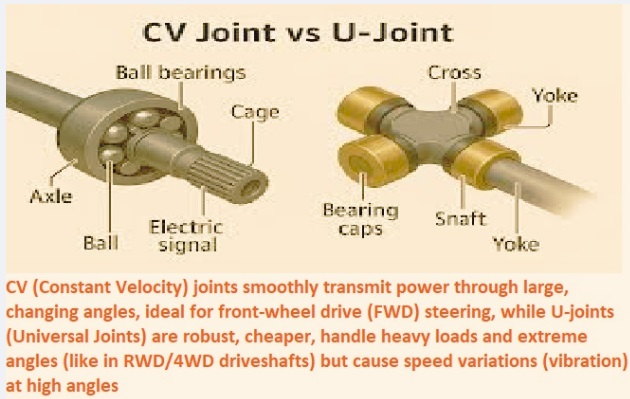
Universal Joints
- U-joints have been used for many years because they have a simple design and assembly. U-joints have a cross-like design with 4 cylindrical points. points connected with bearing caps through the yoke. U-joint configured through a C-clip, full circlering.
- U-joint, also called Spicer joint and Cardan joint. U-joints make the connection of the front and rear differential of a 4WD vehicle.
- They are also part of vehicles where the solid front is connected to the inner and external axle shafts.
- such as 4WD vehicles having a solid axle that comes with seven U-joint locations.
- A U-joint works like a pivot point, transmitting power continuously with an angle. U-joints also cause limited motion.
- For 2 standard driveshafts, the working angle is defined with a U-joint angle on any end.
- Those angle is one degree to each other when the vehicle is not moving. U-joints in 3-degree angles work well.
Constant-Velocity Joints, or CV Joints
- For larger motion ranges, a CV joint is used. CV joints are part of lifted vehicles. As a U-joint reduces velocity for some angles, CV joints work at constant velocity at either working angle.
- CV joints also have different types; some vehicles that work with CV joints follow a combination configuration.
- Commonly used designs of CV joints are Rzeppa, tripod, and double Cardan joints.
Universal joint vs ball joint
Ball Joint
- A ball joint is a flexible pivot point of the suspension system of a vehicle that makes the connection of the control arms with the steering knuckle.
- that causes uniform movement in different directions and causes wheels to turn according to road conditions.
- Ball joint causes accurate wheel alignment for uniform riding.
- The structure of the ball joint comes with a spherical bearing configured in a socket that exists between lubricated casings.
Universal Joint
- A universal joint is used in a shaft that transmits rotary movement between shafts that are not parallel. It makes drivetrain movement for rear-wheel and four-wheel drive vehicles.
| Feature | Ball Joint | Universal Joint |
| working | Suspension part | Drivetrain part |
| Movement | Multi-directional motions | Rotational motion between shafts |
| Location | Front suspension system | Drive shaft |
| Maintenance | uses periodic lubrication | Grease-lubricated |
Universal Joints limitations
Speed variations
- Its basic limitation is that it causes speed variations when operating at larger angles. When the joint moves, the output shaft changes twice according to the revolution, also for a constant input shaft speed.
- Speed variations cause drivetrain vibrations, normally for high speeds and larger angles.
- Fluctuations in speed also cause damage to components and reduce efficiency for high angles. also causes high noise
High maintenance needed.
- Universal joints work in harsh conditions and at larger angles, and face high wear. So they needed maintenance like inspection and lubrication, and provided good working.
- If we have universal joints, they will cause high vibrations and sound, as well as damage to the drivetrain. So if you find any damaged or worn signs of U-joints, perform proper maintenance.
Limited angle
- Universal joints have a limited maximum working angle. Single Cardan joints work for angles of about 15 degrees. A double Cardan joint has an angle of about 25 degrees.
- applications where high angles are needed, like off-road vehicles, where CV joints are employed. since they work at about a 45-degree angle
Universal Joint Applications
There are different applications of universal joints, such as
- universal joints are part of different vehicles, like it exist in the prop shaft of wheel drive cars and the rear wheel. The prop shaft operated through the gearbox on the front of the vehicle, back towards the rear axle. The connection of the universal joint at the end of the shaft helps power transmission without affecting the shaft, since the rear axle moves over the suspension.
- U-joints are also part of marine craft, where power is transferred from the engine to the propeller through propeller shafts in planes, where two components are not in line.
- Universal joints are also part of different industrial machines and manufacturing instruments since these machines work in harsh conditions.
Read our related guide How do spark plugs work?