A thermopile is also called a thermoelectric pile component that is used for converting thermal energy into electrical energy. It comes with different thermocouples in series combinations or some parallel combination. This device operates on the thermoelectric effect and produces a voltage when different metals are exposed to different temperatures. In this post, we will cover the details and features of thermophiles and their relevant features. So let’s get started.
What is a Thermopile?
- A thermopile is an electrical device used for temperature-measuring capabilities.
- Thermopile sensors help to sense released thermal energy and produce thermoelectric voltage proportionally. The thermopile also operated with standard connectors.
- It comes with two different metal wires connected to make a single junction.
- With a change of junction temperature, either cooled or heated, voltage is produced through an electric circuit; that voltage is measured through the temperature value.
- It is said that any two metals are used for the construction of a thermopile, but practically fixed types are used. They are used for providing linear and accurate results and are the best option for special alloys.
- These can be used for different projects. They offer high-speed responses and measure different temperature values.
- Thermophile arrays are thermal flux meters that come with a thin continuous conductor layer and semiconductors.
- These materials cover different surfaces through thin copper layers. Remote calculation of different points helps the thermopile array to make different designs.
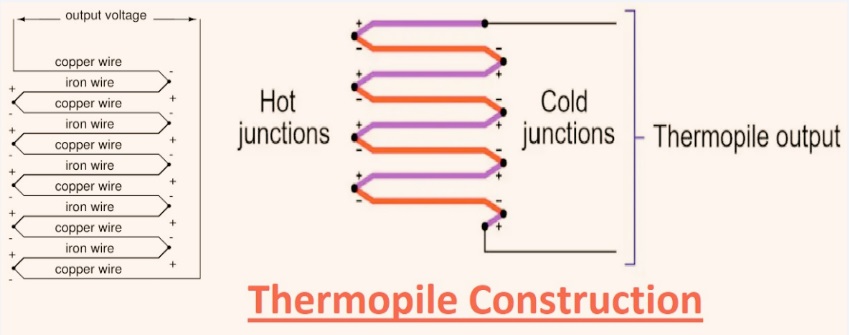
Thermopile Construction
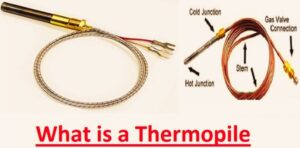
- A thermopile comes with different thermocouples configured in series combinations and parallel combinations for thermal design, with junctions configured between two isothermal locations.
- Thermopiles generate a voltage directly proportional to the temperature differences existing between hot and cold junctions.
- With the connection of different thermocouple voltages, results are measured with junctions and temperature gradients.
- Thermopiles are commonly employed in non-contact infrared thermometry and process monitoring projects.
- There is not a response for the thermopile for absolute temperature, but there is a resulting output voltage with temperature differences.
- Voltage and power are small, measured in milliwatts and mV,, through controlled components that are used for these applications.
- Here we can see the thermopile design, the output voltage of another thermoelectric cell, and the small size. The number of cells connected in series or parallel to get a larger signal. These configurations of thermocouples are known as “thermopiles.”
- For the construction of a thermopile, make a connection of thermocouple pairs in a series combination; as a result, the output voltage increases.
- Thermocouples with dual thermocouple junctions are used for designing thermopiles. A thermopile with series thermocouples comes with two special materials having high thermoelectric power and opposite polarity connected in series combinations.
- Thermocouples are configured with cold and hot parts of the point where hot junctions are separated thermally from cold junctions.
- With respect to temperature changes over material, the thermopile output voltage is called the Seebeck coefficient or thermoelectric coefficient. It’s measuring per Kelvin unit and mV/K in volts.
- A thermopile sensor uses infrared radiation for heat transfer and is used to measure non-contact temperature.
Thermopile Type
Thermopile Type | Metal Combination | Temperature Range | Features |
| Type E | Chromel / Constantan | −270°C to 1000°C | It generated high output voltage and operated at low temperature. it is part of cryogenic and laboratory applications. |
| Type J | Iron / Constantan | −210°C to 1200°C | it is commonly used and a low-cost part of industrial processes and iron oxides for high temperatures. |
| Type K | Chromel / Alumel | −270°C to 1372°C | It is commonly used thermopile/thermocouple type due to different range,and a low-cost option. it is part of engines, furnaces and industries |
| Type N | Nicrosil / Nisil | −270°C to 1300°C | It offers stability and good oxidation resistance compared to Type K. It is part of high-temperature industrial conditons |
| Type T | Copper / Constantan | −270°C to 400°C | It offers high accuracy for low temperature and moisture resistance. it is part of cryogenic operations and for food processing. |
| Type B | Platinum 30% Rhodium / Platinum 6% Rhodium | 0°C to 1820°C | it is used in high-temperature condutons also part of glass, steel, and ceramic furnaces. |
| Type S | Platinum 10% Rhodium / Platinum | −50°C to 1768°C | it is highly accurate and stable moslty part of the laboratory standard, and for pharmaceutical industries. |
| Type R | Platinum 13% Rhodium / Platinum | −50°C to 1768°C | it is like type S but offer high output. part of a high-temperature industrial process. |
| Type W | Tungsten / Rhenium | 0°C to 2300°C | It is preferred for high temperature or inert conditons. it employed in the aviation industry and research furnaces |
Thermopile Vs Thermocouple
| Feature | Thermopile | Thermocouple |
| Definition | A combination of thermocouples connected in series or parallel to increase the output voltage | A temperature sensor constructed with two different metals connected at one junction |
| Working Principle | Uses the Seebeck effect from multiple thermocouples combined together | Uses the Seebeck effect from a single junction of two metals |
| Construction | Multiple thermocouples connected with each other | Single pair of different metal wires |
| Output Voltage | High output voltage because the voltages of different connections add together | Very small millivolt output |
| Sensitivity | High sensitivity | Low sensitivity |
| Temperature Measurement | Detect temperature difference and radiant heat more effectively | Measures temperature at a specific point |
| Accuracy | best for detecting small temperature variations | Good for direct temperature calculations |
| Response Time | slower due to different junctions | high-speed response time |
| Temperature Range | based on the thermocouple materials used | Wide range depending on type (K, J, T, etc.) |
| Power Requirement | self-powered | Self-powered |
| Signal Strength | Strong signal, often no amplification is used for small measurements | Weak signal needs amplification |
| Cost | costly due to complex design | Low cost |
| Durability | sensitive because of multiple junctions | Rugged and durable |
| Application | Infrared sensing, gas burners, heat flux detection, radiation measurement | Industrial temperature measurement and process control |
| Common Uses | IR thermometers, flame sensors, satellite sensors | Boilers, furnaces, engines, HVAC systems |
| Measurement Type | preffered for detecting thermal radiation and small heat changes | Direct contact temperature measurement |
Bolometer vs Thermopile
| Feature | Bolometer | Thermopile |
| Definition | A thermal detector that detects radiation by detecting variations in electrical resistance due to heating | A thermal detector created with different thermocouples configured in series to produce a voltage from the temperature difference |
| Working Principle | Radiation strikes a heated and absorbing element, varying its resistance | Incident radiation produces a temperature difference between hot and cold junctions, generating voltage through the Seebeck effect |
| Operating Principle | Resistance change measurement | Thermoelectric voltage generation |
| Physical Effect | Temperature coefficient of resistance (TCR) | Seebeck effect |
| Construction | Absorber + temperature-sensitive resistor + thermal isolation structure | Different thermocouple junctions connected in series or parallel |
| Output Signal | Change in resistance or current | Direct millivolt voltage output |
| External Power | Yes, needed bias current/voltage | No, self-powered |
| Sensitivity | Extremely high sensitivity to weak radiation | Moderate to high sensitivity |
| Response Time | slower | Faster than bolometers |
| Noise Performance | Very low noise in cooled designs | Higher noise than to cooled bolometers |
| Temperature Stability | Sensitive to ambient temperature changes | stable for general applications |
| Cooling Requirement | Often uses cryogenic cooling for very high sensitivity | operates at room temperature |
| Spectral Range | Broad spectral response from IR to microwave | infrared radiation detection |
| Accuracy | Very accurate for small radiation measurements | Good for practical temperature/radiation sensing |
| Power uses | Higher because of bias circuitry and cooling | Very low power consumption |
| Complexity | Complex construction and electronics | Simple structure |
| Cost | Expensive | Less expensive |
| Durability | delicate | rugged |
| Applications | Astronomy, thermal imaging, microwave detection, and scientific instruments | IR thermometers, flame detectors, gas sensors, and industrial temperature sensing |
| Uses | Detecting extremely weak radiation signals | non-contact temperature measurement |
How to replace the Thermopile
Replacement of thermophiles looks like a different process, but is not easy. Through proper knowledge, we can make devices operate according to requirements. Here, we explained the process for the replacement of the thermophile.
When replacement is needed
- With time it sometimes stops working if the device is not generating the required voltage or not sensing heat differences; it means the thermophile is damaged.
- such as for gas-operating devices, a faulty thermophile stops the pilot light under certain conditions. Light flickering is also an alarming condition.
- Gas fireplace thermophiles have high strength but get damaged over time. Mostly, working life is five to ten years, according to Working Environment.
- High moisture and heat cause them to be damaged shortly. So proper precaution measures help to work them longer, and after some time a new model is needed.
How to Replace thermophile
Follow these steps for replacing the thermophile.
- First of all, turn off the power supply for safety purposes.
- Locate the thermopile that is close to the pilot light of gas-operating devices.
- Disconnect the old thermophile and connect the wires, and put the new thermophile there.
- perform device testing to ensure accurate working
Thermophile Advantages
- There are different advantages and features of thermophiles.
- It does not need an external power source for operation and offers a stable response for DC radiation that comes from temperature detection or measuring components.
- It comes with stable response features, and a thermophile is a non-contact temperature detection component that employs IR radiation for heat transmission.
- Their small and compact construction makes them low-cost.
- It produces a larger output voltage due to the application of many thermocouple components.
Thermopile Disadvantages
- It is static and damaged through high stress and reversing the supply polarity.
- Do not expose to direct moisture or sunlight since it damages or causes corrosion for devices’ functions.
- They also required maintenance and did not function with dusty or oily hands since these factors affect working performance. For good operations, it needs cleaning with cotton.
Thermopile Applications
- It is used for non-contact temperature measurements and helps to calculate the temperature of different devices like mobile phones, ovens, and car climate control
- It is employed as a temperature detection device for IR thermometers and measures the environmental temperature of HVAC systems.
- It also checks processing temperature and measures non-contact temperature of the process and industrial control according to projects.
- It also provides refrigerant leakage detection and monitors blood glucose.
- It was also employed for thermal line scanners, HVAC systems, and checking exhaust gas CO₂, HC, and CO of vehicles.
- It also provides aircraft fire detection.
Limitations of thermophiles
- temperature differences of thermophile-generated voltage but a small value. so not used for high-power operations. But it provides a high-speed response and is preferred for high-temperature operations.
- Different factors like heat and electromagnetic waves, affect thermophiles, such as gas fireplaces. For accurate working, it needed accurate insulation and protection.
- Thermophiles with more features are costly
Conclusion
Thermophiles are simple designs with high power sensing features for different industries and different modules. It is helpful for correct heat calculation and functions without a connection, and also operates accurately in difficult conditions. with the advancement of technology, thermophiles are growing in different smart energy systems and medical fields.
Frequently Asked Questions
Define thermopile.?
- A thermophile is a thermal sensor that transforms thermal energy into electrical energy. It is a combination of different thermocouples connected in series.
Explaining the replacement steps of a thermopile on a gas fireplace?
- First, find the thermophile location and remove the wires,
- disconnect the older module, and connect the new one. on gas and operate the pilot. Check the output voltage with a multimeter. Detect gas leakage
Explain the thermopile testing process.
- First of all, find the thermocouple on the multimeter set to the DC voltage option. Relight the pilot option.
- Measure voltage; normally, a thermophile generates 300 to 750 mV, and if it is less than 300 mV, it is faulty, and no voltage shows defective features.
- pilot on providing no flame testing, removing the flame, and measuring voltage that is close to 0 mV.
What is the thermopile function?
- The thermopile transforms flame heat into current. It comes with different thermocouples configured in series for measuring variations in temperature over larger areas.
What does low thermopile voltage mean?
- It means a clogged, dirty, aged, badly-flamed, loose, or corroded connection
How many mV does a thermopile generate?A
- thermophile is part of the open system and generates 600 to 750 mV during ignition flame.
What does a thermopile use?
- It is part of applications where heat detection is needed, like gas-based devices, radiometers, and infrared sensors.
What makes a thermopile faulty?
- The main causes of faulty thermophiles are
- age, dust, cracks, or loose connections. short circuit, poor connections.
- High temperature and improper maintenance make it faulty
What is a thermopile sensor?
- A thermophile sensor uses a thermophile for heat detection and transforms it into an electrical signal