A start relay is the main component of different circuits. its operations, like switches, where we use small currents for controlling larger devices. It helps control the operation of car starter motors. If the start relay is damaged, it affects the engine’s operation. that causes errors, and in this post we will cover detailed features for starting a relay and its working. So let’s get started.
What is a Start Relay?
- A starter relay is an automatic switch operated using electromagnetic force for controlling the high-current startup motor phase.
- Starting relay, basically momentary control switches. follows electromagnetic principles for joining contacts in control circuits. The
- A relay comes with 2 certain loops.
- control system, giving responses to physical parameters such as heater current. The second is a controlled system or output loop that controls the high-load circuit.
- If the current is input following a certain point, the output conditions vary suddenly from zero to a defined value that controls circuit protection and manages power flow without any interruption or manual intervention.
Starter Relays Types
Electromagnetic Relays:
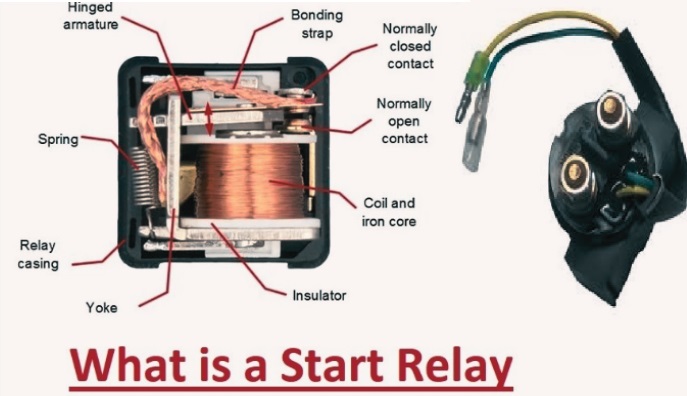
- It is commonly used as a relay, and its working is based on an electromagnetic attraction process. During relay coil energization, a magnetic field is produced in the coil. That field applies an attractive force on the iron core, resulting in the movement of the contact.
- Moving a connection makes a connection or disconnection to a fixed contact for making a connection or disconnection of circuits.
- The relay coil is de-energized, the magnetic field is removed, and the spring gets to its original position. The main components of an electromagnetic relay are the coil, for generating a magnetic field, and the iron core that produces an attraction force in case of the magnetic field of the coil.
- Moving contact, which moves based on the iron core movement for completing connection and disconnection operations,
- Fixed contact, that is, a moving contact, normally open or normally closed categories.
- spring, restoring the moving connection to the real position when the coil is de-energized.
- shell, protect the inner structure, and prevent dust and other environmental factors.
Current start relay
- The main operation of the current relay is to offer easy motor-compressor starting. Small refrigerators come with capillary tubes for metering purposes.
- Devices having fixed orifices and metering devices balance pressure at the time of the closed cycle. The current actuated relay has a low-resistance coil of less than 1 ohm and defined normally open contacts. The coil in a current relay is different from the coil of a general-purpose relay, where current flows in the coil and a magnetic field is produced in the coil. With this technique, the current starting relay shows the working of current monitoring and control according to the devices based on current variations. Current starting relays are mostly used for starting motor protection and applications where control is needed according to current variations.
Ground fault circuit breaker (GFCI)
- It is known as an RCD or GFCI, which is a residual current breaker that protects operators. A ground fault breaker’s main work is personal protection; if our body mistakenly connects to a live device, as we are a conductive body, a leakage current path is created. In a GFCI result, check for this abnormal current and cut the supply to prevent electric shock.
- It also checks leakage current sensitivity; GFCI has a feature for reaction with small current differences, and if a proper difference exists between the current added and leaving to devices, GFCI quickly breaks the circuit.
- Some advanced GFCIs come with self-testing features that ensure accurate inspection and accurate working periodically.
- After detection of a ground fault, the GFCI disconnects the power supply in a very short time for operator safety.
- GFCI also provides electrical device protection if devices are producing high current through a ground fault; GFCI turns off power fast to prevent damage to devices.
- GFCI is also installed in wet conditions since wet environments cause ground faults, so GFCI is connected in kitchens, outdoors, bathrooms, and locations where water exists.
Faulty starter relay Symptoms
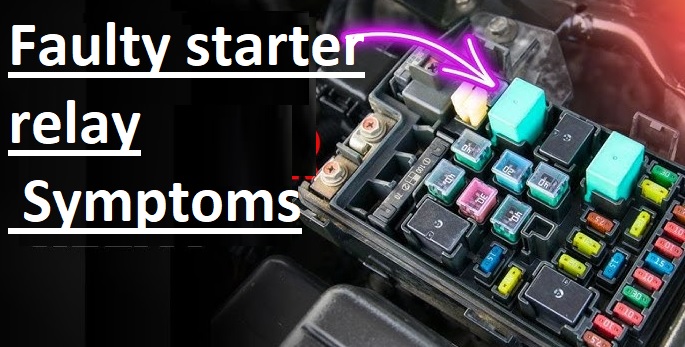
A damaged starter relay shows certain symptoms that affect engine starting features. These symptoms help to find main causes and help to avoid damage of components on the system. Some signs are
The engine does not turn over
If the start button is clicked, it is now created, but the starter motor does not operate. That feature shows the relay inner coil getting a control signal but the power contacts are not accurately closed. The main causes are
- oxidation of inner connections that prevent current flow.
- Voltage losses occur with faulty connection wiring
No response after starting
- When the start button is pressed and no sound is generated, the relay does not get power or can cause internal coil damage. For some conditions, there can be a blown fuse that shows the fuse opened for the protection circuit from overloading and saves the relay to get current.
- Another sign is damage to the safety switch, which saves the engine from starting if safety conditions are not followed. If any switch-side stand clutches oxidize, it interrupts the control signal and makes the relay faulty.
slow-starting
A relay that is not operating properly causes intermittent starting as a result of unstable inner connections or a damaged circuit. These signs increase vibrations through components heated with motor rotation.
Overheating
An overheated relay shows abnormal resistance to contacts or draws high current from the starter motor. with affecting relay functions that conditions affect wiring and other devices’ connections
Starter motor relay testing
Connectivity test
- If it’s not getting power, its contact needs to be open. So connect the multimeter for continuity testing over the contacts of the relay. There will be no connectivity if relay-energized contacts are closed. Perform the continuity test again now; low impedance occurs.
Functional test:
Make motor reconnection on the power supply and start the motor. Check the click sound when the relay switches. If sound is not produced or the motor does not start, it means the relay is not working.
How to check the starter relay?
First of all, set the multimeter at resistance measurement mode. Make a connection of the black pin with one relay pin and the red pin with the other. These leads are normally the input of the battery, and the output of the motor starts.
If the meter value is infinite resistance or high, the relay is not working well.
What is the correct method for replacing the starter relay?
Using an accurate wrench, remove the connectors connected to the relay. Check the connection and locations of each wire so they can easily reconnect if a new relay is connected.
Disconnect the screws holding the relay and remove the old relay. Again, connect the negative battery connector. Start the car to ensure the new relay is operating well. If the car started easily and no sound occurred, that means the replacement was made accurately.
Replacement of the starter relay fuse
- First, find the fuse that needs replacement, the starter relay fuse, normally denoted on the fuse box casing, or we can check it in the vehicle manual.
- Use fuse pliers for removing faulty fuses. If you do not know the fuse is faulty, check the filament; if it is damaged, it means the fuse is faulty.
- Connect the new fuse, ensuring the fuse rating is the same as the older fuse. Connect the new fuse at the defined point where the faulty one was removed.
What is the replacement cost of a starter relay?
There can be different costs based on starter relay types and quality. According to the model, prices are 20 to 150 dollars. Those are estimated prices but can vary.
Starter motor relay located on a motorcycle
. Starter relay location based on vehicle type, electrical system layout, and manufacturing design. Normally, the starter motor relay is close to the battery since it offers a direct connection with less current loss.
For different models, relays are configured over metal on the frame, normally below the seat or in the inside area where the main components are covered. Some sports vehicles or bikes come with a relay configured to the starter motor that makes replacement less complicated.
For inspecting the starter relay, check components that are cylindrical in shape, having two larger-diameter main pins and one or two small connectors in the control circuit.
One or more configured fuses also exist and are configured over the relay structure, providing protection with a transparent assembly.
Maintenance tips for Start Relays
Proper Cleaning
- Dust causes different faults; moisture also causes rust or faulty connections. Make an accurate check of the relay and clean it with a dry cloth. For older rust, make a mixture of soda with water and apply it. Ensure the relay ISC is dry before applying.
- A clean relay causes current flow and avoids any damage. If not performing well causes costly repairs. Cleaning also ensures relays work longer and makes systems operate well.
Battery testing
- A low-strength battery does not provide the required power to the relay. That makes the 12V starter relay not work well or the engine not start well. Use a multimeter for checking battery voltage. A proper battery gives 12.6 volts when the engine is off.
- Faulty battery terminals affect power delivery to the relay. So clean with a wire brush and use a protective layer to control rust. Replace the old battery to prevent damage to the relay.
Overload
- Electrical overloading occurs due to high current flow in the relay. that occurs due to faulty wiring or a damaged starter motor. Make a check of wires for loose points.
- Use a proper relay for the system; a relay with a low current rating causes overheating and damage. You can get help from the manual for an accurate relay.
- starts a relay for handling high currents and helps the car start accurately. Getting an idea about its working and finding faults to avoid serious faults. Replacement accurately provides protection to the system and saves repair costs.
Frequently Asked Questions
How to test the point of a starter relay?
- First test without the relay, so disconnect the relay and set the meter to the resistance range. Check coil resistance. Put the multimeter leads on the terminals. The resistance value is in the range of 50 to 150 ohms.
- If not in this range, the relay coil can open or short-circuit, meaning the relay is faulty
What is the working of a starter relay?
- • A starter relay exists between the battery and starter motor of the vehicle and operates like a circuit breaker. Through current flow control, it checks that engine starting occurs properly and protects components from damage.
What are the signs of a faulty starter relay?
- The faulty starter relay main signs are
- engine not starting accurately,
- Click noise during key turning
- starting errors
- dim dashboard lights, dim headlights during starting
What is the process for bypassing a starter relay?
- First of all, find the starter relay, which exists in the fuse box or close to the battery.
- Disconnect the battery, find the starter motor wires that exist on the engine block, close to the transmission
What is the location of the starter relay?
- for finding the location of the starter relay based on the model. Normally, it exists close to the fuse box in the engine room; a certain point of the engine room, it.
How does a starter relay work?
- Working of the starter relay configured on electromagnetic induction and connection control. The phenomenon of electromagnetic induction helps to control a larger current with a small current.