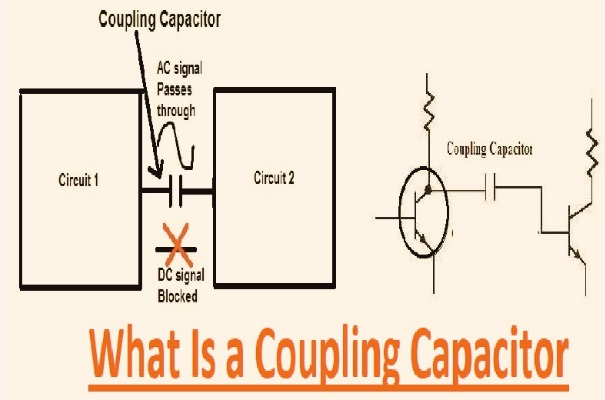
Coupling capacitors are the main part of electronic circuits that allow AC voltage to pass and stop DC voltage. In this way, signal quality is maintained and provides biasing for different phases of circuits. This capacitor is part of RF circuits and amplifiers, where signal transmission is continuously maintained. In this post, we will cover details for the coupling capacitor and learn its practical working in circuits.
What is a Coupling Capacitor?
- Coupling capacitor: a main component of an electronic circuit that helps AC signals to flow, stops DC, and provides accurate biasing and stable circuit operation.
- This capacitor is commonly employed in RF and audio systems since it easily allows AC current flow. Different factors help to find accurate capacitance, such as input impedance and signal frequency.
- Coupling capacitors come in different types, like electrolyte, ceramic, and film, according to the application.
- A ceramic capacitor is part of high-frequency applications, an electrolytic has high capacitance, and a film capacitor is part of circuits where high accuracy is needed.
- Coupling capacitance defines the capacitor capacity that is called “electrostatic coupling,” and it is a coupling technique since it has distributed capacitance.
- The coupling capacitor has features for making two coupled weak and strong current connections and is separated with capacitors that provide high signal paths, avoid low-frequency current of the weak current system, and also keep operators safe operators
Features of Coupling Capacitors
Different factors are involved in the working of the coupling capacitor to define the operation. Some common features of coupling capacitors are as
Capacitance
High capacitance
- A high capacitance value of a capacitor causes low-frequency transmission. It provides high charge storage and provides a uniform signal path.
- Audio circuits commonly use high-capacitance features for transmitting full audio frequencies without any faults.
Low capacitance
- The high-frequency signal circuit uses the low-capacitance feature since it manages low undesired frequencies, working as a natural high-pass filter.
- For high-speed circuits, low capacitance reduces energy storage, causes a fast response time, and provides high efficiency.
Voltage Rating
- voltage rating of the coupling capacitor used for measuring high voltage so that it can manage without any damage.
- We should choose a capacitor having a high voltage rating compared to the circuit operating voltage capacity. These safety features are important for reliable operation, normally for circuits where voltage variations occur.
- Capacitors with the required and proper voltage rating make components’ lives longer since they cause damage during normal working conditions.
Physical Dimensions
- The physical dimension of the capacitor is important for circuit construction, especially for compact electronic devices. Since industries are shifting towards miniaturization, using capacitors that provide the required capacitance and voltage rating in a low space is important.
- Proper fitting for circuit physical dimensions affects heat dissipation and design factors. Larger capacitors either provide good heat dissipation or face electromagnetic compatibility (EMC) errors.
Coupling means of a capacitor.
- Coupling is a process that allows signal transmission from the 1st phase to the 2nd phase, and it means AC coupling.
- In a circuit, it is divided into a power supply and the load. If the load capacitance is high, the operating circuit’s charge and discharge capacitances are required to complete the signal.
- If the rising point is steep, the current is high, so the drive current absorbs a high current from the power supply. Inductance and resistance, compared to normal conditions, cause noise that affects the normal working of the first phase, which is coupling.
What Does Decoupling Mean?
- Decoupling is defined as a filtering measurement for the power supply to remove the mutual interference effect of two signals in the power supply.
- A coupling constant means a time constant related to multiple coupling capacitance values and 2nd phase input impedance.
Why is decoupling used?
- It removes the high-frequency ripple of the power supply and cuts off the high-frequency signal of multi-stage amplifiers in the crosstalk power supply path.
- through operating with a larger signal circuit that uses high power, resulting in power variations and the effect of power variations over input phase when minimizing with decoupling
- It makes floating ground and making connections of each component of ground with complicated design. High-frequency switching noise is produced with active devices when switching occur over a power line. The main working of a decoupling capacitor is to give a local DC power supply for operating devices to avoid switching noise movement on board and shift noise to the ground.
Different Coupling Methods
An interference signal occurring with an interference source results in electromagnetic interference to the electronic control system with a proper coupling path. The main coupling techniques are
Direct coupling
- Direct coupling is a common method of interference and also a common method of process. such as interference signals affecting the system in the wires and resulting in interference of the system. In these techniques, filtering and decoupling are used for avoiding electromagnetic interference signals.
Common impedance coupling
- common impedance coupling techniques. it occurs when current for two circuits comes with two path. Common impedance coupling comes in two categories: common ground and power supply impedance.
- To avoid such a coupling type, the coupling impedance is required to be zero, which makes no common impedance between the interference source and the interfered object.
Capacitive coupling
- Capacitive coupling, also called electric field coupling, is a coupling technique that occurs due to distributed capacitance.
Electromagnetic induction coupling
- Electromagnetic induction, coupling, and other names for magnetic field coupling. That is, coupling techniques through the electromagnetic field of internal or external locations.
- To prevent this coupling to protect devices that have chances of interference.
Radiation coupling
- Electromagnetic field radiation is also a result of interference coupling, which is irregular interference. This interference moves to the system through the power line. If the signal transmission line is longer, it causes radiation and gets interference waves that are known as the antenna effect.
Leakage coupling
- This leakage cpupling isresistive coupling. that interfernce resulted due to the reduction of insulation
Coupling capacitor working
- The main operation of the coupling capacitor is to couple and separate two systems of weak current and strong current with a capacitor, in result high frequency signal path for controlling low-frequency current to add into the weak current system for safe operation.
- If capcitor connected with ac circuit, the voltage of the circuit connected to a single pin increases, and charge is stored on the plate. When the voltage of the circuit is configured with pin losses, charge is stored during high potential again to the circuit. It also occurs on the other side.
- A capacitor comes with an insulated design and no current flow in the capacitor. It stores and releases charge when the potential increases or decreases, causing a sign of current flow.
- So it separates the DC and AC signals coupled in raising form, reduces potential at both sides and delivers it to the battery circuit parts. capacitor comes with features of ac resistance and dc passing. Working as a coupling capacitor, its main operation is to allow AC signal flow and block DC current of the upper stage amplifier circuit so it does not cause any effect on the next stage amplifier circuit.
- Capacitors allow AC to flow but not DC since two plates of a capacitor store charge without making a loop. DC charges the capacitor, but voltage over the capacitor, like power supply voltage, makes the circuit stable and prevents current flow.
- Capacitor charged during positive AC half cycle and discharged during negative half cycle.
- This charging and discharging equal the current flow for the capacitor.
How to Connect a Coupling Capacitor in a Circuit
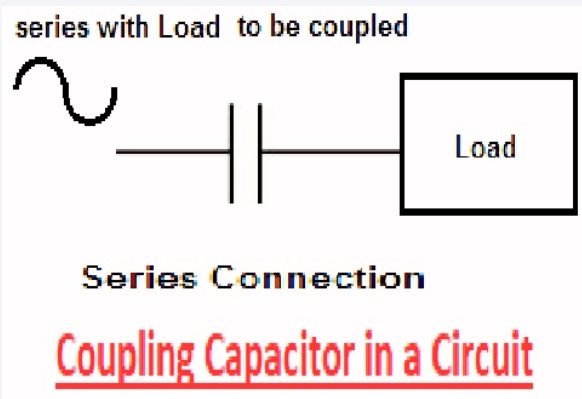
- For connecting the capacitor in the circuit to make AC coupling, the capacitor is connected in a series combination with the load.
- A capacitor has the feature to block low frequencies like DC and pass high frequencies of AC since it is a reactive device. It functions for different frequencies at different techniques.
- For low-frequency signals, it comes with high impedance or resistance that prevents low-frequency signals moving through. A very high-frequency signal causes low impedance and helps high-frequency signal flow.
How to Select the Value of the Coupling Capacitor
- Coupling capacitor based on the AC signal frequency flows through. A capacitor is a reactive device that provides different impedances for signals at different frequencies. For a low-frequency signal, for example, a DC having a zero hertz frequency, a capacitor has a high resistance. So the capacitor has features to block DC signal flow.
- When the signal frequency increases, capacitors provide low resistance. Capacitor reactance varies through these equations.
reactance = 1/2πfC
- In this equation, f is frequency and C is capacitance. In this equation, reactance has a direct relation with frequency and capacitance.
- For high frequencies, the capacitor has low reactance and a low capacitance value required for pass-through. High-frequency signals are required for small capacitors like those in the picofarad (pF) range.
- A capacitor has high reactance for low frequency. so required high capacitance is required, which helps low-frequency signals to flow. A microfarad capacitor is needed for low-frequency signals.
- Some other features are as
| Signal Frequency | Coupling Capacitor |
| 100 Hz | 10 µF |
| 1 kHz | 1 µF |
| 10 kHz | 100 nF |
| 100 kHz | 10 nF |
| 1 MHz | 1 nF |
| 10 MHz | 100 pF |
| 100 MHz | 10 pF |
Coupling vs Decoupling Capacitor
coupling capacitor is used for flowing AC signals between circuit stages with impedance DC components. A decoupling capacitor is used to reduce noise and make a stable DC power supply. Some other differences are as
| Characteristic | Coupling Capacitor | Decoupling Capacitor |
| Function | AC signals allow, block DC | Filtering noise, stable DC power |
| Signal Handling | send AC signal between stages | minimizes AC noise on DC lines |
| DC Component | Blocks DC bias, avoiding affecting subsequent stages | make a stable DC voltage by absorbing variations |
| connection | series connection between circuit stages | Parallel with the power supply rail, close to the load |
| affect | Signal isolation & AC signal transmission | stable Power supply and noise reduction |
Coupling Capacitors applications
Audio Circuits
- Coupling capacitors are the main components of different electronic projects that are used to allow AC and block DC. This feature makes it effective for audio applications for high-speed data transmission, for quality signals, and for avoiding undesired bias affecting circuit work.
Amplifier
- Coupling capacitors are important for separating AC signals for amplifier circuit stages. It ensures the DC bias of one stage does not affect the other functions of the circuit. Such a multi-stage amplifier employs a capacitor between the collector of one stage and the gate of the next stage.
Power supply circuit
- A decoupling capacitor used in a power supply circuit, so a decoupling capacitor is used for reducing noise and separate part of power distribution system. It is also used for circuits for reducing low-frequency noise. that helps noises to avoid signal contaminations
Communication project
- For communication circuits, the coupling capacitor block DC voltage. That helps the AC signal, like radio frequency, to deliver without interference from DC. So, if you have radio frequency circuits, the coupling capacitor delivers only the RF signal from the transmitting circuit towards the antenna and blocks DC transmission.
High-Speed Data Interfaces
- For high-speed digital communication protocols like PCIe, a coupling capacitor makes quality signals with blocking DC and causes signals to circulate to circuit parts. that helps to transmit data through separating the signal path and stopping DC volts from affecting data signals
Conclusion
coupling capacitor is the main component for making AC signal transmission easy with a stable cirucit. These features are based on different parameters like, frequency response and audio collaboration with radio frequency communication. choosing accurate type and proper capacitnace make signal clear, reduces distortion and is compatible with different system functions.
Frequently Asked Questions
What is the function of a coupling capacitor?
- Main working of coupling capacitor to passes ac signal from first part of the circuit to the other, while blocking dc biasing. That is important for shifting the dynamic component of the signal without varying the DC operating point.
what is differnce between coupling capacitor and bypass capacitor?
- Coupling capacitors deliver AC transfer between stages, separate DC, and bypass capacitors are employed to cause low impedance for AC signals towards ground. It filters noises of the power supply.
- Bypass capacitor connected in parallel and coupling capacitor in series combinations
Where are coupling capacitors part of electronic circuits?
- Coupling capacitors are prevalent in audio amplifiers to isolate DC offsets, in communication systems to block DC components from interfering with AC signals, and in digital circuits to ensure the integrity of high-speed data transmission.
What factors are important for selecting the proper value for a coupling capacitor?
- The main factor for selecting the required value is the cutoff frequency. The coupling capacitor should pass low-frequency AC signals and other blocked signals. that needed proper impedance of the source and load.
What happens if the coupling capacitor value is low?
- If capacitance is very low, the capacitor stops the low-frequency part of the AC signal, causing signal distortion. that affect output quality in audio circuits.
What is the effect of using an electrolytic capacitor as a coupling capacitor?
- Electrolytic capacitors have high capacitance and come with polarized features. it not used for applications where reverse voltage exists. With that, it has a high equivalent series resistance and inductance, making it less effective in high-frequency projects. So coupling circuits use ceramic capacitors.