High Rupturing Capacity (HRC) fuses are made to protect electrical systems from too much current, especially during problems like short circuits or power surges. They are strong, act fast, and can handle high currents without breaking. In this article, we’ll look at how HRC fuses work, their types, features, uses, and what makes them a reliable choice for circuit protection.
What is a High Rupturing Capacity (HRC) fuse?
- A high fuse belongs to the fuse family that is employed for electrical circuit protection from overcurrent and short circuits.
- Its design safely controls high fault current without affecting neighboring devices. HRC fuses easily manage and interrupt fault current of about 80 kA or higher without causing fire.
- A high rupturing capacity fuse comes with fuse wire used for easily carrying short circuit current at a certain point.
- If the fault is cleared during this duration, fuse continues functioning, then melts, and a new fuse is needed.
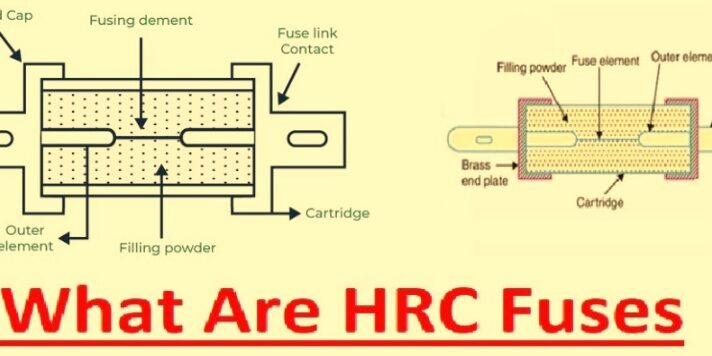
HRC Fuse Construction
The structure of HRC fuses comes with different components, and each performs a certain operation. Each inner component is used for operating in high heat conditions, as well as pressure during fault occurrence.
Some components of HRC fuses are as
External casing
- Ceramic casing offers a high-strength structure. that offers high temperature and pressure resistance without damage. It’s helpful that the HRC fuse comes with a feature that protects all faults that occur internally, protecting other connected components and operators.
Fuse component
- In a fuse casing, a copper or silver component is used. Its design is narrow components that heat when a high current flows. This layout is compatible with the correct functioning of the HRC fuse, which helps to disconnect the circuit accurately.
Filler Material & Sealing the
- Inner space is covered with silica powder or quartz. Through the melting of the element, the filler easily absorbs heat and reacts with the metallic vapor. As a result, arc suppression results in safe HRC work, even at high fault current occurrences.
HRC Fuse Working Principle
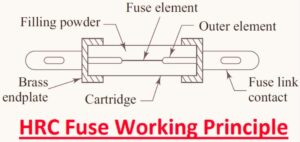
The HRC fuse is working based on controlled melting and absorption of high-speed energy. In fault conditions, fuse elements melt and disconnect the circuit. Filler materials control arc production and perform interruptions. Working of an HRC fuse based on different points.
Normal load conditions
- Under normal conditions, the fuse element maintains stable conditions. Heat production is less and smoothly separated. It helps HRC function regularly without replacement or sudden damage.
Overload conditions
- overloading, causing slow increases in current, and when heat is generated, the fuse element crosses the thermal limit and melts. These controlled features make HRC fuses reliable operations, offering overheating safety for connected devices.
Short circuit response
- A short circuit produces an instant surge current. An HRC fuse working helps to provide instant element melting. arc fastly eliminated with filler, controlling the explosion and serious damage.
HRC Fuse Types
NH Type
- NH fuse overloading and short circuit protection for low and medium voltage ranges. It offers backup protection to motor starters and different electric components from overloading and short circuits. This fuse is lightweight with a compact structure.
Din Type
- The DIN fuse comes with different ratings of current. It is employed for different operations; each comes with certain features in different conditions. This fuse comes with different voltage values, and part of the transformer protection system also protects from faults if there is no low-voltage secondary in the circuit. It provides good features for low overcurrent with short circuit features. DIN fuses are also part of projects for gas-insulated switchgears, transformers, and mining.
Blade fuse
- This fuse is also called a spade or plug-in fuse, having a plastic body with two metallic caps that fit with a socket. It is part of vehicle short-circuit protection, and low-weight features offer low off-current features.
- These fuses are part of providing motor short-circuit and backup protection features. It also has different dimensions with different current rating features.
HRC fuse breaking capacity
- High breaking capacity is commonly a defining feature for HRC fuses. The breaking capacity of a fuse defines the maximum fault current that the fuse can safely interrupt the circuit, measured in amperes.
- A glass M205 fuse comes with a ten-time rated current interrupting rating. high-ampere rating.
- Interrupting rating is 1500 amperes, one of the ampere ratings of the fuse. The ceramic M250 control overloaded about ten times larger, either having physical dimensions of a fuse or an ampere voltage rating like a glass LBC fuse.
HRC Fuse “Hyper-Speed Arc Extinction techniques
- The interruption sequence of the HRC fuse is a complicated feature. Here, we explained it in detail. That process is applied at high speed, normally with a range of 0.005 to 0.02 seconds, which is high-speed compared to other breakers.
- Due to the short circuit surges, the element of HRC gets heated fast, according to the Joule heating process (P = I²R).
- As a result, the element evaporates and melts in a few milliseconds, causing initial breakage. The molten element separated; a high-temperature, high-pressure electric arc connected to break, trying to provide current flow maintenance. As a result, high energy is released.
- As a result of the arc, the quartz sand melts densely packed. Molten silica becomes a cool arc and wraps over it, making a solid, non-conductive material.
- This glass configuration barrier not only absorbs arc energy but also removes the conductive plasma channel. It occurs with fast-lengthening and splitting arc roots.
HRC Fuse vs MCB vs Circuit Breaker
| Parameter | HRC Fuse | MCB (Miniature Circuit Breaker) | Circuit Breaker |
| Full Form | High Rupturing Capacity Fuse | Miniature Circuit Breaker | Electrical Circuit Breaker |
| Definition | A protection device that melts under fault current | Automatic switch trips during overload/short circuit | Protective switching device used for control and protection of power systems |
| Function | Overcurrent and short-circuit protection | Overload and short-circuit protection | Switching, isolation, overload, and fault protection |
| Working Principle | The fuse element melts as a result of the high heat generated by the overcurrent | Thermal-magnetic tripping mechanism | Electromechanical or electronic tripping system |
| Operating Mechanism | Metal strip/fuse wire melting | Bimetallic strip and electromagnetic coil | Mechanical contacts with trip unit |
| Reusability | No | Yes | Yes |
| Reset Capability | Replace the fuse | Manual reset | Manual or automatic reset |
| Response Speed | Extremely fast | Fast | Moderate to fast |
| Fault Clearing Time | Very low (milliseconds) | Low | Depends on breaker type |
| Current Limiting Capability | Excellent | Moderate | Good |
| Breaking Capacity | Very high | Moderate | Very high |
| Interrupting Rating | Up to 80kA or higher | 6kA–16kA | more than 150kA |
| Rated Voltage | Up to 11kV in some applications | 230V/415V | Low, medium, and high voltage |
| Rated Current | From a few amps to several hundred amps | 0.5A–125A | 1A to thousands of amps |
| Frequency Range | 50/60 Hz | 50/60 Hz | 50/60 Hz |
| Arc Quenching Method | Silica sand | Air arc extinction | Air, vacuum, oil, SF6 gas |
| Arc Energy | Very low | Moderate | Controlled using advanced systems |
| Trip Characteristics | Fixed | B, C, D curves | Adjustable trip settings |
| Overload Protection | Yes | Yes | Yes |
| Short Circuit Protection | Excellent | Good | Excellent |
| Earth Fault Protection | No | Limited | Available |
| Under Voltage Protection | No | No | Available in advanced breakers |
| Selective Coordination | Limited | Moderate | Excellent |
| Thermal Protection | Indirect through fuse heating | Yes | Yes |
| Magnetic Protection | No | Yes | Yes |
| Electronic Protection | No | No | yes |
| Remote Operation | Not possible | Limited | yes |
| Automation Compatibility | No | Limited | compatible |
| Smart Monitoring | No | No | Available in intelligent breakers |
| Mechanical Life | Single-use | 10,000+ operations | 10,000–20,000+ operations |
| Electrical Life | Single operation | Moderate | Very high |
| Maintenance Requirement | Frequent replacement | Minimal | Periodic maintenance |
| Reliability | High | High | Very high |
| Efficiency | High | High | High |
| Heat Generation | High during fault | Moderate | Controlled |
| Energy Let-Through | Low | Moderate | Low |
| Surge Handling Capability | Excellent | Moderate | Excellent |
| Switching Function | No | Yes | Yes |
| Isolation Function | No | Limited | Yes |
| Contact Wear | Not applicable | Low | Moderate |
| Installation Complexity | Simple | Easy | Moderate to complex |
| Size | Compact | Compact | Larger |
| Weight | Light | Light | Heavy |
| Cost | Low | Medium | High |
| Replacement Cost | High over time | Low | Low |
| Operating Noise | Silent | Clicking sound | Mechanical sound |
| Safety Level | Moderate | High | Very high |
| Fire Risk | Possible after fuse rupture | Low | Very low |
| Environmental Impact | Waste due to replacement | Lower waste | Long service life |
| Uses | Motors and capacitor banks | Residential and commercial wiring | Industrial plants, substations, transmission systems |
| Industrial Usage | Common | Limited | Extensive |
| Domestic Usage | Limited | Very common | Rare |
| High Voltage Suitability | Limited | No | Yes |
| Low Voltage Suitability | Yes | Excellent | Yes |
| Types | Cartridge fuse, blade fuse | Type B, C, D | MCCB, ACB, VCB, OCB, SF6 CB |
| Standards | IEC 60269 | IEC 60898 | IEC 60947 |
| Advantages | Fast operation, low cost, excellent current limiting | Resettable, compact, easy to use | Advanced protection, automation support |
| Disadvantages | One-time use, replacement required | Lower interrupting capacity | costly and larger in size |
H.R.C. Fuses Applications
- HRC fuses for protection from overcurrent and short circuit conditions to the transformer.
- It also operated like backup protection for the motor from overloading and short circuits.
- HRC fuses are also employed for vehicle electrical systems, offering protection to different components.
- It’s also part of the motor stator for accurate protection from electrical faults.
- These fuses also offer protection to electrical devices and circuits. These fuses are part of a low-voltage distribution system for preventing fault effects.
- HRC fuses are used for different industrial configurations for the protection of circuits. It is also employed in feeder sectionalizing, offering safe electrical distribution.
- This fuse is important for protecting components in air- and gas-insulated switchgear.
- These fuses are used for minimizing functions for electrical circuit protection.
Conclusion
HRC fuses offer reliable protection by melting high current and properly interrupting high current with effective arc suppression. Its structure is helpful for applications in different projects, and high breaking capacity, fast response, and proper working help to use it for control panels, power distribution transformers, and backup protection systems.
Frequently Asked Questions
What occurs when the HRC fuse blows?
- If the HRC fuse blows, the fuse current melts and the circuit breaks. that control current flow and protect the system
What point is needed for choosing an HRC fuse rating?
- For using an HRC fuse, different parameters like voltage, fault current features, ambient temperature, and load features needed to be followed. Improper use causes faulty conditions.
Do HRC fuses lose accuracy over time?
- HRC fuses are not affected by mechanical wear, but high exposure to high temperature or overloading affects operation. Proper inspection and accurate installation processes offer constant working during operating life.
Are HRC fuses used for protecting sensitive electronic devices?
- Standard HRC fuses are used for high fault levels; some special high-speed operating HRC fuses are used for providing protection to sensitive electronic devices. These types offer high-level prevention of damage from short-time fault currents.
How do you check if an HRC fuse is faulty?
- We can check with a multimeter for continuity. if not continuity occurs, fuse blown and replace it
Can an HRC fuse be repaired or reused?
- No HRC fuse is reusable; when it functions, it needs replacement.
What is the working life of an HRC fuse?
- HRC fuses work for many years in normal conditions. It’s working life based on load connected, applications, and environmental factors.
Can HRC fuses connect in both AC and DC circuits?
- Yes, HRC fuses part of AC and DC systems, so accurate ratings are used according to circuit application
What causes an HRC fuse to fail frequently?
- Overloading, faulty fuse rating, or faulty devices cause permanent failure. The best is to find main causes for replacement.