Hello, fellows, I hope all of you are having fun in your life. In today’s tutorial, we will have a look at the starting method of induction motors. A three-phase induction motor is hypothetically self-starting. The stator part of an induction motor comprises three-phase windings. When these windings connect with the three-phase supply, they generate a revolving magnetic field (B). This field will connect and cut the rotor conductors, which will cause the field to be produced in the rotor.
The field generated by the rotor will interact with the revolving field (B) in the stator and cause the rotor to rotate. So, three-phase induction motors employ a starting technique not to deliver a starting torque at the rotor, but for these two reasons: the first one is to decrease heavy initial currents and stop the motor from overheating, and the second is to deliver overload and no-voltage protection. In today’s post, we will see the different starting methods and their circuitry. So, let’s get started with the starting method of induction motors.
Starting Method of Induction Motors
The induction motor does not show the starting issues which are present in the synchronous motor.
In numerous situations, induction motors can be initiated by just connecting them to the input supply.
Though, there are occasional causes due to which it is not possible. For instance, the initial (starting) current can cause such a decrease in the power system voltage that across-the-line starting is not suitable.
In the case of a wound-rotor induction motor, starting conditions can be obtained at less current by adding an additional resistor in the circuitry of the rotor.
This additional resistor not only enhances the starting torque but also decreases the starting (initial) current.
In cage rotor induction motors, the starting (initial) current can fluctuate extensively, depending mainly on the rated power of the motor and on the effective rotor resistance in initial (starting) situations.
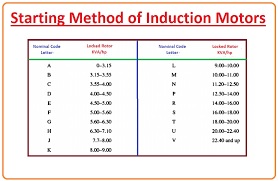
To know the rotor current at starting (initial) situations, all cage motors now have a starting code letter on their nameplates. The code letter puts restrictions on the quantity of current the motor can get during starting (initial) circumstances.
These restrictions are stated in terms of the initial apparent power of the motor as a function of its horsepower ratings.
In the given diagram, a table is shown that covers the starting kilovolt-amperes per horsepower for each code letter.
To regulate the initial current for an induction motor, note the rated voltage, horsepower, and code letter from its nameplate.
Then the starting apparent power of the motor can be found by the given formula.
Sstart = (rated horsepower) (code letter)
- The starting current can be found by this equation.
IL= Sstart/√3VT
Autotransformer Starter for an Induction Motor
If essential, the starting (initial) current of an induction motor can be decreased by starting circuitry. But, if it happens, it will also decrease the starting torque of the motor.
One method to decrease the initial current is to add additional inductors or resistances into the power line during the initial (starting) condition.
Although formerly common, this method is infrequent nowadays.
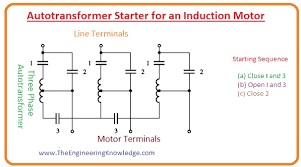
A substitute method is to decrease the terminal voltage of the motor during starting by using an autotransformer to step down the starting voltage.
The given diagram shows the typically decreased voltage starting circuitry using an autotransformer.
During initial conditions, contacts (1) and (3) are closed, providing less voltage to the motor.
When the motor is almost up to speed, contacts one and three are opened and contact (2) is closed.
These contacts (connections) provide full-line voltage to the motor.
It is significant to understand that while the initial current is decreased in direct proportion to the reduction in terminal voltage, the starting torque declines as the square of the supplied voltage.
- So, only a particular quantity of current reduction can be done if the motor is to start with a shaft load connected
Induction Motor Starting Circuits
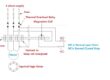
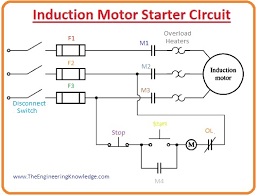
- A distinctive full-voltage induction motor starter circuitry is drawn is given a diagram.
The components of this circuit is explained in this figure.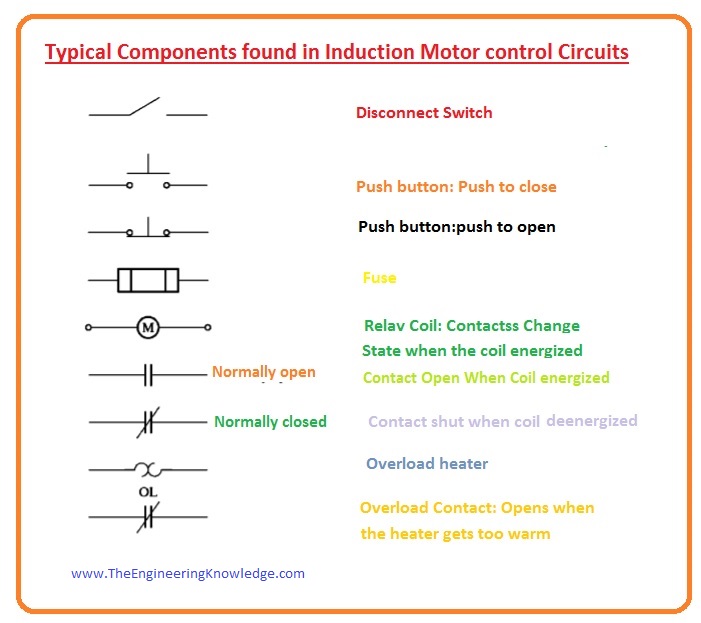
The working of this circuitry is very simple. When the start button is pushed, the relay (or contactor) coil (M) is energized, which causes the generally open contacts (M1, M2, and M3) to close.
When these contacts closed, power is supplied to the induction motor, and the motor starts working.
Contact (M4) also closes, which shorts out the starting switch, letting the worker release it without eliminating power from the (M) relay.
When the stop button is pushed, the (M) relay is de-energized, and the (M) contacts open, discontinuing the motor’s working.
Magnetic motor starter circuitry has numerous protective topologies, which are mentioned here.
Under-voltage protection
Overload protection
Short-circuit protection
Short-circuit protection
Short-circuit safety for the motor is provided by fuses (F1), (F2), and (F3). If an abrupt short circuit exists within the motor and originates a current flow several times higher than the rated current, these fuses will work, separating the motor from the input supply source and preventing it from burning and suffering serious damage.
Though these fuses should not be damaged during normal motor initial conditions, they are intended to need currents numerous times higher than the full-load current before they open the circuitry.
It clearly explains that if a short circuit happens due to high load at the motor, then these fuses will not be enough for this fault and can’t clear this fault.
Overload protection
Overload protection to the motor is given by the component which is denoted in the diagram as (OL).
These overload (OL) protection components comprise 2 portions: an overload heating component and overload connections.
Though this harm takes time, an induction motor will not usually be damaged by short-term phases of high currents (like starting current).
If the higher current is continued, then damage will happen. The overload (OL) heating components also depend on the heat for their process, so they will not be disturbed by short phases of higher current during the initial condition, and still, they work during the long time interval of higher current, eliminating power from the motor before it can be hurt.
Under-voltage protection
Under-voltage protection to the motor is given by the controller circuit also. You can see from the figure that the controlling power for the (M) relay is coming from over the lines to the motor.
If the voltage supplied to the motor becomes less, the voltage provided to the relay (M) will also decrease, and the relay will stop working or get de-energised.
The (M) connection will be open and eliminating power from the motor terminals.
Three-Step Resistive Stator for an Induction Motor
The starting circuitry of an induction motor with the resistances to eliminate the initial current of the motor is drawn in the given diagram.

This circuitry is like the former circuitry, which we have discussed, except that this circuitry has some extra elements that govern the elimination of the starting resistance.
In this circuitry, you can see that the relays, which are denoted by 1TD, 2TD, and 3TD, are all time-delay relays. They are called time delay because when these relays get energized, they will take some time, which is set on these relays, to close their contacts.
In this circuit, when the starting button is pressed, relay (M) gets energized, and then the supply will be provided to the motor. The complete starting resistance is in series connection with the motor, which lessens the initial current.
When the contact (M) gets closed, you can see that the 1TD relay is energized. However, there is a limited delay before the 1TD contacts close.
During this time delay, the motor partly speeds up, and the initial current drops to some extent.
After this time interval, the contacts of 1TD get closed, eliminating a portion of the initial resistance and instantaneously energizing the (2TD) relay.
After some time, the interval contacts of the 2TD relay get closed, eliminating the 2nd portion of resistance, and it energizes the 3TD relay.
In the end, the (3TD) contacts get closed, and the complete starting resistance is out of the circuitry.
By a sensible choice of resistance values and delay of time, this initial circuitry can be used to stop the motor starting current from becoming hazardously large while still letting sufficient current flow to confirm rapid acceleration to ordinary operation speeds.
It is the most complete tutorial on the starting method of an induction motor. If you have any queries, ask in the comments. Thanks for reading. See you in the next tutorial.
You can also read some related articles to the induction motor. That is described here.
- Introduction to Induction Motor
- Introduction to Three Phase Induction Motor
- Equivalent Circuit Induction Motor
- Induction Motor Torque-Speed Characteristics
- Variations in Induction Motor Torque-Speed Characteristics
- Power and Torque in Induction Motors
- Induction Motor Design Classes
- Induction Motor Design