R744 is a refrigerant that is called carbon dioxide, or CO₂. It is normally associated with greenhouse gases that have been used in refrigeration for approximately 100 years. R744 is part of a group of natural refrigerants and is defined as safe for the environment, including the ozone layer. In this post we will cover details about the R744 refrigerant and its P-T chart. Let’s get started
What is R744?
R744 is called carbon dioxide, which is the standard number for certain refrigerants, and its assembly is made according to the following ISO 817. It is a pure carbon dioxide refrigerant, with a content of about 99.9%. CO₂ does not have color or an odor and has a high weight compared to air and makes up 0.04% of the atmosphere.
This refrigerant comes with a global warming potential of 1 and an ozone depletion potential of 0, which means it is environmentally friendly. CO₂ was employed in refrigeration and food storage.
But now CO₂ is used in compressors to provide safe functioning at high pressures. It has less impact compared to synthetic refrigerants. Since it is a natural refrigerant, it is part of a transcritical system with refrigerant R134a
R744 Features
EFFICIENCY
CO₂ refrigeration has high energy efficiency in low- and high-temperature conditions. Its optimized energy use for CO₂ due to transcritical and subcritical cycles reduces power expenses and reduces carbon footprints. With the passage of time, the system offers higher savings than older refrigerants.
Environmental Impact
R744 is a natural refrigerant that has low global warming potential (GWP) and is more environmentally friendly than conventional synthetic refrigerants such as HFCs and HCFCs (hydrochlorofluorocarbons), which come with high GWPs. But R744 does not affect the ozone layer, so it is best to use.
Low cost
CO₂ is easier to find and less costly than synthetic refrigerants. With that, it is an accessible supply that minimizes the chances of shortage, offering high stability
Non-Toxic and Non-Flammable:
It is a non-flammable and non-toxic refrigerant, so it is safe to use for different projects. So it is best to use it in industries since it has a high safety factor, for example, food processing and health industries
Compatibility
There are different rules for high-GWP refrigerants. Working with R744 CO2 provides compliance by following environmental standards and regulations and helps manage high retrofit costs.
Versatility nature
R744 is used for different heat pump projects, and its features make it best for small- and large-scale operation, providing the best solution for different industries
R744 properties
| Property | Technical Value |
| Refrigerant designation | R744 |
| Chemical name | Carbon dioxide (CO₂) |
| Chemical formula | CO₂ |
| ASHRAE safety class | A1 (Non-toxic, non-flammable) |
| Molecular weight | 44.01 g/mol |
| Boiling point at atmospheric pressure | −78.5°C (sublimation) |
| Critical temperature | 31.06°C |
| Critical pressure | 7.38 MPa (73.8 bar) |
| Triple point temperature | −56.6°C |
| Triple point pressure | 5.18 bar |
| Global Warming Potential (GWP) | 1 |
| Ozone Depletion Potential (ODP) | 0 |
| Normal operating pressure | High-pressure system; application-dependent |
| Refrigerant type | Natural refrigerant |
| Refrigerant color code | Varies by cylinder standard |
R-744 Temperature – Pressure Chart
Temperature (°C) | Temperature (°F) | Pressure (bar) | Pressure (psig) |
| -50 | -58 | 5.81 | 83.5 |
| -45 | -49 | 7.13 | 103.4 |
| -40 | -40 | 8.7 | 126.2 |
| -35 | -31 | 10.5 | 152.3 |
| -30 | -22 | 12.54 | 181.9 |
| -25 | -13 | 14.86 | 215.4 |
| -20 | -4 | 17.43 | 253 |
| -15 | 5 | 20.35 | 295.2 |
| -10 | 14 | 23.59 | 342.2 |
| -5 | 23 | 27.2 | 394.5 |
| 0 | 32 | 31.18 | 452.2 |
| 5 | 41 | 35.58 | 516 |
| 10 | 50 | 40.42 | 586.2 |
| 15 | 59 | 45.74 | 663.4 |
| 20 | 68 | 51.62 | 748.3 |
| 25 | 77 | 58.02 | 841.6 |
| 30 | 86 | 65.12 | 944.4 |
R744 vs R134a
Technical Feature | R744 (CO₂) | R134a |
| Refrigerant type | Natural refrigerant | Synthetic HFC refrigerant |
| Chemical formula | CO₂ | C₂H₂F₄ |
| Molecular weight | 44.01 g/mol | 102.03 g/mol |
| ASHRAE safety class | A1 | A1 |
| Toxicity classification | A (lower toxicity) | A (lower toxicity) |
| Flammability | Non-flammable | Non-flammable |
| Normal boiling point | −78.5°C (sublimation) | −26.1°C |
| Critical temperature | 31.06°C | 101.1°C |
| Critical pressure | 73.8 bar | 40.6 bar |
| Triple point temperature | −56.6°C | −103.3°C |
| GWP (100-year) | 1 | 1,430 (traditional IPCC AR4 value) |
| ODP | 0 | 0 |
| Operating pressure | Very high | Moderate |
| Heat transfer characteristics | High volumetric cooling capacity | Lower volumetric cooling capacity |
| availability | Widely available | Subject to phase-down restrictions |
| applications | Supermarkets, transport refrigeration, heat pumps | Automotive AC, chillers, refrigeration |
| Environmental impact | Very low direct climate impact | Higher direct climate impact |
R744 vs Other Refrigerants – Technical Features Comparison
Technical Features | R744 (CO₂) | R134a | R404A | R410A | R32 | R290 (Propane) | R717 (Ammonia) |
| Chemical formula | CO₂ | C₂H₂F₄ | Blend | Blend | CH₂F₂ | C₃H₈ | NH₃ |
| Molecular weight (g/mol) | 44.01 | 102.03 | 97.6 | 72.6 | 52.02 | 44.1 | 17.03 |
| Normal boiling point (°C) | -78.5* | -26.1 | -46.5 | -51.6 | -51.7 | -42.1 | -33.3 |
| Critical temperature (°C) | 31.06 | 101.1 | 72.1 | 72.5 | 78.1 | 96.7 | 132.2 |
| Critical pressure (bar) | 73.8 | 40.6 | 37.4 | 49 | 57.8 | 42.5 | 113.5 |
| Triple point temperature (°C) | -56.6 | -103.3 | — | — | — | -187.7 | -77.7 |
| GWP (AR4) | 1 | 1,430 | 3,922 | 2,088 | 675 | 3 | 0 |
| ODP | 0 | 0 | 0 | 0 | 0 | 0 | 0 |
| ASHRAE safety class | A1 | A1 | A1 | A1 | A2L | A3 | B2L |
| Flammability | Non-flammable | Non-flammable | Non-flammable | Non-flammable | Mildly flammable | Highly flammable | Mildly flammable |
| Toxicity classification | A | A | A | A | A | A | B |
| Refrigerant category | Natural | HFC | HFC blend | HFC blend | HFC | Hydrocarbon | Natural |
| Operating pressure | Very high | Moderate | Moderate | High | High | Moderate | High |
| Volumetric cooling capacity | Very high | Low | Moderate | High | High | High | Very high |
| Heat transfer performance | Excellent | Good | Good | Good | Good | Good | Excellent |
| Temperature operating range | Low to medium | Medium | Low to medium | Medium | Medium | Low to medium | Low to high |
| Compressor | CO₂-rated compressor | Reciprocating/scroll | Reciprocating/scroll | Rotary/scroll | Rotary/scroll | Reciprocating/rotary | Screw/reciprocating |
| Lubricant compatibility | POE/PAG, application-dependent | POE | POE | POE | POE | Mineral/POE, application-dependent | Mineral/synthetic, application-dependent |
| applications | Supermarkets, heat pumps, cold storage | Chillers, automotive AC | Commercial freezers | Air conditioning | Split AC, heat pumps | Refrigeration, heat pumps | Industrial refrigeration |
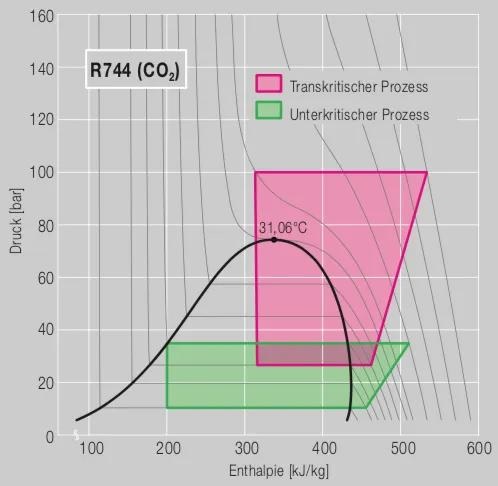
R744 subcritical vs transcritical system comparison
Technical Features | R744 Subcritical System | R744 Transcritical System |
| Operating principle | Below the critical point | Across the critical point |
| Critical temperature | Below 31.06°C during condensation | Heat rejection occurs above 31.06°C |
| Critical pressure | High-side pressure less than 73.8 bar absolute | High-side pressure crosses 73.8 bar absolute |
| Refrigerant state during heat rejection | Vapor changes into liquid | Supercritical fluid is cooled without condensation |
| Heat rejection component | Condenser | Gas cooler |
| Heat rejection process | Desuperheating, condensation, and possible subcooling | Sensible cooling of supercritical CO₂ |
| High-side pressure | Below critical pressure | Above critical pressure |
| High-side temperature | Below critical temperature during condensation | Above critical temperature during gas cooling |
| Evaporator operation | Subcritical | Subcritical |
| Compressor operation | Compresses low-pressure vapor | Compresses low-pressure vapor to supercritical high-side conditions |
| Expansion device | Expansion valve | High-pressure expansion valve |
| Refrigerant condensation | Yes | No |
| Pressure-temperature relationship | Saturation pressure related to saturation temperature | Pressure and temperature are independent above the critical point |
| Pressure control | Condensing pressure control | Optimized high-side pressure control |
| Receiver arrangement | Liquid receiver used | High-pressure receiver commonly used |
| System complexity | Relatively simple | Complex control and component arrangement |
| Operating pressure requirements | High-pressure CO₂ equipment | Higher-rated high-pressure CO₂ equipment |
| Energy efficiency | Best at suitable low ambient temperatures | Dependent on ambient temperature and optimized high-side pressure |
| Ambient temperature suitability | Best for cooler conditions | warmer conditions |
| applications | Cascade refrigeration, low-temperature industrial cooling | Supermarkets, commercial refrigeration, CO₂ heat pumps |
| advantage | Efficient condensation under suitable conditions | Enables CO₂ operation when heat rejection temperature exceeds its critical temperature |
| limitation | Condensation becomes difficult close to the critical point | Higher pressure and throttling losses can reduce efficiency |
R744 Subcritical Refrigeration System
Conclusion
R744 CO₂ has superior features and low environmental impacts, so it is preferred for different industries. As HFC is standard for HVAC systems but has a high GWP and harms the environment, it poses hazards to users and needs replacement. R744 CO2 is best suited to uses in these conditions and works better than refrigerants such as R-134a and R-404a
FAQ
Is R744 supported on R134a equipment?
- No, because R744 operates at a higher pressure than R134a. R744 systems come with special components made to fulfil SAE and industry regulations
Are there any safety issues when using R744 refrigerant?
- High concentrations of R744 can replace oxygen in closed areas. High CO2 causes drowsiness and asphyxiation in different conditions
Do you need a license to use R744 refrigerant?
- Not necessary but in some areas licenses are needed for refrigerant. But regulations can be different for blended systems.