Two vehicles can share the same model name, exterior styling, and much of the same cabin design while still requiring different interior accessories.
The 2026 Mazda CX-50 is a good example. With both Gas and Hybrid configurations available, owners shopping for floor protection need to look beyond the CX-50 badge. Differences in vehicle configuration can affect the geometry that a molded floor liner must match.
This makes floor mat fitment an interesting engineering problem: compatibility depends on physical geometry, not simply the vehicle name printed on the product label.
Why Model Name Alone Does Not Determine Fitment
A vehicle floor is much more complex than a flat surface.
The front and rear passenger areas may include:
Curved footwell contours
Center tunnel transitions
Seat rails and mounting areas
Door-side edges
Factory retention points
Pedal clearance zones
Raised and recessed floor sections
A custom liner must work around these features while providing enough coverage to protect the carpet.
Even relatively small differences can matter. If the shape is incorrect, a liner may leave exposed carpet, sit unevenly, fail to align with retention hardware, or create unwanted movement around the driver’s footwell.
For this reason, fitment should be treated as a geometry problem rather than a naming problem.
2026 Mazda CX-50 Gas vs. Hybrid: Why Fitment Must Be Checked
The distinction becomes especially important when choosing 2026 mazda cx 50 floor mats.
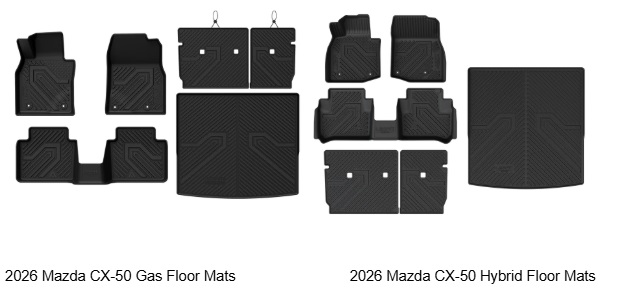
Lasfit currently lists vehicle-specific options for applicable 2023–2026 Mazda CX-50 configurations and distinguishes between Gas and Hybrid applications. Buyers should therefore confirm the correct powertrain and product configuration rather than assuming every CX-50 uses an identical floor liner.
This does not mean every visible part of the cabin is dramatically different. It means that molded accessories must match the actual surfaces they contact.
A floor liner has little tolerance for incorrect geometry because its edges, retention locations, and lower surfaces need to align with the surrounding cabin.
The safest purchasing process is therefore: Model Year → Vehicle Model → Powertrain → Product Configuration → Confirmed Fitment
Skipping the powertrain or configuration check can result in a liner that looks close but does not fit as intended.
How Vehicle-Specific Geometry Is Captured
Modern custom-fit liners can be developed using 3D measurement technology.
The basic process begins by capturing the geometry of the vehicle interior. Those measurements can then be converted into a digital model that designers use to define the liner’s perimeter, raised edges, retention areas, and other molded features.
A simplified development process looks like this:
Vehicle scan → Digital model → Liner design → Prototype → Fit verification → Production
Lasfit uses vehicle-specific 3D scanning when developing its floor liners. This allows the design to account for footwell contours, door-side edges, rear-floor areas, and factory-compatible retention locations.
The purpose of this process is not only to make the liner look integrated with the cabin. Accurate geometry also reduces exposed carpet and helps keep the product positioned correctly during use.
Why Universal Mats Require Engineering Compromises
Universal mats solve a very different design problem.
Their goal is to create one shape that can work reasonably well in many vehicles. This reduces development complexity and makes the mats inexpensive and widely available.
However, broader compatibility requires compromises.
A universal mat may:
Leave more exposed carpet around the edges
Require trimming
Provide limited sidewall coverage
Use generic rather than vehicle-specific retention
Fit differently depending on the cabin
These characteristics do not necessarily make universal mats poorly designed. They simply reflect a different engineering priority: broad compatibility instead of precise vehicle-specific fitment.
Custom-fit liners take the opposite approach. More effort is required to design separate products, but the result can follow the floor geometry much more closely.
Material Selection: Why TPE Works for Molded Liners
Geometry is only one part of floor-liner engineering. The material must also meet several performance requirements.
Lasfit uses 100% TPE for its CX-50 floor liners. TPE works well for this type of product because it combines flexibility with enough structural stability to maintain molded edges and channels.
A floor-liner material should ideally provide:
Flexibility: It needs to follow complex floor contours without becoming excessively rigid.
Shape Retention: Raised edges and molded channels need to maintain their form during normal use.
Water Resistance: The liner should prevent rainwater, melted snow, and spills from reaching the carpet.
Temperature Stability: The material must remain practical across changing seasonal conditions.
Easy Maintenance: It should be removable and easy to rinse or wipe clean.
These requirements explain why material selection is just as important as the shape of the product.
Raised Edges and Channels Form a Containment System
The ridges and channels found on molded floor liners are functional rather than decorative.
Water, mud, melting snow, sand, and other debris rarely remain exactly where they first land. Shoe movement and vehicle motion can move contaminants across the surface.
Raised perimeter edges create a boundary, while channels help control and retain liquids and loose debris.
The liner receives contaminants, manages where they move, keeps them away from the surrounding carpet, and allows the entire mess to be removed when the mat is cleaned.
This is why simply using a waterproof material is not enough. The geometry of the liner determines how effectively that material manages real-world messes.
Retention and Pedal Clearance Are Functional Requirements
A floor liner can match the cabin shape and still perform poorly if it does not remain securely positioned.
Retention is especially important on the driver’s side.
Vehicle-specific liners can be designed around factory retention points, while anti-slip backing features provide additional resistance to movement.
Pedal clearance must also be maintained. The liner should protect the carpet while remaining clear of the accelerator and brake throughout normal operation.
From an engineering perspective, fitment therefore includes three related requirements: Shape + Retention + Clearance
A product that satisfies only one or two of these conditions is not a complete fitment solution.
What to Check When Buying Mazda Floor Mats
When choosing mazda floor mats, checking the model name alone is not enough.
Before ordering, confirm:
Exact model year
Mazda model
Gas, Hybrid, or other applicable powertrain
Product configuration
Factory retention compatibility
Front and rear coverage
Cargo or seatback fitment when included
This becomes increasingly important as manufacturers offer multiple powertrains and configurations under the same model name.
The Same Principle Applies to Cargo and Seatback Protection
Vehicle-specific geometry is not limited to passenger footwells.
Cargo liners must work around wheel-well shapes, trim edges, load-floor transitions, and seat hinges. Seatback mats must remain aligned while allowing the rear seats to fold normally.
For an SUV such as the CX-50, these areas may regularly carry pets, luggage, camping equipment, groceries, and sports gear.
Whether the product protects the footwells, cargo floor, or rear seatbacks, the engineering principle remains the same: measure the actual vehicle geometry first, then design the protective surface around it.
Final Thoughts
The 2026 Mazda CX-50 demonstrates why accessory fitment cannot always be determined by the badge on the vehicle.
Gas and Hybrid models may require different vehicle-specific products, making model year, powertrain, geometry, retention, and configuration important parts of the selection process.
Custom-fit floor liners address these variables through vehicle-specific measurement, molded geometry, suitable materials, raised containment structures, and secure retention.
Lasfit’s separate CX-50 fitment options illustrate this approach well: rather than treating every CX-50 as identical, the product selection process accounts for specific vehicle configurations. For owners, that extra attention to fitment can mean better coverage, easier maintenance, and a liner that functions as part of the cabin rather than simply sitting on top of it.