When we walk through enough labs, we find someone pipetting bacterial culture in a clean bench, facing a foot away from work air, washing slowly over a plate and straight into the breathing zone. Check it, and the answer is some type of it: “It has a HEPA filter, so it’s sterile.”
Those details are correct and besides the point. The filter is protecting the sample. Nothing in that cabinet is protecting the person.
The clean bench and biosafety cabinets look the same from the room. both stainless boxes with a working area, fan and HEPA filtration, and both are known as “the hood” in casual lab speech. The airflow inside them runs in opposite directions, and that difference shows who or what survives a mistake.
What a clean bench actually protects
A laminar flow clean bench performs work that keeps particles away from work. Room air is pulled through a HEPA filter and pushed in a smooth, unidirectional stream onto the work surface.
In a horizontal unit, the air comes from the back wall and flows straight at the operator. In a vertical unit, it comes from above and releases through the open front.
Either way, clean air sweeps over the sample first, so nothing from the room, or from you, lands on it.
Check what that means for the operator: each aerosolised particle at the working surface, each droplet of a pipette, and each particle removed from powder rides that airstream out of the cabinet and towards your face.
A clean bench is not a containment device. It is the opposite of one. It is an exposure device with a very clean input.
That is good and best when material on the bench does not affect us: media preparation, pouring plates, assembly of a sterile fluid path, electronic inspection and optics that are not like dust, and setting the PCR master mix where the issue is contaminating the reaction compared to the technician.
For that work, a clean bench is the best option and a cheaper, simpler one than any alternative.
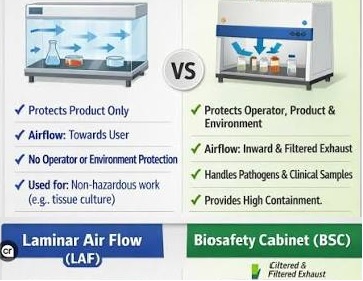
What a Class II biosafety cabinet does differently
Class II biosafety cabinets provide protection for three things: the operator, the product and the room. Air moves inward in the front grille, so aerosols produced at the work surface get pulled away from the person standing there rather than delivered to them.
Overworking zone: a downward curtain of HEPA-filtered air protects the sample as the clean bench would. The exhaust passes through another HEPA filter before it leaves the cabinet, so the lab itself is not seeded with whatever escaped the work.
Inward airflow at the sash completes the details, so a BSC is basic containment for work with infectious agents, human-derived cells and fluids, and anything else that becomes dangerous when aerosolised.
In North America, these cabinets are made and certified against NSF/ANSI 49, and they need periodic recertification to keep meaning anything, because a BSC with a degraded filter or a disturbed air curtain quietly turns into costly furniture.
One caution runs the other direction: a standard Class II cabinet recirculates a large share of its air through HEPA filters, and HEPA does nothing against gases and vapours.
Volatile toxic chemicals belong in a fume hood, not a BSC, unless the cabinet is specifically designed and ducted for that use.
Common error that keeps getting made
Main confusion almost runs one way: hazardous work shifts onto a clean bench. It occurs for mundane reasons. The BSC is occupied, and the clean bench is free.
A new hire was told to “work in the hood” and picked the wrong one. A lab that historically did only media prep initiated handling patient-derived samples, and nobody revisited the equipment.
A procurement officer gets 2 HEPA-filtered cabinets, one at half the price, and uses them sensibly by the numbers in front of them.
The outcome is a from-operating paragraph; weigh out bad powder on a clean bench, and a laminar stream manages the fine fraction directly to the operator.
Vortex a tube of anything infectious there, and you have built an aerosol delivery system. The exposure is invisible, and there is no alarm. That silence is what makes the errors survivable for years and then suddenly not.
Deciding which one the work needs
That decision is not about tools; that is for material. Before defining anything, note down what will be handled at the station for the next few years, not just next quarter.
If any of it is infectious, cytotoxic, allergenic, potentially infectious, or an inhalable toxic powder, the station requires a biosafety cabinet. Your biosafety officer settles arguments here, not the catalog.
If the proper answer is that the material threatens nothing but the experiment, product protection is the whole requirement, and laminar flow clean benches cover it at lower cost, with easier siting and less certification overhead.
Different labs correctly run both, a few feet apart, each doing the job the other cannot.
Biological Safety Cabinets
Biological safety cabinets give personnel, product, and environmental protection from hazardous particles that need biosafety levels 1, 2, or 3 containment.
The Centers for Disease Control and Prevention shows biological safety cabinets are “the primary part of containment developed for working safely with infectious microorganisms.”
Due to the hazardous materials that they handle, it’s important to keep safety as the best method for using BSC:
• Do not work with volatile or flammable material in BSC since these machines do not have features for protection from toxic fumes.
Maintain accurate sash height during work with BSC; a sash that set high-impact inflow and downflow rates causes product contamination.
Check that the airflow grill does not have obstructions; a blocked grill causes contamination that leaks into the laboratory environment.
Use protective gear like a buttoned lab coat, glasses, and nitrile gloves.
Biological Safety Cabinets types
There are 3 biological safety cabinet types that can have different protection levels. Socket selection is based on the protection needed for working staff.
Class I
This gives protection to us and the environment, but not your samples.
Class II,
That is common protection for operators, samples, products, and the environment. With that, in this type of BSC, there are 4 further types. Type A1, Type A2, Type B1, and Type B2.
The basic difference is the percentage of air that moves in the cabinet versus the percentage that leaves the cabinet through the exhaust HEPA filter.
A1 and A2 cabinets can exhaust into a room or make a connection with the facility’s HVAC system, and B1 and B2 cabinets should connect to the HVAC system.
Class III
This type gives common protection due to a gas-tight enclosure. This type comes with the same features as Class II cabinets, with a basic physical barrier that gives protection from lab operators and the biological agent.
Laminar Flow Clean Bench Advantages
Laminar flow hoods come with 2 models; the first one is horizontal, and the 2nd is vertical, according to the required airflow direction. If space is not large, use a vertical model.
Space-confined types are best for limited locations like IV and nursing stations, satellite pharmacies, and intensive care units.
Disadvantages
Since a laminar flow hood is the main component for devices that provide protection to samples, it does not provide protection to operators of the lab.
Either we just need the protection that laminar flow provides based on working, or we need to use BSC instead.