Fuses are the main component of the power system for preventing electrical faults in connected devices. As we know, electrical devices get power from electricity. During that, a high current flow can affect a component. Fuses work in those conditions and protect devices from overcurrent since they melt when the current is high and break the circuit.
In this tutorial, we will cover the detailed features of inline fuses that perform certain functions in the system. We will cover all details. So let’s get started.
Inline Fuse Introduction
- An inline fuse is a safety component connected to the wire to protect the circuit from high current. It breaks the circuit when the current increases to a safe limit.
- This fuse is connected in a series to the power cable’s normally positive line providing protection to the complete wiring circuit and connected devices from fire and overheating.
- Since there are different types of fuses, each has own connection method but an inline fuse is connected directly in the path without fuse box.
- These fuses are normally installed in vehicles and solar panels. They are connected between the supply and the electric devices for protection from overcurrent effects.
In-Line Fuses Working
- The in-line fuse needs a two-part holder. holder directly connected in the circuit path. If the circuit comes with a cable, cut it, and connect each part of the holder connected to the cable on each end.
- If holder connected, in-line fuse is connected in the holder. Normally, an inline fuse holder comes with a snap structure. According to type, we can snap two parts together when a fuse is put in them.
- If the fuse does not work, replace it; fuses are only preferred for overcurrent occurrences. So when fused, fused damage replaces it for saving devices.
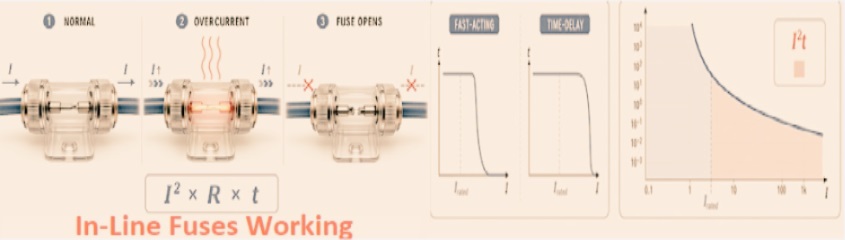
- Inline fuses provide protection to the circuit by transforming current into heat in a metallic component. When normal current flows, metallic components or elements remain connected.
- If high current flows, high heat is generated. If it’s higher than the safe value, the element melts and the circuit breaker trips.
- Heating occurs according to these equations
I² × R × t
- In the relation, small increases cause high heat; as a result, surges affect the fuse if high energy occurs.
- • A fuse opens fast when current crosses a given rating; that’s best for small or no-surge occurrences. In time-delay fuses, provide short current increases with an opening that is best for loads having a starting surge.
- The time-current curve indicates the fuse-working feature for handling load levels before circuit breaking.
- An I²t rating indicates how much energy a fuse can bear before opening
Inline Fuse Types
Blade fuses
- These fuses are commonly used for low-voltage DC systems and vehicles. They offer easy replacement and are easily available and come color-coded based on current rating.
Glass or ceramic cartridge fuses
- These fuses are part of electronic devices and small power circuits. It needed to fulfill the requirements of electrical rating and the accurate physical dimensions of the folder. Its common dimensions are 5×20 mm and 6.3×32 mm.
High-current bolt-down fuses
- These fuses are part of battery cables, different high-current systems, and power distribution lines. It offers strong mounting and accurate protection for heavy-load projects.
Special automotive fuse
- It is part of vehicles’ power systems; it must have features according to the holder or fuse blocks and be used with a compact design and high-capacity current.
Resettable PTC fuses
- It is not like a full open as normal fuses do, but it increases resistance fast when overcurrent occurs and returns to normal conditions when the fault is cleared and device temperature reduces
Features of Inline Fuse
Current rating (continuous vs. surge)
- Current is measured at worst conditions like stall, full rpm, and high brightness; also check for inrush conditions.
- Use a fuse with a rating of 125 to 150 percent of continuous current when inrush current is normal or apply a time-delay fuse that closes for continuous current when inrush current is high.
Voltage rating
- Fuses come with a high voltage range, like 32 V DC automotive and 125/250 V AC cartridge. Use a fuse according to the system voltage, the same or larger.
Interrupt rating
- current that fuses safely, interrupting without affecting the stated interrupt rating. In a high-energy DC system, use fuses having proper DC interrupt value rating.
Speed (fast vs. time-delay)
- Fast acting is employed for sensitive electronic devices and for low inrush current.
- time delay used for motors/lamps/capacitive loads
Temperature
- High ambient temperature affects fuses. Enclosed are required low-current fuses or high-rating holders for preventing nuisance blowing.
fuse wire
- Fuses provide protection to wires and downstream gear; check fuse rating for wire ampacity in the required range
Inline Fuse Holder
- An inline fuse holder protection device is connected directly on the wire for fuse connection. If a high current flows beyond a safe level, the fuse trips or burns, breaking the circuit and preventing damage.
- This fuse holder is employed for marine, vehicle, and heavy-duty projects and has different types such as ATO, mini, ATC, maxi, and glass-tube fuses.
Installation step of Inline Fuse
Follow these steps for the installation of an inline fuse.
Tools
- First of all, arrange some tools and materials such as
- inline fuse holder with accurate rating and waterproof design
- accurate inline fuse wire
- crimp terminals or solder kit
- ratcheting crimper and heat shrink tubing
- cable ties, multimeter and labels
Safety factor
- First of all, turn off the power supply and disconnect the battery before cutting. Use eye protection and manage energized DC lines.
Installation Steps
- First of all, turn off the power supply; now find the positive pin and cut at the point where the inline fuse lives. cut about 6–7 mm.
- Use tubing over each wire end before soldering.
- now with gas-tight ratcheting crimps or clean solder joints.
- use an adhesive-lined tubing seal for removing moisture
- accurate rating of FuseConnect there and close cap/O-ring.
- Make a label holder such as “F1—LED Bar, 15 A.
- prevent hot areas and make secure cables
- In the last performance, continuity through the fuse path measuring voltage with load; check hot joints.
Selection factor of an accurate Inline Fuse
Follow these steps for selection of the correct inline fuse.
- find maximum continuous current and wire current ampacity
- check if there is a startup surge that exists
- use required fuse types like fast-acting for forstable loads, time-delay for surge loads
- Use a fuse rating about 125 to 150 percent of the continuous current. With that, check the voltage rating and also check the interrupt rating.
- Current ratings based on wire size are
| Wire Size | Current |
| 20 AWG | ~1–3 A |
| 18 AWG | ~5–7 A |
| 16 AWG | ~8–10 A |
| 14 AWG | ~12–15 A |
| 12 AWG | ~20–25 A |
| 10 AWG | ~30–40 A |
Voltage losses
- Voltage losses affect the system’s functioning normally for low-voltage circuits.
V = I × R
- Low resistance maintains a stable voltage
Fuse Placement Rule
- Connect the fuse close to the power supply, about 10–20 cm. That helps the downstream wire protect when a fault occurs.
Inline Fuse Holders types
| Type | Fuse design | Uses | Current Range | Voltage Range |
| Blade-Type | ATC, ATO | Automotive | 10A – 40A | 12V – 32V |
| Mini Blade | Mini | Compact electronics, modern cars | 5A – 30A | 12V – 24V |
| Maxi Blade | Maxi | Heavy-duty automotive, RVs | 20A – 100A | 12V – 32V |
| Glass Tube | AGC | low-power electronics | 1A – 30A | 12V – 250V |
| Waterproof | ATC, ATO | outdoor, solar setups | 10A – 50A | 12V – 24V |
| Heavy-Duty | ANL, Mega | high-power systems | 50A – 300A | 12V – 240V |
Selection factor of Inline Fuse Holder
There are different factors for inline fuse holders.
Current Rating
- Make a matching holder with the highest current that the circuit draws. Normal holders are 10A, 20A, 30A, 40A, and 50A.
Voltage Rating
- Vehicle and marine systems work with a 12-volt rating; in some applications, about 240 volts are needed.
Wire Gauge (AWG)
- Check that the fuse holder has a feature for handling wire size, such as
Wire Gauge (AWG) | Use | Current Capacity |
| 0–2 AWG | Heavy-duty applications (e.g., 100A systems, battery cables, winches) | Up to ~100–200A+ |
| 4–8 AWG | car audio amplifiers, auxiliary lighting, power distribution) | ~40–100A |
| 10–18 AWG | sensors, control circuits, small accessories | ~2–30A |
Fuse Type
- Use a holder supported with a fuse type such as ATO, mini, ATC, maxi, AGC, or glass.
Environmental Protection
- • For marine or outdoor applications, use waterproof or water-resistant types.
Conclusion
Inline fuses are the main and easiest techniques for the protection of electrical circuits if accurately used. Accurate sizing and proper connection make easy installations for wiring and protection from damage. It is best to use a fuse according to wire capacity and follow it according to load requirements. This method makes safe and stable functions for different applications.
Frequently Asked Questions
Why is an inline fuse sized to protect the wire, not only the load?
- A fuse is needed to open before the wire gets overheated, and if the fuse rating is high for cables, the wire gets damaged.
When is a time-delay inline fuse preferred over a fast-acting fuse?
- Best for loads having normal startup surges like motors, audio systems, or battery devices. It also controls inrush current effects.
What is the meaning if the fuse is intact but the holder or wire gets hot?
- It shows there is high resistance, like a faulty connection, corrosion, or a faulty holder, and the fuse protection circuit accurately
How do the time-current curve and the I²t value affect an inline fuse?
- They indicate a small fuse manages surge without interruption. So it is best for circuits having a burst current.
Why should an inline fuse be connected close to the power source?
- Since it provides protection to the wire from devices. Connecting close to the source protects the larger cable part.