Load-bearing parts clear two distinct checks before converting into structure: strength, final limit condition, and deflection serviceability limit state. One geometric quantity not the section’s moment of inertia. It’s working for each inspection, not the same, and conflicting 2 is the main source of sizing errors. What follows separates those two roles and shows why there are different variations in the order in which a member gets sized.
Two checks, one geometric input
Each member inspected over two limit states. Strength checked with different factors, loads, stress, and stability should be in the range of the section’s capacity.
Deflection is monitored under service loads without those factors, where movement under working load must not disrupt use, damage finishes, or become perceptible to occupants. Different load levels, different meanings of failure.
Moment of inertia is added to both checking, according to the definition I = ∫ y² dA, so each element of area counts in proportion to the square of its distance from the neutral axis.
As an MIT mechanics course puts it, the moment of inertia sets the geometric stiffness of a section in bending.
Stiffness is resistance to deformation. That stiffness is what ties the moment of inertia directly to deflection. Its link to strength is indirect.
Deflection depends on moment of inertia alone.
Beam deflection has an inverse relation with the moment of inertia. For a simply supported beam under uniform load, δ = 5wL⁴/(384EI), and the only section property in that expression is I.
The modulus E is fixed by the material. Span L and load W are fixed by the problem. One variable is left to control.
The deflection check is, in effect, a check on whether the moment of inertia is large enough.
Codes set the deflection limit as a fraction of span. Eurocode EN 1990, Annex A1, suggests a vertical deflection no higher than L/250 for floors and roofs, L/300 for members supporting brittle partitions, and L/500 under rigidly fixed tiling.
The US IBC, Table 1604.3, caps floor-beam deflection at L/360 under live load and L/240 under total load.
Each limit is really a minimum-inertia requirement. Substitute the provided deflection into the formula, solve for I, and the outcome is a lower bound on the section before any stress check.
Crane runways show how demanding that limit can get. EN 1993-6 holds the vertical deflection of a runway beam to roughly L/600 for cranes in service classes SC1 to SC3, against L/250 for an ordinary floor.
At the same span and load, that calls for nearly 2.4 times the moment of inertia, for deflection alone. On long spans, deflection rather than strength causes the section depth.
The beam passes the stress check with a margin and still needs a deeper section for stiffness.
In the strength check, inertia enters through section modulus.
In the bending strength checking, moment of inertia does not appear on its own. The condition reads σ = M/Wel ≤ fy/γM₀, where the section modulus Wel = I/c, and c is the distance from the neutral axis to the extreme fibre.
Inertia enters only inside the well, divided by that distance.
The distinction matters. Moment of inertia describes geometrical stiffness, and it governs deflection and buckling.
Bending strength in terms of stress is set by the section modulus, which also carries the position of the extreme fibre.
Two sections with the same I but different c have different W and different bending capacity.
More inertia does not by itself mean more bending strength: push material farther from the axis, and c grows along with I, so the gain in section modulus comes out smaller than the gain in inertia.
Which section modulus applies depends on the section class. Eurocode 3 (EN 1993-1-1) sorts sections into four classes by whether local buckling arrives before the plastic hinge: Classes 1 and 2 use the plastic section modulus Wpl, class 3 the elastic Wel, and class 4 a reduced value. EN 1993-1-1 added an intermediate elastic-plastic modulus, Wep, for class 3, sitting between Wel and Wpl. In every case, the input is a correct moment of inertia, because the section modulus is derived from it.
Stability relies directly on the moment of inertia.
Strength is not only about stress. Buckling is part of the same ultimate limit state, and here, the moment of inertia returns to the calculation directly.
The Euler critical load of a compression member, Ncr = π²EI/(KL)², rises in direct proportion to I.
Columns are handled through the radius of gyration r = √(I/A) and the slenderness KL/r: a higher radius of gyration at the same area means more resistance to flexural buckling per unit weight.
In beams, stability shows up as lateral-torsional buckling. The important moment is based on the weak-axis moment of inertia Iz, the torsional constant J, and the warping constant Cw.
So even the strength of a beam in bending has a branch that runs on weak-axis inertia, together with the torsion properties. Inertia performs a double role in strength. In the stress check, it is indirect, through the section modulus. In the stability check, it is direct, through the moment of inertia and the radius of gyration.
One input, three governing checks
Practical order follows from this; the same moment of inertia added 3 different checkpoints, but a different one governs in each case.
A long floor beam is governed by deflection, so it is sized on the moment of inertia. A short, heavily loaded beam is governed by bending stress, so the section modulus decides.
A slender column is governed by flexural buckling, so candidates are ranked by radius of gyration. The geometric input is shared. The governing check is not.
For a standard rolled profile, the moment of inertia, section modulus, and radius of gyration come from tables.
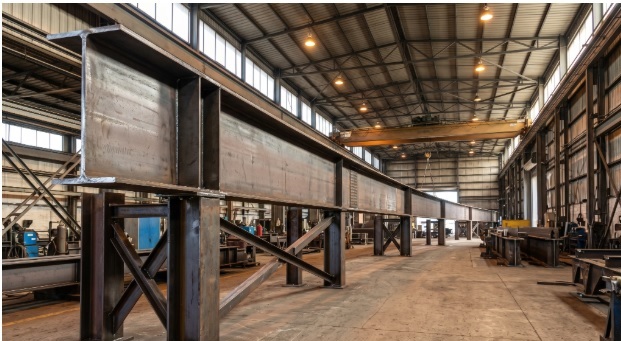
For non-standard and built-up sections (a welded I-girder, a plate box, a monosymmetric profile), there are no tables, and the whole feature set has to be computed from geometry.
An error in the moment of inertia then corrupts all 3 checks at once. If I is overstated, the deflection check passes a section that is actually too small, while the section modulus and slenderness computed from that same I come out wrong.
An inertia calculator is preferred to this step at the comparison stage. From the profile dimensions, it returns a consistent property set in one pass: area, moments of inertia about both axes, elastic and plastic section modulus, radius of gyration, J, and Cw, including built-up shapes that standard tables do not list.
One calculation gives a single coherent input for all three checks: deflection, strength, and stability.
What this changes in sizing
Noting two roles of moment of inertia apart saves both steel and code-checking time. Size a section for its governing checking, deflection for a long beam, section modulus for a heavily loaded one, or radius of gyration for a column, and it passes on the first attempt without carrying weight for stiffness the member does not need.
Blur the roles, and the result is either oversized steel or a missed stability check. A correct moment of inertia at the input stays the condition for both outcomes: it sets deflection directly and strength through the section modulus and stability.