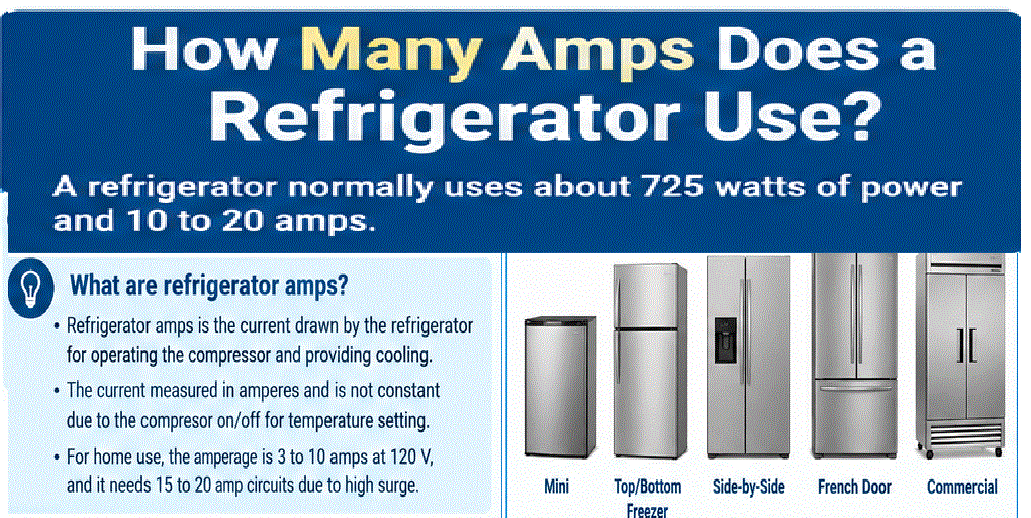
Before selecting a refrigerator, the most important factor is how many amps it uses. So understanding power usage is important before you use it. In this tutorial, we will find the amps of refrigerators, but normally a refrigerator uses 725 watts of power and 10 to 20 amps. Let’s get started
What are refrigerator amps?
Refrigerator amps are the current drawn by the refrigerator for operating the compressor and providing cooling. current measured in amperes, and the current drawn is not constant due to the compressor on/off for the temperature setting.
Refrigerator amps means the current required for correct working.
The amperage for the refrigerator used at home is three to ten amps, and the voltage is 120 V. It needs 15 to 20 ampere circuits due to the high surge of amperes
How Many Amps Do Refrigerators Use
Normal refrigerators use 3 to 10 amps according to model types and size. Here are the refrigerator amps given for different models.
Mini Refrigerators
It is a small unit that consumes 1 to 2.5 amps in normal conditions. During startup surge, refrigerator amps are high, at 3 to 7.5 amps for a mini refrigerator.
Top-Freezer & Bottom-Freezer Refrigerators
For these conventional refrigerators, the amperage range is three to 6 amps, and startup current is 9 to 18 amps.
Side-by-Side Refrigerators:
The amp value for this refrigerator is 5 to 9 amps, and the startup surge for this model is 15 to 27 amps. since it is a larger size that uses more current. It comes with an ice maker and a water dispenser that get high current
French Door
- It is a larger size and uses 6 to 10amps current. And its startup current is 18 to 30 amps, since it comes with a larger compressor and it needs high surges.
Commercial model
- These models come in different sizes, and the current range is 10 to 30 amps
Read also What Are The Amps For 12 Gauge Wire?
| Refrigerator | Running Amps | Startup Surge Amps |
| Mini / Compact | 1 – 2.5A | 3 – 7.5A |
| Top/Bottom Freezer | 3 – 6A | 9 – 18A |
| Side-by-Side | 5 – 9A | 15 – 27A |
| French Door | 6 – 10A | 18 – 30A |
| Commercial Units | 10A+ | 30A+ |
Refrigerator Amps by Type
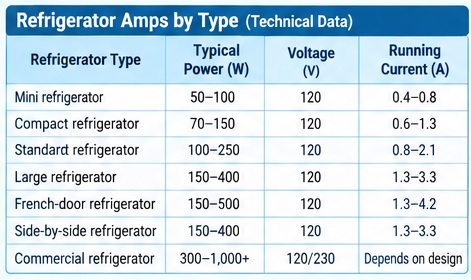
Refrigerator Type | Typical Power (W) | Voltage (V) | Running Current (A) |
| Mini refrigerator | 50–100 W | 120 V | 0.4–0.8 A |
| Compact refrigerator | 70–150 W | 120 V | 0.6–1.3 A |
| Standard refrigerator | 100–250 W | 120 V | 0.8–2.1 A |
| Large refrigerator | 150–400 W | 120 V | 1.3–3.3 A |
| French-door refrigerator | 150–500 W | 120 V | 1.3–4.2 A |
| Side-by-side refrigerator | 150–400 W | 120 V | 1.3–3.3 A |
| Commercial refrigerator | 300–1,000+ W | 120/230 V | Depends on voltage and design |
Refrigerator Amps at Different Voltages
| Power (W) | Current at 120 V (A) | Current at 230 V (A) |
| 100 W | 0.83 A | 0.43 A |
| 150 W | 1.25 A | 0.65 A |
| 200 W | 1.67 A | 0.87 A |
| 300 W | 2.50 A | 1.30 A |
| 500 W | 4.17 A | 2.17 A |
| 750 W | 6.25 A | 3.26 A |
Refrigerator Energy Consumption and Daily Electricity Use
Average Power While Running | Operating Time per Day | Daily Energy Consumption |
| 100 W | 6 hours | 0.6 kWh |
| 150 W | 8 hours | 1.2 kWh |
| 200 W | 8 hours | 1.6 kWh |
| 250 W | 10 hours | 2.5 kWh |
| 300 W | 10 hours | 3.0 kWh |
How many amps does a startup refrigerator use?
Each model uses different startup currents, such as the 480W, which uses 24 amps of startup with 1440 watts, and the stable, which uses 4 amps.
Difference between Startup Watts and Running Watts
Startup watts
Startup watts are the power needed to start a refrigerator’s compressor. Startup watts are higher than running watts.
For example, a refrigerator with a running wattage of 170 gets startup watts of about 500 watts.
This high power usage is for a short time for starting refrigerator parts.
Running watts
Running watts power is used by the refrigerator when the compressor starts and other parts are in normal functioning mode. Running watts show the continuous power usage of the refrigerator, normally in the range of 100 to 1000 watts.
Difference between Startup Amps and Running Amps
Startup amps are also high current, as startup watts for starting the refrigerator. That normally lies between 5 to 7 times the normal running amps.
While running, amps occur regularly after startup amps that are less than startup current
Wire size for a refrigerator
In the USA, the normal used refrigerator wire size is a 15-amp or 20-amp circuit, and for kitchen homes, it uses 15- or 20-amp circuits.
Common wire sizes for refrigerators are
14-gauge wire = 15 amps
12-gauge wire = 20 amps
10-gauge wire = 30 amps
Your wire size has a greater ampacity than the devices demand for safety purposes. Such a refrigerator using 8 amps and 14-gauge wire having 15 amps) is a good choice.
12-gauge wire is preferred for the 20-amp circuit. The wire material for the refrigerator is copper
Factors Affecting Amps of Refrigerator
The refrigerator does not always use the same current for all conditions. Different factors work for drawing amps for refrigerators. Some common ones are
Compressor
Compressor working life and dimensions are important factors for drawing current. A more than ten-year-old compressor uses high amps compared to a new one since efficiency has reduced
Ambient Temperature:
Refrigerator working temperature also affects the ampere unit; at 35 degrees, it uses more amps compared to low temperature. Since the compressor works hard and takes more time to maintain temperature compared to the external.
Room door opening
If your room frequently experiences temperature variation in the refrigerator, that affects compressor startup. So the high startup current the fridge uses compared to running amps
Defrost Cycle:
New refrigerator models come with a defrost cycle that works after 6 to 24 hours. In this cycle, resistance heating equipment uses more watts.
Extra features:
The new advanced refrigerator model comes with new features such as cameras, a wifi connection, a touchscreen, and an ice dispenser that uses extra power with a compressor. The smart refrigerator that comes with the dispenser and ice maker uses up to 40 percent more amps than the other model of the same size.
How to Measure Refrigerator Amps
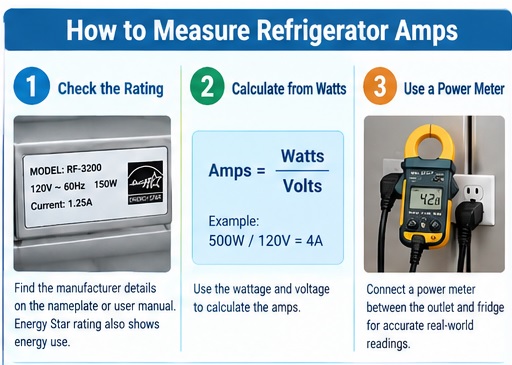
There are some steps to follow for measuring the refrigerator rating.
Rating
The first easy method is to find the reference amps and read the manufacturer details. This is written on the fridge nameplate or user manual. A new refrigerator model comes with an Energy Star rating that gives required details of energy consumption.
such as if the Energy Star rating of the refrigerator shows using 300 kWh in one year with a 120V circuit, that helps to find the daily amps
Amps From the Wattage
The second method is to find the refrigerator amperage with wattage and voltage details. Suppose a refrigerator uses 500 watts for one hour. How many amps are
Amps = Watts/Volts = 500W/120V = 4A
Power Meter
To get an accurate value of refrigerator power, use a power meter. To use a power meter, connect the power meter to the fridge outlet and connect the refrigerator to the meter.
The power meter gives the amps that are measured during practical conditions. According to the power meter, the type of power usage can differ during normal conditions
How Many Amps Does a Refrigerator Use on Different Power Sources?
Power Source | Voltage | Refrigerator Power | Current | Important factor |
| Household AC (USA) | 120V AC | 150W | 1.25A | Check circuit capacity. |
| Household AC (Pakistan) | 230V AC | 150W | 0.65A | Verify rated voltage. |
| Solar inverter | 230V AC | 150W | 0.65A | startup surge |
| 12V battery with inverter | 12V DC | 150W AC load | 13.9A DC | Requires adequate battery capacity |
| 24V battery with inverter | 24V DC | 150W AC load | 6.9A DC | Lower DC than a 12V system |
| Portable power station | 230V AC output | 150W | 0.65A | Check continuous and surge ratings. |
| Generator | 230V AC | 150W | 0.65A | Must handle compressor startup |
Conclusion
Refrigerator ampere with different devices is best for safe operation and high energy efficiency. For measuring and understanding values, helpful to optimize energy usage. Each refrigerator uses a different amount of current; it must consider each factor. This provides high efficiency for working devices.
FAQs
Conclusion
Refrigerator ampere with different devices is best for safe operation and high energy efficiency. For measuring and understanding values, helpful to optimize energy usage. Each refrigerator uses a different amount of current; you must consider each factor. That provides high efficiency for working devices.
How do I know if a refrigerator requires a certain circuit?
Refrigerators normally need certain circuits to prevent overloading. If the refrigerator is rustling, the light is flickering, and the breaker is tripping, use a dedicated circuit
Does a refrigerator function on a generator?
Yes, the refrigerator works on the generator; a new refrigerator needs 2000 to 3000 watts. For devices running at the same time, more devices use a larger generator.
Does the refrigerator work on a 15-amp circuit?
Yes, the refrigerator works on a 15-amp circuit since the refrigerator needs three to 10 amps that fulfill the 15-amp circuit.
How many refrigerators can be used on a 20-amp circuit?
It is preferred not to use more devices on a 20-amp circuit, just one refrigerator. Since if you connect 2 fridges with this circuit, it crosses the 80 percent capacity rule of the circuit, starting with a surge of each fridge that crosses that limit, and both start at the same time, causing overlapping.
Can 2 refrigerators be connected to a single outlet?
It is not recommended due to safety reasons that are causing electrical circuits. A refrigerator needs high power for startup, and connecting 2 units to one outlet can exceed the safety factor of the wiring, resulting in a tripped circuit.
If it is necessary to use two units, please consider using two dedicated circuits to prevent overloading and ensure stable operation.
How many solar panels are needed to run a refrigerator?
For running a standard refrigerator, there is a need for two to four solar panels with a battery and an inverter
Refrigerator Type | Daily Energy Use | Solar Panel Size | Panels Needed |
| Mini refrigerator | 0.5–1 kWh | 400W | 1 panel |
| Small refrigerator | 0.8–1.2 kWh | 400W | 1 panel |
| Standard refrigerator | 1–2 kWh | 400W | 2 panels |
| Large refrigerator | 2–3 kWh | 400W | 2–3 panels |
| French-door refrigerator | 2–4 kWh | 400W | 3–4 panels |
| Commercial refrigerator | 3–6 kWh | 400W | 4–6 panels |