The electrical component of a car with an internal combustion engine employs a fuel pump relay. The fuel pump’s main operation is to deliver or pass steady voltage towards the fuel pump when ignition gets on. If the vehicle does not start, it shows stalling, idling, and a display sign. There can be some signs that show the fuel pump relay is faulty.
In this post we will cover detailed features of a fuel pump relay and its importance for vehicles. So let’s get started.
What is Fuel Pump Relay?
- The fuel pump relay has important operations for the fuel system. That means the fuel pump is regulated with the fuel pump relay.
- certain fuel quantity required for accurate working of the vehicle. Fuel is added into the combustion chamber from the gasoline tank when the car starts.
- In this process gasoline flows through different components. The fuel pump offers a voltage signal and current to the fuel pump.
- It ensures accurate pressures to the fuel system and checks that a certain gasoline quantity is provided to the injector.
- fuel after that applied on the combustion chamber with the injector.
- Proper control of fuel pump delivery is required since the fuel pump is the main component.

Fuel Pump Relay Features
The main feature of a fuel pump relay is based on its functions, like an electromagnetic switch that is used for regulating the power supply towards the fuel pump. Its some features are as
Fuel pump activation
- fuel pump relay starts operation of fuel pump during ignition, which helps engine get required fuel usage. It gets a signal from the ignition system that operates a relay for supplying voltage towards the fuel pump.
Fuel Supply:
- It also delivers a constant fuel supply to the engine. If the engine is operating, the relay is closed for making the fuel pump function.
Safety
- For some vehicles, the fuel pump relay comes with safety factors that turn off the fuel pump when engine stalling occurs. That avoids fuel to move according to no required demand minimizes fire chances.
Backup System
- Some vehicles or cars come with a backup system, such as an oil pressure switch that delivers power to the fuel pump when the relay is not operating but the engine is functioning
Fuel Pump Types
- Fuel pumps come with different types, such as relay, constant control relay, PWM relays, and solid-state relays, that are used for controlling fuel pump functions at different accuracy levels.
Fuel pump relay location
car fuel pump relay like other fuses. The normal fuse box is located. According to car type, a fuse box can exist at two different locations.
It can exist close to the firewall in the hood. It also exists below the dashboard towards the setting area of the vehicle.
You can see the black box having a plastic covering. When you open this box, you can see fuses, relays, and switches.
Fuel Pump Relay Function
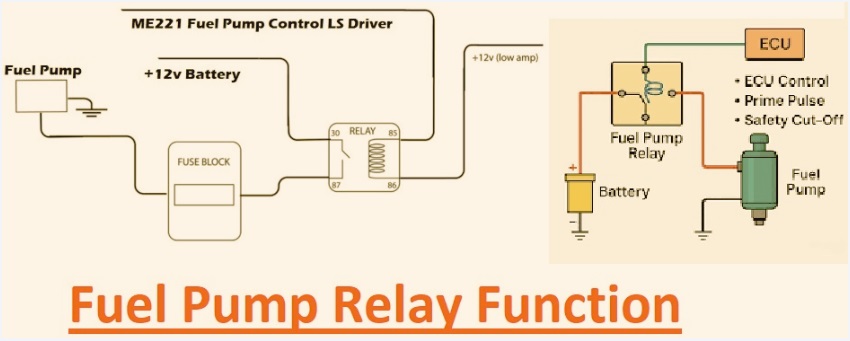
- A common fuel pump relay comes with two operating circuits; the first one is the control circuit, and the second is the power circuit. It comes with 4 pins or blades coming from lower relay that is mentioned at the lower side of the relay structure.
- current towards control circuit flow through copper coil wound over iron core, then towards ground. Current flow generates an electromagnetic field over a copper coil.
- Magnetic force attracts the switch arm in the power circuit, closing it so the connection of the arm makes a connection with the ground, resulting in a closed power circuit and allowing current movement to the fuel pump
- when current off-flowing towards the control circuit field affects and shifts spring arms to the back condition, it opens the circuit and affects current flowing towards the fuel pump
- The fuel pump relay comes with 5 terminals for some Toyota models that cause power at different speed levels.
- ECM/PCM deliver power from fuel pump relay control circuit during start-up or during high fuel pressure like heavy acceleration
- If there is no current flow in the control circuit, then the power circuit’s opening contact arm shifts towards the 2nd circuit that directs current towards the fuel pump with a resistor. A resistor minimizes current flow and delivers power with less speed.
Bad Fuel Pump Relay Symptom
The engine does not start.
- The main sign of a faulty fuel pump relay is that the engine faces difficulty during starting, either the engine cranks if the key is turned or no power is delivered to the fuel pump.
Engine stalling
- Another common fault occurs with a failing fuel pump relay that causes the engine to stall. When the engine is running, the fuel pump relay cuts off power supply towards the fuel pump, resulting in engine stalling.
- Engine stalling affects restarting it, meaning a completely damaged fuel pump relay is needed for replacement.
- If the car restarts after a short time, it means the fuel pump relay is affected, so perform an inspection.
power losses
- The fuel relay is main failure component if the car abruptly loses power during driving or reduces speed suddenly. It does not mean the car is stalling.
- In some conditions, the vehicle runs normally. So when facing power losses during driving, inspection is recommended and repairing if needed.
Noise in the fuel pump
- Another sign that indicates a faulty fuel pump relay is noise generation in the fuel pump during ignition. A fuel pump exists in the fuel tank, close to the vehicle, and noise is heard during engine starting.
- Accurate fuel with accurate relay causes change in low-volume sound that is listened to in the vehicle also externally close to the fuel tank
- If not operating, the fuel pump gets zero power and does not operate, so it becomes noiseless
Check Engine Light
- • The check engine light on at an early phase means an electrical system component is not working. The electronic control unit of a car, also called a vehicle building block, is connected with all electrical components.
- Each component delivers a signal towards the ECU that divides instructions according to input from different sensors. ECU detects damaged relay or failure
- ECU gets a check engine light on the dashboard. You have features to indicate car facing failure.
- • The check engine light is the best part for identification of faults. That is the cause of that check engine light glowing for showing different faults.
- For detection of faults, check signs of faulty components.
Diagnose steps for Bad Fuel Pump Relay?
Visual inspection
First of all, perform a visual inspection before performing tests.
- First check the black fuse box existing in the engine bay. Then find a relay; that cube design makes a connection to an electrical plug.
- If relay exists in black box, remove through flathead screwdriver. Separate plug and fuse to relay for removing.
- check terminals and sockets for finding corrosion and overheating. Note that fuel pumps need small current; corrosion-avoiding accurate current flow. So overheating indicates an error through the relay or circuit connected.
- Clean corroded points and sockets through contact cleaner. Protect your hands through gloves and use goggles.
- Also inspect the connection and coil; that is a sign of a damaging component. Also inspect fuses.
Faulty fuel pump relay testing
If, during visual inspection, no serious fault is found, perform testing of the faulty fuel pump relay.
- Select digital multimeter at low range like ohms or choose continuity. Make a connection of one pin with the power circuit pin and connect the other pin with the 2nd power pin.
- • The meter has features for reading infinite resistance. If you find zero ohms or a resistance value other than infinity, the fuel pump relay comes with short power pins and replace it.
Fuel Pump Relay Systems
Mechanical Fuel Pump Relays:
- These fuel pumps are part of older vehicles since they use a physical system for controlling current flow. These relays are affected with time.
Electronic Fuel Pump Relays:
- Advanced vehicles employ electronic relays based on semiconductor modules for controlling current flow. It is more effective and operates better than mechanical relays.
Advanced Relay Systems
- There are some vehicles that come with advanced systems, such as pulse width modulation relays that are used for variable fuel pump speeds and provide high performance for different driving
Fuel Pump Relay Feature
High Safety
- The fuel pump relay has features for deactivating the fuel pump when the engine is not operating, reducing fuel leakage if the engine stalls. That factor is helpful for controlling fire hazards through controlling fuel movement when not needed for usage.
- Relay also operates the fuel pump when the ECM is getting a signal showing the engine is operating. That help that pump working in a safe condition minimizes related faults to fuel spillage.
Working Performance
- with controlling power to fuel pump relay, help fuel delivered to engine. that causes good engine operation, speedy starting, and fuel efficiency.
- Relay-operated fuel pumps for some time when ignition is on provide fuel system pressurization. That is helpful for engine good operations in cold conditions.
Reliability
- through accurate control when fuel pump functions relay miniscule wear on the pump and different parts of the fuel system that enhances the working life of these components.
- Advanced electronic relays have features for managing different driving conditions with settings for power delivered according to data getting from the ECM. that features helpful for managing engine functions in different conditions
low cost
- The fuel pump relay is a low-cost component. that can be easy to replace for avoiding costly repairing through the damaged fuel pump when the relay affects
.
FAQS
What is the function of a fuel pump relay?
- fuel pump relay electromagnetic switch that operated with low current for managing high current circuits. It controls the fuel pump on and off conditions according to the signal getting from the vehicle computer. If the engine-operating fuel pump is really energized, the fuel pump helps to get fuel from the tank and send it to the engine.
Where is the fuel pump relay location?
- fuel pump connected in power distribution box that exists in engine compartment. For finding its location, find the below hood close to the battery in the fuse box and open the box.
What are the symptoms of a faulty fuel pump relay?
- Main symptoms of a faulty fuel pump are the engine cranking but not starting and faults with ignition, the fuel pump not operating properly, and the check engine light getting on.
- Some other faults are starting problems, engine misfires, and bad fuel efficiency.
Can a faulty fuel pump relay affect the fuel pump’s ability to run continuously?
- Yes, a faulty fuel pump relay results in the pump’s continuous running; also, if the engine stops, it gets power from the battery and causes fuel system problems.
How much fuel pump relay working life?
- fuel pump for a longer time, but their working life is based on different conditions, also driving and electrical faults. If you find fault, replace it as possible.
What is the testing process of a fuel pump relay?
- Main method for testing fuel pump relay: replace with other relay from power distribution box, like AC condition compressor relay. If the fuel pump is operating through another relay connected, then replace the original fuel pump.
Will a bad fuel pump relay cause a code?
- faulty fuel pump relay resulting in a code set in the powertrain control module on vehicles. Code P0230 Fuel Pump Primary Circuit is a code that is not compatible with all models.