In this tutorial, we will cover detailed features about how an ECU actually does things, how it reads sensor data and makes final decisions, and what happens electronically when an engine is “tuned.”
What Is an Engine Control Unit (ECU)?
An ECU is an embedded electronic control system that is a specially designed microcontroller whose function is to control the internal combustion engine’s operation.
In a diesel engine, the ECU monitors many inputs and sets outputs hundreds of times in a single second to make the engine run smoothly, safely, and cleanly.
At its core, the ECU performs three functions:
It reads inputs from sensors over the engine.
Perform this value processing using preprogrammed maps and logic.
Deliver outputs to actuators that perform engine control
It is a classic closed-loop controlled system that is the same process that exists in courses of embedded electronics applied to a 6.7-liter diesel powertrain.
Inputs: Sensors That Feed the ECU
ECU is working based on the data received. The diesel engine comeswith sensor system that transforms physical conditons into an electrical signal. ECU elaborate. commonly exist, sensors in the ECU configuration are
Crankshaft and camshaft position sensors:
- These sensors give signal to the ECU, where the engine is in rotation that important for injection timing.
TMAP sensor (temperature/manifold absolute pressure):
- It helps in measuring intake air pressure and temperature best for measuring boost and air density.
- This sensor measures incoming air volume
Exhaust gas temperature (EGT) sensors:
- This sensor monitors the thermal load for the protection of the engine and turbo
Rail pressure sensors:
- It recorded the fuel pressure of common-rail diesel systems.
Each sensor outputs a voltage or frequency signal. ecu analog to digital ovnerter convert into digital values, where processor uses for real-time.
In this configuration, automotive engineering and electronics configure, and it’s the base that makes advanced diesel performance technology possible.
Logic: Fuel Maps and Control Algorithms
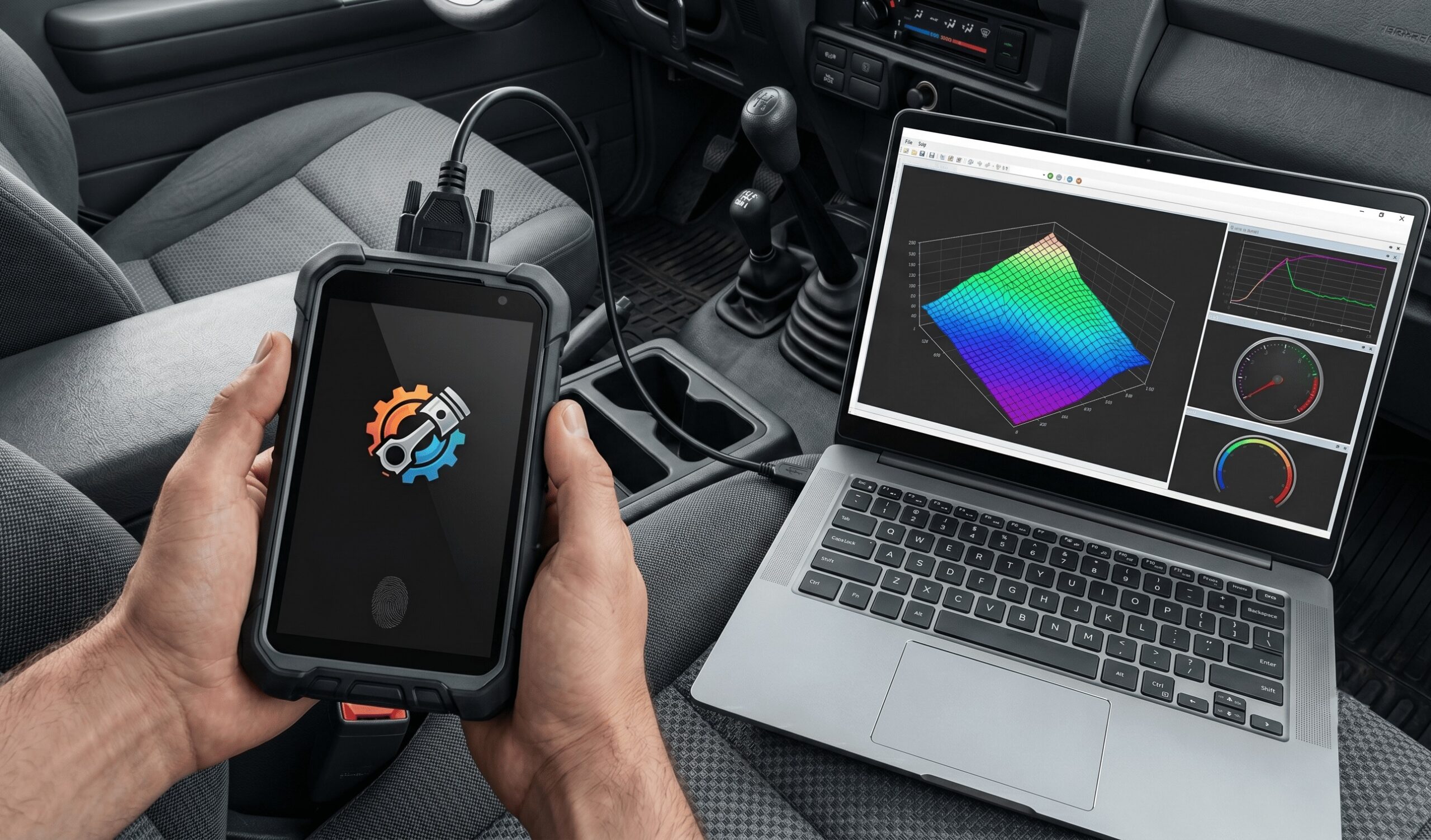
In ECU firmware calibration tables, that is known as maps. A fuel map is a multi-dimensional lookup table that indicates ECU fuel injection for a combination of RPM, throttle position, boost pressure, and temperature.
When we press the accelerator, the ECU doesn’t simply “add fuel.” It:
Monitor the throttle position and current engine load.
Cross-references the relevant maps for fuel quantity, injection timing, and boost target.
Measure the optimal output values.
Instruct the injectors and turbocharger accordingly.
In the industry, these maps are measured conservatively. Manufacturers should consider warranty issues; a low-quality fuel truck can face emissions following over-regions and under different working conditions. The main result is that the engine works safely, with accurate potential.
Outputs: Actuators That Control the Engine
When the ECU makes a decision, it delivers a signal to the actuator that varies according to the engine’s working.
Fuel injectors:
Solenoid or piezoelectric valves open for accurate microsecond durations.
Variable geometry turbocharger (VGT):
Set vane position for controlling boost.
EGR valve:
It regulates exhaust gas recirculation.
Glow plugs:
It manages cold starts.
Accuracy is an important factor; injections are timed to the microsecond and calculated with fractions of mm of valve lift. It is high-speed, real-time embedded control in action.
How Tuning Reprograms the ECU
Tuning is an important factor; ECU tuning is a method for modifying calibration data stored for the ECU to change engine behaviour.
That is best for understanding tuning that does not physically affect engine hardware. but rewrites software maps that the ECU references during the decision process.
For electronic details, we update firmware lookup tables and control factors.
There are two common techniques:
Flash tuning:
New calibration data is written directly to the ECU flash memory with the diagnostic (OBD-II) port. This permanently modifies the stored maps.
Piggyback/module tuning:
External devices intercept the sensor signal or output signal and modify it in real time, setting it without overwriting the factory firmware.
Modern diesel tuners follow these methods to unlock the performance the factory left on the table. With recalibrating fuel delivery, optimising injection timing and setting boost targets, tuners offer smooth throttle response, proper torque value and easy configuration for cost-measurable fuel-efficiency gains.
What Tuning Varies
A quality tune normally sets the following:
Fuel quantity and timing:
High accuracy, application-based fueling.
Boost pressure:
recalibrated VGT control for sustained power and stronger spool
Torque limiters:
Factory software caps removed or raised within safe limits
Throttle mapping:
Sharper, linear pedal response
Due to each engine system employing different ECU layouts and sensor designs, tuning is based on the platform. The best hardware and software for a Power Stroke are different from what a Cummins or Duramax requires, which is why fulfilling the correct diesel performance components for the exact engine is important for both results and reliability.
why Important
Understanding of ECU rephrasing about engine working performance, the main feature for advanced diesel engineering, is not always mechanical but electronic. Truck features, efficiency, and power output are defined based on lines of calibration code as well as the metal in the engine bay.
For engineers and students, a diesel ECU is best for real-world discussion for embedded systems, sensors, analog-to-digital conversion, closed-loop feedback, lookup tables, and actuators working in combination hundreds of times per second.
For truck users, it defines why tuning is important and why it is an effective method for enhancing diesel engines without ever turning a wrench.
The next time you hear that a diesel truck has been “tuned,” you’ll know the real story: it’s not magic, and it’s not just more fuel. It’s smarter software, written for a smarter engine.