The electrical actuator is an important component of an automation system that controls signals and converts them into movement. The electrical actuator is considered the best option since it provides high efficiency and accurate working-range data. In an industrial processing system, it works well. In this tutorial, we will cover detailed features of actuators and practical applications. So let’s get started.
Introduction to Electric Actuators
An electric actuator is a device that employs an electric motor for functioning mechanical devices. It works to convert a digital control system into a digital process that helps pull, lift, position, etc
The actuator is part of a linear motion system of automatic machines and controls different machines with the conversion of electrical energy into mechanical motion.
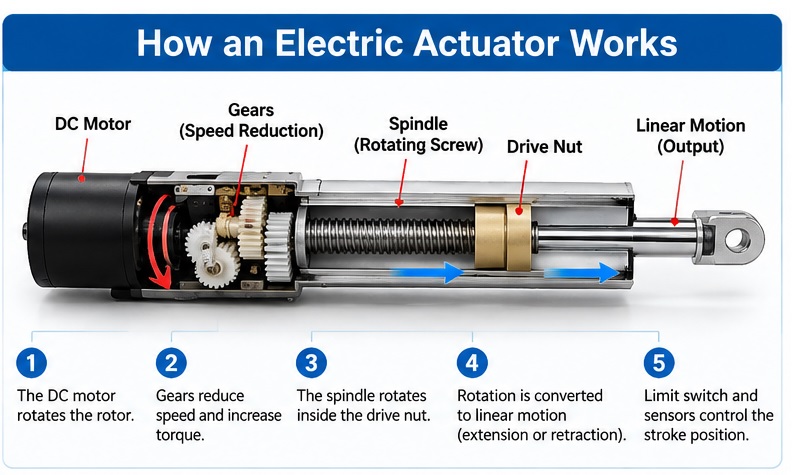
Its motor causes the rotor to rotate. In the actual structure, helical screws are connected to the motor drive shaft that spins in a ball screw nut for linear motion.
Rotor rotary motion is converted into linear motion that is the basis of electric linear actuators
How an Electric Actuator Works
- Rotor rotation causes rotary motion that is coupled with a helical screw through the drive shaft; with that, the motor spindle moves in the ball screw nut that is the function of a linear actuator
- In result of spindle turns, the ball screw causes rotation on the helical screw longitudinally for conversion of motor rotation into linear motion, and the spindle connects with a hollow piston.
- That process occurs based on the direction of motor rotation and also based on stroke length control.
- Electric drive control of the actuator movement adjusts rotation speed with linear speed. feedback system causes high-accuracy movement and pauses movement at the required point.
- These features support synchronized movement and help machines work effectively.
Actuator effective force features are managed through motor power according to torque.
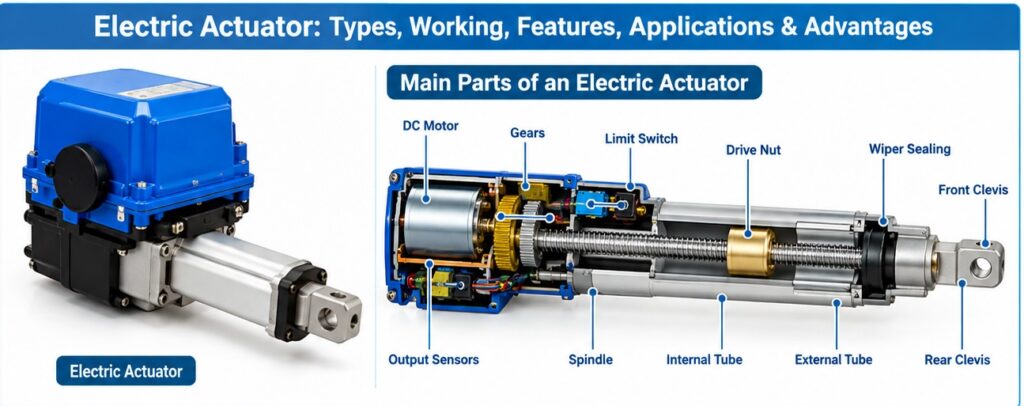
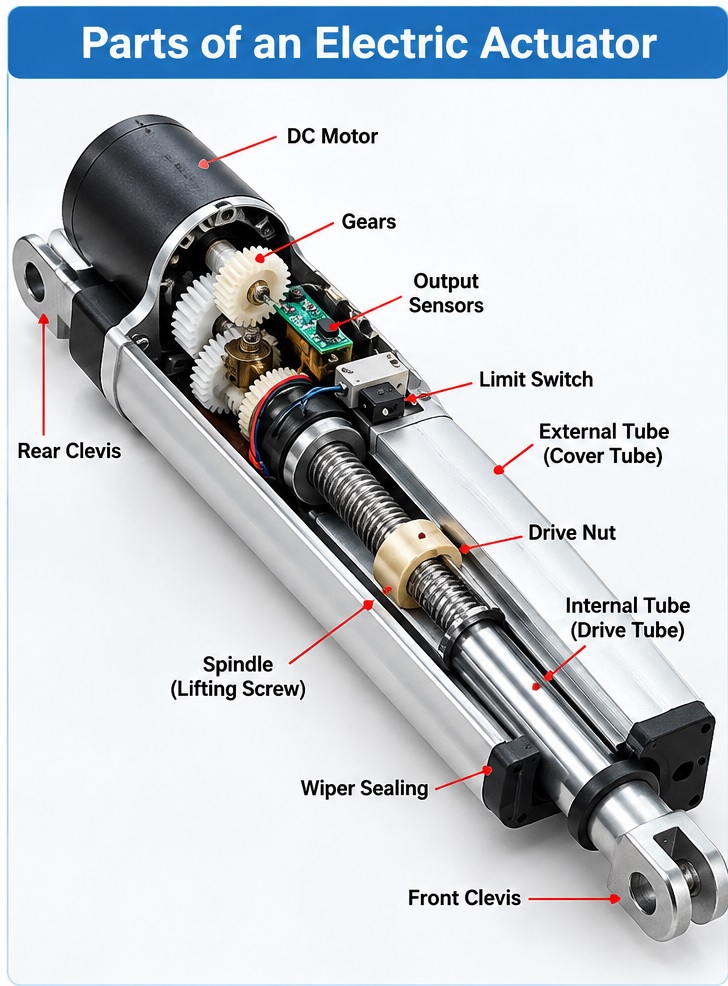
Different parts of an electric actuator
Front/Rear Clevis
This component is U-shaped, made of metal, and has holes on the ends that facilitate connections with external tools, which makes a connection of actuators for front and rear clevis fittings for a strong connection and provides linear movement shifting
External Tube
It is also known as a cover tube that is aluminum-made, serving as a covering of a linear actuator external assembly with cover internal parts.
This tube also saves the actuator from corrosion and provides a rigid structure and protection from different conditions
internal tube
This tube is called a drive tube, or piston, and different materials such as stainless steel and aluminum manage the spindle at the time of retraction.
This tube is configured with a threaded drive nut that helps rotate the spindle extension or retraction for accurate stroke setting and managing output.
Spindle
It is called a rotating screw or lifting screw; it is a straight rod rotate in a machine to regulate internal tube retraction and extension.
It is made of durable steel and has different thread configurations for different speed and load features for machining torque and traveling speed according to requirements.
Wiper Sealing
It is connected with an external tube, and it prevents dust and moisture from affecting the spindle. It provides an accurate seal between the internal and external tubes that affects the actuator rating and helps work in different conditions
Drive Nut
It is connected with an internal tube and slide-over spindle, and its function is to provide easy extension and retraction. Its structure is made with metallic material that provides smooth movement and also minimizes wear
Limit Switch
This switch manages the internal tube position during extension or retraction with motor current halting. This switch controls overextension and transmits a signal for feedback and repeating position.
Gears
Gears made of plastic and connected with the gears for speed modification features between the driving system and driven components. Gears connected with the power supply, called drive gears and gear trains, manage torque with motion output
DC Motor
DC motors provide power to actuators, and motors come in different types, but brushed motors are normally used.
Output Sensors
This sensor delivers an actuator stroke position to the control box that provides synchronization. It comes with different feedback components that provide accurate movement and repeatability. The Hall effect sensor is a normal output sensor that gives a signal according to the magnetic field. As a result of a high magnetic field crossing a certain value, the sensor generates an output voltage.
Different Types of Electric Actuators
There are different types of electric actuators that perform certain functions. Some common types are
Linear Electric Actuator
Linear electric actuator generates straight-line movement. It’s used for linear-design valves such as globe valves as well as gate valves. It is commonly used for steam operations, boilers, and HVAC systems for high flow control
Quarter-Turn Electric Actuator
It is a rotary actuator since it provides 90-degree movement, especially for ball valves, dampers, etc. It is a component of the fluid transport system and automated industry systems
Spring-Return Electric Actuator
This actuator uses an internal spring that is helpful for mechanical energy storage at the time of working, and the motor causes compression to the spring when the valve is at the commanded position. When power stops, the stored energy causes actual rotation at the proper position.
This actuator is employed for ventilation tunnels, safety applications, etc.
Multi-Turn Electric Actuator
for providing different full rotations at valves to cause movement from an open towards a closed position, and in result causes rotational motion. This actuator is configured with large gate valves, also seen in water treatment plants and in oversized valves.
Explosion-Proof Electric Actuator
These actually work well in different conditions, like oil refineries, since they provide chemical resistance. Its design is helpful for heating ventilation and protection features. Burst-resistant electrical actuators work in industries, offering accurate control in hazardous environments
Electric vs. Hydraulic and Pneumatic Actuators
Read more
Technical Parameter | Electric Actuator | Hydraulic Actuator | Pneumatic Actuator |
| Energy Input | Electrical power | Pressurized hydraulic fluid | Compressed air |
| Operating Pressure | Not applicable; motor-driven | 70–350 bar (industrial systems) | 4–8 bar (typical industrial systems) |
| Force Generation | Motor torque converted into linear or rotary motion | Fluid pressure on piston area | Air pressure on piston area |
| Force Range | Application-dependent; from N to hundreds of kN | Hundreds of N to several MN | Tens of N to tens of kN |
| Speed | Application-based; controllable through motor drive | 0.05–1 m/s | 0.1–1.5 m/s |
| Positioning Accuracy | High; can reach sub-millimeter or better with suitable feedback | Moderate to high with servo-hydraulic control | Moderate; affected by air compressibility and load |
| Motion Control | Servo motor, stepper motor, VFD, or linear actuator controller | Directional, pressure, and flow-control valves | Directional and flow-control valves |
| Response Characteristics | Precise, programmable motion | High force with smooth control when properly designed | fast response for repetitive cycles |
| Energy Efficiency | high, especially with efficient drives | pump, valve, and actuator losses | Minimizes compressed-air generation and distribution losses |
| Overload Protection | Current limiting, torque limiting, or mechanical protection | Pressure-relief valve | Pressure regulator and suitable force-limiting measures |
| Maintenance Requirements | Motor, bearings, gearbox, and electrical connections | Fluid condition, seals, filters and leakage checks | Air filtration, seals, lubrication where required, and leak checks |
| Environmental Considerations | No hydraulic-fluid leakage; electrical enclosure required. | Fluid leakage and temperature sensitivity | Exhaust noise and compressed-air leakage |
| Applications | CNC axes, robotics, precision positioning, and electric valve actuation | Hydraulic presses, injection molding, mobile equipment, and heavy lifting | Packaging, clamping, pick-and-place, and assembly automation |
How to Choose the Right Electric Actuator
There are different points of fact that must be considered for selection of electric actuator types:
Torque:
Measure torque from valve size, differential pressures, and friction. Use special safe points without high sizing that damages the valve.
Motion:
Check your project: which motion is needed, either linear or rotary? Quarter-turn rotary actuators are used for ball valves, and linear actuators are used for gate and globe valves
Duty cycle:
Note down cycles in a single hour and peak functioning time; frequency cycling is best for ball screw linear actuators compared to lead screw
Environmental condition
Check environmental conditions such as temperature, chemicals, steam, and frequency before selecting an actuator.
Electric Actuators: Advantages
There are different advantages of electric actuators.
The actuator provides high accuracy and repeatable settings of speed, torque, and position that are helpful for complicated processes
Electric actuators use power when moving, causing higher efficiency than pneumatic systems where continuous pumps are needed.
Electric actuators are also supported by PLC systems, IoT systems, industry, and remote control
Since they do not need compressed air so needed less maintenance.
It also offers clean functioning, with no fluid leakage, and works well for sensitive parts.
These actuators are commonly seen in oil and gas industry, HVAC systems, and water treatment plants
Electric Actuator Application
It is used for electronic systems since it provides accurate control for fluids and gases in manufacturing processes.
The water treatment system uses it for automating valves of wastewater treatment features and remote operation.
It is used in smart industries for the compatibility of electric control valves to automate coolant movement and heat flow. through using real-time data, actuator control overheating and reduce energy wastage for easy integration
It makes a connection between control valves with automatic coolant circulation and the heat exchange system. Through real-time data, actuators save machines from overheating and minimise energy wastage
In power plants, it provides steam and water fuel flow in the power generation system and is also an important component of the solar tracking system
In the aviation industry, part of testing devices and a fuel handling system for providing high accuracy in manufacturing.
In automated manufacturing, quality is high through fluid control automation in surface treatment
Electric Actuator Application
It is used for electronic systems since it provides accurate control for fluids and gases in manufacturing processes.
The water treatment system uses it to automate valves of wastewater treatment features and remote operation.
It is used in smart industries for the compatibility of electric control valves to automate coolant movement and heat flow. By using real-time data, actuators control overheating and reduce energy wastage for easy integration
It makes a connection between control valves with automatic coolant circulation and the heat exchange system. Through real-time data, actuators save machines from overheating and minimise energy wastage
In power plants, it provides steam and water fuel flow in the power generation system and is also an important component of the solar tracking system
In the aviation industry, part of testing devices and a fuel handling system for providing high accuracy in manufacturing.
In automated manufacturing, quality is high through fluid control automation in surface treatment
Conclusion
Electric actuators are devices whose function is to transform electrical energy into motion. It comes with different types that offer different operations. Easy assembly of electric actuators makes them prominent compared to other modules and easy to work with, with a low-cost option. It is used in different projects.
Frequently Asked Questions
How do I choose the proper electric actuator?
Valve torque is an important factor before selecting an electric actuator; with that valve type, working type, actuation angle, and installation conditions are also important factors. With that, check the site requirements and valve features before final selection.
Define an electric actuator.
It is a device that converts electrical energy into mechanical momentum. It is used for regulating systems such as valve opening andshock absorbers
How Does an Electric Actuator Work?
• The electric actuator uses a motor for rotary motion. The motor provides power to the gearbox for converting motor rotation into the required movement.
What are the main types of electric actuators?
• The main types of electric actuators are rotary actuators that are used for valve robotic systems for generating rotary movement. The second is linear actuators that induce direct movement and are part of robotics.
What are the differences between electric actuators and hydraulic and pneumatic actuators?
Electric Actuators:
It provides a high-accuracy and low-cost energy management system and has a constrained output power system
Hydraulic Actuators:
It has high actuation force and performs heavy-duty projects, but it needs hydraulic fluid
Pneumatic Actuators:
Its simple design provides a high-speed response time but is less accurate.
What maintenance is used for electric actuators?
Either electric actuator not needed high maintenance, but check it after sometime for preventingoverheating alsowear
Can electric actuators connect in hazardous environments?
Yes, it has features to manage different conditions; that’s why it is installed in hazardous conditions
What is the working life of an electric actuator?
Different factors, such as working conditions, indicate the working life of an electric actuator. But normally, it works for 5 to 20 years.
Can Electric Actuators be regulated remotely?
Yes, it provides remote functioning and monitoring; these systems are part of digital communication systems such as Profibus and Ethernet Modbus.