AG13 BATTERY is an alkaline button cell battery that is commonly used for different electronic projects and devices. This battery is a compact design part of different toys, watches, and remote controls. AG3 is a replacement for SR41 and 392 batteries.
In this tutorial, we will cover detailed features of the AG13 battery and its importance for electronic projects.
What is an AG3 battery?
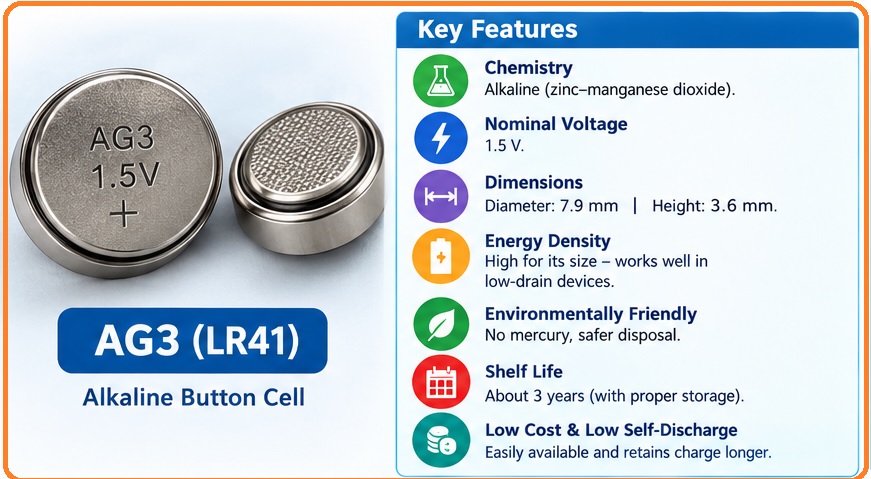
- An AG13 is an alkaline button cell battery with 1.5 volts, measuring 7.9 mm long and 3.6 mm high.
This battery-powered device supports applications that need longer-lasting power. It is normally used in low-drain projects since it offers effective and constant energy.
These features make it effective for digital thermometers, laser printer watches, etc.
It maintains output for a longer time, enhances its working life, and continuously provides power.
so preferred for medical devices and backup power supplies. AG3 alkaline chemistry make the main replacement for SR41.
AG3 Battery Features
AG3 Battery Chemistry:
AG3 battery chemistry is alkaline manganese dioxide that is commonly used for small batteries. Chemistry is a combination of combining zinc and manganese dioxide (MnO₂) to produce current. In some structures, the anode is zinc and the cathode is manganese dioxide.
Stable Voltage
The AG3 battery offers a constant 1.5-volt output that best supports devices’ accurate functioning. Constant voltage is best for the continuous operation of electronic devices such as watches and digital thermometers, where continuous power is needed.
The AG3 battery maintains voltage till depletion compared to other batteries, so it is preferred in medical instruments.
Energy Density
It is a small-dimension battery but comes with high energy density and works well for compact devices. Its small button cell design stores high energy and works well in low-drain devices such as remote control watches and hearing aids. High energy density also means it lasts longer and does not need replacement.
Its high power and small size make it prominent for different devices. where space is limited and needs longer power.
Environmentally friendly design
The AG3 battery design is environmentally friendly since it does not use mercury, as other button cells come with mercury that causes hazardous material when disposed of. Since AG3 does not follow environmental guidelines that affect disposal and reduce pollution
Shelf Life
The AG3 battery working life is about 3 years if storage is done accurately. That is best for devices that are not commonly used. Accurate storage in dry, cool conditions retains energy density, compared to a battery that loses energy if not used, and the AG3 stores charge for a longer time. so best to function in emerging applications so preferred in industries
Low cost
The AG3 battery is low cost and easily available.
Low Self-Discharge:
Battery does not lose charge in storage conditions and is easy to use when needed.
AG3 Battery Equivalent
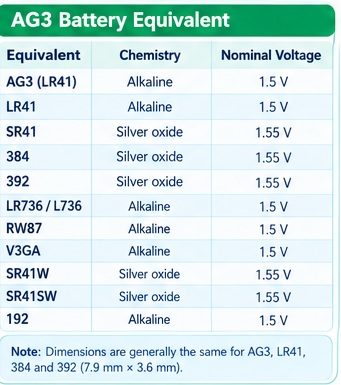
The AG3 battery is part of different projects and devices, and it comes with different replacements. Some common replacements of AG3 batteries are
LR41
LR41 small-size button cell battery that has 1.5V and alkaline chemistry, used as the best replacement for AG3 batteries. It is used in small devices since it has a short working life compared to silver oxide. The LR41 battery is easy to access and replace with other small batteries.
SR41
It is a silver oxide button cell battery since it offers stable voltage and provides a longer working life. It was replaced with an AG3 battery since the nominal voltage is 1.55 high for alkaline batteries. Its uses are in thermometers and watches. It has a maintenance voltage for a longer time and is best for devices where constant energy is needed
Its longer working life minimizes replacement, so it is preferred where constant power is needed
384 battery
Its chemistry is silver oxide with a 1.5 V constant voltage. Its uses are in medical devices and electronic components where stable supply is needed. There is more than one replacement; it has a long life. It provides steady voltage and is best in projects where power fluctuations occur. Silicon oxide chemistry prevents leakage, which protects sensitive components.
RW87 battery
Its small-sized button cell is part of watches and medical devices. Its volts are 1.5v, and it’s the best replacement for an AG3 battery. It has alkaline and silver oxide types, and silver oxide provides constant voltage.
It provides a steady supply for smooth functioning where low energy is used. Compact design makes it the best replacement for limited-space projects.
V3GA battery
It is a 1.5V alkaline chemistry employed for electronic devices. It has the best replacement features and is part of the printer, thermometer, and remote control. V3GA battery losses in volts with time is not used in sensitive projects. it used where not neededsteady voltage suppy.
SR41W
SR41W battery: The best silver Xide battery provides a constant power supply. Its voltage is 1.55 V and is the best equivalent of an AG3 battery. letter w in this battery shows high energy and is preferred for thermometers where high power is needed.
Silver oxide components provide stable voltage during complete life. It works at a longer life than alkaline replacements of AG3 batteries and low-cost options. Its main uses are in medical instruments
SR41SW battery
SR41SW silver oxide cell battery: part of low-drain devices provides a stable 1.55 volts. SW stands for low drain, meaning high efficiency for devices that use less power. It is a preferred replacement for the AG3 battery compared to alkaline batteries that lose voltage, as SR41SW provides constant voltage and a long life.
This battery has less leakage than alkaline batteries.
192 batteries
It is the best button cell battery and the best equivalent of the AG3 battery with 1.5V and is used in small devices. It is a low-cost part of a laser printer and comes with different features. Its alkaline nature reduces voltage slowly, which can affect the operation of some devices.
Its uses are in low-drain projects where a non-constant supply is needed.
Technical Parameter | AG3 | LR41 | LR736 | L736 | 192 / GP192 | SR41 |
| Battery chemistry | Alkaline | Alkaline | Alkaline | Alkaline | Alkaline | Silver oxide |
| Nominal voltage | 1.5 V | 1.5 V | 1.5 V | 1.5 V | 1.5 V | 1.55 V |
| Diameter | 7.9 mm | 7.9 mm | 7.9 mm | 7.9 mm | 7.9 mm | Approx. 7.9 mm |
| Height | 3.6 mm | 3.6 mm | 3.6 mm | 3.6 mm | 3.6 mm | Approx. 3.6 mm |
| capacity | 25–41 mAh | 24–41 mAh | Manufacturer-dependent | Manufacturer-dependent | Manufacturer-dependent | Manufacturer-dependent |
| Rechargeable | No | No | No | No | No | No |
| Voltage stability | Decreases during discharge | Decreases during discharge | Decreases during discharge | Decreases during discharge | Decreases during discharge | Generally more stable |
| applications | Toys, calculators, watches | Watches, calculators | Compact electronics | Compact electronics | Small electronic devices | Watches and precision electronics |
| Replacement compatibility | Reference battery | equivalent | Generally equivalent | Generally equivalent | Generally equivalent | Conditional; verify device requirements |
AG3 vs Other Button Cell Batteries
| Technical Parameter | AG3 (LR41) | AG1 (LR621) | AG4 (LR626) | AG5 (LR754) | AG10 (LR1130) | AG13 (LR44) |
| Battery types | Button cell | Button cell | Button cell | Button cell | Button cell | Button cell |
| Chemistry | Alkaline zinc–manganese dioxide | Alkaline zinc–manganese dioxide | Alkaline zinc–manganese dioxide | Alkaline zinc–manganese dioxide | Alkaline zinc–manganese dioxide | Alkaline zinc–manganese dioxide |
| IEC designation | LR41 | LR621 | LR626 | LR754 | LR1130 | LR44 |
| Nominal voltage | 1.5 V | 1.5 V | 1.5 V | 1.5 V | 1.5 V | 1.5 V |
| open-circuit voltage | 1.5–1.6 V | 1.5–1.6 V | 1.5–1.6 V | 1.5–1.6 V | 1.5–1.6 V | Approximately 1.5–1.6 V |
| Nominal diameter | 7.9 mm | 6.8 mm | 6.8 mm | 7.9 mm | 11.6 mm | 11.6 mm |
| height | 3.6 mm | 2.1 mm | 2.6 mm | 5.4 mm | 3.1 mm | 5.4 mm |
| volume | 177 mm³ | 76 mm³ | 94 mm³ | 265 mm³ | 328 mm³ | 570 mm³ |
| capacity | 25–35 mAh | 15–20 mAh | 20–25 mAh | 45–70 mAh | 50–80 mAh | 100–150 mAh |
| nominal energy | 37.5–52.5 mWh | 22.5–30 mWh | 30–37.5 mWh | 67.5–105 mWh | 75–120 mWh | 150–225 mWh |
| Energy density by volume | Moderate | Low to moderate | Low to moderate | Moderate | Moderate | Moderate |
| Discharge profile | declining voltage | Gradually declining voltage | Gradually declining voltage | Gradually declining voltage | Gradually declining voltage | Gradually declining voltage |
| Discharge features | Best for low-drain applications | very low-drain applications | low-drain applications | low-drain applications | low-drain applications | low-to-moderate-drain applications |
| Internal resistance | temperature, and state of charge brand | temperature, and state of charge | temperature, and state of charge | Depends on brand, temperature, and state of charge | Depends on brand, temperature, and state of charge | Depends on brand, temperature, and state of charge |
| Maximum continuous discharge current | Manufacturer-specific | Manufacturer-specific | Manufacturer-specific | Manufacturer-specific | Manufacturer-specific | Manufacturer-specific |
| Self-discharge rate | Depends on construction and storage | Depends on construction and storage | Depends on construction and storage | Depends on construction and storage | Depends on construction and storage | Depends on construction and storage |
| Shelf life | Manufacturer-specific | Manufacturer-specific | Manufacturer-specific | Manufacturer-specific | Manufacturer-specific | Manufacturer-specific |
| Rechargeability | Non-rechargeable | Non-rechargeable | Non-rechargeable | Non-rechargeable | Non-rechargeable | Non-rechargeable |
| Polarity | Positive top; negative case/bottom | Positive top; negative case/bottom | Positive top; negative case/bottom | Positive top; negative case/bottom | Positive top; negative case/bottom | Positive top; negative case/bottom |
| applications | toys, laser pointers, compact electronics | Small watches and compact electronics | Watches, calculators, small toys | Small electronic devices and toys | Calculators, thermometers, small electronics | Calculators, toys, digital instruments |
| limitation | Limited energy storage | Lowest capacity among the listed cells | Limited energy storage | Greater height than thin button cells | Wider footprint | Greater diameter and height than AG3 |
| Replacement requirement | chemistry, and voltage. | chemistry, and voltage | specified size, chemistry, and voltage | size, chemistry, and voltage | specified size, chemistry, and voltage | specified size, chemistry, and voltage |
AG3 vs. LR41 Battery: Technical Comparison
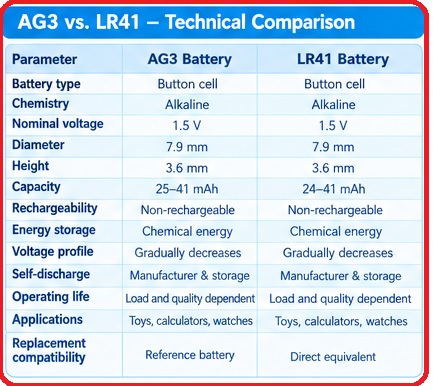
Technical Parameter | AG3 Battery | LR41 Battery |
| Battery type | Button cell | Button cell |
| Chemistry | Alkaline | Alkaline |
| Nominal voltage | 1.5 V | 1.5 V |
| Diameter | 7.9 mm | 7.9 mm |
| Height | 3.6 mm | 3.6 mm |
| capacity | 25–41 mAh | 24–41 mAh |
| Rechargeability | Non-rechargeable | Non-rechargeable |
| Energy storage | Chemical energy | Chemical energy |
| Voltage discharge profile | Gradually decreases during discharge | Gradually decreases during discharge |
| Self-discharge | Manufacturer and storage | Manufacturer and storage |
| Operating life | load and battery quality | load and battery quality |
| applications | Small toys, calculators, watches | Small toys, calculators, watches |
| Availability | Widely available | Widely available |
| Replacement compatibility | Reference battery | direct equivalent |
| difference | Common commercial designation | Standard IEC-style alkaline designation |
AG3 vs. SR41, 384, and 392 Batteries: Technical Comparison
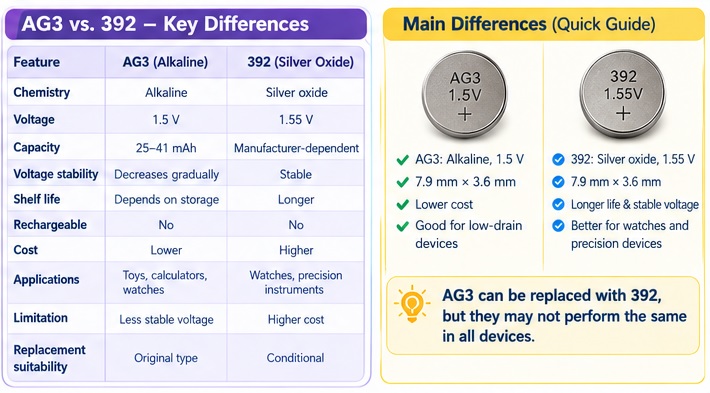
Technical Parameter | AG3 | SR41 | 384 | 392 |
| Battery chemistry | Alkaline | Silver oxide | Silver oxide | Silver oxide |
| Nominal voltage | 1.5 V | 1.55 V | 1.55 V | 1.55 V |
| Diameter | 7.9 mm | . 7.9 mm | 7.9 mm | 7.9 mm |
| Height | 3.6 mm | 3.6 mm | 3.6 mm | 3.6 mm |
| capacity | 25–41 mAh | Manufacturer-dependent | Manufacturer-dependent | Manufacturer-dependent |
| Voltage stability | Decreases gradually during discharge | stable | stable | stable |
| Discharge characteristics | low-power devices | devices needing stable voltage | precision electronics | precision electronics |
| Shelf life | Depends on manufacturer and storage | longer | longer | longer |
| Rechargeability | Non-rechargeable | Non-rechargeable | Non-rechargeable | Non-rechargeable |
| applications | Toys, calculators, small electronics | Watches and compact electronics | Watches and precision instruments | Watches and precision instruments |
| Cost | lower | higher | higher | Generally higher |
| AG3 replacement suitability | Original battery type | Conditional | Conditional | Conditional |
AG3 BATTERY APPLICATIONS
Watches
AG3 battery is used in clocks and watches; these batteries enable proper functioning in industries for clocks to track time. Its compact size provides dependable power output.
Calculators
Small electronics, capacitors, and other devices, such as thermoelectrics, use it. With this battery, capacitors work well, making devices function correctly and offer different functionality. AG3 is part of our homes and schools, and also industries
Medical instruments
Different medical devices such as glucometers are commonly used. meter helps measure blood sugar. It is used in sensors for providing power to sensors that work well. AG3 battery constant power makes it prominent for healthcare projects
Toys
Children’s toys also function with an AG3 battery, and that helps to provide power for the motor-driven system and remote-controlled car to move with them.
Remote Control System
Remote control of different devices to control the working of different devices. Radio frequency helps devices to control devices by providing power to the remote control from these batteries. Common uses are in TV remotes, car key fobs, and different devices.
Flashlights
The AG3 battery is also seen in small lights and LED systems for glowing, and the battery helps light up our houses. The compact design of ag3battery best for portable lights
conclusion
The AG3 battery is compact-sized, accurate, low-drain, and used in different devices. Its different battery replacements are SR41, 384, 192, and LR41, etc., and they provide the same features and are used for different projects. AG3 batteries give power to different devices, watches, toys, etc. They maintain performance and work for different industries
How to Maintain the Working Life of an AG3 Battery?
Different factors must be considered for a longer working life of an AG3 battery.
Storage
Store the battery in cool and dry places, and protect it from high and low temperatures that can cause the battery to discharge fast. Storing the battery in dry conditions also increases working life. Protect batteries from high temperatures, which reduce working life
device usage
Turn off devices if not in use, such as calculators or toys, and do not leave them open that drain the battery. so off devices when not in use to save battery
If devices are not in use for a longer time, remove the battery and connect when needed.
Quality
Get batteries from famous brands that provide quality services and work longer. If you choose a low-quality battery, it will not last long
Frequently Asked Questions [FAQ]
What are the differences between AG3 and 392 batteries?
AG3 and 392 have the same batteries in terms of dimensions and structure and differ in composition and working performance. AG3 has alkaline chemistry, and the other is a silver oxide button. Sver oxide batteries have a longer life with stable voltage and are best to use in watches.
AG3 can be replaced with 392 but does not work the same
What does “AG” mean on an AG3 battery?
AG means an alkaline cell that comes with a small, round, disposable design with an alkaline electrolyte. This battery is part of small devices and toys.
What is the basic difference between AG3 and LR41 batteries?
Both have the same functions and are alkaline batteries with dimensions of 7.9 mm diameter and 3.6 mm height. Just name differences; that is, AG3 is the general name, and LR41 is the International Electrotechnical Commission standard. Some brands say “AG3” and “LR41,” but they are interchangeable.
Is AG3 similar to 312?
Both are different; both are small button cells, 312 battery is zinc-air. So zinc-air batteries offer different voltages and do not repacement of AG3.
Is LR41 replaced with LR44?
Neither has different sizes and is not replaced; LR41 dimensions are 7.9 mm in diameter and 3.6 mm in height, and LR44 is 11.6 mm in diameter and 5.4 mm in height, a larger size and not supported to devices where LR41 is used.
If device battery compatibility requires space, the R44 battery can be used since offer 1.5vots
Where are AG3 batteries used?
AG3 batteries may be used in small devices, such as thermometers, toys, watches, and medical devices such as blood glucose meters.
Can the AG3 battery be replaced with an LR41?
The LR41 battery has the same size and voltage as the AG13 batteries.
What are the signs that an AG3 battery is dead?
If devices stop operating, slow down, or do not work, it means the battery is dead. Use a battery tester to check that the voltage is less than 1.2 volts, and then replace it.
Are AG3 batteries safe to dispose of?
Since the AG3 battery does not contain mercury, it is safe to dispose of. It’s best to recycle it