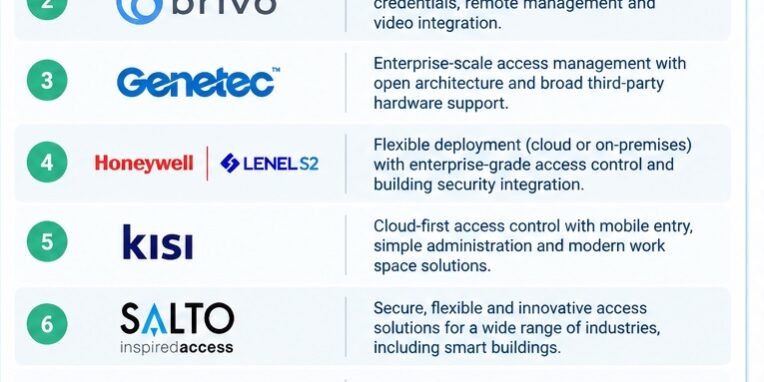
The scale of that shift is important, Bravo defines, supporting 78,000 customers, 15 million credentialed users, and 5 million mobile credentials across 87 countries. At the same time, Coram’s 2026 physical security research determines that 80.9% of security teams like one connected physical security system, yet only 22.4% currently have one.
That gap helps explain why cloud management, mobile access, video verification, and support with existing hardware have become significant factors for U.S. organizations upgrading physical security.
The market is also crowded. Established industries are now competing with cloud-native platforms and newer unified security systems. The best option depends on building size, current hardware, IT resources, compliance demand, and how deeply access needs to configure with video.
With those factors in mind, here are 10 access control companies worth evaluating in the USA in 2026.
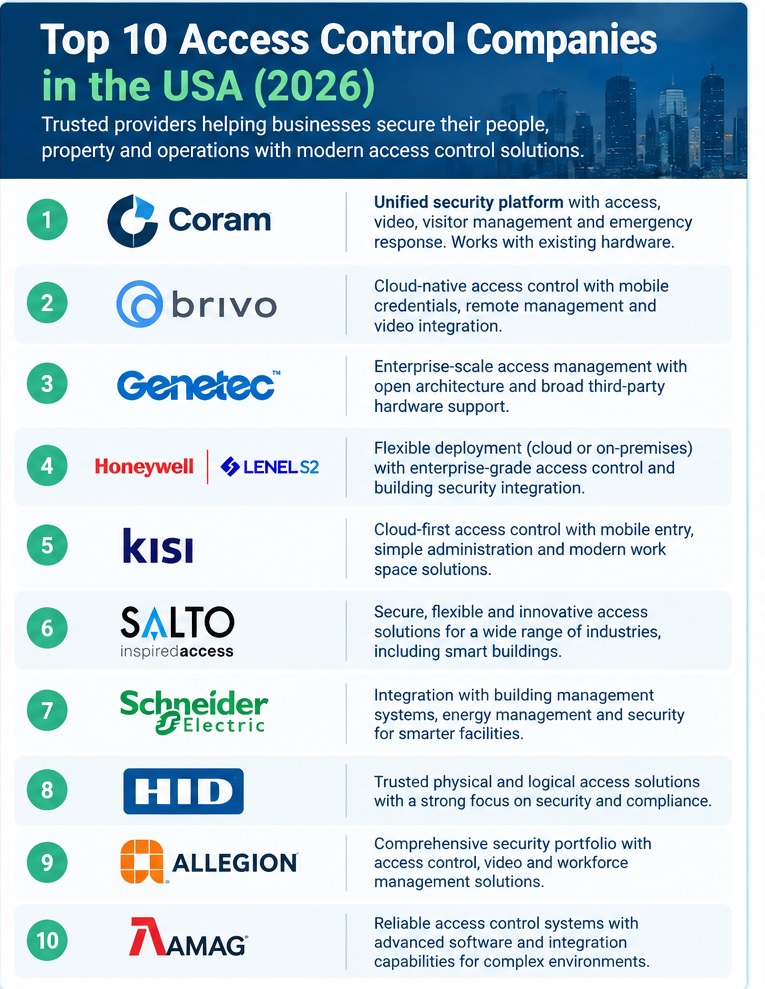
Coram
- Coram offers process control as a component of a wider unified security system, compared to an isolated door-management product. Coram’s access control company offering combines access, video, visitor management, and emergency response, making it relevant for organizations reducing the number of separate security tools they use.
- Its access platform functions with current readers, controllers, locks, and ONVIF cameras. Door events can also be paired with synchronized video, helping teams to visually check an entry, denied access, forced door, or similar event without manually covering timestamps between separate systems.
Features
- Cloud-based management system
- Existing hardware support
- Access events connected with video
- Remote door control and lockdown
- Mobile management and multi-site support
This combination makes Coram relevant to businesses that own substantial security hardware but want a high unified software layer.
Brivo
Brivo is known in cloud-based access control and has a strong presence in organizations handling different locations.
Its platform helps administrators to control doors, users, credentials, schedules, and activity remotely from a centralized system
Brivo is also compatible with mobile devices such as phones and wearable devices, over physical, PIN, biometric, and other credential options.
Its Security Suite connects access with video, visitor management, intrusion detection, and other building systems.
Features
- Cloud-native access management
- Mobile and physical credentials
- Role-based permissions
- Video and door-event integration
- Open APIs and third-party integrations
Brivo reports 15 million credentialed users, which defines the scale cloud-managed physical access has reached. It is preferred for organizations prioritizing remote administration and multi-location scalability.
Genetec
It focuses on the method through its Synergis access control system. The platform features to manage secure areas over large and geographically distributed systems while being compatible with centralized cardholder administration and remote door management.
• The main feature is its open architecture. Synergis supported a larger range of third-party devices and intelligent controllers, helping larger organizations prevent unnecessarily limiting themselves to a single hardware ecosystem.
Features
- Enterprise-scale access management
- Broad third-party hardware support
- Remote door administration
- Electronic lock integrations
- Unified physical security options
Genetec is relevant when access control is a component of a larger security deployment. Its larger security center environment can configure access with video and other physical security technologies, making it best for complicated campuses and high-security operations.
Honeywell and LenelS2
Honeywell is older in commercial building technology, while LenelS2 gives its security portfolio important depth in enterprise access control.
• The portfolio offers different deployment paths. Organizations can use developed enterprise systems such as OnGuard or new cloud-oriented options, based on infrastructure and operational requirements.
This flexible best for businesses that cannot move a complete security estate to the cloud at once.
Features
- Enterprise access control
- Cloud and on-premises options
- Mobile, biometric, and card credentials
- Multi-facility management
- Integration with larger building security
The platform is based on large facilities and regulated environments where detailed permissions, integrations, compliance requirements, and long-term system scalability can be more important than rapid plug-and-play deployment.
Kisi
- Kisi is a new generation of cloud-first access control, with a strong focus on easy administration and mobile entry.
- Its model is used for advanced workspaces where users access changes frequently. Administrators can manage permissions remotely, while integration with workplace, HR, and other business software can help connect physical access with employee workflows.
Features
- Cloud-based administration
- Smartphone access
- Remote credential management
- Entry logs and reporting
- API and workplace integrations
Kisi is relevant for offices, coworking environments, and distributed businesses that prioritize ease of management. Organizations needing complex enterprise workflows, however, should compare its integration and customization depth against conventional enterprise platforms before making a decision.
Bosch
Bosch Building Technologies is best for organizations that need access control as a component of a larger building security infrastructure.
Its method is based on industries, commercial, and high-security systems where access management is configured with intrusion detection, video surveillance, and different security technologies. Bosch’s strength is providing a broad security ecosystem compared to focusing only on lightweight cloud door management.
Features
- Enterprise access management
- Building-security integrations
- Advanced monitoring and reporting
- Scalable hardware options
- Support for complex installations
Bosch is best for organizations with demanding physical conditions and established security systems. Buyers should factor professional installation, maintenance, and integration needed into the total project cost.
Verkada
Verkada has built its physical security system around a cloud-managed ecosystem to manage access control, cameras, and other security methods.
For industries that need access and video for closely connected environments, this method can define day-to-day security operations. Compared to handing a door event and nearby camera footage as unrelated records, integrated systems can provide more context when reviewing incidents.
Coram’s 2026 buyer guide shows Verkada among the prominent unified cloud options considered by commercial organizations.
Features
- Cloud-managed access
- Mobile credentials
- Integrated video ecosystem
- Centralized administration
- Multi-site management
Verkada is important when an organization is defining a closely integrated vendor ecosystem. Existing hardware support and long-term licensing costs should be evaluated carefully during comparison.
Avigilon Alta
Avigilon Alta, which handles the technology formerly known as Openpath, is based on cloud-managed and mobile-first physical access.
Its phone-based method is best for workplaces asking to reduce dependence on conventional badges while giving administrators flexible control over credentials.
As part of the wider Avigilon and Motorola Solutions ecosystem, it also gives industries options for connecting access with larger video-security features.
Features
- Mobile-first credentials
- Cloud access management
- Remote administration
- Video-security integration options
- Flexible workplace access
Avigilon Alta can be best for offices where employee experience and touchless entry are main needs. Buyers should still compare hardware features, integration needs, and licensing structure against the infrastructure already configured in their buildings.
Ubiquiti UniFi Access
Ubiquiti UniFi Access gets certain methods from subscription-heavy access platforms. Ubiquiti defines UniFi Access as a scalable, licence-free door access system built around its UniFi consoles, control hubs, readers, and supporting locks.
It has compatible access methods and processes, also NFC, PIN, and mobile app unlocking. UniFi also offers retrofit hardware that can save existing wiring and, in some configurations, third-party readers.
Features
- No recurring software license
- NFC, PIN, and mobile entry
- PoE-based hardware
- Centralized user and policy management
- Integration with UniFi Protect video
UniFi Access is best for companies with capable in-house IT teams that use the UniFi ecosystem and want high control over applications and ongoing software costs.
ButterflyMX
ButterflyMX works on property access, especially in multifamily residential and smaller industrial environments where visitor entry is just as important as employee details.
It configures cloud-based access handling with video intercom functionality and smartphone-based entry. That makes it different from traditional enterprise systems managed around secured corporate doors and highly complex cardholder databases.
Features
- Mobile property access
- Video intercom functionality
- Visitor entry management
- Cloud-based administration
- Multifamily-oriented workflows
ButterflyMX is based on apartments and mixed-use properties where residents need to admit guests, delivery personnel, and service providers. Larger companies needing certain high-security workflows can find platforms designed specifically for complicated commercial deployments high best.
What to Compare Before Selecting an Access Control Company
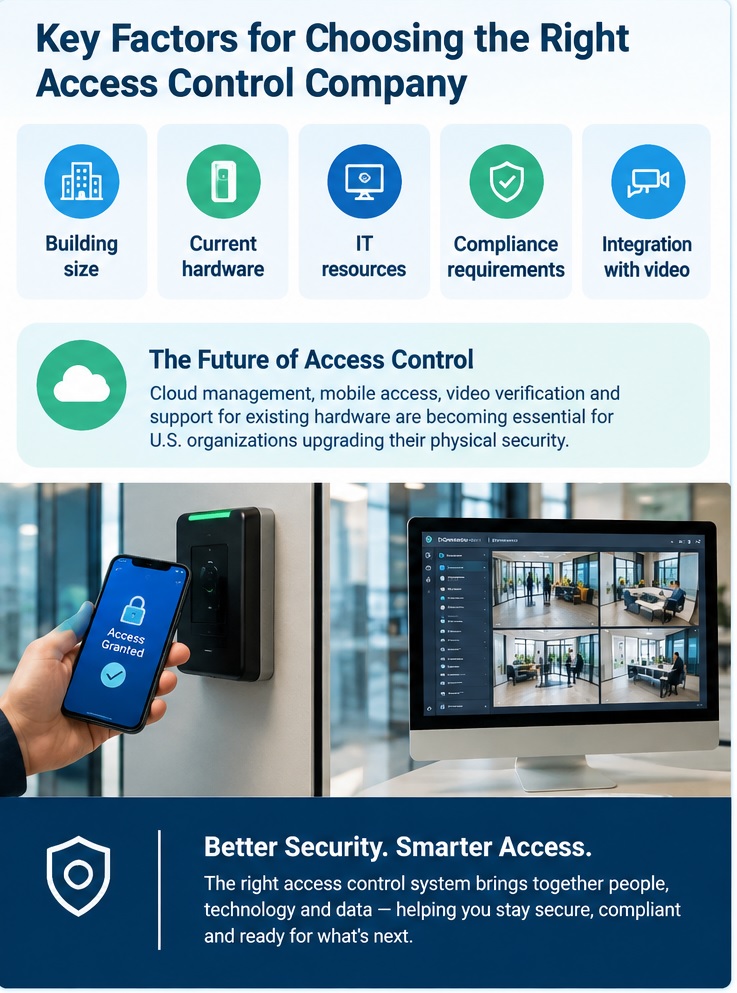
The best fit depends on the environment being protected. A 10-door office comes with different features from a hospital network, university campus, apartment portfolio, or company operating hundreds of locations.
Before selecting a provider, compare:
Deployment model:
- Cloud, on-premises, or hybrid
Hardware support:
- Whether current locks, readers, wiring, and cameras can remain
Credentials:
- Cards, mobile devices, biometrics, or a combination
Video support:
- Whether access events can be configured directly with footage
Multi-site management:
- How easily teams can manage many locations
Total cost:
- Hardware, installation, subscriptions, maintenance, and future expansion
Resilience:
- What happens to door access if internet connectivity is interrupted
Hardware can account for roughly 60% to 70% of upfront access-control spending, based on Coram’s 2026 buyer detais, so the features to reuse existing infrastructure can materially affect project economics.
Main Features
- Cloud management is becoming important, especially for companies managing doors across several buildings or cities.
- Access and video are increasingly is evaluated together, giving security teams visual context for door events.
- Mobile credentials continue to grow, although cards and other conventional credentials remain important in different deployments.
- Hardware can significantly affect cost, mostly when a company already has readers, locks, wiring, and cameras connected.
- Different companies work for different environments, from advanced offices and apartments to industrial facilities and large enterprise campuses.
- Total cost is important compared to software price alone, so businesses should consider installation, subscriptions, integrations, hardware replacement, and ongoing administration when comparing providers.
FAQs
What should I look for in an access control company in 2026?
starting with deployment models, capability, hardware support, credential details, video connection, remote handing, cybersecurity, and installing cost. with the following: how easily the platform can follow when companies add employees, doors, or locations.
Are cloud access control systems better than on-premise systems?
Neither model is important; cloud platforms make remote simple and multi-site administration, while on-premise systems can suit organisations with certain infrastructure or data-control features. Hybrid design can offer another option.
Can businesses keep their existing door hardware?
Supporting different bases on providers, some platform-compatible existing readers, counter wiring, or cameras, and others needing proper proprietary hardware. Confirm support before calculating migration costs.
Why is video integration important in access control?
Access to the log defines that the credential opened the door, but video defines what physically happened. Connecting the two can make details faster and help engineers examine events such as forced entry, tailgating, or disputed access.
How should a business choose between these companies?
Start with the real building compared to the brand name. Count doors and locations, document existing hardware, define credential requirements, find necessary connections, and develop security and compliance requirements. Then compare different providers over the same features and total-cost assumptions.
Conclusion
The U.S. access control market in 2026 is providing more options compared to simply deciding which card reader to install. Businesses can select between cloud-native platforms, define video and access ecosystems, conventional enterprise systems, and lower-cost IT-managed solutions.
That makes the buying process highly flexible but also highly complicated.
Coram, Brivo, Genetec, Honeywell, LenelS2, Kisi, Bosch, Verkada, Avigilon Alta, Ubiquiti, and ButterflyMX each have access control from a different direction. The important function is matching those techniques to the organisation’s buildings, hardware, security engineers, and plans for growth.
Finally, the strongest access control technique is not important to the system with the longest feature list. It is the one that can make security easy to handle now while still fitting the buildings and security system the organisation is asking to have several years from now