
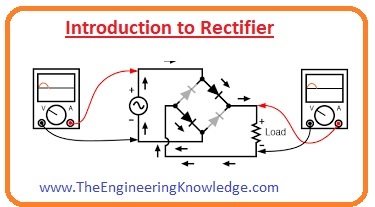
Hello, friends, I hope all of you are enjoying your life. In today’s tutorial, we will have a look at the introduction to Rectifiers. The rectifiers are such circuits that are used to transform alternating current into direct current. There are numerous electronic devices that operate on the DC current, but in our electrical system AC voltage is generated. To make use of these voltages for devices that operate on the DC, rectifier circuits are used. There are 2 types of rectifiers. The first is a half-wave rectifier, and the second is a full-wave rectifier.
Before the invention of the rectifier, the silicone semiconductor vacuum tube thermionic diode or selenium rectifiers were used. But with the invention of semiconductors, diode vacuum tube diodes became rare to use. In today’s post, we will have a detailed look at its working, circuits, types, and some other related parameters. So let’s get started with the Introduction to Rectifier.
Introduction to Rectifiers
The rectifier is an electric circuit that transforms AC current into DC. The process of AC to DC conversion is known as rectification.
There are numerous categories of diodes; some were used in the previous year, such as vacuum tube diodes, mercury arc valves, etc.
Currently, semiconductor diodes are used as rectifier circuits.
There are numerous applications of rectifiers, but the most commonly used are in DC power supplies and transmission systems that transmit high-voltage DC.
There are 2 main types of rectifiers. The first one is the half-wave rectifier, and the second one is the full-wave rectifier.
A half-wave rectifier converts the positive cycle of AC into DC, and its circuit consists of a single diode.
A full-wave rectifier converts a complete cycle of alternating current into direct current, and its circuit uses 2 or 4 diodes for rectification.
The output obtained by these filter circuits is not pure DC and has some ripples to make it pure DC, and smooth different filter circuits are used.
Types of Rectifier
- There are numerous types of rectifiers all these types are defined according to the circuit arrangements and applications. Let’s discuss them with the detailed.

Single-Phase Rectifiers
Half-Wave Rectification
- In this type of rectifier halfwave of input is converted into the direct current. The circuit of half-wave diode uses only a single diode.

- This diode operates only forward biased condition and converts positive half of AC signal into the DC.
- In input, supply is a single-phase then there is a need of only a single diode and if the supply is three-phase, then it uses 3 diodes for the rectification process.
- The output of a half-wave is not pure dc and has some fluctuation called ripples. To remove these ripples, filter circuits are used.
- The rectified output voltage of the half-wave rectifier in case of no load is shown below.
Vrms = Vpeak/2
Vdc= Vpeak/Π
- In these equations.
- Vdc is the DC output voltage
- Vpeak is the peak value of an input voltage
- Vrms is the root mean square value of output voltage.
Full Wave Rectifier
- During full-wave rectification process, a complete input signal is transformed into the dc current.
- This rectifier circuit operates for both parts of the sinewave either positive or negative.
- There are normally two configurations used for full-wave rectification first is a bridge rectifier that has four diodes, and the second is two diodes and center taped configuration.

- If the input is single-phase AC and the transformer used is center-tapped then 2 diode with connection arrangments cathode connected with cathode and anode connected with the anode or back to back connections can be used for a full-wave rectifier.
- To make the output voltage of center-tapped equal to the bridge rectifier double the turns on secondary windings of a center-tapped transformer.

- The output of full-wave rectifier is given when there is no load connected.
Vdc = Vav=2.Vpeak/Π
Vrms =Vpeak/√2
Control Rectifier
The above-discussed rectifier is a non-controlled rectifier, as their output voltage is not controlled. Rectifiers whose output voltage can change are called controlled rectifiers.
To make uncontrolled rectifiers controlled rectifiers, SCR, MOSFET and IGBT are used.
These SCRs operate like a switch that controls the output voltage of rectifiers.
These circuits use a single or more SCRs according to circuit requirements.
The SCR (silicon controlled rectifier), also called a thyristor, has 3 terminals. These are anode-cathode and gate.
The working operation of a silicon controlled rectifier is similar to the normal diode, as it also operates in a forward-biased condition and does not operate in a reverse-biased condition.
- As it has three terminal anodes,cathode and gate, its gate operates as a switch and it controlled the operation of SCR. SCR only operate when the signal is also provided to the gate.

Controlled Rectifier Types
- There are 2 main types of controlled rectifiers.
- Half Wave Controlled Rectifier
- Full Wave Controlled Rectifier
- Let’s discuss them with the detailed.
Half Wave Controlled Rectifier
- Like an uncontrolled half-wave rectifier this rectifier also uses only one SCR for the rectification process.
- The circuit arrangement of a half-wave controlled rectifier are similar to the noncontrolled rectifier but the difference is that it has SCR instead of a diode.
- SCR operates only in a forward-biased condition and converts half cycle of input into the DC.
- It operates only when a signal is provided to the gate
- Its output voltage also has pulses like an uncontrolled rectifier to remove these pulses, a capacitor is used as a filter circuit.

Full Wave Controlled Rectifier
- Similar to the noncontrolled rectifier circuit this circuit also converts the complete input signal into the dc but the difference is that this circuit also controls the amplitude of the rectified output.
Types of Controlled Rectifier
- There are 2 main types of controlled rectifiers.
Controlled Bridge Rectifier
- In this circuit instead of a diode, a silicon control rectifier is used to make a bridge circuit.

Controlled Rectifier Positive Half Cycle:
- When a positive cycle of input supply is provided to the circuit, then the T1 and T2 SCRs will be operating as they are in a forward-biased condition.
- While SCRs T3 and T4 will not operate, as they are in a reverse-biased mode so there will be a positive cycle of dc will be shown across the load resistance.

Controlled Rectifier Negative Half Cycle:
- When the negative half of the input comes across the circuit than the SCRs T3 and T4 will be operating as they are in a forward-biased condition.
- T1 and T2 will be in reverse-biased conditions and will block the current.

Controlled Center-Tap Rectifier
- The circuit arrangement if the center-tapped controlled rectifier is shown below figure.
- The circuit of this rectifier is similar to an uncontrolled rectifier but the difference is that it uses two SCRs for the rectification process.
- It converts the complete input AC signal into the DC current like a normal center-tapped rectifier.

Rectifier Comparision
- The given below figure shows the comparison among the different types of rectifiers.

Rectifier Applications
- These are some common applications of rectifiers.
- It is used in different batteries for ac to dc conversion.
- It used in electrical windings for polarized voltage.
- It used in traction motors to run trains.
- A soldering iron has half-wave rectifier circuits.
- These circuits are also used in modulation, demodulation, and different amplification circuits.
FAQs
What is a rectifier and its types?
- The rectifier is a device that transforms AC into direct current. Rectifier gets different types like vacuum tube diodes and crystal radio receivers etc.
What are the three types of rectifiers?
- The main types of rectifiers are as half-wave, full wave, and bridge rectifiers. The rectifiers have two main types based on voltage control.
Read also
So, friends that are the complete tutorial about the rectifiers, I have mentioned each and every parameter related to rectifiers. I hope you enjoyed this tutorial. Have a good day. see you in the next post. Thanks for reading.



Hello! I realize this is sort of off-topic but I had to
ask. Does building a well-established website such as
yours require a large amount of work? I’m brand new to writing
a blog however I do write in my diary every day. I’d like to start a blog so
I can share my experience and views online. Please let me
know if you have any kind of ideas or tips for new aspiring bloggers.
Thankyou!
This post offers clear idea designed for the new users of blogging, that
in fact how to do blogging.