
Hello, fellows, I hope all of you are enjoying your life. In today’s tutorial, we will have a look at the full form of OLED, its construction, applications, and uses. The full form of OLED is an organic light-emitting diode. First, OLED was manufactured in 1987 by Ching W. Tang, who belonged to Hong Kong, and Steven Van Slyke (an American chemist) while working at Eastman Kodak (an American company that manufactured cameras). After that, in 1999, Sanyo (an electronic company of Japan) and Kodak partnered with each other to create OLEDs. In September 1999 they manufactured the first 2.4-inch OLED, the first time created by any company in the world.
This 2.4-inch OLED had an active matrix and a complete colored display. After almost three years, in September 2002, they introduced a fifteen-inch HD-TV having a white OLED with color filters. The creation of small-molecule organic light-emitting diodes was initiated in 1997 by Pioneer Corporation (a Japanese company). In 2001, TDK also started making small-size OLEDs, and in the same year, 2001, Samsung NEC made mobile displays using OLEDs. After one year, in 2002, Samsung became the largest manufacturer of an OLED displays. In today’s post, we will have a detailed look at working, manufacturing, applications, and uses. So let’s get started with the full form of OLED.
Full Form of OLED
The word OLED stands for organic light-emitting diode, also called an organic electroluminescent diode.
This device comprises an electroluminescent layer manufactured with the organic layer that releases photons of light when current passes through OLED.
The layer of organic material is placed among the 2 electrons; one electrode is transparent.
The screens of TVs, PC monitors, mobile screens, and other electronic devices are manufactured with the organic LED for digital displays.
The OLEDs are categorised into 2 groups: the first one uses small-sized molecules, and the second one uses polymers.
If we add movable ions in the organic LED, then it becomes an electrochemical cell that provides different features than a normal OLED.
There are 2 techniques to control the OLED. The first one is a passive matrix, and the second is an active matrix.
In the passive matrix control technique, every row (pixel) in the display is controlled in a sequence, while in the active matrix, each pixel is controlled separately with the use of a thin-film transistor and provides a large resolution.
Due to the emission of visible light in organic LEDs, there is no need of background light.
Due to this, these devices are less thick than the LCD, less weight and can display a deep back level.
In a darkroom or less lightroom, organic LED provides a higher contrast ratio than the liquid crystal display irrespective of the cathode fluorescent lamp used as a background light source
.
Working of LED
Before a discussion of the practical working of OLED, first, we discuss the working of LED that will help you to understand OLED.
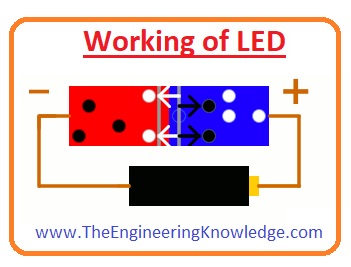
For the LED working with two different materials of semiconductors, one has a large number of free electrons, and the other has a large number of holes.
The material has electrons called N-type, while others have holes called P-type semiconductors. Both these N-type and P-type semiconductors are different from each other.
After that, attach these 2 semiconductor materials to each other, and you can see no movement between electrons and holes.
Now apply input supply at the terminals of both pieces, and you will see the current start to flow. This current flows due to a combination of electrons and holes with each other.
Due to a combination of electrons and holes, ions are created that make a barrier to move the electrons and holes.
When electrons move from one place to another, they emit energy in the shape of light. A light-emitting diode (LED) works on this phenomenon.
The energy emitting and movement of electrons from one energy level is explained in the article “What is an Atom?” with detail.
Working of OLED
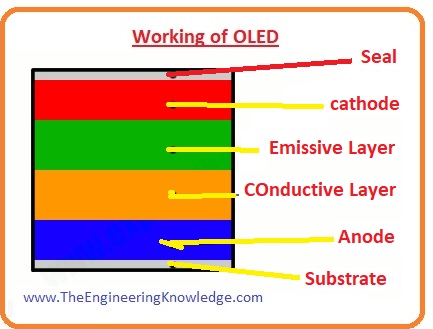
The working of an organic light-emitting diode is similar to the general diode and light-emitting diode, but the difference is that instead of n-type and p-type semiconductors, they comprise organic materials for the production of electrons and holes.
There are 6 different layers in an organic light-emitting diode. The upper layer and the lowermost layer are manufactured with glass or plastic to protect the outer environment.
Among the upper and lower layers, there are 2 terminals, positive and negative; the positive is called the anode and the negative is called the cathode.
Further, 2 layers are created with the organic material; one is near to the cathode, used to emit light, and second after come to the anode, called a conductive layer.
How Do OLEDs Emit Light?
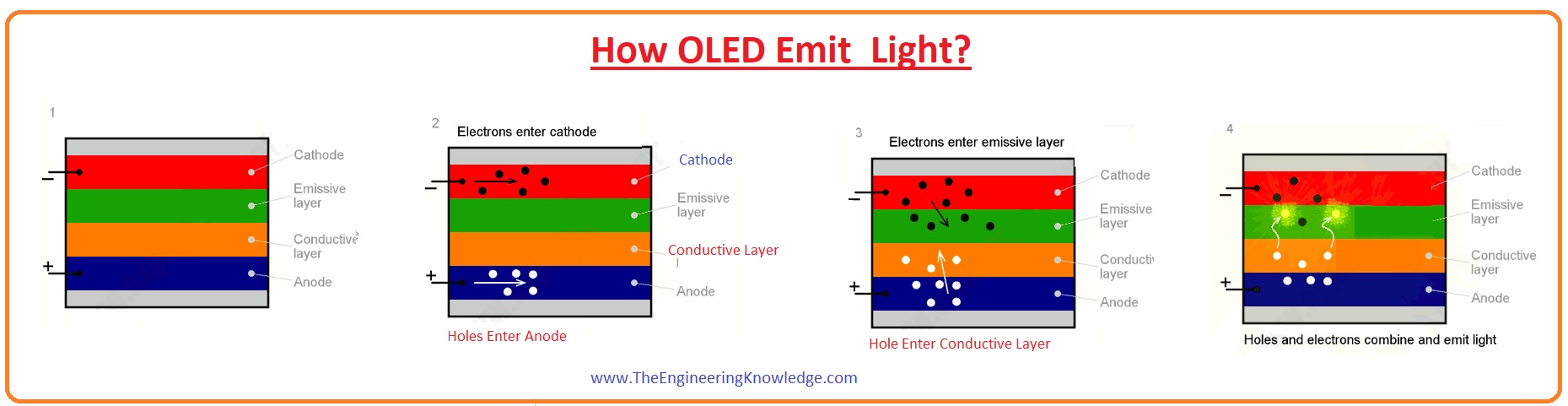
For the emission of light, we just connect the negative terminal of a battery with the anode and the positive terminal with the cathode.
When current flows through the input, supply electrons move towards the cathode, and the anode loses the electrons and makes the holes.
Now the condition is like the n-type material at the cathode, and like the P-type, the condition is the same at the anode.
The holes move towards the emissive layer from the conductive layer and combine with the negative electrons and neutralise each other, and energy with the light of the photon is released.
This process happens numerous times in one second, and continuous light is emitted through the organic light.
For the production of coloured light, place a coloured filter after a glass or bottom layer.
Difference between LCD and OLED
- These are some differences between the LCD and OLED.
OLED | LCD |
| Its full form is Organic Light-Emitting Diode | Its full form is a liquid crystal display |
| It uses organic materials like carbon to manufacture screens. | It screen is made with liquid crystals. |
| It’s every pixel that produces light radiation. | In this device, background light such as a lamp, is used to provide light. |
| To show different colors its pixels blink and then off independently. | While in LCD pixels are not on and off independently; they use light at the backend and pixels panels to block white light and make different colors. |
| Its brightness is large | Its brightness is low. |
| when the brightness of colors on the screen is less it consumes less power. | It uses a large amount of energy. |
| When the color is white it consumes high energy. | It uses a small amount of power. |
| The usage of organic material decreases operating life. | Its working life is high. |
| It is costly | It is less expensive |
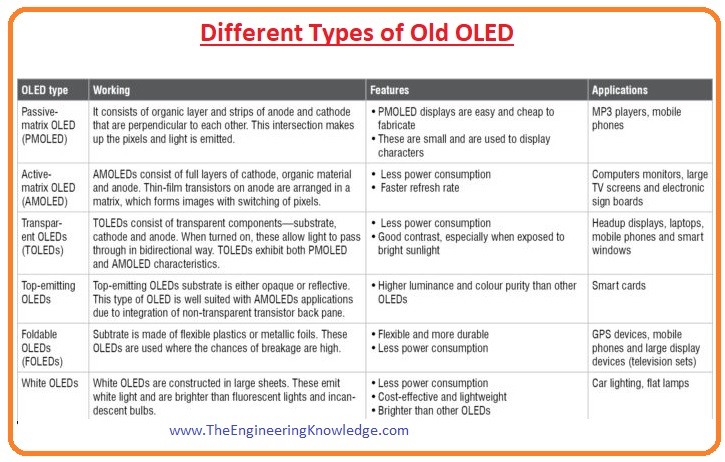
Different Types of Old OLED
- In the pictures given below, you can see the older types of organic LEDs and their features.
OLED Architecture
- The structure of the organic light-emitting diode comprises these parts.
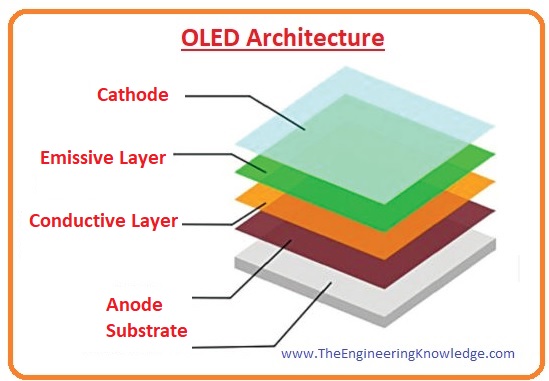
Substrate:
It is also known as the base of an organic light-emitting diode that is constructed with a glass of foil substance.
Anode:
The other name of the anode is the emitter. When input supply is connected, it releases electrons.
Organic Layer:
The layer over the anode is known as an organic layer; it comprises a polymer that is conductive and created with the hydrogen.
Conductive Layer:
This layer is for the movement of holes from anode to cathode and is constructed with organic material.
Emissive Layer:
It is used to transfer electrons from cathode to anode and is constructed with a material different from the material used for the conductive layer.
Cathode
It is the upper layer of organic LED, and at this layer, electrons are generated when the supply voltage is provided.
Advantages of OLED
These are some advantages of OLED.
Lower Price in the Future
The organic light-emitting diode can be printed on any substrate by using an inkjet printer that
Hypothetically make OLED less expensive than liquid crystal display.
However, the manufacturing of organic light-emitting diodes is currently more expensive than liquid crystal display.
However, using the roll-to-roll vapor deposition technique can make OLEDs at a lower price and large numbers of pieces in a minute.
But for the creation of OLEDs having many layers, this technique creates some problems.
Less weight and flexible plastic substrates
OLED displays can be manufactured on a substrate created with flexible plastic.
If a substrate is of polyethylene terephthalate, it will decrease the manufacturing price.
High-Quality Picture
Due to the direct emission of light, the organic light-emitting diode provides a higher value of contrast ratio and a larger angle of view than the liquid crystal display.
Response time
The response time of the organic light-emitting diode is higher than that of the liquid crystal display.
The response time of liquid crystal display can be one millisecond by using different techniques.
Almost the one thousand times the response time of an organic light-emitting diode is larger than the liquid crystal display.
Disadvantages of OLED
With its different benefits, it also has some disadvantages.
Lifespan
The main issue of organic light-emitting diodes is the shorter operating life of the organic material used.
Research in 2008 was done to monitor the performance of OLED and found that after continuous working for one thousand hours. There was a twelve percent decrease in the blue, a seven percent decrease in the red, and an eight percent decrease in the green luminance.
It is less than the lifetime of a liquid crystal display and light-emitting diode; their brightness decreases to half after 25,000 to 40,000 operating hours.
The absorption of oxygen in the OLED structure decreases the operating life of organic material as oxygen reacts with that material.
A report created by the United States Department of Energy says that the operating life of OLED decreases with the increment of brightness; according to that report, the operating life at twenty-five percent brightness was forty thousand and ten thousand hours at hundred percent brightness.
Color balance
The organic substance used in OLED manufacturing to generate blue color light degrades within very little time as compared to the materials used for other color lights.
In simple words, the output of the blue color decreases as compared to others.
This difference in the output of colors will vary the color balancing of the display screen.
For balancing, a more sophisticated control circuitry is needed, and users of OLED should also have the knowledge to operate OLED and control circuitry.
Water Damaging
- The absorption of water from the external environment can disturb the assembly of OLED. So its structure is such that water cannot pass from it.
Power Usage
- The power consumption for the organic led for the display of an image that is black is forty percent of the power used by the liquid crystal display.
- But to show an image with a white background like any document or web page, it consumes more than three hundred percent power.
- So it will very easily decrease the battery of devices in which a white background is shown.
Applications of OLED
These are some important applications of OLED.
Mobile phones
There are numerous smartphones using OLED screens introduced in the year 2016, such as the Samsung A8+, Glonee S11S, M7 Plus, and iPhone X.
OLED TV
Almost nowadays most televisions are using organic LED screens and replacing the older LED displays. Currently, every television-making company is working on the OLED to construct the screens.
Toshiba X97, Bild9, Bild 5, and Panasonic EZ950 all have OLED screens.
Digital cameras
Nowadays the use of organic LED displays is used in the screens of cameras. The first camera using an organic LED display was manufactured in 2003, and the name is Kodak LS633.
Currently, Canon PowerShot G1 X Mark III, DL24-85, HX80, etc., use OLED displays.
. Wearable Devices
Devices like smartwatches are using OLED in screen manufacturing. Water Damaging
The absorbance of water from the external environment can disturb the assembly of OLED. So its structure is such that water cannot pass from it.
Power Usage
The power consumption for the organic LED for the display of an image that is black is forty percent of the power used by the liquid crystal display.
But to show an image with a white background like any document or web page, it consumes more than three hundred percent power.
So it will very easily decrease the battery of devices in which a white background is shown.
Read also:
- Difference between LCD and OLED
- Difference Between LED & LCD
- Full Form of LCD, Working, Types, Features & Applications
- How to Stop Dimmable LED Flash and Flickering
FAQs
What are the applications of OLED?
OLED displays are used for digital devices like high-end TV systems, computers, pocket-size systems like media players, Android phones, digital cameras, etc.
What are the features of OLED?
The OLED display comes with good-quality images, bright colors, fast motion, and high contrast. The simple OLED design also shows that it is relatively easy to make flexible and transparent displays.
What is OLED working?
OLED releases light through conducting electricity to organic materials that are sandwiched between electrodes. LEDs release light with a current to inorganic materials that are sandwiched between electrodes.
What are the different types of OLED?
OLED is an emerging technology for effective, thin, and bright displays. There are two types of OLED: passive-matrix (PMOLED) and active-matrix (AMOLED).
So friends, that is the detailed post on the full form of OLED. I have written each and everything related to OLED. If you have any queries about this post, ask in the comments. See you in the next post. Have a good day.