Hello, friends, I hope all of you are enjoying your life. In today’s tutorial, we will have a look at the construction of DC Machines. In our electrical system, there are 2 main types of machines. The first one is AC machines, which are further divided into AC motors like synchronous motors, induction motors, single-phase induction motors, and three-phase induction motors and generators like synchronous generators and induction generators. The second type of machine is DC machines that are also divided into DC motors and DC generators, and these are further divided into shunt motors, shunt generators, series motors, and series generators.
Both of these two machines, either DC or AC, play a very important role in our electrical power system. AC machines are used in our generation system, while DC machines are used in drill machines, trains, robotics, etc. In today’s post, we will have a look at the construction of the DC machine and will explain every part with detail. So let’s get started with the construction of DC machines.
Construction of DC Machines
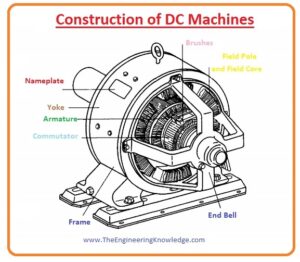
In the structure of a DC machine, either a DC motor or a generator, there are 2 main parts; the first one is static, and the second one is moving. The static part is the stator, and the moving part is the rotor.
In the stator of a DC machine, there is a frame that provides protection and support to the internal structure from the external environment. In this frame, there are poles that produce a field at the stator.
The part of the pole that is close to the rotor and distributes the flux on the surface of the rotor is known as pole shoes.
The surface of the pole in front of the rotor is known as the pole face, and the space between the rotor and pole face is known as an air gap.
There are 2 main types of windings that are wound on these machines. The first one is field windings that are wound on the stator, and the second one is armature winding that is wound on the rotor.
Friends, now we discuss all parts of DC machines with detail.
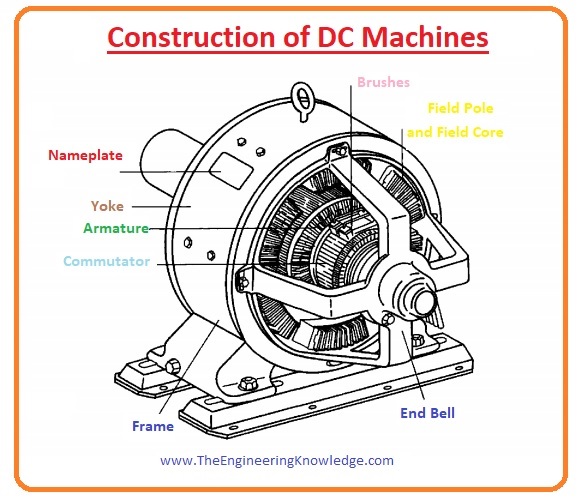
DC Machine Pole and Frame
- The pole of the earlier dc machine at the stator was constructed by cast metallic material and had the stator (field) winding wound on it.
- Tips of these poles were insulated with insulating material to eliminate of core losses at the faces of the poles.
- Nowadays, solid-state drives are mostly used so poles of dc machines are constructed with insulating material (insulated).

- The use of these high-lamination poles in machines reduces the eddy current losses.
- The faces of poles are generally eccentric in design; it means that the outward part of a pole face is spread out slightly away from the surface of the rotor than the midpoint of the pole face, as you can see in this given figure.
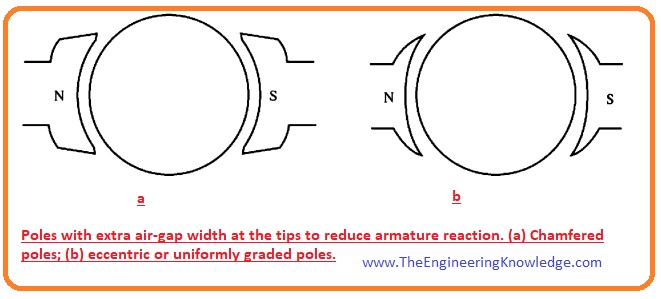
This design technique enhances the reluctance at the outward part of a pole face and so decreases the flux-weakening effect of armature reaction.
The poles at the stator of the DC machine are known as salient poles, as they can be removed from the stator.
The locations of interpolates that are used to reduce the armature reaction in-between the main poles at the stator are also laminated with insulation because in these poles losses are similar to the main poles.
Rotor of DC Machines
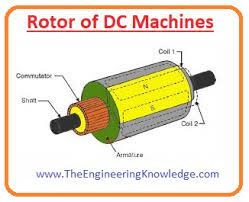
The rotor of DC machines comprises the shaft manufactured with the steel and core assembled on this shaft.
The core consists of numerous laminated sheets of steel plate that have some cuts to arrange the armature windings.
At the end of the shaft, the commutator is fixed for the conversion of AC into DC, and armature windings are connected with them.
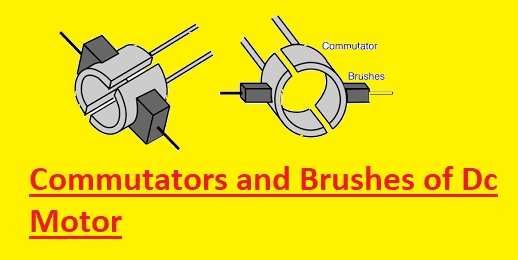
DC Machine Commutator and Brushes
The commutators in DC machines are constructed with copper and laminated with mica.
The copper bars have a high thickness to work for a longer time, almost the life of the machine.
The mica protection between commutators is more solid than the commutator itself; therefore, with the passage of time, it is essential to remove the commutator lamination to confirm that it does not stick up rotor bars.
The brushes of DC machines are connected with the commutators and are constructed with carbon, graphite, or a mixture of graphite and carbon.
Due to their best conductive behavior, they minimize electrical losses and have a lower coefficient of friction.
They are normally constructed with a softer material than the material used for commutators, so there is no need of special protection at the commutators.
The hardness of the brush should be medium; if they are too soft, they will be damaged after some time and should be replaced, and if hard will affect the commutators.
DC Machine Winding Insulation
The most sensitive part of DC machines is winding insulation. If windings are not properly wound or are damaged due to some certain reasons, then the windings of machines will be short-circuited.
The maintenance of a machine after a short circuit is very costly; sometimes it is not possible to repair it, and we have to buy new windings.
To increase the life of winding insulation, there is a need to decrease the temperature of the winding. The temperature of a machine can be decreased by providing cool air to a machine, but the main factor that controls heating is the power provided to the machine.
Insulation is infrequently damaged from instant failure at some dangerous temperature. In its place, the upsurge in temperature generates a slow ruin of the insulation, making it subject to damage due to shock, vibration, or electrical stress.
As we listen, the motor life is halved with each ten Celsius increment in temperature; this rule is true and applicable on the machine.
So friends, that is the detailed post on the construction of DC machines. If you have any questions, ask in the comments. See you in the next comments.