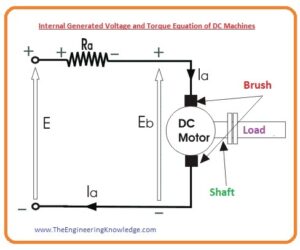
Hello, fellows. I hope all of you are enjoying your life. In today’s tutorial, we will have a look at the internal generated voltage and torque equations of DC machines. Like AC machines, there are 2 types of DC machines. The first one is the DC motor, and the second one is the DC generator. There are some important factors in DC machines, like commutation, in which AC is converted into DC. There are some problems that occur during commutation, like armature reaction and L di/dt voltage. All these factors play an important role in the operation of these DC machines.
If the load is connected to the DC machine armature, current starts to flow due to the flux produced in the armature windings. The flux of poles at the stator is linked with the armature winding flux, and a force acts on a rotor of the machine so it rotates. Due to this, a force-torque is applied on the machine that rotates the machine. In today’s post, we will have a look at how this torque is produced in the DC machine, find its equation and also calculate the internal generated voltage in the machines. So let’s get started with the internally generated voltage in DC machines.
Internal Generated Voltage and Torque Equation of DC Machines
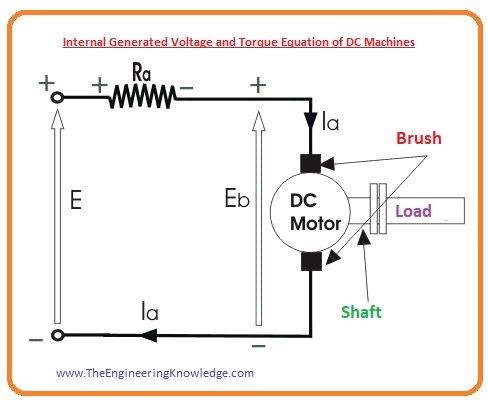
Voltage Induced in DC Machines
There are 3 main factors on which DC machines’ voltages depend.
Flux ø of the machine.
A rotation speed of the machine.
Third, it is a constant over which the construction of DC machines relies.
The value of voltage at the armature winding of a DC machine is the number of winding conductors in a single current path with the voltage in every conductor.
The voltage induced in a single conductor under the effect of a pole is given as.
eind = e = vBI
- The value of voltage at the armature of a machine is given as.
EA = ZvBI/a——(1)
- In this equation, ‘Z’ is no of conductors in the armature winding and ‘a’ is the number of current paths.
- The rotation speed of every conductor is given as (V=rw) in this equation ‘r’ is radius of the rotor.
- So equation (1) becomes.
EA = ZrwBI/a
- This equation can be written in a more comprehensive way as we know flux of the poles is equal to the product flux density and area of the poles.
ø= BAp
- The area of the rotor is like a cylinder on written as.
A= 2πrl
- If there are P poles on the machine, then the portion of the area associated with each pole is the total area A divided by the number of poles P.
- If the no of poles in a machine is ‘P ’, then the area covered by all poles will be equal to the.
AP= A/P= 2πrl/P
- So, the total flux in a machine will be.
ø= BAp = B(2πrl/P)
ø =2πrl B /P
- so internal generated voltage in dc machine will become.
EA = ZrwBI/a
EA =(ZP/2πa)( ZπrBI/P)w
EA =(ZP/2πa)(øw)
EA =K(øw)
Here K =(ZP/2πa)
- In industries, the rotation speed of machines is measured in (rpm) instead of radians per second. So we have.
W=(2π/60)n
- So induced voltage equation in terms of rpm can be written as.
EA =K’øn
K’=(ZP/60a)
Torque in DC Machines
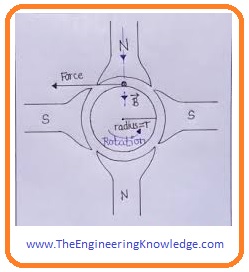
- The induced torque in dc machines depends on three main factors that are listed here.
- Flux ø in a machine.
- Armature current (IA) in the machine.
- The third is constant which depends on the structure of the machine.
- The torque induced on armature windings is equal to the product of no of conductors in the armature winding and the torque in every conductor.
- The value of torque on every conductor of the armature winding is given as.
Tcond=rIconcLB
- If the no of current paths in a machine is ‘a’ so the current IA will divide into each current path.
- So, the current in a conductor of the armature winding is given as.
Icond= IA/a
- The torque in a single conductor will be given as.
tcond= (rIALB)/a
- as the no of a conductor are ‘Z’ thus the total induced torque in the armature winding of the rotor is given as.
Tind=(ZrIALB)/a
- The flux of each pole of the machine is given as.
Ø=BAP=B(2πrL)/P
= B2πrL/P
- So, the total induced torque can be written as.
Tind =(ZP/2πa)(ØIA)
Tind=K ØIA
K =ZP/2πa
- Both the voltage and torque equations that we find are just estimations since not all conductors of the armature windings are under the effect of pole flux.
- To calculate the accurate value of internal generated voltage and induced torque, use the conductors that is under the effect of the poles, not all conductors of the armature windings.
So friends, that is the detailed post on the Internal Generated Voltage and Torque Equation of DC Machines if you have any query, ask in comments. Thanks for reading; see you in next post.