Hello, friends, I hope all of you are having fun in your life. In today’s tutorial, we will explain what a laser diode is. White light is a composite of seven colors: violet, indigo, brown, green, yellow, orange, and red. All these seven colors have different frequencies and wavelengths. Contrary to this, the normal light-emitting diode gives an output of a single color. There are numerous diodes used in electronic engineering projects and circuits, such as Zener diodes, PIN diodes, photodiodes, etc. Each diode provides its own benefits and advantages to the circuit for which it is used.
In today’s post, we will have a detailed look at the laser diode, which uses a single frequency of light for operation. It is not only used in electronic instruments but also used in the medical and optical fiber industries for the detection of diseases and faults in optical fiber. So let’s get started with what a laser diode is.
What is a laser diode?
The laser diode, also called the injection laser diode, stands for light amplification by stimulated emission of radiation.
This electronic device transforms the electrical energy provided by the input source into the beam of light.
The light beam produced by the laser is monochromatic, unidirectional, and visible.
The semiconductor material used for the construction of this diode defines the wavelength of a wave produced by the laser diode.
Nowadays, lasers are used to generate beams in the range of the infrared to ultraviolet spectrum.
A laser beam is currently used in numerous applications, such as in fiber optics for fault detection. Such pointers are manufactured that use laser, barcode readers use laser beams for a reading of data, compact disks, etc.
It can also be used for lighting purposes if phosphors are used in its construction, like in light-emitting diodes.
Working of Laser Diode
To have a detailed understanding of lasers, we must have an understanding of two terminologies: the first one is stimulated emission, and the second one is population inversion.
Let’s discuss them one by one with the detailed.
Spontaneous and Stimulated Emission
Let’s suppose that there are some free atoms in the ground state with the energy E1 and some electrons are in an excited state with the energy E2 as shown in a given figure.
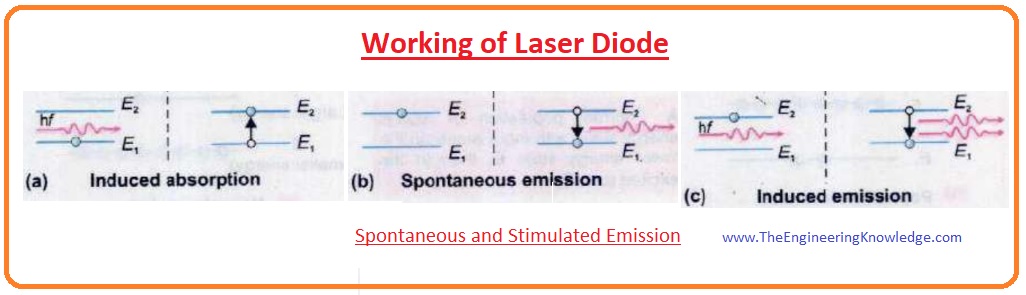
If photons of light collide on this arrangement of atoms having energy hf = E2-E1.
This photon of light can affect the atom in two ways. The first is that it can collide with the atom in the ground state, and this atom will reach an excited state.
This process is known as stimulated or induced emission, and in the figure, it is denoted as a.
When an atom moves to an excited state, then there will be two further possibilities. The first one is that it loses a photon of energy hf = E2 – E1 spontaneously and moves to the ground state, as denoted in the figure as b.
The second possibility is it may collide with another photon of energy hf = E2-E1 and move back to the ground state.
The generated photon from an atom will move in the direction of the incident photon; it is denoted in the figure as c.
We can see that for every incident photon, we will have two photons moving in a similar direction.
So we can find 2 things from this experiment: an amplified and coherent (a wave having a single wavelength) wave moving in one direction.
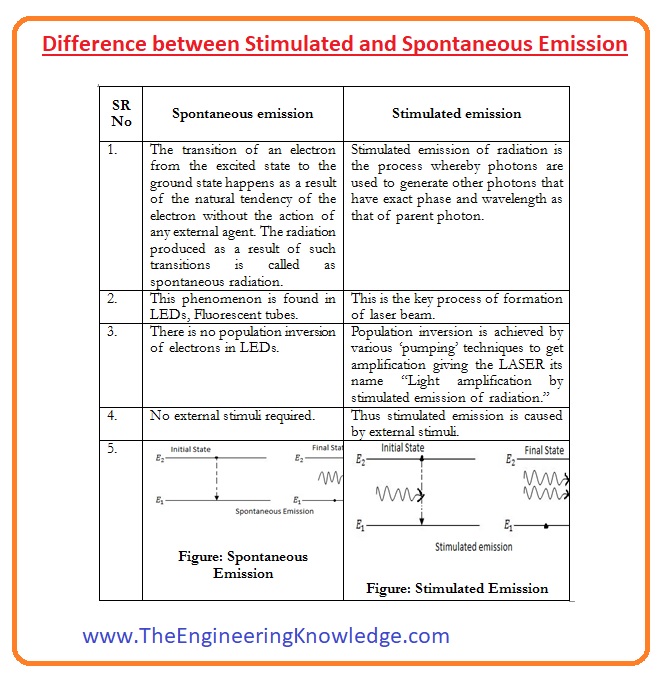
Difference between Stimulated and Spontaneous Emission
Population Inversion and Laser Action
- For practical understanding, let’s take an atom of a material that can stay in three different conditions, as shown in a given figure.
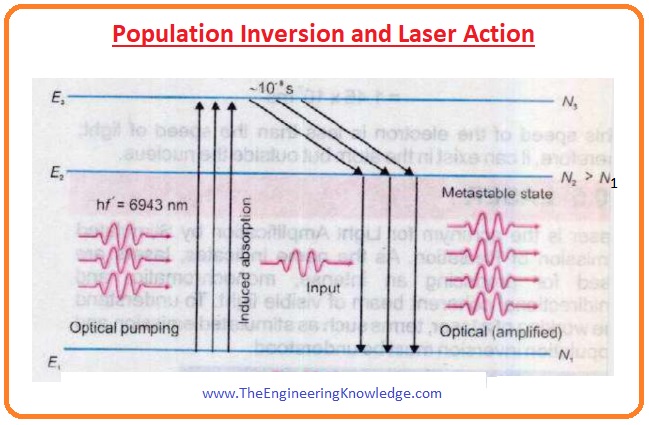
In the figure, you can see that the first state is E1, which is the ground state; the second is the excited state E3, in which the atom can stay for 10⁻⁸ s; and the third is a metastable state E2, in which the atom can stay for 10⁻³ s.
The metastable state is also an excited state where an atom resides unusually for some time interval and then spontaneously moves to a lower energy state.
The transition of an atom from or into this state is a little bit difficult as compared to other excited states.
For this reason, electrons do not directly get excited to this state but move to a higher-energy state and then move spontaneously to this state.
Let’s suppose that an incident photon of energy hf=E3-E1 moves the atom directly from the ground state to the excited state E3.
The atom then moves to a metastable state and stays there for a long time interval. The atom reaches the metastable state very quickly but leaves it after a long time.
Due to this, such a condition occurs when the quantity of atoms in the metastable state is larger than the excited state. This situation is known as population inversion.
After obtaining the metastable state, it is very easy to get the lasing action of the laser.
The atoms in the metastable state E2 collide with the external photons of energy hf=E2-E1, and the result is induced emission that causes them to emit an intense, coherent beam moving in the direction of the incident photons.
The generated photons are controlled or confined in a closed structure to further stimulated emission.
It can be done by using a mirror on both sides of the structure by making one end completely covered or reflecting and another half reflecting to provide a path for the beam to move out from the structure.
This is shown in a given figure.
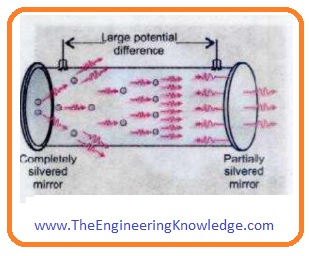
- All photons move randomly in the mirror confinement and collide with other atoms, producing a more intense and coherent beam of light.
Laser Diode Symbol
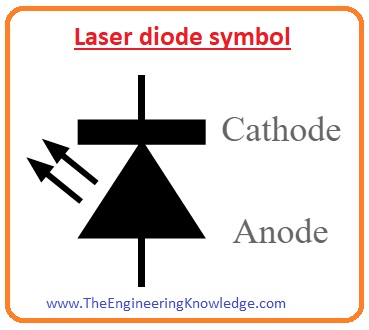
- The symbol of laser diodes used in different circuitry is similar to the light-emitting diode.
- The arrowhead on the symbol of a diode defines the light emitted from the diode.
Laser Diode Characteristics
- These are some characteristics of a laser diode.
Monochromatic:
The light beam produced by the laser is monochromatic, meaning it has a single color.
Unidirectional:
The beam produced by this instrument moves in a single path or unidirectionally; due to this feature, it is used in optical fiber for fault detection.
Coherent:
The light beam produced has a single wavelength.
Laser Diode Hair Removal
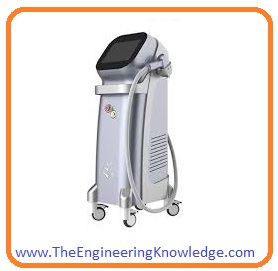
Laser diode uses the SPTL (selective photothermolysis) to hit the chromophores in the skin, usually found in blood.
The laser beam removes the chromophores by heating them and does not affect nearly all tissues.
When it is used to remove unwanted hair, the melanin existing in hair follicles is only damaged by the light beam, and it stops the further growth of hair on that part of the body.
The use of cooling technology with the laser diode for decreasing pain makes this treatment more effective and increases its efficiency.
Types of Laser Diodes
These are some types of laser diodes that are described in detail.
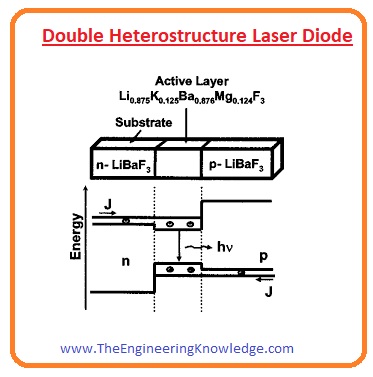
Double Heterostructure Laser Diode:
This diode is manufactured with sandwich-like arrangements in the center; a substance of a lower bandgap is placed, and both sides of material of a high bandgap are assembled.
Due to different layers of different material, it makes 2 heterojunctions. Normally used substances are gallium arsenide and AlGaAs.
The benefit of double heterojunctions is that the portion where electrons and holes are present together is constrained by the thin central layer.
It provides more electron-hole pairs for the amplification process.
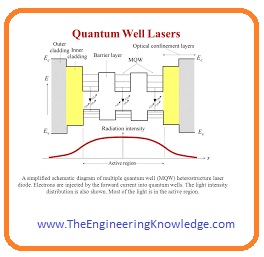
Quantum Well Laser Diode
- This diode has a thin central layer that works like a quantum well (a quantum well is a potential well that has discrete energy values).
- As the quantum well is square-like in shape so it confine electrons at energy levels that are necessary for laser operation and it also enhances the efficacy.
- With single quantum well diodes, multi-quantum well diodes are also available that enhance the overlapping among the gain portion and the optical waveguide mode.
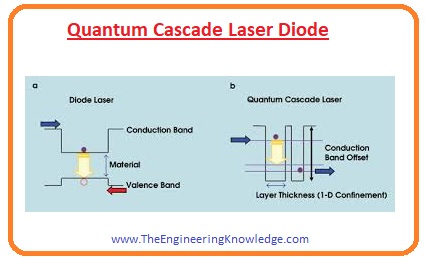
Quantum Cascade Laser Diode
- A quantum cascade laser diode is a heterojunction diode that uses transitions between energy levels to help the production of a laser light beam.
- It produces a longer wavelength and the product wavelength can be controlled by varying the thickness of the diode layer.
Separate Confinement Heterostructure Laser Diode
This type of laser diode has been mostly used from the year 1990. It resolves the problems that occur in other diodes.
In other diodes, due to the thin central light, it is not confined properly, but these diodes confine light effectively.
For confinement of light into the diode, this diode has 2 exterior layers with the less refractive index value.
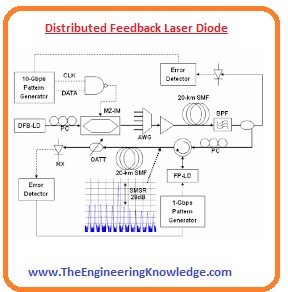
Distributed Feedback Laser Diode
This diode is mostly used in signal transmission systems, such as in optical fiber.
The problem is that the wavelength of this diode is affected by the external environment temperature, etc.
To stabilize, the wavelength of the beam diffracting grating is placed near to the PN junction of this diode.
This grating work, like an optical filter, directs the single wavelength to gain a portion of the diode.
So the grating delivers the feedback that is necessary for the lasing action of the laser.
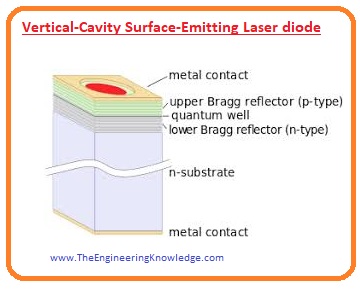
Vertical-Cavity Surface-Emitting Laser diode
- This diode emits waves from the surface at an angle of ninety degrees and provides some mWs with high beam quality.
- The length of the active part of this diode is less the lateral so waves come out through surface then the from the edges.
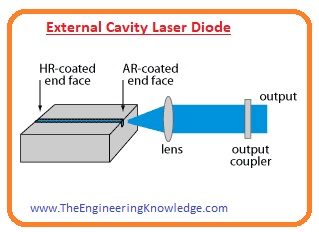
External Cavity Laser Diode:
- This diode comprises a laser diode having a larger laser cavity as a gain medium.
- This diodes is a wavelength variable and display less size spectral lines.
Read also
- What is a Rectifier Diode? Symbol & Uses, Applications
- Introduction to FR102 Diode Pinout, Datasheet, Applications, Uses Features
- Forward biased p-n junction diode
- Difference between Normal Rectifier Diode vs Schottky diode
So, friends that is the detailed post on the laser diode I have mentioned each and every parameter related to laser diodes. I tried my level best to make this post simpler for you if you still have any questions, ask in the comments. I will solve your queries. Thanks for reading. See you in the next tutorial. Have a good day.