Hello, friends, I hope all of you are having fun in your life. In today’s tutorial, we will have a look at wave winding in DC machines. In an electrical system, DC machines are such devices that generate and use DC current. There are numerous parts of these machines, like the stator, rotor, brushes, etc. The most important parts of these machines are the windings, especially the windings wound on the rotor.
The windings of the rotor have many types according to their structure, arrangements, and connection with the commutator, like lap winding, frog-leg winding, and wave winding. In today’s post, we will have a detailed look at wave windings, their design, and connections with the commutators and how many parallel paths are available for the current in this winding. So let’s get started with the lap winding.
Wave Winding in DC Machines
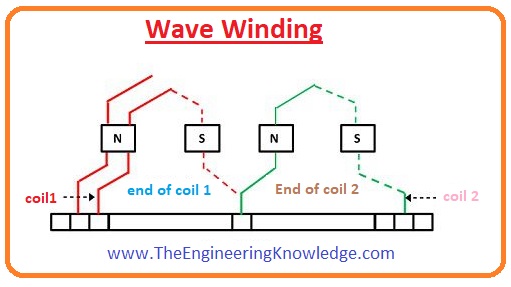
- The wave winding is a kind of rotor winding that provides only 2 current paths. In this winding, the endpoint of the first winding is linked with the initial point of the second winding at the neighboring commutator.
- The other name of this winding is a series winding in the given figure, you can see the machine having 4 no of poles and wound with a simple wave winding.
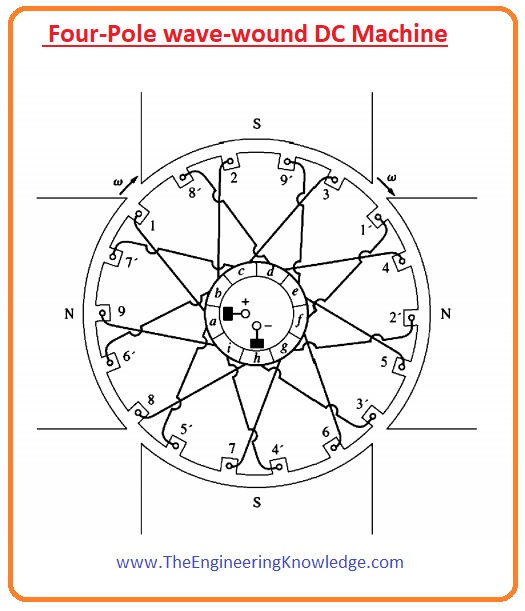
- In this winding, each rotor coil is attached back to a commutator contiguous to the start of the ist coil.
- So there are 2 coils in sequence among the neighboring commutators. Moreover, as every couple of coils among adjacent commutators has a side below every pole, all output voltages are the addition of the effects of each pole, and there can be no voltage unbalancing.
Progressive lap winding
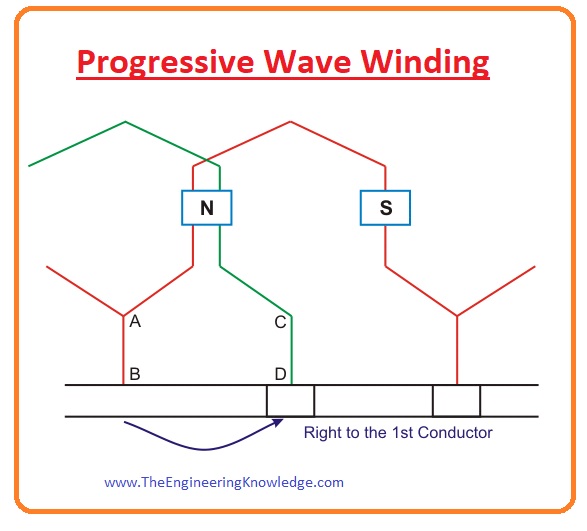
- If the endpoint of one coil and the starting point of the second coil is linked with the same commutator, then this type of winding is known as progressive lap winding.
Retrogressive lap winding
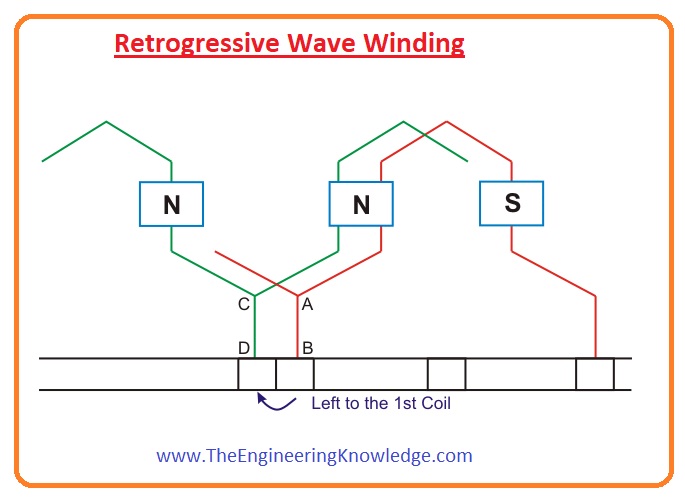
- If the endpoint of two winding is connected to the same commutator, then this type of arrangement is known as retrogressive winding.
- In simple words, we can explain that if the no of poles in a machine is ‘P’ then P/2 coils are arranged among neighboring commutators.
- If (P/2)th windings are linked with the commutator ahead of the ist coil, then the winding is progressive.
- If (P/2)th coil is associated with the commutator behind the ist coil, this winding is known as
- Simplex wave winding provides the 3 current paths. Half the winding is in the first current path and another half in a second parallel path. The brushes will be placed a full pole pitch away from one another.
What is the commutator pitch for a wave winding?
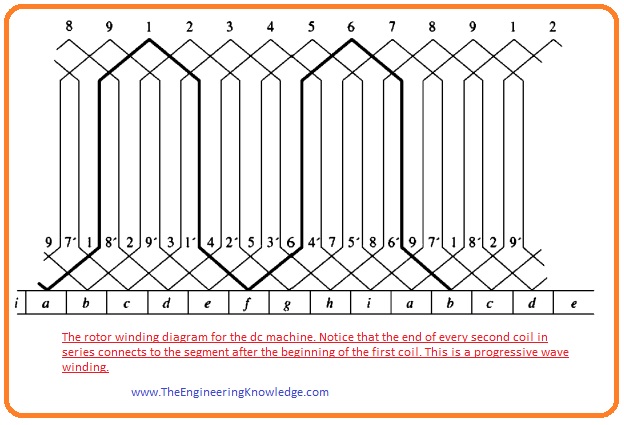
- In the given figure, you can see that a progressive winding having 9 coils has been wound on the rotor of 4 poles dc machine. The ending point of a coil is at the 5 points ahead from the initial point.
- While in retrogressive winding the ending point of the windings lies 4 commutator segments down from the initial point.
- So, the ending point of a coil in a 4-pole wave winding should be associated just beforehand or just afterward the point midway around the loop from its initial point.
- The formula for the commutator pitch in any simplex winding is given as.
Yc = 2(C+-1)/P , simplex wave
- In this equation, the C is the no of coils on rotor and P is no of poles.
- In this equation, the (+) sign is for the progressive winding and (-) sign for the retrogressive winding.
- In this given below figure simplex wave winding is drawn.
As we discuss in wave windings, there are only 2 current paths, so 2 carbon brushes are required to get current out of the machine.
It is due to the commutators that perform commutation (converting AC into DC) that link the points with identical voltage underneath all the poles.
Extra brushes can be connected at the electrical angle of one eighty degrees if required in a machine, as they have the same value of voltage and are linked with one another through a wire that is doing commutation.
Additional carbon brushes are normally inserted into machines having wave winding, but they are not necessary for machines, as they decrease the quantity of current that should be passed through the brushes.
Wave winding is the best choice for high-rating DC machines, as no windings in sequence among the commutators allow the large value of the voltage to generate effortlessly, while in the case of lap winding it is difficult.
Multiplex Wave Windings
It is winding that has large no-winding sets on the rotor; these additional windings have 2 current paths separately. Thus the number of current paths on the multiplex wave winding can be fined as.
a =2m multiplex wave
That is the detailed post about the wave winding in the dc machine. I have explained this winding with the detailed if you have any queries ask in the comments. Thanks for reading see you in the next tutorial. Have a good day.