Hello, fellows, I hope all of you are having fun in your life. In today’s tutorial, we will discuss the difference between N- and P-type semiconductors. Semiconductor substances are materials that have conductivity properties between conductors and insulators. Their conductance is restricted due to the small number of free electrons and holes in the valence band. A pure semiconductor material is mixed or doped with other materials to create free electrons and holes for conduction.
The addition of another material to the semiconductor is called doping, and the material created is known as a doped substance. There are two types of elements created after the addition of external atoms. The first one is N-type, and the second one is P-type. In today’s post, we will have a look at these semiconductor materials in detail and compare their properties and features. So let’s get started with the difference between N- and P-type semiconductors.
Difference between N and P-Type Semiconductors
N-Type Semiconductor
For the increment in conductive electron elements from group five of the periodic tables, they are doped with pure material semiconductors like antimony, phosphorus, arsenic, etc.
All these groups have five elements with five electrons in their valence shell.
In the given figures, you can see that the 4 electrons of group five-element are making a covalent bond with the four neighboring atoms of silicon, and one electron of the antimony that is pentavalent is released free.
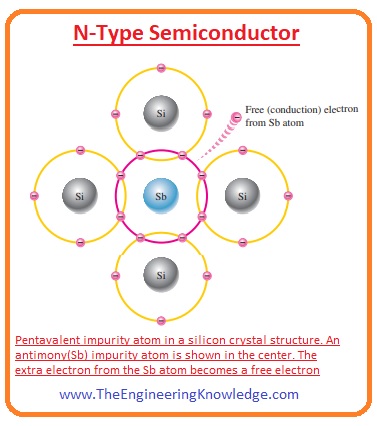
The fifth electrons move freely in the structure, and current flows due to these electrons. Due to the releasing of an electron, a pentavalent atom is called a donor atom.
The number of free electrons can be varied by changing the doping material. These free electrons also do not make a hole in the material since these electrons are freed from the pentavalent impurity that is the extra electron.
Majority and Minority Carriers in N-Type
As mostly charge carriers in n types are electrons, as free electrons are created with the addition of a pentavalent impurity atom.
With the electrons there are some holes also created due to the creation of electron-hole pairs; these holes are minority carriers in N-type materials, and electrons are majority charge carriers.
P-Type Semiconductor
If semiconductors are doped with the elements of group three of the periodic table, then P-type semiconductors are formed.
The elements of group three are boron, gallium, indium, etc.
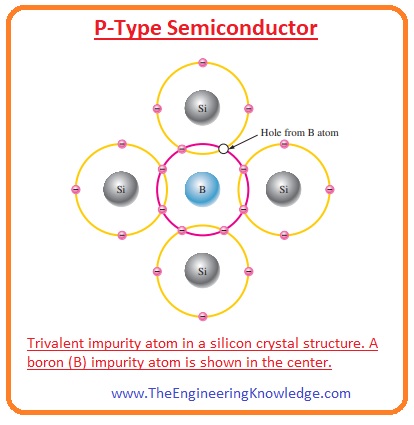
If we dope silicon with a trivalent impurity, then three electrons of the impurity make a covalent bond with the three electrons of silicon, and the hole is generated due to one remaining electron.
In the given figure, the impurity atom is boron, which is a P-type material with the silicon atom.
In P-type substances, the number of holes can be varied by varying the trivalent impurity amount.
Majority and Minority Carriers in P-Type
- As with the addition of a trivalent impurity, holes are created so the majority of carriers in P-type semiconductors are holes and free electrons are also created due to the thermal creation of electron-hole pairs.
- The important thing to keep in mind is that these electrons are not created due to the addition of a trivalent.
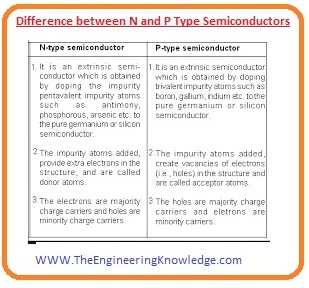
N-Types Vs P-Types Semiconductors
| P-Type | N-Type |
| When a member of group three is added as an impurity substance in a semiconductor, then P-type material is formed. | When an element of group five of the periodic table is doped into the semiconductor, then the N-type semiconductor is formed. |
| An impurity in this material can take an electron so it is called an acceptor atom. | In these materials, impurity provides electrons so this atom is known as the donor atom. |
| Impurities added in these substances are aluminum, gallium, etc. | These materials have impurities like phosphorus, antimony, bismuth, etc. |
| In P types substance holes are the majority carriers. | In N-type materials, electrons are the majority carriers while holes are the minority. |
| In these materials, the density of holes is larger than the density of electrons. | These substances have a larger density of electrons compared to holes. |
| The energy level of the impurity is close to the valence band and distant from the conduction band. | In these substances, impurity or donor atoms have energy levels near to the valence band and distant from the conduction band. |
| The Fermi level of these semiconductors is between the impurity energy level and the valence band. | These materials have Fermi levels between the impurity energy level and the conduction band. |
| In these substances, the majority of carriers move from high to low potential. | The majority carrier moves from less to high potential. |
Faqs
What are the differences between intrinsic and extrinsic semiconductors?
The difference between intrinsic and extrinsic materials is doping and charge carriers. The semiconductor for intrinsic form is pure material, and for extrinsic, it comes with impurities and doping agents.
What is the principle of intrinsic semiconductors?
Intrinsic semiconductors are undoped materials meaning holes in the valence bonds are spaces created by electrons that move to the conduction band and oppose the doped semiconductors where holes or electrons are provided through external atoms working as an impurity.
So, friends, that is the detailed post on the difference between N-type and P-type semiconductors. I tried my level best to make this post simpler and easy for you to understand. If you still have any query ask in the comments. Thanks for reading. In the next article, I want to shift our focus to another exciting field: aerospace engineering. Have you ever wondered why aerospace engineering is important? Aerospace engineering plays a crucial role in our society, making significant contributions to various aspects such as air travel, space exploration, and national defense. Its significance lies in the fact that it empowers us to venture beyond our planet, enhance connectivity and communication, and uphold national security.”