Hello, fellows, I hope all of you are having fun in your life. In today’s tutorial, we will discuss the conductivity of semiconductors. The number of electrons present in any substance defines the conductance of that material. Elements that show a high value of conductance has a large number of electrons, such as conductors. While the material has fewer or zero free electrons, it also has less value of conductance and is called an insulator.
In semiconductors, the number of free electrons is between conductors and insulators, so their conductivity is also between conductors and insulators. In today’s post, we will have a detailed look at the conductance behavior of semiconductors and will explain which factors play roles for conductance in these materials. So let’s get started with the conductivity of semiconductors.
Conductivity of Semiconductor
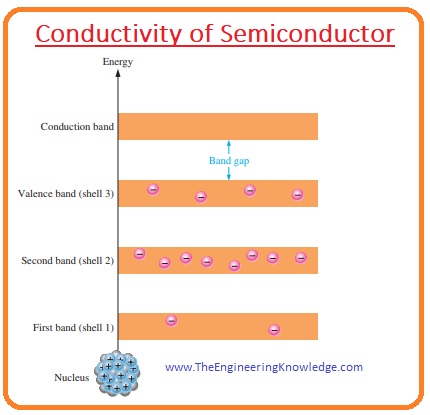
As we know, in every atom there are certain shells or energy levels; each shell has a specified number of electrons.
Every shell is a certain distance from its neighboring shell; this gap between two shells is called the band gap, and there are no electrons residing in this band.
In the figure below, you can see the energy diagram of a pure silicon atom that is in a non-excited state, and there are zero electrons in the energy band.
Such a state exists at a 0-K temperature, which is the absolute temperature.
Conduction Electrons and Holes
In pure or intrinsic silicon material at normal temperature, outermost or valence shell electrons have enough energy to cross the band gap and move to the conduction band.
The electron after removal from the shell is called a conduction electron.
This arrangement is shown in the given figure.
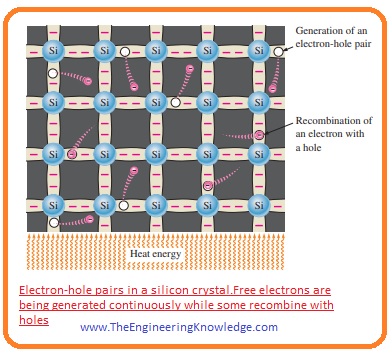
After the movement of an electron from the valence shell to the conduction band, there is free space created called
Each electron moved from the valence shell to the conduction band; there is a hole created, and also an electron-hole pair is made at the valence shell.
If an electron in the conduction band loses energy, then it comes back to free space created after moving to the conduction band.
This phenomenon of creation of holes and electron pairs is shown in a given figure.
Electron and Hole Current
- If we apply a power source to the pure silicon crystal, then electrons in shells will gain energy and move to the conduction band.
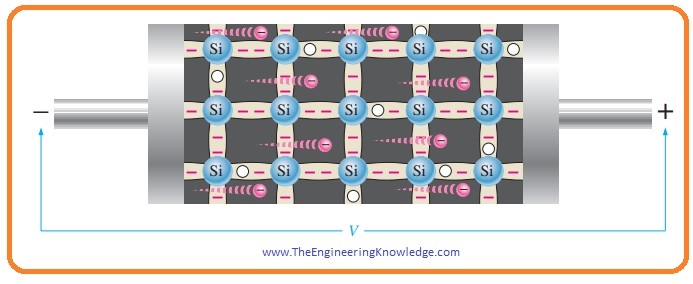
- These free electrons will move to the positive terminal of the battery; this movement of electrons in a semiconductor substance is called electron current.
- When electron left their respective place hole created due to this hole creation, current flows in the substance.
- Some electrons in valence shells that not have a high value of energy do not move to the conduction band but they can move to their adjacent hole created by the high-energy electron.
- When an electron move hole is created in its place; that way, holes also move, and current will flow due to these holes.
- This configuration is shown in a given figure.
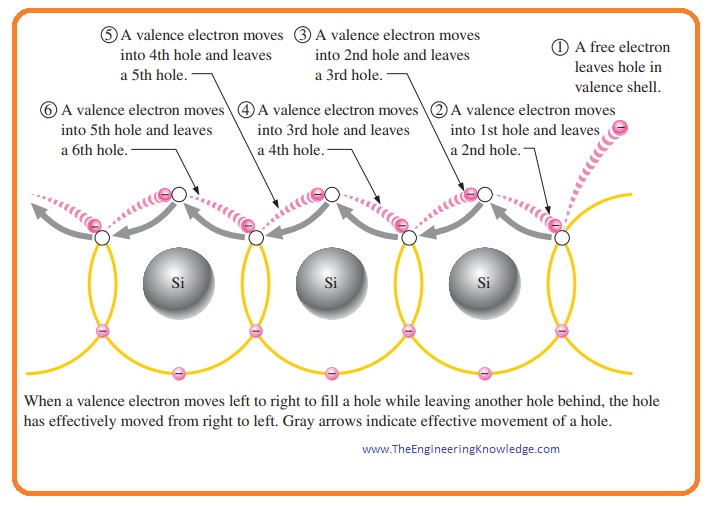
In valence electrons, current flows due to the holes called hole current.
So we can conclude that current in semiconductors is flow due to the free electrons and holes; these holes are spaces created by the moving electrons in opposite directions.
It is very informative to compare the current movement in conductors and semiconductors. In semiconductors, the current flows due to the 2 charges, while in conductors, current flows due to one type of charge, like in copper.
The atoms in copper make a different category of crystal in which the atoms do not have a covalent bond with one but comprise numerous positive ions.
What is conductivity and mobility?
In doped extrinsic semiconductor materials, conductivity can change based on types and concentrations of dopants. Mobility defines how fast charge carriers can move in semiconductors when an electrical field is provided.
Why does the conductivity of a semiconductor increase with a rise of temperature?
The gap between the conduction band and valence band is less for semiconductors. So electrons from the valence band move to the conduction band when temperature increases. So conductivity increases with temperature increases.
Which semiconductor has higher conductivity?
- The conductivity of extrinsic semiconductors is higher as compared to intrinsic materials. Since for intrinsic material, carriers are thermally generated carriers
What is the conductivity of a semiconductor?
- The conductivity of the semiconductor is based on the sum of multiple of hole concentration and hole mobility, and the product of electron concentration and electron mobility.
What is the relationship between conductivity and temperature?
- When temperature increases, the vibration of metallic ions also increases. In a result, the resistance of the metal increases, and conductivity. For electrolyte conductors, ions are charge carriers and as temperature increases, ionization increases and decreases in conductivity.
Read also
- What is Semiconductor? Working, Types, Features, & Uses
- Difference Between Semiconductors and Superconductors
- Differences Donor and Acceptor Impurities in Semiconductor
- Difference between N and P Type Semiconductors
- Difference Between Conductor, Insulator and Semiconductor
- Aluminum Nitride Ceramic PCB
That is a complete post on the Conductivity of semiconductors. If you have any questions, ask in the comments. See you in the next tutorial.