

Hello, fellows, I hope all of you are having fun in your life. In today’s tutorial, we will discuss the difference between conductor, insulator, and semiconductor. There are 3 types of material according to their electric behavior and features. The first one is an insulator, the second one is the conductor, and the third one is a semiconductor. All these categories show different electrical behavior according to their structure and availability of free electrons.
In any solid pattern, the atoms are arranged in a symmetrical fashion. There are some types of bonds, like an ionic bond, a covalent bond, etc. In any crystal, atoms are joined with one another by covalent bonds. This bond is created among the outermost electrons, or valence electrons, of an atom. In today’s post, we will have a detailed look at conductors, insulators, and semiconductors and compare their different properties and also discuss the role of these materials in electronic materials. So let’s get started with the difference between a conductor, an insulator, and a semiconductor.
Difference Between Conductor, Insulator, and Semiconductor
Every substance is created with the atom; these atoms explain the electric features of any substance and also explain the conductance of that substance.
To an understanding of the electrical behavior of any substance, we can draw a physical structure of an atom that consists of valence shell electrons and internal shells and a nucleus.
In the given figure, you can see the carbon atom in the above to explain the structure.
You can see in the given figure that the carbon atom consists of 4 electrons in the outermost of the valence shell and 2 electrons in an inner shell.
In the nucleus of the carbon atom, there are 6 protons and 6 neutrons; six define the positive charge of 6 protons.
The net charge on the core of the carbon atom is plus four.
What is an insulator?
Such substances that show a high value of resistance for movement of current under normal situations are called insulators.
These insulators are available in a single element or compounds and provide a large value of resistance.
The outermost electrons, or valence shell electrons, are strongly fastened to the structure of the substance, and there are no free electrons for conduction or flow of current.
Examples of insulators are quartz, mica, plastic, rubber, etc.
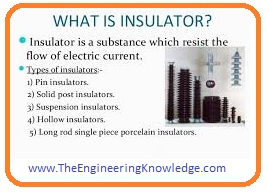
Applications of Insulator
Rubber is a very common insulator material used in different clothes; tyres are constructed with rubber, etc.
Porcelain is an insulator material used for the construction of bushings to provide insulation between different conductors.
What is a conductor?
Conductor features are the reverse of insulators; there are a lot of free valence electrons in their valence shells for conductance.
The examples of these substances are iron, copper, silver, gold, etc.
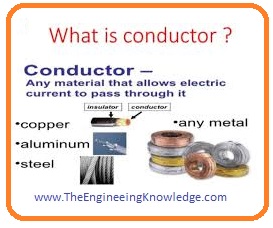
Applications of Conductors
These are some applications of conductors.
Iron is a very common conductive material used in different devices like the engine of vehicles for the conduction of heat.
Silver is used in transmission lines for the transfer of power and in different electrical machines, either DC or AC, like an induction motor, an induction generator, a synchronous motor, or a synchronous generator, all of which consist of copper windings that are conductors.
Aluminum is also a conductor that is used in different cooking devices that absorb heat for cooking purposes.
What is a semiconductor?
Semiconductors show conductance behavior between insulators and conductors. These are also known as semiconductors.
Intrinsic or pure conduction semiconductors do not show conductive behavior and also do not show insulating behavior.
With the increment of temperature or external supply source, they start their conductance.
Examples of these materials are silicon, germanium, arsenic, etc.
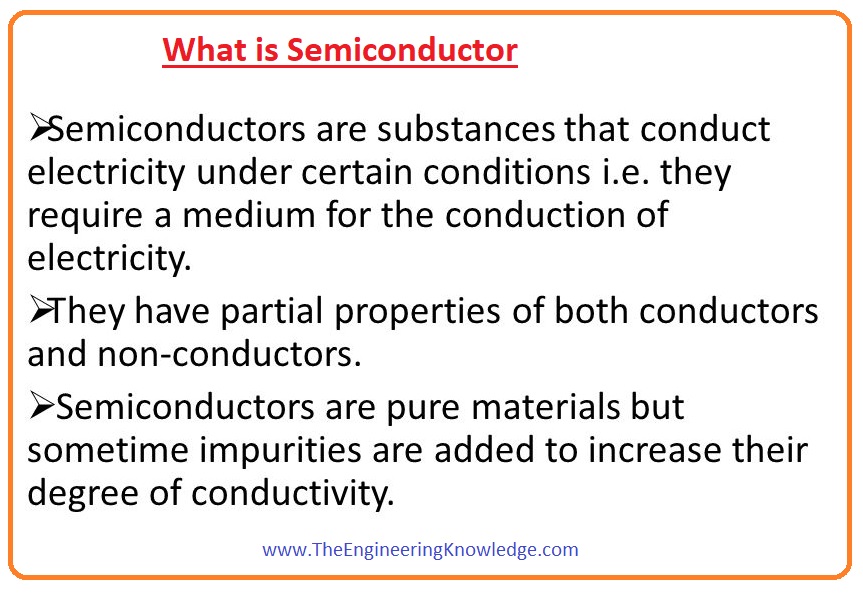
Applications of Semiconductor
- These are different types of semiconductor materials that are used in different circuits, such as a transistor diodes.
- Transistors are used for switching and amplification circuits, and diodes are used for rectification purposes.
Conductors Vs Semiconductors Vs Insulators
| Conductors | Semiconductor | Insulator |
| A conductor is such a substance that allows current to flow through it. Like iron, aluminum, and copper. | Semiconductors are such materials that show conductivity behavior between conductors and insulators. Examples are silicon and germanium. | Such substances that provide a high value of resistance for current movement are called insulators. Rubber, mica, etc. are examples. |
| The conductivity of these materials is very high. | This substance shows conductive behavior between conductors and insulators. | Their conductivity is zero. |
| This substance has no forbidden gap. | Their forbidden gap is less. | These materials have a very high forbidden gap |
| The resistance of these materials is very less. | These materials show a moderate value of resistance. | The resistance of this substance is very high. |
| The temperature coefficient of these substances is positive. | The temperature coefficient of these substances is negative. | The temperature coefficient of these substances is also negative |
| The conductivity value for these substances is 10-7 mho/m. | The conductivity value for these substances is 10-7 mho/m to 10-13 mho/m. Medium | The conductivity value for these substances is 10-13 mho/m. That is very less. |
| In these substances, there are many electrons for conduction. | Fewer electrons for conductors. | Almost zero electrons for conduction. |
| The resistivity of these substances is less than 10-5 ohm meter | The resistivity of these substances is between 10-5 ohm meter and 105 ohm meter. | The resistivity of these substances is greater than 105 ohm meter |
| In these substances, there is only one electron in valence electron. | These materials have 4 electrons in the valence shell. | These materials have eight electrons in the valence shell. |
| In conductor’s valence and conduction bands overlap with each other. | In these materials, the valence and conduction bands 1.1ev energy difference. | Valence and conduction bands are separated from each other 6ev to 10ev. |
| In conductors, a metallic bond is excited. | Semiconductors consist of covalent bonds. | Insulators have ionic bonds. |
| Their examples are iron, copper, gold. | Silicon and aluminum are examples of semiconductors. | Mica, rubber, and wood are insulators. |
Band Gap
- As we know the valence shell of an atom defines the band of energy that tells about any electron in the valence shell for required energy.
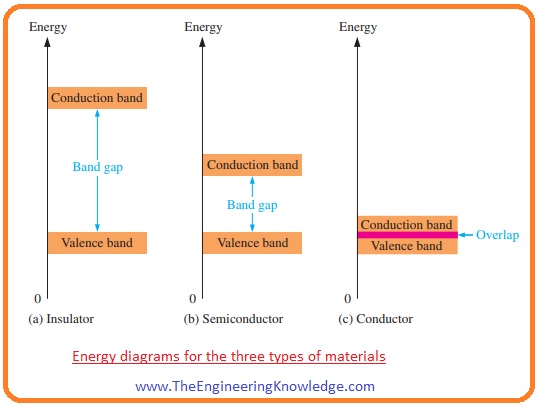
When a valence electron gets specific energy, it will leave the valence electron and move to the band called the conduction band.
The energy required for an electron to move from a valence shell to a conduction band is called the band gap.
When an electron moves to the conduction band, then it can easily move freely in the atom.
In the given figure, you can see the energy diagrams of conductors, insulators, and semiconductors.
We can also define the band gap as the energy difference between 2 energy levels that an electron should have to move between.
In the case of insulators and semiconductors, there are no electron exits, while in conductors, electrons exit or may not exit due to free movement of electrons.
If we apply a high voltage across the insulator, then it will be possible for an electron in an insulator to cross the band gap.
In the above figure, the insulator band gap is explained.
In the case of semiconductors, you can see the band gap is smaller, so in semiconductors, less energy is required for an electron to cross the band gap.
If we observe the conduction band, then you can see that the conduction band and valence band are overlapping with each other, so there is less amount of energy required for electrons to move from the valence to the conduction band.
Comparison of a Semiconductor Atom to a Conductor Atom
- Now we do a comparison between two atoms the first one is from a conductor and the second one from the semiconductor.
- For this, we take silicon as a semiconductor and copper that is a conductor. In given image, both atoms are shown.
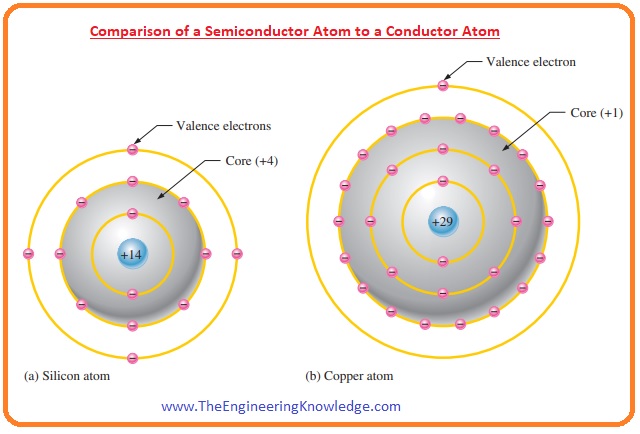
You can see that the total charge on a silicon atom is four, while on the carbon it is one.
The valence electrons of a copper bear force of attraction from one side, while in silicone, at valence electrons, four attractive forces are applied.
So we can say that at the valence electron of silicon, four attractive forces are applied.
The valence electron of copper is in the 4th shell, while silicon’s valence shell is in the third shell.
As we know that electrons at a larger distance from the center have a high value of energy, the energy of the copper valence electron is larger than the energy of the silicon atom.
So after getting less amount of energy in copper atom, electrons will leave the shell, while in silicone, a large amount of energy is required.
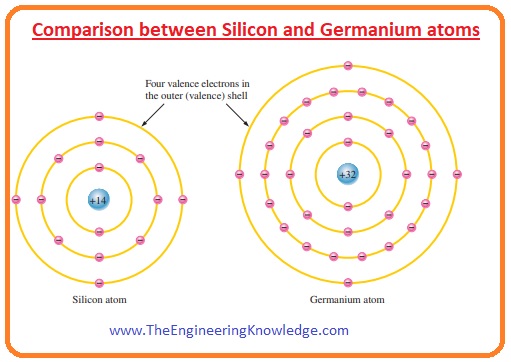
Comparison between Silicon and Germanium Atoms
The internal structure of silicon and germanium atoms is shown in the figure below.
You can see that the total charge on a silicon atom is four, while on the carbon it is one.
The valence electrons of a copper bear force of attraction from one side, while in silicone, at valence electrons, four attractive forces are applied.
So we can say that at the valence electron of silicon, four attractive forces are applied.
The valence electron of copper is in the 4th shell, while silicon’s valence shell is in the third shell.
As we know that electrons at a larger distance from the center have a high value of energy, the energy of copper valence electrons is larger than the energy of silicon atoms.
So after getting less amount of energy in copper atom, electrons will leave the shell, while in silicone a large amount of energy is required.
Comparison between Silicon and Germanium Atoms
The internal structure of silicon and germanium atoms is shown in the figure below.
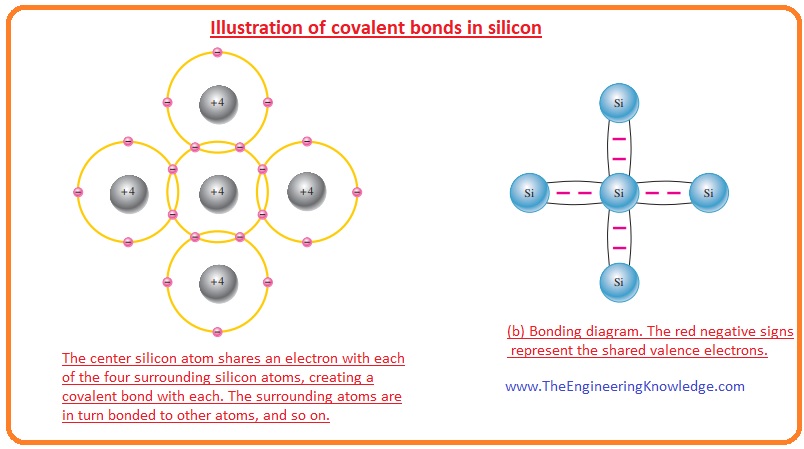
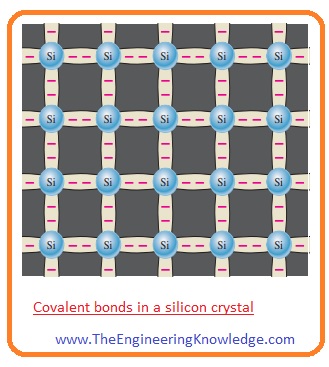
- Four valence electrons of silicon atoms are paired with the other four electrons of another atom and this makes all silicon atoms stable.
- This sharing of valence electrons makes the covalent bonds that make a strong connection among atoms of silicon.
- The covalent bond of a pure or intrinsic atom is shown in a given figure. Covalent bonding of germanium is also similar to that of silicon because there are 4 electrons in valence shell of germanium.
Read also
- What is Semiconductor? Working, Types, Features, & Uses
- Differences Donor and Acceptor Impurities in Semiconductor
- Conductivity of Semiconductor
- Difference between N and P Type Semiconductors
So friends this the detailed post Difference Between Conductor, Insulator, and Semiconductor I have mentioned each and every factor related to these materials. If you still have any query ask in comments. See you in the next tutorial.




Hi Sir, I have searched many online materials to learn this concept. But I haven’t found an explanation for this concept with this much clarity anywhere. Thanks for sharing your knowledge with us.