
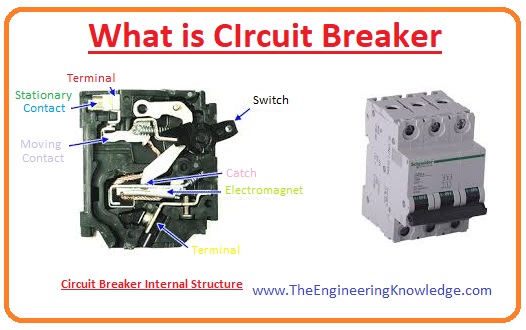
Hello, friends, I hope all of you are enjoying your life. In today’s tutorial, I am going to explain what a circuit breaker is. The first-time circuit breaker was invented by Tomas Edison (who was the inventor of the United States of America) in 1879. He used this circuit breaker in lighting circuitry to minimize short circuits and overloading. Before the invention of a circuit breaker, fuses were used in different circuits, but in large power and grid systems, these fuses did not operate well and did not provide protection to huge circuitry. In the grid station, where a large number of high-rated generators of high ratings are linked, these circuit breakers are necessary to break the faulted component from the circuitry.
Nowadays, from every simple circuit to complex circuits, from our house wiring to large buildings’ electrical wiring or generation systems, distribution systems all use a circuit breaker to protect their loads from short circuits or overloading conditions. There are many types of circuit breakers, like miniature circuit breakers, SF6, oil circuit breakers, air circuit breakers, and vacuum circuit breakers. In today’s post, we will have a look at circuit breaker construction, principles, applications, types, and some related parameters. So let’s get started with what a circuit breaker is.
What is a circuit breaker?
The circuit breaker is an electrical device that is used in a circuit to provide protection from different faults like a short circuit; it breaks the circuit when a fault occurs.
It operates both mechanically and automatically; its construction is such that it automatically breaks circuits.
During the construction of the breaker, it keeps in mind at which current value it will operate, as nowadays such circuits are working in our power system that needs a high-accuracy circuit breaker.
In simple words, the main operation of a circuit breaker is to stop the flow of current when a fault occurs.
Its advantage over a fuse is that after its operation to remove a fault, it starts operating again, while the fuse must be changed after fault detection.
There are numerous ratings of circuit breakers available for small-sized devices that use less current to larger circuits like switchgear panels that use high voltage.
If we look at its operation, then it is known as OCPD (overcurrent protection device).
Working of Circuit Breaker
The operation of the circuit breaker is simple; it first of all senses when a fault occurs in the circuit.
In small circuits or lower voltage rating breakers, sensing of the fault is done by the breaker itself, and then it breaks the circuit.
Normally, heating is produced by the large current of the fault used for that detection purpose.
While in large circuits or in grid stations for sensing, fault protection relays are used that detect a fault and send a signal to the breaker, and then it breaks the circuit.
For this large system, there is a need for a separate power source like a battery, but some circuit breakers get their supply from current transformers.
After sensing the fault occurring in a circuit, the connections of breakers get separated; for this contact separation, mechanical energy provided by the spring or compressed air applies force on these contacts to open.
The magnetic field produced by the fault current is also used for the tripping of the breaker.
In smaller circuit breakers, there is a manually operated lever installed to remove the load or again join the contacts that separated during a fault.
While in larger circuit breakers, motors are installed to provide energy to the spring that was used during tripping.
- The breaker’s contact has the ability to bear the heat produced during fault and can also bear the heat of the arc then generates during the breaking of the circuit.
- For that purpose, the materials used for the construction of breaker contacts are copper, silver, or some other material that can bear high temperatures like alloys of metals.
Circuit Breaker Working Principles
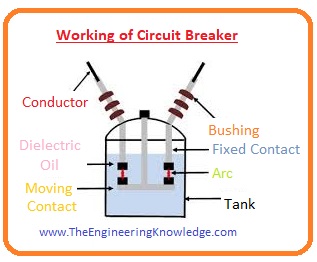
2 main contacts in a circuit breaker are fixed contacts and movable contacts.
When the breaker is closed, that is a normal condition; the contacts touch each other and carry current.
In a closed breaker, current-carrying contacts are called electrodes that work with each other due to the pressure of the spring.
Switching and maintenance of the system is looked after by opening or closing the arms of a breaker. The breaker is opened through a pressure application to trigger.
If there is a faulty current passing through any component of a system, the trip coil of the breaker is energised and moves it to an open circuit.
Circuit Breaker Ratings
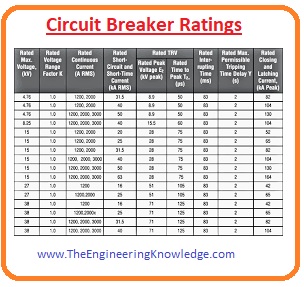
The circuit breakers are constructed with different ratings according to their applications and the circuits for which they will be installed.
The ratings of MCB (miniature circuit breaker) are fixed; if we want to vary its rating, then there is a need to change the complete structure of the breaker.
But larger-rating breakers have the ability to change their operating rating. Let’s suppose we have a breaker of four hundred ratings; it can also be set to operate at a three hundred-ampere current.
Circuit Breaker Tripping Principles
The circuit breaker comes with two different tripping principles for protecting the circuit.
Thermal protection that causes circuit interruption for overheating
The protection design through the electromagnet principle is due to short circuits.
If the breaker is in the ‘on’ state, current flows from the lower terminals to the bimetallic strip to the electromagnetic coil and then to the moving contact and stationary contact and to the upper terminal.
Phenomenon of arc formation in circuit breaker
If a fault exists in high current flow through the contact with the breaker. This contact separates, resistance increases, and a high current generates high heat. This heat ionises air or oil, and as a result, an arc is generated between the contacts of the breaker. Two methods can be used to extinguish the arc.
Increases resistance
This method is used for the DC circuit breaker, and the current is decreased to a value that does not maintain the arc. It is done through increasing resistance arc by separating the contacts effectively or by splitting arc with the use of conducting pieces between the contacts.
Zero current method
This method is used for extinguishing arcs in AC breakers. The current becomes zero after each half-cycle, and at that time arc is removed.
Circuit Breaker Types
Different types of circuit breakers are classified according to structure, tripping type, and voltage ratings.
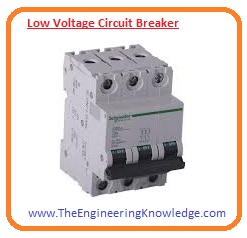
Low-voltage circuit breaker
Lower voltage circuit breakers are normally used in our homes, offices, and some small industries. Some small rating circuit breakers are discussed here.
MCB (Miniature Circuit Breaker): The rating of this breaker is one hundred twenty-five amperes. The tripping current of this breaker is not adjustable.
MCCB (Molded Case Circuit Breaker): The rating of these breakers is sixteen hundred amperes. Its operation is thermal and non-thermal.
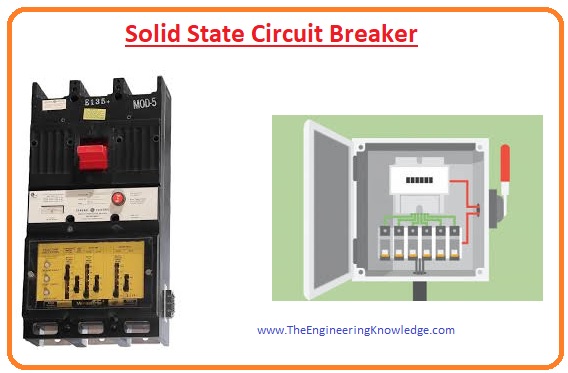
Solid-State Circuit Breaker
- This type of circuit breaker is a new invention in circuit breaker categories that changed from mechanical to electrical. Another name of a solid-state circuit breaker is a digital circuit breaker.
- It provides many benefits over other breakers like its operating time is fault-detecting, its fault-detecting power is also high its operating life is also longer.
Magnetic circuit breakers
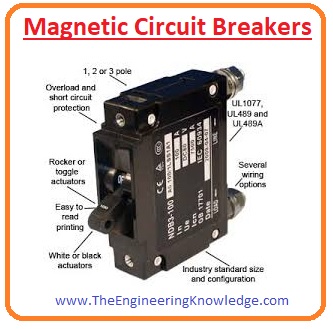
This type of circuit breaker uses a solenoid for tripping purposes to disconnect connections; the force used for disconnection depends on the amount of current.
In some circuit breakers, instead of a solenoid, electromagnetic force is used for tripping.
The contacts of the breakers are fastened to each other through a latch. With the increment of a current due fault, the solenoid’s pull releases the latch due to the connections of breakers getting off.
The breakers are mostly used in the United States of America.
Thermal-Magnetic Circuit Breaker
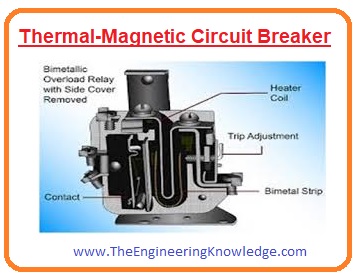
The thermal-magnetic circuit breaker is mostly used in DBs (distribution boards).
In this circuit breaker, there are 2 types of elements used for the detection of faults.
This element is an electromagnet that is used to detect the large surging current in the circuitry. Surging current is very dangerous for our home appliances like air conditioners, freezers, etc.
The electromagnet operates very fast when surge current flows through the circuit and disconnects the circuit.
The 2nd detection element in this circuit is the thermal bimetallic strip, which works for lower-level electric surges or for overloading conditions.
When a fault occurs, then current passes through this bimetallic strip due to current heating produced that bends the strip and removes it from the circuitry.
Its popularity is since it responds very fast to a fault and starts its operation when a fault is removed.
SF6 Circuit Breakers
SF6 is a sulfur hexafluoride breaker where sulfur hexafluoride is used as arc extinguishing.
The sulfur hexafluoride gas attracts elections. Circuit contacts are opened, and gas flows through the chamber, striking an arc.
The free electrons are absorbed through SF₆, causing immobile negative ions. For arc extinguishing, the insulating strength of the medium must be high. Both contacts, fixed and removed, are put in an arc chamber with the gas.
Minimum oil circuit breaker (MOCB)
The oil in the breaker performs two functions: first, it works as an arc-quenching medium, and second, it insulates live components from earth. It has a small amount of oil used for arc extinction and is mostly partly used for insulation purposes.
Due to the quantity of oil in bulk, oil circuit breakers become high as system voltage increases. It not only increases the cost, tank size, and weight of the breaker but also increases fire risk and maintenance problems.
Advantages of Air Circuit Breaker
it reduces the fire hazard.
Arcing products can be removed.
The contact gap is smaller as dielectric strength increases.
It is best for frequent uses since arcing time and arc energy are small.
It can interrupt current.
Disadvantages of Air Circuit Breaker
The features of arc extinguishers are not good.
It is sensitive to types of voltage.
Compressor needed to maintain air circuit breaker.
It is sensitive to the variation in voltages.
The properties of arc extinguishers are inferior.
Read also:
- Difference Between a Single and Double Pole Breaker
- Where is the Doorbell Breaker Located? Easy Way to Findout
- What to Do if Your Circuit Breaker Won’t Reset
- Top Reasons Why Electric Outlet Stopped Working Breaker Not Tripped?
- 60 Amp Wire Size – Which AWG is Best for 60 Amp Breaker
- What Is A Shunt Trip Breaker & How Does It Work? Detailed Guide
Faqs
What is the main principle breaker?
The main breaker controls the current flow from two main wires to two bus bars. Tripping the main circuit breaker disrupts 240 volts of current before reaching the branch breaker. If the main breaker is tripped, it will turn off the devices.
What is the main purpose of a circuit breaker?
The breaker is an electrical switch made for the protection of the circuit from damage due to overcurrent or short circuit. Its main function is to interrupt current flow after protective relays detect fault.
What is the basic principle of MCB?
If current overflow exists in MCB, bimetallic strips get heated and deflect through bending. The deflection of the bimetallic strip releases the latch. The latch resulted in the MCB turning off by stopping the current flow in a circuit.
How important are circuit breakers?
A breaker is a switch made for an automatic open circuit to avoid damage to components, overheating and fire overload
What are the two functions of a circuit breaker?
The circuit breaker is an automatically operated switch that detects issues and, through interrupting continuity, has features to discontinue electric flow.
What are the advantages of a circuit breaker?
It is best to replace mechanically operating fuses.
highly reliable.
more functional.
If the trip can easily be fixed
What are the three functions of a circuit breaker?
Discharge voltage on lines to earth after disconnection.
It disconnects part of the system from live parts in case of a no-load condition.
Switching during normal and abnormal conditions interrupts the fault currents.
What are the principles of MCB and MCCB?
MCB comes with a fixed tripping circuit, and MCCB has a moveable tripping circuit. Pole-in breakers define some switching and safety phases it has for maximizing protection. The MCB normally comes with 1, 2, or 3 poles, and the MCCB has 4 poles.
What is another name for RCCB?
RCCB’s full form is Residual Current Circuit Breaker. and called RCB or RCD. It is an electrical wiring device that disconnects circuits when it detects a current leak to the earth wire.
That is the detailed tutorial on the circuit breaker I have mentioned and everything related to a circuit breaker in this post. If you have any issues or queries related to circuit breakers ask in the comments. Thanks for reading. See you in the next tutorial.


I didn’t know that a circuit breaker protects a circuit whenever a fault happens. I don’t know a lot about electricity but I can imagine how important this is. It keeps the electric system from messing up and frying your whole home.
I like the helpful info you provide in your articles. I will bookmark your weblog and check again here frequently. I’m quite sure I will learn many new stuff right here! Best of luck for the next!
It’s nice that you mentioned how the main operation of a circuit breaker is to stop the flow of current when a fault occurs. I was looking at a list of industrial electrical parts earlier and I saw some circuit breakers in it. I heard circuit breakers are quite essential, which is why they are being used for residential, commercial, and industrial purposes.