
Hello friends, I hope all of you are having fun in your life. In today’s tutorial, we are going to have a look at what an electric generator is. There are numerous machines, like motors and transformers, operating in our power system. The motor is an electrical machine that converts electrical energy into mechanical power. The transformer is used to step up and step down the voltage level in the system. A motor is a machine used to transform electrical energy into mechanical energy. There are 2 main types of motors: first, the AC motor, and second, the DC motor. The subtypes of DC motors are DC series motors, DC wound motors, DC shunt motors, and compound motors. Like DC motors, there are numerous types of AC motors, such as induction motors, synchronous motors, phase induction motors, and three-phase induction motors.
Like these motors, there is a most important machine used in an electrical system that is a generator. Like motors, there are numerous types of generators, such as induction generators, synchronous generators, DC generators, etc. AC generators, like synchronous generators, are used in generation stations. In today’s post we will have a detailed look at working, construction, applications, types, and some other related parameters of the generator. So let’s get started with what a generator is.
What is an electric generator?
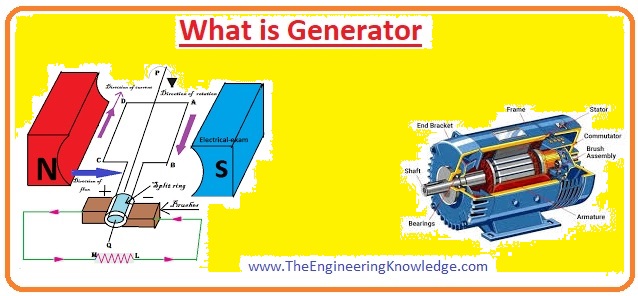
A generator is an electrical machine that transforms mechanical energy provided by the prime mover into electrical energy. The prime mover can be steam, water, a gas turbine, a wind turbine, etc.
The first electrical generator was invented by Faraday in 1831, who was a scientist of the United Kingdom. Faraday’s generator name was Faraday Disk. This generator was to deliver power to the grid station.
With the invention of the generator, Faraday also gave its operating principle in 1831; its rule is also known as Faraday’s law.
Faraday’s law states that if some conductive material is placed in a magnetic field, then emf will be induced in that conductive material.
EMF = dØ/dt
The construction of the Faraday disk generator was very simple, for he used a simple copper disk and rotated it in a field of horseshoe-shaped magnets. The output of the Faraday generator was DC voltage.
Both motors and generators have almost similar construction; some can also be driven as generators.
Either a generator is DC or AC is playing a very important role in our generation system for industries and our homes, providing power to our appliances and machines.
Working Principle of Generator
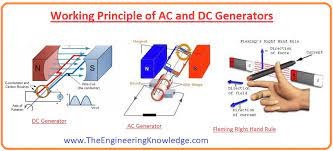
The operation of an electrical generator depends on Faraday’s law of electromagnetic induction.
That says if a conductor is put into a field, then a voltage is induced in that conductor. In the case of the generator, the conductor is the rotor of a generator, and the field is provided by the stator of the generator.
We can use the Fleming rule to find the direction of the voltage induced by that conductor. That explains that if we arrange our right-hand first finger, second finger, and thumb in such a way that these are at 90° to each other and we suppose that the motion of the conductor is along the thumb and the first finger is in the direction of the field, then the second finger will show the direction of voltage induced in the conductor.
The working principle of both AC and DC generators is similar, but the difference is that in DC generators, commutators are used to provide a DC output.
Construction of Generator
There are numerous parts of the generator that are used in the construction of a generator, but the most important parts are the rotor and stator. Let’s discuss all these parts in detail.
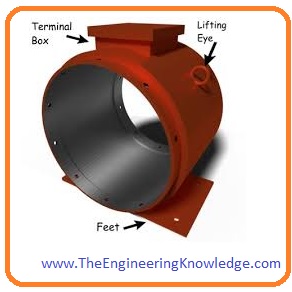
Yoke
The outer structure of a generator is known as a yoke; it provides safety to the generator from the external environment. It is constructed with steel or cast iron.
By providing strength to the internal structure, it also holds the stator windings that provide flux to a machine.
Windings
There are two types of main windings used in any generator, either dc or ac. The first one is armature winding that is wound on the rotor of the motor, and the second one is stator winding wound on the stator of the generator.
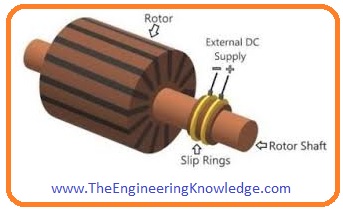
Rotor
The rotor is a part of a generator that is rotating over which armature windings are wound. In some DC generators, instead of windings on the rotor, a permanent magnet rotor is used.
In AC machines there are two main types of rotors used: the first one is the wound rotor and the second one is the squirrel rotor.
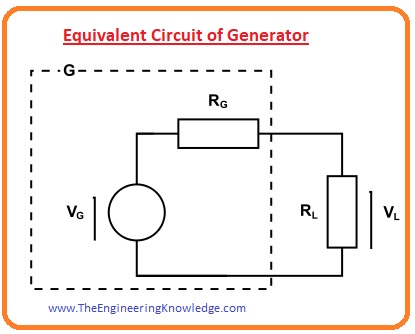
Equivalent circuit of Generator
- In the given figure, you can see the equivalent circuitry of the generator linked with the load. In the given figure you can see some parameters that are described here.
- VG is the open circuit voltages of a generator.
- RG is the interior resistance of the circuit.
- VL value of voltage when load connected.
- RL is the value of resistance offered by the load.
DC Generator
A DC generator is a type of electrical generator that produces a DC voltage at its output terminals. Its construction is similar to the DC motor, and we can use the DC motor as a generator also.
There are some sub-types of DC generators, like shunt generators, series generators, compound generators, etc.
For an understanding of the workings of this generator, we take an example of a loop rotating in a magnetic field and compare it with the practical generator.
If we rotate a loop in a magnetic field of a permanent magnet, then a voltage will be induced in the loop.
This is also according to Faraday’s law, which says that if we rotate any conductor in a field, then voltage will be induced in that conductor due to flux variation in the conductor.
If we compare a loop rotation in a field with the practical DC generator, then we will come to know that the rotating part is the rotor of the generator, and the field is provided by the magnet at the stator or windings of the stator.
Advantages of DC generator
- These are some advantages of a dc generator.
- Its construction is very easy and can be repaired without any difficulty.
- Its working principle is very simple.
- This machine provides higher reliability.
- Its speed can be controlled very easily.
- Its output voltage value is constant.
AC Generator
- An AC generator is a type of electric machine that transforms mechanical energy into ac electric energy. Nowadays, mostly ac generator is used in our commercial and industrial applications.
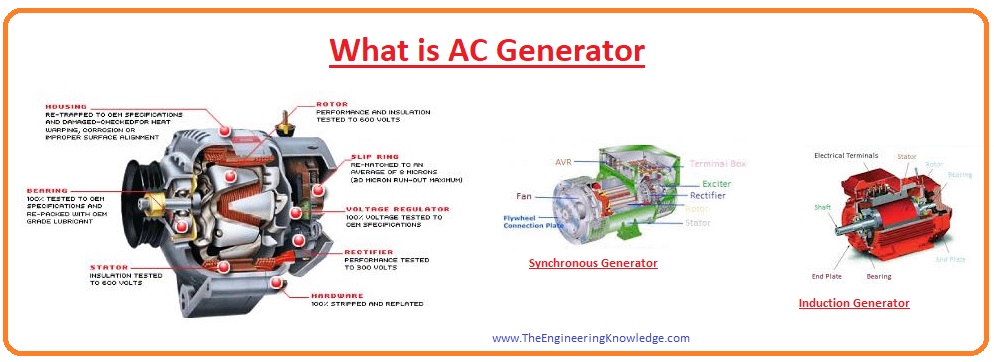
- There are 2 main types of ac generator first one is a synchronous generator, and the second one is an induction generator that is also known as an asynchronous generator.
- In local and some commercial uses, an induction generator is used while in generation and in a wind turbine, a synchronous generator is used.
- With the type of rotor design, the ac generator is further divided into two types first one is the wound rotor and the second one is the squirrel rotor generator.
Induction Generator
- An induction generator is a type of ac generator it also known as an asynchronous generator. It works on the principle of electromagnetic induction.
- Its construction is similar to the induction motor so an induction motor can also be used as an induction generator with some modifications.
- It is mostly used in wind turbines, mini hydel generation plants, etc.
Synchronous Generator
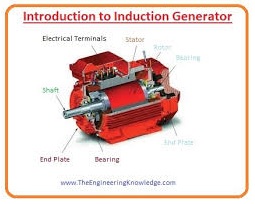
- The synchronous generator is a type of ac generator that operates on the synchronous speed. Synchronous speed is the rotation speed of the field at the stator provided by the input supply.
- It is also called an alternator and is used to transform mechanical energy into electricity.
- In our generation stations, mostly a synchronous generator is used.
- They are available in ratings of fifteen hundred megawatts.
Difference between AC and DC Generator
- These are some differences between the ac and dc generator that is explained with the detailed.

| AC Generator | DC Generator |
| The main difference is that the ac generator converts mechanical power provided by the prime mover into AC power. | A DC generator converts mechanical input into DC output. |
| Its output voltage varies its polarity after a certain interval of time. | Its output voltage flows with a similar polarity means are dc. |
| There is no need of commutators in the construction of this generator. | In this generator, commutators are used. |
| In an ac generator, slip rings are used. | In this generator, split rings are used for the conversion of ac into DC at the output terminals. |
| In ac, the generator armature is always exists at the rotor. | In a DC generator, the armature part can be either the rotor or the stator. |
| Its efficiency is larger due to less power losses. | Its efficiency is less due to large power losses. |
| Its output current can be induced at the stator or the rotor. | Output current is produced at the rotor. |
| Its output voltages are high and vary in amplitude; normally, the frequency of output voltage is fifty or sixty hertz | Its output voltages are of lower value and frequency is zero. |
| Its repair is very simple and its reliability is also good. | Its reliability is less due to continuous repairs. |
| Its types are induction, synchronous, single-phase, three-phase, wound rotor, etc. | There are only two types of dc generators. First one is self-excited and separately excited. |
| It is more expensive than the dc generator. | Its price is less |
Difference between Motor and Generator
- These are some differences between a motor and a generator.
| Motor | Generator |
| A motor transforms electrical energy into mechanical energy. | The generator converts mechanical energy into electrical energy. |
| It uses electrical energy. | It produces current. |
| The rotor of the motor rotates with the interaction between the field of the stator and the rotor. | Its rotor is rotated with the prime mover. |
| In the motor, the input is provided at the armature windings. | In the motor, the output is taken out from the armature. |
| The motor operating principle is according to Fleming’s left-hand rule. | The generator working principle follows Fleming’s right-hand rule. |
Applications of Generator
- These are some common applications of generators that are described here in detail.
Power station
The power station is also called a powerhouse; it is a place where electrical energy is produced. At these powerhouses, more than one generator is installed for the production of 3-phase electrical power.
Due to relative movement between the field of the stator and the rotor of the generator, voltage is produced.
The prime mover is used to rotate the rotor of the generator; the most used prime movers are coal, fuel, gas, hydel, etc.
Roadway vehicles
In vehicles, a generator is used to provide power to their different components and recharge batteries.
Till the 1960s, DC generators were used, but with the invention of rectified AC generators, they are also used in different vehicles.
Bicycles
In bicycles, a generator is used to provide power to their lights and to charge batteries. Mostly, there are 2 main kinds of generators that are used for bicycles; the first one is a bottle dynamo that are controlled by the tire of the bicycle.
The other type of generator is a hub dynamo that is directly linked to the bicycle’s drivetrain.
Sailboats
In sailboats, the generator used gets mechanical power from the water or air. It is used in boats to provide energy to their batteries and some lighting instruments.
Electrical scooter
Generators are also used in scooters to provide power for their operation.
Mechanical calculations
The tacho generator is a device that generates voltage equal to the rotation speed of its rotor.
This generator is used as a speed indicator and for a feedback speed control system.
In industries, the speed of motors and engines is measured with a tachometer that gets power from the tachogenerator.
Read also:
So, friends, it is the detailed post on the generator. I have written each and every parameter related to a generator in this post. If you have any queries about this electrical machine, ask in comments. Thanks for reading. See you in the next tutorial.


I had no idea that in AC machines there are two rotors used. I have always wondered how AC machines work. Once you explained how rotors work, it makes sense for why they have two.
Hi! This is my first visit to your blog! We are a collection of volunteers and starting a new initiative in a community in the same niche. Your blog provided us beneficial information to work on. You have done a outstanding job!
I found your blog website on google and test a number of of your early posts. Continue to keep up the excellent operate. I simply extra up your RSS feed to my MSN Information Reader. In search of ahead to studying extra from you in a while!…
Superb blog you have here but I was wondering if you knew of any community forums that cover the same topics discussed in this article? I’d really love to be a part of group where I can get suggestions from other knowledgeable individuals that share the same interest. If you have any recommendations, please let me know. Appreciate it!