The engine block, also called the cylinder block, is considered the main part of an internal combustion engine. This part is the main assembly component of pistons, cylinders, and the crankshaft. engine block covering to these components and making strong assemblies since it also makes it easy to work on engines that are used in vehicles and machines. In this post, we will cover detailed features and practical working. So let’s get started
What is a Cylinder Block?
An engine block is basically a cylinder block that comes with components that perform combustion in a reciprocating engine. Its structure is made of aluminum alloy and provides covering to cylinders and internal parts.
Since it is made of metal, it has high strength and easily transfers heat from the combustion system to the cooling system.
Water cools through the water jacket and gets through the car radiator; that water, after cooling, is sent towards the engine block. If not cooled well, engine working efficiency reduces, and it stops working. Engine cylinders come with different piston combinations, such as 4, 6, or 8, that are covered with a water jacket.
Wheel movement occurs through the cylinder head at the piston position, with the crankshaft causing piston movement up and down in the cylinders and turning the crankshaft, which ultimately drives the wheels.
When engine parts move, they need lubrication for this purpose. An oil pan exists at the engine block, and the lubrication level is monitored electronically through the car dashboard. A dipstick is also used for the lubrication level.
Change engine oil after some time using the sump plug, which is connected to the block base or through a vacuum pump and hose added through the dipstick hole.
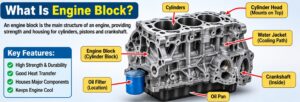
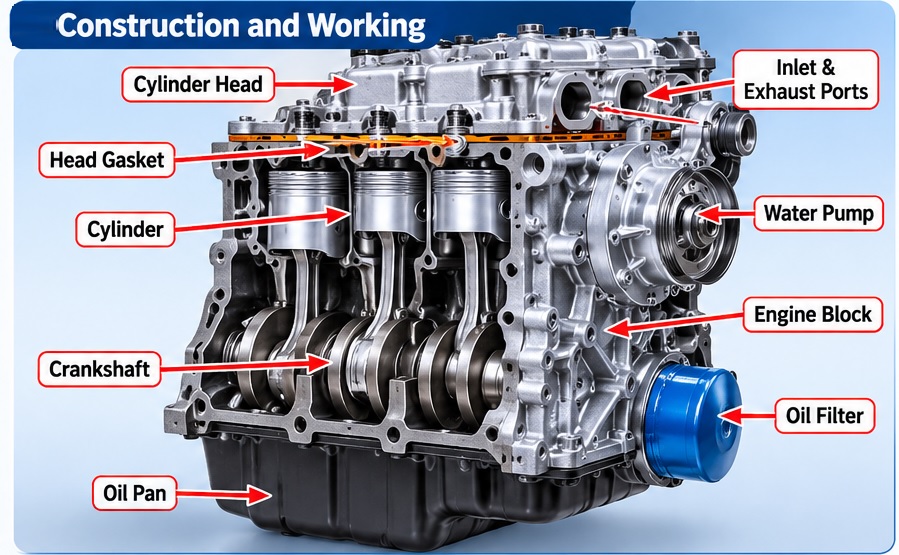
Construction of Engine Block :
An engine block has different parts, and each has a certain function.
Cylinders:
A cylinder is the main component of an engine that makes compression of the air-fuel mixture, a process known as a compression cylinder. It is basically a cylindrical hole in the engine block that moves up and down in the cylinder. One cycle is completed after the up-and-down movement, called a stroke.
Generally, engines are four-stroke engines that have called intake stroke, exhaust stroke, and power stroke. The air-fuel mixture goes towards the suction stroke and becomes compressed with the compression stroke, causing power in the power stroke, and is released in the final exhaust stroke. The cubic capacity and power product capacity of the engine define the numbers and dimensions of the cylinders
Cylinder head:
The cylinder head is a component that sits over the cylinder and works as the roof of the combustion chamber in the cylinder. It is the top of the engine block. It is a combination of the intake manifold, coolant path, and exhaust manifold.
When combustion is finished, this part manages the intake and exhaust of air-fuel mixtures into and out of the cylinders. It also reduces engine temperature. For cooling purposes, it uses air and water. New engines use water as a cooling material.
Head studs
Head studs have features for handling loads and for providing cylinder head strength and sealing from the block. Threads are cut from the middle point of the engine block in a single axis and give proper clamping forces. Head studs are used since they face high torque.
Oil filter:
The oil filter is located below the cylinder block. This filter mainly works to remove dust particles before lubricating oil flows into the engine.
Crankshaft:
The crankshaft basically moves the engine component that makes movement in the piston and then transforms it into strokes. It is connected to the connecting rod over the piston. When the crankshaft causes the connecting rod to move up and down, it affects the piston
Crankcase:
The casing of the crankshaft is called the crankcase. It exists under the cylinder block. It mainly works to prevent dust from affecting the crankshaft. It has a camshaft and oil pump, depending on the engine design
Head Gasket:
A gasket exists between the cylinder head and cylinder block. Its main work is to provide sealing and make a partition between the flow of the head and the block. A damaged head gasket causes coolant from the head to mix with different cylinder block parts.
Inlet & exhaust ports:
These ports exist in the cylinder head: the inlet port provides air to the combustion chamber, and the exhaust port removes gases when combustion completes and reduces pressure creation.
Water pump
A water pump is connected at the end part of the cylinder head and operated with a belt that moves over the alternator. This is known as a coolant pump. It’s working to manage circulating coolant water towards the engine block used to cool the engine, passing it in the coolant path. It’s an important component of the cooling system that helps the engine work at the proper temperature by controlling overheating of the engine.
Core plugs
The core plug is mainly works to control coolant leaking from the engine. It is an engine block cap that exists at the end point of the coolant path.
Oil passage:
Lubrication is an important part that helps with engine functioning and maintenance. oil passages are used for delivering lubrication to different engine parts.
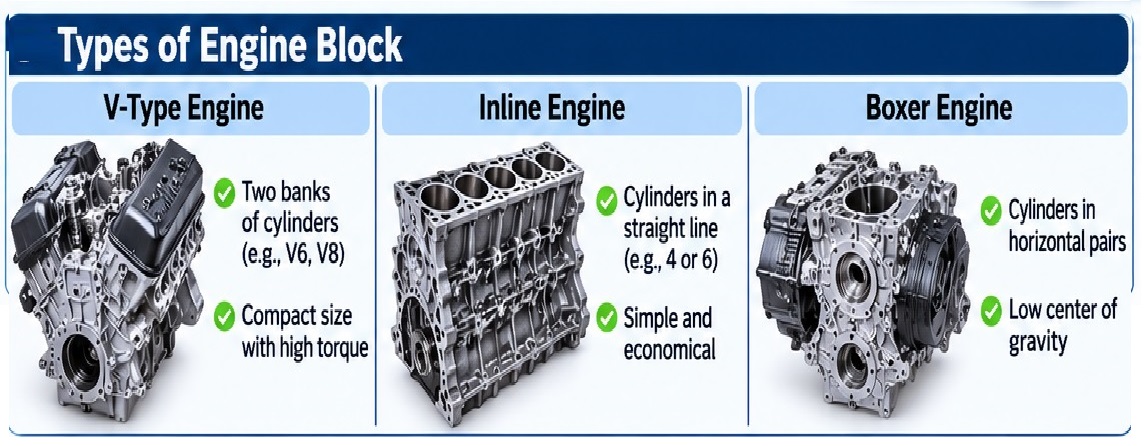
Types of Engine Block
There are different types of engine blocks, and each has certain features
V Engine Cylinder:
The V engine type commonly used that was first made in 1889 was used in the 1889 Daimler-Stahlradwagen automobile. This engine design has two cylinders in rows, making a V design from the front angle. Cylinders are configured in banks, meaning the base points intersect each other. This engine provides capacity in a small area. This complicated design makes cylinder design accurate.
V6 has six cylinders, and V8 has eight cylinders. These cylinders are connected in features there; there are 3 and 4 cylinders in the cylinder bank. 2 cylinder banks connected at a certain angle in the angle of 60° to 90°, making a V-angle.
This engine has a crankshaft and connecting rod of a reverse cylinder configured at the same crankpin. These engines are short in length but have a large width.
This engine comes with an overhead camshaft and is called an overhead cam. V-type engine minimizes the height, width, and length of the engine. So the V engine has an engine capacity crossing 3 liters. Small engine sizes minimize bonnet height, which makes good aerodynamics and smooth working with high speed.
It results in high torque at low speeds compared to different engine types.
Inline or straight Engine Cylinder
This engine has a cylinder configuration that, in series combinations, makes a straight engine design. These engines are used for capacities of less than three liters. Their design is so simple and low-cost to manufacture. Its design has two to eight cylinders.
This comes with an engine camshaft, tappets, and pushrod design. valve is connected to the cylinder head after the piston. cylinder configured in row over crankshaft.
This engine has good balance since the weight is distributed uniformly. Its maintenance is easy and simple due to the design. It handles odd-numbered cylinders due to single cylinders connected in series and no uneven cylinders.
But they have some limitations that are low torque compared to the V engine when run at low speed.
Boxer Engine Cylinder
The cylinder block in a boxer engine has two cylinders banked. That is flat pressed on a V-engine type. That is called a horizontal opposed engine.
Cylinder banks are on either side of the central crankshaft. Since a piston movement is like a boxer in a horizontal plane, it is known as a boxer engine.
But the difference is that pistons move in the reverse direction, reversing to the boxer moving in that same direction. Piston movement towards and away from the middle crankshaft.
This engine has a complicated design compared to V- and inline assemblies. It uses complicated parts that increase production costs.
The boxer engine has a low center of gravity and good balance, helping output flow into the transmission with high efficiency
Reverse piston movement improves balance. so it does not use a damping system; with that, it has a high chance of using a cooling system
Common Engine Block faults
Some common engine block problems are
Engine coolant leakage
Engine coolant leakage is the main error of the engine block. This error results from different component faults, such as the water pump and heater core. The engine block causes cracking, and coolant leaking occurs. The freeze plug becomes rusted and needs replacement.
damaged cylinder
Cylinder wall cracks result from coolant friction and heat produced when the engine runs. This crack affects piston ring sealings from cylinder walls as a result of compression losses. If a crack occurs in the cylinder wall, check it, since larger holes are generated in the damaged cylinder wall.
Porous Engine Block
This error occurs due to contamination in the metal during assembly at the time of production. This issue is caused by casting errors. Casting errors are not serious issues, but over time they cause engine blockage. This issue is difficult to find since it occurs during the production process