The canister purge valve is a main part of the evap system that functions to regulate fuel vapors toward the charcoal canister and the engine. The canister purge valve is an important part of gasoline vapor regulation. in this tutorial, we will cover the detailed functioning and practical understanding of symptoms of faults. So let’s get started
What is a Canister Purge Valve?
It is an electrically controlled valve that manages the gasoline vapor path from the charcoal canister towards the engine intake manifold, and its other name is the EVAP purge valve or purge solenoid. It manages vapor movement for burning in the engine rather than releasing it to the air.
It is like a switch that increases engine performance and minimizes emissions by opening and closing according to the signal received from the engine control unit (ECU). It strikes a balance between fuel usage and the environment.
Its operation is done in collaboration with the engine control unit for accurate operation of the EVAP system.
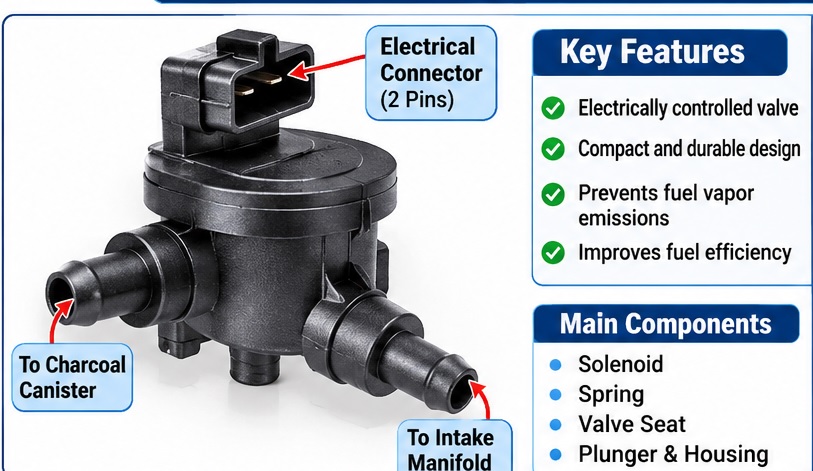
Structure of the canister purge valve
The canister valve comes with different structural parts, and each has certain functions
Solenoid:
It is an electromagnetic part that controls valve opening and closing and is considered the main component. Its structure is made of a moving iron core where a wire coil is wrapped. During energization, the core moves and generates a magnetic field used for opening or closing the valve
Spring:
When the solenoid is non-energized, its design keeps the valve closed. For accurate sealing during closed conditions and easy opening, spring tension is properly managed.
Valve seat:
Valve closure occurs over a sealing area that is made of sturdy material and controls leakage. Its main feature is to manage not working.
Plunger:
• The plunger controls the valve channel opening and closing process, and it is connected to a solenoid. Its movement offers proper vapor regulation.
Electrical connector:
It has two pins and helps with signal transmission for valve functioning. These connectors are weather-resistant designs that protect them from corrosion
Housing:
It is a plastic covering or metallic design that comes with mounting holes for easy installation on vehicles and protects the inner structure.
Flow path:
During valve opening, it contains accurately set internal channels directing gasoline vapor flow. This channel design reduces hindrance in flow for accurate control. Each component is important in the operation of the purge valve and functions to provide control of fuel vapor flow in the EVAP system.
Canister Purge Valve Working
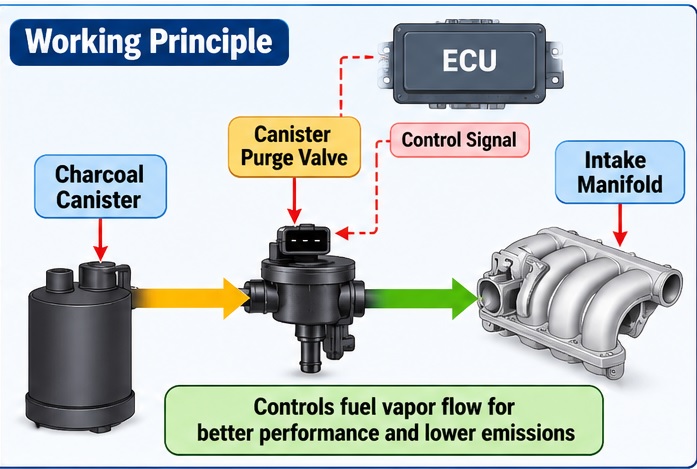
Canister purge valve operation involves different steps, and each performs a certain process.
Vapor storage:
In this step, fuel vapors are stored in the charcoal canister when the engine is off.
Engine working
• The ECU starts monitoring purging conditions when the engine starts and reaches an accurate temperature of about 74°C.
Purging requirement
To check accurate purging, the ECU checks different factors such as engine temperature, speed, and oxygen sensor values.
Valve activation:
The purge valve solenoid gets an electrical signal from the ECU according to the conditions.
Valve opening:
Spring tension is minimized by the solenoid that opens the valve. It results in 20 to 50 ms after getting the signal.
Vapor flow:
Vapors stored in the canister move to the intake manifold with engine suction, moving through the valve opening
Combustion:
Combustion occurs in the engine cylinder, and vapors burn when mixing with incoming air and fuel.
Flow modulation:
For an accurate air-fuel ratio, make regular modifications for valve opening. This modulation occurs hundreds of times in sixty seconds.
Purge completion:
The ECU de-energizes the solenoid when the purge cycle is completed.
Valve closing:
The spring stops vapor movement by reversing towards the valve-closed condition in about 30 ms.
What is the function of the Canister Purge Valve?
The canister purge valve mainly works to control the flow of fuel vapour released through the charcoal canister towards the engine. Gasoline in the fuel tank evaporates, and vapours are stored in the evap system for a short time. When the engine gets accurate wrking cnditins ecu give signal for the purge valve opening.
When the opened intake manifold vacuum gets fuel vapours in the combustion chamber for mixing air, fuel and burning. During valve closing, vapour movement stops, and the EVAP system is sealed for the required pressure value. That vapour flow enhances the efficiency of fuel, minimises emissions, and helps the engine to run properly.
Location of the Canister Purge Valve
The canister purge valve is connected at the internal part of the engine bay since its configuration is directly beside the intake manifold and the evap charcoal canister. For different vehicles,, it is connected close to the intake manifold where the throttle body exists at that location; the engine vacuum line gets fuel vapours towards the engine.
The valve is constructed with a small plastic body with an electrical connector and two vapour hoses. Some vehicles come with the purge valve on the front side of the engine, and in larger vehicles it is located over the vacuum line close to the engine casing.
Symptoms of a Bad Canister Purge Valve
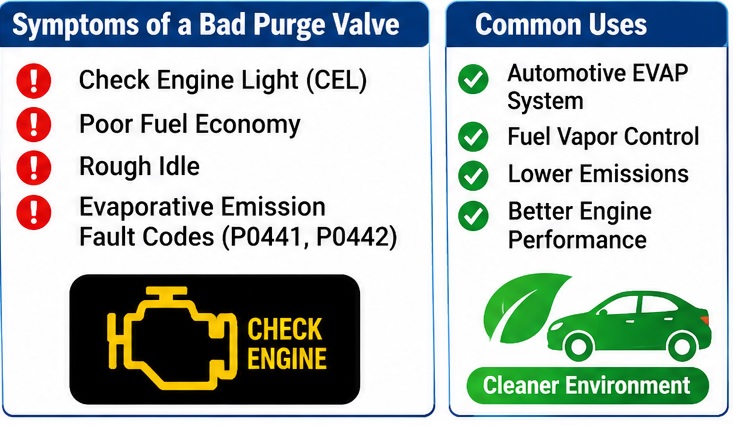
Different signs show a bad canister purge valve.
Check Engine Light
ECU performs monitoring of the EVAP system by tracking pressure variations and required vapor movement. If these parameters are not within the required values, it causes different fault codes such as
P0441
It means purge flow is not accurate; the ECU gives a signal to purge, with required pressure losses of the system not being the same. That shows the valve is not opening properly.
P0496
In this code, the system checks vapor flow but the correct or extra purge flow is not occurring. That means the valve is stuck open.
P0455
It means it is not holding pressure when self-testing occurs. The purge valve is having difficulty opening; it triggers it but causes a loose gas cap.
Stalling
If the purge valve is stuck open, it causes fuel vapors to flow towards the intake when not needed, mostly when airflow is low. Proper RPM occurs in the range of 500 and 900 RPM, then becomes stable.
Engine vibration remains high in these conditions since improper combustion occurs. High disruption in the mixture causes it first. when sparking occurs
Hard Starting
It is a common sign that occurs after refilling the tank; vapor pressure of the system rises quickly. If the valve is stuck open, vapors go towards the intake. The engine cranks longer than normal, taking two to four seconds compared to a fast start. For engine stability, press the accelerator slowly. But in some conditions, the engine starts and stalls after some time.
Low Fuel Efficiency
If the canister purge valve is bad, it affects engine fuel management, and that occurs during usage with time. Fuel efficiency losses up to 15 percent under severe conditions. Short-term fuel goes beyond ±10%; that shows constant correction. ECU manages by minimizing or enhancing injector pulse width.
Fuel Smell
If vapors are not burning properly, there can be a gasoline smell, mostly during parking. The smell is strong and close to the engine bay. But it is commonly observed after refueling.
Main Causes of Bad Canister Purge Valve
Carbon Buildup
Fuel vapors cause carbon deposits in the valve. In these conditions, charcoal particles in the charcoal canister affect the valve causing it to clog when opening or closing
Electrical Faults
• The purge valve works with a solenoid that is managed by the ECU. Damaged wiring or connectors with corrosion affect valve working
Charcoal Canister faults
If the charcoal canister is damaged, dust moves through vapor lines and affects the purge valve.
Fuel Tank overfilling
If the fuel tank fills to the top point, it can push liquid gasoline toward the EVAP system. That can saturate the charcoal canister and affect the purge valve’s operation.
Wear
- Regular engine heating and continuous opening and closing cycles result in wear
How to Test a Canister Purge Valve
Different methods are used for testing the canister purge valve.
Visual Inspection
First, check the connector and wiring for finding damage, corrosion, or any loose connections. So check vacuum hoses to find leakage. If the connector is affected, the faulty result of the evap system error is that neither valve is working well.
Vacuum Test
Disconnect the purge valve and use a vacuum for the single port and valve not getting power. The valve needs to close and retain vacuum. If the air moves without power, the valve is stuck opening; replace it
Resistance measurement
With the help of a multimeter, measure the resistance over purge solenoid pins. Make a comparison of the measured value with the manual resistance value. If the value is not in the given range, it means the solenoid is faulty or damaged
Can we drive with a bad purge valve?
Yes, we can drive with a faulty canister purge valve, but drive for a short time before any effect on the car.
Short-Term Driving
• The car can run but can cause rough idle, acceleration issues, and reduced fuel efficiency, reducing it to five to ten percent. The engine becomes unstable; mostly idling occurs for traffic lights.
Long-term error
If not addressed, unburned vapors cause emissions and also affect the catalytic converter, which is often costly to replace.
Conclusion
The canister purge valve minimizes emissions by delivering stored fuel vapors towards the engine, where they burn through combustion. During its failure, it causes a check engine light, low fuel efficiency, bad smell, and different error codes, such as P0441 or P0496. Different testing procedures for accurate operation of the valve
Frequently Asked Questions
What is the canister purge valve replacement cost?
Normal canister purge valve replacement charges are 50 to 150 dollars for a single component but can vary depending on the brand. Labour costs can be higher or about 200 dollars, according to mechanic experts.
Is it good to drive with a bad canister purge valve?
Driving with the faulty canister purge valve occurs for a short time, so do not do it. That causes a rough idle, reduces fuel efficiency, and causes high emissions. But if the drive lasts for a longer time, it causes evap damage.
What is the canister purge valve’s working life?
The normal purge valve working life is 80000 to 150000 miles according to working conditions. High heat causes carbon buildup, and overfilling the fuel tank reduces working life.
Can a faulty purge valve cause engine misfire?
Yes, it causes a high air-fuel mixture that results in engine misfires. This results from high fuel vapors adding to the intake manifold
What is the difference between a purge valve and a vent valve?
| Feature | Purge Valve | Vent Valve |
| function | Removes unwanted gases, air, or contaminants from a system | Releases trapped air or excess pressure |
| Primary purpose | Cleans the system | Relieves pressure or allows air to escape |
| Operation | Opens to flush unwanted gases or fluids out of the system | Opens to discharge accumulated air or gas |
| Gas handling | Removes air, vapor, or other unwanted gases | Releases trapped air, gas, or pressure |
| Installation location | Purge lines, fuel systems, refrigeration systems, and process equipment | Tanks, pipelines, pressure vessels, and hydraulic systems |
| Control method | Manual, automatic, or solenoid-controlled | Manual, automatic, or pressure-controlled |
| applications | Refrigeration systems, automotive EVAP systems, boilers, and industrial equipment | Storage tanks, pipelines, hydraulic circuits, and pressure vessels |
| System benefit | Improves system cleanliness and operating efficiency | Prevents air accumulation and helps maintain safe operating conditions |
| types | Manual purge valve, automatic purge valve, solenoid purge valve | Air vent valve, automatic vent valve, pressure vent valve |
Is resetting required for the check engine light after replacing the purge valve?
For some features, resetting the check engine light requires clearing the stored OBD-II codes with scan tooling. Some vehicles turn the light off when different driving cycles solve the error.
Can a faulty purge valve drain the battery?
For some conditions, a stuck purge valve with an electrical error results in this type of engine cranking that affects the battery.