A purge valve is an important part of the vehicle’s system for controlling evaporative emissions that regulates fuel vapor flow through the fuel tank and evaporative canister of the engine, where it is burned for combustion purposes. Purging is also helpful for handling hazardous fuel vapors from cars. In this post, we will cover details of the features of the purge valve and related features. So let’s get started.
Purge Valve: What It Is
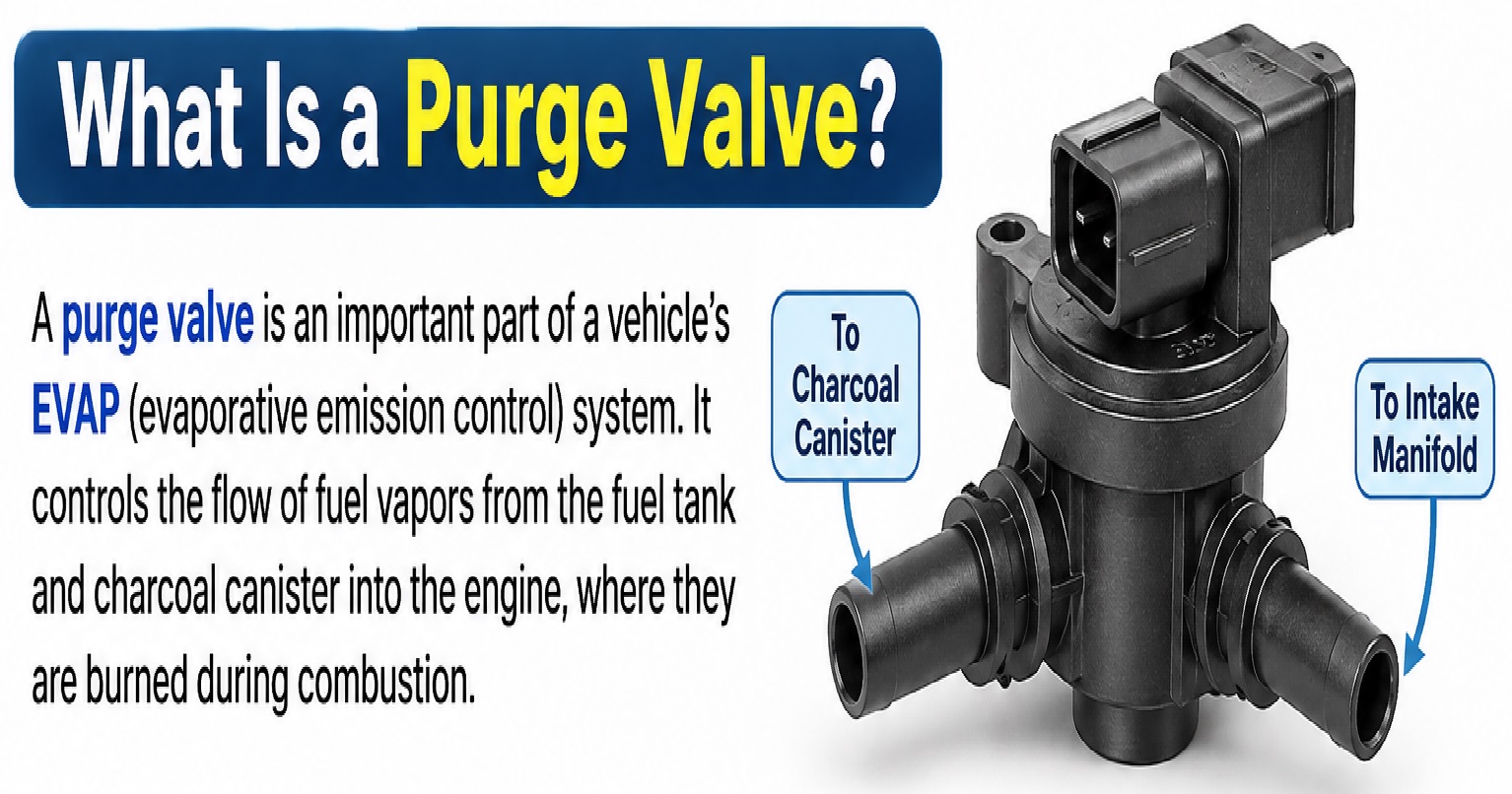
The purge valve, also called the canister purge valve or purge solenoid valve, is an important part of the vehicle’s evaporative emission control system. The main function is to manage the movement of fuel vapors from the fuel tank and evaporative canister into the engine, where fuel burns for the combustion process.
Purge valve functioning occurs during engine operation and in certain running conditions when the engine control module opens the purge valve.
The purge valve has features for minimizing emissions of vehicles and managing environmental conditions, with that increasing fuel efficiency.
Parts of a Purge Valve
There are different parts of a purge valve, and each has certain operations. Main components are
Solenoid
- The solenoid is an important component of the valve; it is an electromagnetic switch. It comes with a wire coil covered in a metallic core. The current flow in the coil causes induction of a magnetic field that causes metallic core movement and causes the valve to open and close
Valve
This system is connected to a solenoid and comes with a spring-loaded plunger that causes movement when the solenoid functions. The valve causes vapor movement.
Connections
Wires are an important part of the valve’s operation. ECM commands are used for valve opening or closing according to engine condition.
Plunger
The plunger is a rod existing in the valve that is affected by the electromagnetic field generated through the solenoid. through activation of solenoid plunger position changes and valve opening and fuel vapour flow. Through solenoid deactivation, the plunger returns to its original closed position valve. This movement provides correct vapour flow control and prevents leaking.
ports
It comes with inlet and outlet ports that offer control over vapour movement between the charcoal canister and intake manifold. The inlet port is configured with the charcoal canister for storing fuel vapours shortly, and the outlet port directs vapours towards the combustion process. These ports have features for smooth vapour flow
Purge Valve working process
Working of the purge valve based on different steps that are explained here
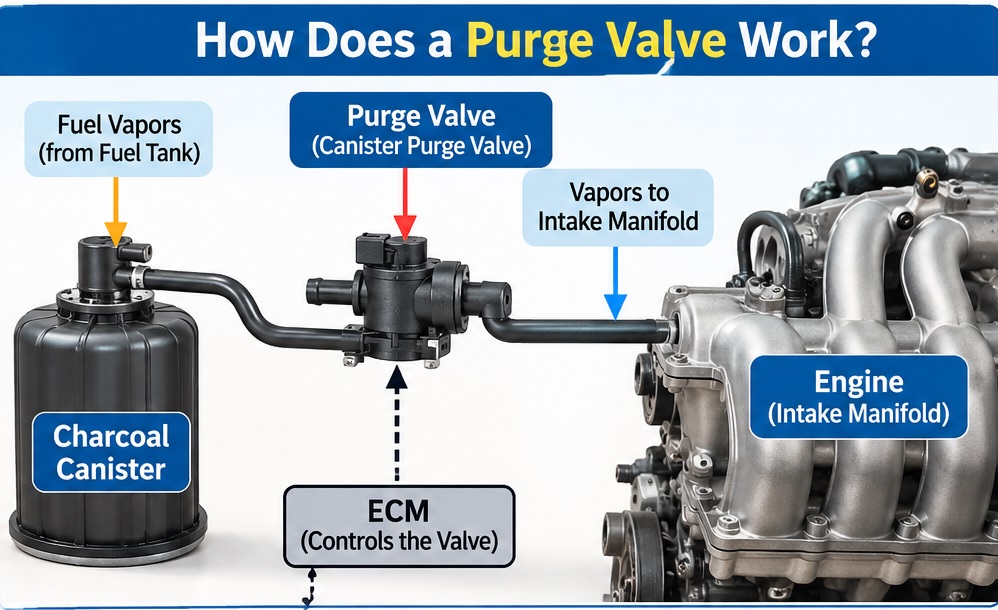
• The first step involves fuel storage. That is when the vehicle is in off condition; vapors of gasoline stored in the charcoal canister, called the evaporator control, release vapors from the evaporating system
In this step vapor purging occurs when the vehicle is in running conditions and gets certain functioning cnditns ecu send opening signal to the evaporator purge valve or canister purge valve.
When the canister purge valve opens, gasoline vapor is released from the evaporator with engine vacuum and moves towards the engine’s intake manifold.
Now combustion occurs, and vapors are burned in engine cylinders.
In the last step, if the vehicle’s computer defines the engine as not working properly or the vehicle is shutting down, it closes the evaporator purge valve and vapor flow towards the engine stops
Main Types of Purge Valves
There are different types of purge valves, and each comes with certain features.
Electromechanical Purge Valves
This valve is part of vehicle evaporative emission control (EVAP) systems. It is operated with an electrical operating solenoid that controls fuel vapors from the charcoal canister towards the engine intake manifold. A single delivery from the ECU to the solenoid for valve opening when the ECU detects proper working conditions during accurate air-fuel mixture vapor burning. This redirects fuel vapor towards the combustion process, compared to venting, and increases fuel efficiency.
This valve offers accurate control for the required vapor purge. Since it is connected with the ECU system that helps to follow certain conditions.
Manual Purge Valves
A manual valve needs intervention to work. This valve does not work with ECU commands but is opened or closed manually with a lever knob or with actuation systems. This valve is used in industries for gases and air venting. Such as chemical processing plants.
This purge valve is a simple design since it does not use sensors, which can cause errors during operation. Making physical functions is not best for automatic functions since it is manual control.
Automatic Purge Valves
This valve provides self-regulating functioning according to system demand. An automatic purge valve comes with a sensor that performs monitoring of temperature, pressure, and gases. During certain conditions, such as high pressure, temperature, valve operation and gas or vapour release, it operates according to requirements. This valve is used in vehicles and has a system for regular monitoring and accurate actuation.
Its main feature is that it functions automatically, so no manual operation is needed, and the system balances functioning. It also controls overheating and overpressure that can damage instruments. Its operation is based on sensors, so any error in the sensor wiring affects its operation, and proper maintenance is needed
Solenoid Purge Valves
A solenoid purge valve is basically an electromechanical valve that works with a solenoid coil for performing venting processes. When current flows, a coil magnetic field is generated that operates the plunger, since it offers high accuracy for fuel vapour emissions. ECU operates the solenoid when extra fuel vapours are accurately burnt rather than released
- Main features of this valve is that
- fast response times
- Precise control,
- integration with electronic diagnostics.
- These valves use OBD-II (On-Board Diagnostics) systems for monitoring faults.
Vacuum-Operated Purge Valves
This valve is normally used in older vehicles and works according to the vacuum pressure of the engine’s intake manifold. This valve works based on a mechanical vacuum signal for opening and closing purposes and does not follow direct electrical activation. The engine vacuum generator applies force on the valve, causing movement of vapors from the charcoal canister towards the intake manifold. When that vacuum pressure is low, the valve becomes closed.
It is a simple design but has low accuracy compared to other types. It works based on engine vacuum conditions such as load, efficiency, and altitude. So they do not give high efficiency and result in improper fuel vapor control and also do not manage emissions
Pressure-Relief Purge Valves
- This valve comes with automatic opening features when internal pressure crosses a defined value. These valves have features for controlling overpressure of the system, for example, fuel tanks, hydraulic systems, and gas lines. valve operates when internal pressure reaches a certain value, removing extra gases for safe functioning. when prsure at normal conditons valve clse for stopping venting.
- This valve is part of high-pressure installations, since it manages pressure so it does not affect instrument readings from leaking.Its uses are in
- fuel tank storage
- industrial processing
- compressed gas systems
Faulty Purge Valve symptoms
Check engine light
Common signs of a faulty purge valve are a check engine light and glow. That sign occurs with different errors, and that also for the purge valve. if the engine control unit is showing error readings in the evaporative emission system It means the check engine light shows faults.
Idling or stalling
Stalling means the engine is not working or is facing a stall. that result of high vapors leaking in the intake manifold since the valve is not working or is stuck in an open position. In these conditions, the air-fuel mixture is not working well and is idle. If bad conditions occur, the engine stalls completely, mostly in low gear.
Low fuel efficiency
If you are facing low fuel efficiency, it means the purge valve is not working well. A faulty control valve causes high vapor to enter the combustion chamber and give varying fuel-to-air mixtures. It loses too much fuel and causes high pressure on the engine
Emissions test failure
Vehicle emission test failure causes a purge valve error. Since the purge valve is an important component of the evaporative emissions control system, it manages fuel vapor release. In these conditions, the valve is not working and causes high emissions, and the car is not fulfilling the required standard for preventing pollution.
fuel smell
Sometimes we face some bad smell around the vehicle that also indicates the purge valve is not working well. It occurs when the open position of the valve is stuck and causes high fuel removal.
Testing of a faulty purge valve
Different methods are used for inspecting the faulty purge valve, such as
First, find the location of the purge valve that occurs close to the engine intake manifold. If you find any damage or leaking, it means it is becoming faulty.
When the check engine light is on, it means a fault exists, so use an OBD-II scanner to get code details for the computer. If codes are P0443, P0444, or P0445, they can indicate an error with the purge valve.
Now disconnect the valve from the vehicle to perform testing. Use a voltmeter on the purge valve connector. When the valve opens, a click sound is produced; if it does not produce, it means the valve is not working well.
Another testing technique is that the vacuum pump is used for testing the purge valve. Disconnect the purge valve from the vehicle and use a vacuum; if it loses vacuum, the valve is leaking, and you should use a new one.
If you do not have professional experience, get service from a mechanic to solve errors and find the purge valve error
Purge valve importance in a car
The purge valve is considered the main component of the Evaporative Emission Control (EVAP) system in a car. The EVAP system works to store fuel vapors temporarily in a charcoal canister that is in the fuel tank. The main function of the system is to control vapor release since it causes pollution.
Another function of the purge valve is to control the flow of fuel vapors. If the car engine is running and gets the required speed, the ECU sends a signal to open the purge valve. In result, vapors shift towards the engine from the charcoal canister. Vapors are burned for combustion process and purge valve controls fuel vapor flow, providing more flow when the engine is not running and when the engine is idling, not flowing. With that feature, the purge valve provides high engine performance and offers high fuel efficiency.
Purge valve vs other valve
Conclusion
A purge valve is a main component of cars that use fuel and minimizes hazardous gas releases. It is also employed in industries and their devices for controlling pressure and making system operations safe. Purge valves come in different types, and they work well for different conditions. Their accurate operation makes them long-lasting and the best for vehicles as well as positive for the environment
Frequently Asked Questions
What is the use of a purge valve in a vehicle?
The purge valve controls fuel vapor movement from the charcoal canister towards the engine. This minimizes pollution for car operation. An accurately working purge valve makes car operation effective
What are symptoms of a malfunctioning purge valve?
Check the check engine light, a gas smell, and the car is not starting well. engine uses more fuel; a purge valve error causes
How to check a faulty EVAP purge control valve?
Use a scanner if the codes are P0441 or P0443. This mean valve is leaking. Testing of the purge valve is working is also important for finding purge control valve faults.
Can I drive without a purge valve?
Yes, we are technically driving for a short distance without a purge valve, but it is not best for longer distances.
How do faulty purge valves affect emissions testing?
A damaged purge valve affects emissions testing. These systems do not manage vapors and release them, causing pollution. So solve the valve error before testing