mAh is a unit that is used for measuring the electrical charge capacity of a battery. It is basically defined as the electrical charge the battery stores and releases during its working time, showing how long the device works when it is fully charged. A high mAh battery means it works longer. In this tutorial, we will cover the importance and practical features of mAh. So let’s get started
What is mAh (milliampere-hour)?
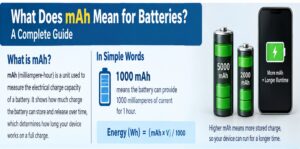
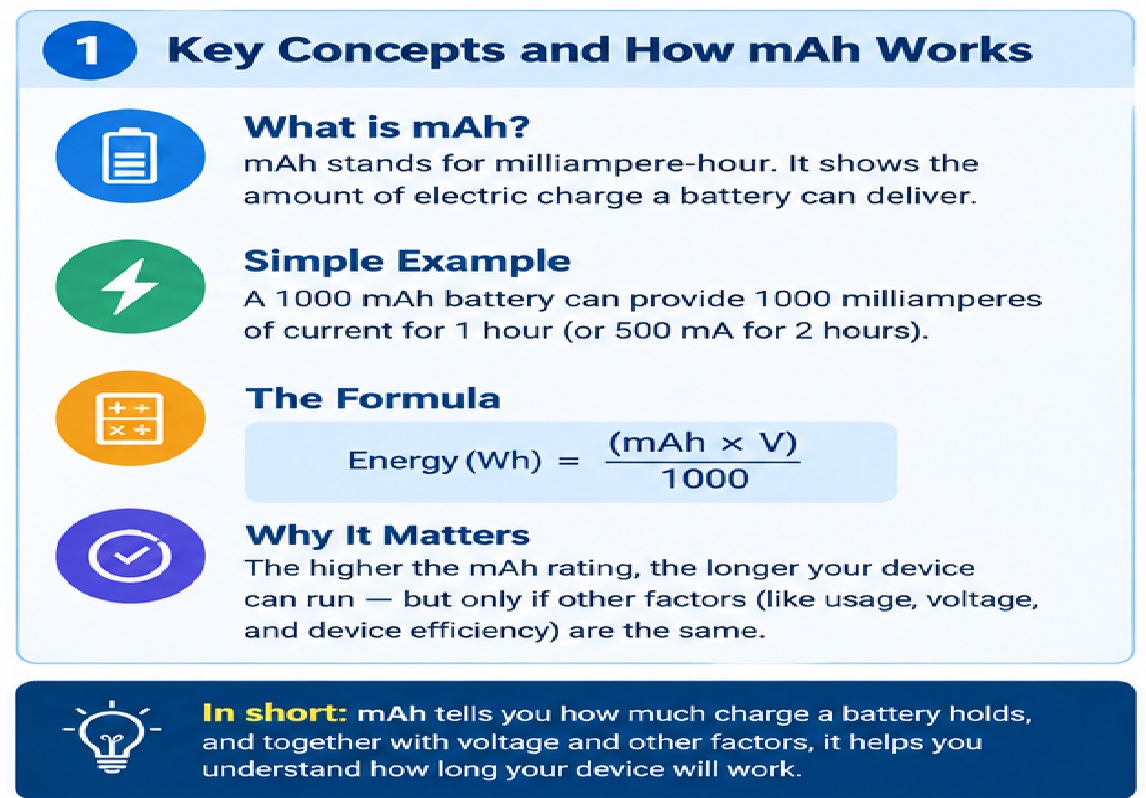
mAh, the full form, is milliampere-hour. That is the unit used for electric charge, for storing energy stored and supplied in a battery over time. In simple words, a 1000mAh battery has the capacity to provide 1000 milliamperes of current in a single hour, according to this equation
Energy (Wh)=(mAh×V)/1000
Is mAh relevant to Battery Life?
mAh of a battery is relevant to battery life, with different factors involved. In simple words, if the battery has a high mAh, it works longer before recharging. such as if your phone battery is 3000 mAh, that works longer compared to a 1000 mAh or 2000 mAh battery.
But the battery works based on different factors, such as
Usage
If you are watching videos on your phone or playing games, your phone has heavy apps that can cause fast battery discharge.
Device features
In phones, some important features such as power processors, high resolution, and advanced graphics use high energy that affects battery life, especially in devices with high mAh ratings.
Environmental Conditions
Environmental conditions are also an important factor for battery performance and working lifespan.
Charging process
Battery charging methods, reverse charging, using incompatible chargers, or discharging the battery to zero percent can cause bad effects on the battery over time
is Higher mAh Rating shws Battery is good?
Read also: A Complete Guide To Battery Charging Fundamentals and Types
A high mAh rating shows high capacity and high runtime compared to batteries of the same chemistry and design. For example, a 5000 mAh mobile battery works longer compared to a 4000 mAh battery.
But high mAh does not necessarily mean good, since high-capacity batteries are larger, heavier, and more expensive or not supported by the charging system of devices.
High capacity also takes more time to recharge.
What Is the Difference Between mAh and Ah?
mAh and Ah are used to define battery energy storage capacity. But the difference is that Ah is a larger unit compared to mAh. In other words, 1000 mAh is equal to 1 Ah.
In simple terms, small batteries work on mAh and larger batteries on AH rating.
What Do mAh and Wh Tell You About a Battery?
Battery Capacity
The mAh of a battery shows battery electric charging features under certain conditions. But mAh does not define net energy available.
such as, a 1000 mAh battery that provides a constant 2000 mAh current and works normally for 5 hours in normal conditions.
But practical runtime is short due to discharge rate, temperature, and battery working life
Energy Capacity
Watt-hours show the net energy stored and delivered through the battery. such as, a 100 Wh battery, in the right way, provides 50 watts for 2 hours or 25 watts for 4 hours.
In real runtime based on usage, battery condition, temperature, and power losses.
Runtime (hours) ≈ Battery Energy (Wh) ÷ Device Power Consumption (W)
If the battery is 100wh that using 40 W, the theoretical runtime is:
runtime-=100wh/40w=2.5h
Practically, battery-run devices are about to run for about 2.5 hours due to conversion losses.
Energy Over Time
Runtime of a battery is based on the energy stored in the battery and the power usage in devices. such as
mAh shows electric charge.
What is stored electrical energy?
W is the device that consumes energy.
Why Are Lithium-Ion Batteries Rated in mAh?
Read more: Battery Symbol in Circuit Diagrams: A Detailed Guide
Lithium-ion batteries are used in electronic devices due to their high energy density and ease of use in terms of weight and size. Their high energy density make it prominent for phones.
It is important due to the capacity needed; high battery material makes the battery larger in size and heavier. But good battery chemistry, cell structure, and energy density help to store high energy in a small design.
In rechargeable batteries of phones and other devices, they are used to understand battery charging and storage.
mAh vs. Voltage
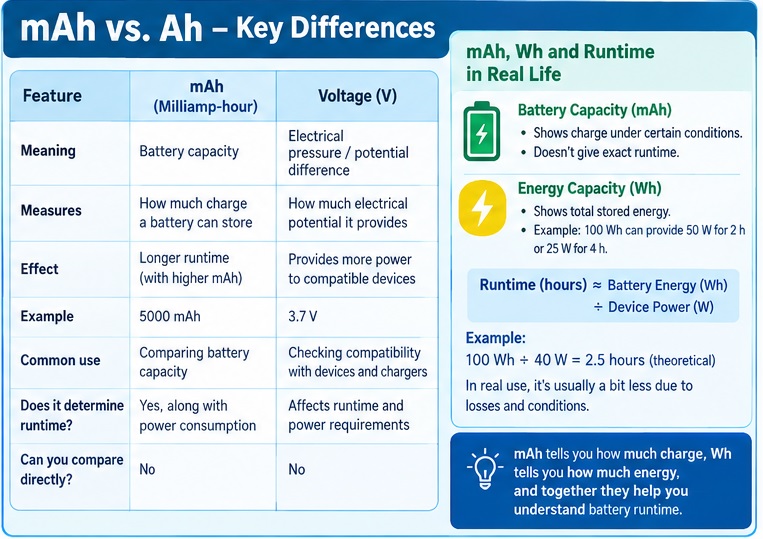
Battery capacity and voltage are two important features that affect battery performance. mAh rating means how much charge the battery provides, and voltage shows the electrical potential difference that causes current flow in a circuit.
| Feature | mAh (Milliamp-hour) | Voltage (V) |
| Meaning | Battery capacity | Electrical pressure / potential difference |
| Measures | How much charge a battery can store | How much electrical potential it provides |
| Effect | Higher mAh means longer runtime | Higher voltage provides more power to compatible devices |
| Example | 5000 mAh | 3.7 V |
| Common use | Comparing battery capacity | Checking device and charger compatibility |
| Does it determine runtime? | Yes, along with power consumption | It affects runtime and power requirements |
| Can you compare directly? | No | No |
| Battery capacity | Nominal voltage | Energy capacity |
| 2000 mAh | 3.7 V | 7.4 Wh |
| 2000 mAh | 5 V | 10 Wh |
| 2000 mAh | 7.4 V | 14.8 Wh |
| 5000 mAh | 3.7 V | 18.5 Wh |
| 5000 mAh | 12 V | 60 Wh |
Battery Capacity and Theoretical Runtime Comparison
| Battery capacity | Capacity in Ah | Runtime at 100 mA | Runtime at 500 mA | Runtime at 1000 mA |
| 500 mAh | 0.5 Ah | 5 hours | 1 hour | 0.5 hour |
| 1000 mAh | 1 Ah | 10 hours | 2 hours | 1 hour |
| 2000 mAh | 2 Ah | 20 hours | 4 hours | 2 hours |
| 5000 mAh | 5 Ah | 50 hours | 10 hours | 5 hours |
| 10,000 mAh | 10 Ah | 100 hours | 20 hours | 10 hours |
mAh to Ah Conversion Chart
Ampere-hours (Ah) and milliampere-hours (mAh) are used for measuring electrical charge capacity. The basic difference is the unit scale: 1 Ah equals 1000 mAh.
mAh to Ah Conversion Formula
mAh to Ah Conversion Table
| Battery capacity (mAh) | Battery capacity (Ah) | example |
| 100 mAh | 0.1 Ah | Small electronic sensor |
| 250 mAh | 0.25 Ah | Compact rechargeable device |
| 500 mAh | 0.5 Ah | Small battery-powered gadget |
| 750 mAh | 0.75 Ah | Compact rechargeable battery |
| 1000 mAh | 1 Ah | Small rechargeable battery |
| 1500 mAh | 1.5 Ah | Portable electronics |
| 2000 mAh | 2 Ah | AA NiMH rechargeable cell |
| 2500 mAh | 2.5 Ah | High-capacity AA NiMH cell |
| 3000 mAh | 3 Ah | Lithium-ion cell |
| 5000 mAh | 5 Ah | Smartphone or battery pack |
| 10,000 mAh | 10 Ah | Power bank or battery pack |
| 20,000 mAh | 20 Ah | Large portable battery pack |
How to Select the Best Battery for Your Requirements
Usage conditions
Accurate battery selection based on battery usage. Phones use compact design, battery, and energy capacity, and vehicles need high discharge features, heat management, and proper energy capacity
Batteries are compared in Wh
If the battery comes with different voltage ratings, convert it into WH for comparison features. This is best for understanding energy capacity compared to charge rating
Energy Density
Energy density shows how much energy a battery stores based on weight. High energy density helps batteries store high energy without affecting size or weight.
Certification
Selecting a battery from a famous brand provides accurate safety features. Battery quality is an important factor for safety, reliable features, and longer life
Factors Influencing Battery Capacity and Lifespan
Discharge Rate:
Fast battery discharge affects me. High-drain devices have low usable capacity compared to defined MAH values, that affect their operation.
Temperature:
High and low temperature conditions have a bad effect on battery capacity and performance. Low temperature affects existing charge, and high temperature results in accelerated degradation and reduces MAH.
Age
Rechargeable batteries have certain charge-discharge cycles that cause capacity degradation. A full cycle reduces the net MAH rating. With the passage of time, batteries not in use cause degradation due to chemical processes
Battery Chemistry:
Batteries come with different chemistries, such as lithium-ion (Li-ion), nickel-metal hydride (NiMH), and nickel-cadmium (NiCd), that have different shelf lives, energy densities, and discharging features.
Lithium-ion batteries are commonly used in electronics since they have high energy density and good working life, providing high mAh for a compact form factor
Internal Resistance:
Since battery work is high-stress, and inner resistance rises. This causes high energy losses due to charging and discharging, affecting battery mAh usage and efficiency
Importance of mAh in Different Devices
Read also: Understanding 18350 Battery: Features, Applications, & types
mAh rating is an important feature that is used for different devices for their power features.
Mobiles
mAh is important for phones’ batteries since we use phones for multiple purposes, such as video streaming, browsing, etc. Some of the latest phone models come with a range of 3000 mAh to over 5000 mAh. High mAh helps the battery to work for a longer time
Laptops:
• The laptop charging system uses watt-hours for basic energy features since it comes with different cell designs and voltage values, and the mAh of single cells provides total battery capacity. high-mah of cells, CMEs with proper heat management
Power Banks:
Power Bank Charging: With mAh, a 10000 mAh power bank provides charging to 3000 mAh phones for two to three days. Larger power banks, such as those with 20000 to 30000 has featres to charge many devices
IoT Devices
Different Internet of Things devices, smartwatches, and CEMS with batteries in the same rating for functioning. Since they need small power, they use 100- to 500 mAh batteries.
Electric Vehicles
EVs come with larger battery packs that are rated in kilowatt-hours (kWh). High kWh provides a larger voltage, and the vehicle works longer. EVs’ batteries come with many cells that provide net charge capacity.
Misconceptions about mAh
There is some misconception that exists about mAh that must be checked.
Higher mAh means good performance.
It is not always correct, since voltage is an important factor. battery whose mAh is low but the voltage is high provides high wh to charge to low mAh and low voltage. A high mAh but faulty design battery causes slow charging.
Batteries with the Same mAh Rating Are Not Always Interchangeable
It is not always correct with Mah, dimensions, voltage, connector type, and internal protection circuits must be according to the device’s features. If a battery is not supported, it can affect device operation.
A higher mAh rating always means a better battery.
mAh does not mean battery quality; some factors such as internal resistance, life cycle, and safety parameters are best for proper battery operation. such as, a 3000 mAh battery works well cmparing to a 4000 mAh battery for a constant power supply
Conclusion
mAh for batteries is the best factor for selecting the proper power option. mAh rating shows battery capacity, defines energy storage, and details runtime. A high mAh battery provides long functioning time. working devices’ efficiency, power usage, charging, and battery quality based on real projects. Whether we are buying any electronic device such as a phone, EV, or battery pack power bank, it is an important factor for all devices
Frequently Asked Questions
How many mAh is preferred for a power bank?
For normal charging of a phone, 10000 mAh is preferred, but if you are travelling a longer distance, 20000 mAh is used to charge different devices. So use a power bank according to the device’s battery and usage.
Does a higher mAh battery take more time to charge?
Normally, a high mAh battery is needed for a time to fully charge. but real charging speed is based on the charger, battery compatibility, charging method, and temperature conditions
Why Does Battery Runtime Differ Between Devices with the Same mAh Rating?
The same mah mean the same runtime, since different devices use energy with different ratings. Such as network, display, processor, and apps; all affect battery mAh rating
What does a 5000 mAh battery mean?
A 5000 mAh battery means
- 5000 mA =1 hour
- 2500 mA = 2 hours
- 1000 mA = 5 hours
- 500 mA = 10 hours
Is a 6000 mAh Battery Better Than a 5000 mAh Battery?
For capacity purposes, the 6000 mAh battery has higher energy-storing capacity compared to 5000 mAh. But in real battery life based on device power usage and working conditions. device with a 5000 mAh battery is not as effective cmparing to a 6000 mAh battery.
How to convert mAh to Wh?
This formula is used for converting mAh into Wh
Wh = (mAh × V)/1000,
- V shows the battery voltage,