The 18350 battery is a high-performance compact device that is used in portable devices and flashlights. This battery provides excellent features of efficiency and portability. In this tutorial, we will cover detailed features of the 18350 battery and important parameters.
What is an 18350 battery
The 18350 battery is a lithium-based battery with a cylinder-shaped design that is part of energy storage applications and provides power to small devices through recharging features.
It has recharging features and is available in different chemistries, such as lithium manganese and lithium cobalt nickel manganese. Lithium-ion chemistry has a high energy density compared to nickel-lithium batteries, so it is used in different devices such as mobile phones.
Its dimensions are a diameter of 18 mm with a 35 mm length; that is small compared to other batteries but has high energy output.
The normal voltage for this battery is 3.6V or 3.7V, and the full-charge voltage is 4.2V. These batteries have high energy density with a compact design and are preferred where space is limited.
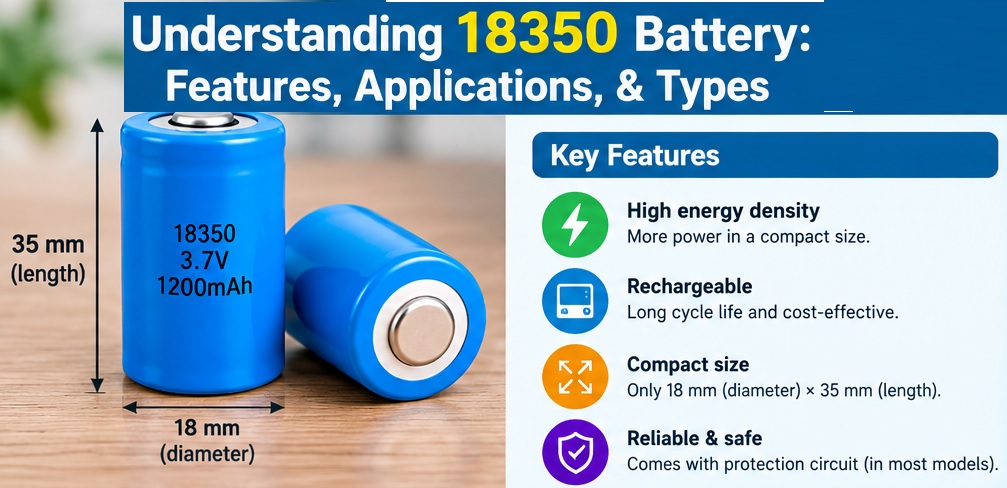
18350 stands for
The 18350 is the brand number or model number. Each digit shows certain dimension values, such as.
The number 18 is the battery diameter measured in mm, and 35 is the length. The last digit 0 shows the battery is cylindrical, so it is preferred for smartphones and laptops.
18350 BATTERY Working Principle and Structure
18350 as a lithium-ion battery that is made to provide high energy storage and offer high efficiency. The battery functions with lithium ions that exist between 2 parts: the anode and cathode.
During the charging process, lithium ions move towards the anode for energy storage, and during battery use, ions move to the cathode, and energy is released in the form of current to deliver power to devices.
In a battery, an electrolyte exists that causes ion movement, and the battery comes with features for controlling short circuits. In this way, devices are connected to the power.
To prevent the battery from over-discharge and short circuits, the battery comes with a protection circuit that protects the battery from different conditions. These features make the battery work in different devices
18350 battery technical features
Voltage
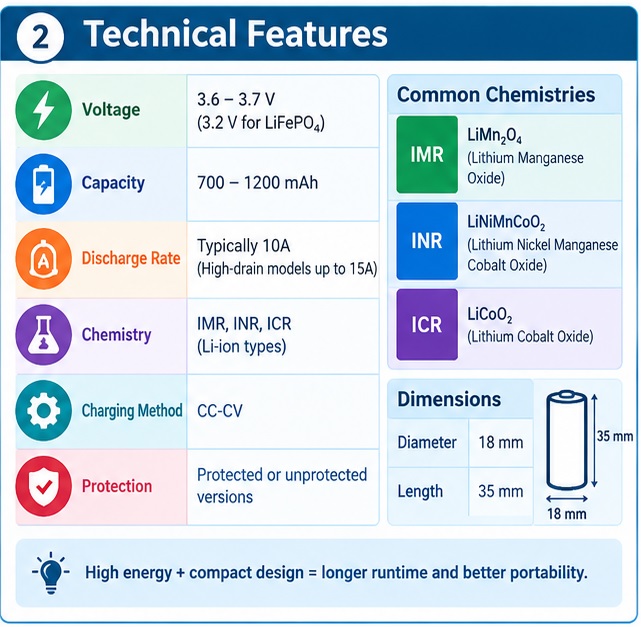
18350 lithium chemistry comes with 3.7 volts that are compatible with different devices. Voltage is a measurement of battery potential. For chemistries INR, IMR, and ICR, LITHIUM IONS have a voltage of 3.7V, and for LITHIUM IRON PHOSPHATE, they have a lower nominal voltage around 3.2V.
Capacity (mAh):
The capacity measuring unit is milliampere-hours (mAh), which shows how much time the 18350 battery works during a single charge. High mAh shows high runtime. The normal capacity of this battery is 700 mAh to 1200 mAh.
Select the correct capacity based on runtime. Normal capacity is the main factor for the device to work.
Discharge Rate (A)
Discharge rate is measured in amps, which shows the battery provides safe power. Capacity is basically like water in a tank, and discharge rates show pipe width.
18350 high capacity comes with a moderate continuous discharge rate of about 10 amperes. While 18350 has a high discharge of 15 amperes and lower capacity.
Crossing discharge values notsafe features that make battery overheating, and reducesworking life, and sometime the battery to explode.
SFE discharge is important for lithium-ion batteries.
Chemistry
The chemistry of the lithium-ion 18350 battery shows safety features and working parameters. There are three main types of chemistries for the 18350 battery
| Battery | Cathode Material |
| IMR | Lithium Manganese Oxide (LiMn2O4) |
| INR | Lithium Nickel Manganese Cobalt Oxide (LiNiMnCoO2) |
| ICR | Lithium Cobalt Oxide (LiCoO2) |
| Feature | Technical specification |
| Battery model | 18350 |
| Battery chemistry | Lithium-ion (Li-ion) |
| Nominal voltage | 3.6–3.7 V |
| Charging voltage | 4.2 V |
| Capacity | 700–1200 mAh (model-dependent) |
| Energy | 2.52–4.44 Wh |
| Diameter | 18 mm |
| Length | 35 mm |
| Cell shape | Cylindrical |
| Rechargeable | Yes |
| Charging method | CC-CV |
| Standard discharge cutoff | 2.5–3.0 V, depending on model |
| Maximum continuous discharge current | Model-dependent |
| Internal resistance | Model-dependent |
| Positive terminal | Flat-top or button-top |
| Protection circuit | Protected or unprotected versions |
| Cycle life | Model-dependent |
| Self-discharge rate | Chemistry- and storage-dependent |
| Applications | Flashlights, portable electronics, compact devices |
Difference Between 18350 and CR123 Batteries
Size
The CR123 batteries look the same in dimensions and are about the same size as each other. The CR123 dimensions are 17 mm in length and 34.5 mm wide, while the 18350 battery dimensions are 18 mm and 35 mm wide.
Chemistry and Voltage
The CR123 battery is a non-rechargeable lithium cell with 3.0 volts. While a 3.6 to 3.7 V lithium-ion cell 18350.18350 is rechargeable and has recycling features.
Votage different causes overheating for devices that function on CR123 since they need low voltage, and if 18350 is used, result of overheating
Technical Feature | 18350 Battery | CR123 Battery |
| Battery type | Rechargeable lithium-ion | primary lithium |
| Common chemistry | Lithium-ion | Lithium manganese dioxide (Li-MnO₂) |
| Battery format | 18350 | CR123A |
| Shape | Cylindrical | Cylindrical |
| Diameter | 18 mm | 17 mm |
| Length | 35 mm | 34.5 mm |
| Nominal voltage | 3.6–3.7 V | 3.0 V |
| Fully charged voltage | 4.2 V | Not rechargeable; fresh-cell voltage is typically around 3.0–3.2 V. |
| capacity | 700–1200 mAh | 1400–1700 mAh |
| Energy capacity | 2.5–4.4 Wh | 4.2–5.1 Wh |
| Rechargeable | Yes | No, for standard CR123A |
| Charging method | CC-CV | Not applicable |
| Self-discharge | cell design | low during storage |
| Discharge performance | cell model | Depends on load and manufacturer |
| Protection circuit | Protected or unprotected versions | Not normally applicable |
| applications | Compact flashlights and rechargeable electronics | Cameras, security sensors, and flashlights |
Can we interchange CR123 with the 18530 battery?
Either CR123 or 1850 comes with the same dimensions but is not interchangeable. CR123 is three volts; devices operating with this battery do not work on 18350 since it has a higher voltage of 3.7V.
18350 battery-powered devices, if working with a CR123 battery facing a performance issue since CR123 is non-rechargeable, stop working.
18350 vs. 21700 Battery
Technical Feature | 18350 Battery | 21700 Battery |
| Battery chemistry | Lithium-ion (Li-ion) | Lithium-ion (Li-ion) |
| Battery format | 18350 | 21700 |
| Shape | Cylindrical | Cylindrical |
| Diameter | 18 mm | 21 mm |
| Length | 35 mm | 70 mm |
| Nominal voltage | 3.6–3.7 V | 3.6–3.7 V |
| Fully charged voltage | 4.2 V | 4.2 V |
| Typical capacity | 700–1200 mAh | 4000–5000 mAh |
| Energy capacity | 2.52–4.44 Wh | 14.4–18.5 Wh |
| Rechargeable | Yes | Yes |
| Charging method | CC-CV | CC-CV |
| Maximum discharge current | Model-dependent | Model-dependent |
| Internal resistance | Model-dependent | Model-dependent |
| Protection circuit | Protected or unprotected | Protected or unprotected versions |
| Cycle life | Depends on cell design and usage | Depends on cell design and usage |
| applications | Compact flashlights and portable electronics | Electric vehicles, power tools, high-capacity battery packs, and flashlights |
18350 battery types
High-Drain 18350 Batteries:
This battery has high performance and is part of flashlights and vaping devices where high power is needed. It generates high power for a short time and comes with a high discharge rate and lower capacity.
Button Top Batteries:
Button Top 18350 Batteries: Supported devices where an accurate connection is needed since it comes with a protruding button at the positive side of the battery.
Protected Batteries:
This 18350 battery safe factor comes with a built-in protection circuit that prevents short circuits and stops overcharging
Flat-top 18350 batteries:
This battery supports devices where a flat top is needed to make a straight connection since it comes with a flat positive end.
High-Capacity 18350 Batteries:
This battery has a high runtime per charge due to its high capacity compared to a normal 18350 battery. It comes with a reduced discharge rate and is best for low-drain applications
Difference Between 18350 and 18650 Batteries
Dimensions
The basic difference between the 18350 and 18650 batteries is their dimensions. The 18350 battery is 18 mm, and the 35 mm is the length of 18650.
Size differences define battery differences. 18350 is used in small devices such as flashlights. But 18650 is used where high power is needed, such as laptops and power devices
Capacity
18650 is a larger size and provides a higher capacity compared to 18350. 18350 is 700 to 1200 mAh, while 18650 is higher than 18350.
Technical Feature | 18350 Battery | 18650 Battery |
| Battery chemistry | Lithium-ion (Li-ion) | Lithium-ion (Li-ion) |
| Battery format | 18350 | 18650 |
| Shape | Cylindrical | Cylindrical |
| Diameter | 18 mm | 18 mm |
| Length | 35 mm | 65 mm |
| Nominal voltage | 3.6–3.7 V | 3.6–3.7 V |
| Fully charged voltage | 4.2 V | 4.2 V |
| Typical capacity | 700–1200 mAh | 2000–3500 mAh |
| Energy capacity | 2.52–4.44 Wh | 7.2–12.95 Wh |
| Rechargeable | Yes | Yes |
| Charging method | CC-CV | CC-CV |
| Maximum discharge current | Model-dependent | Model-dependent |
| Internal resistance | Model-dependent | Model-dependent |
| Protection circuit | Protected or unprotected | Protected or unprotected |
| Cycle life | Based on cell design and usage | Depends on cell design and usage |
| Common applications | Compact flashlights and portable electronics | Laptops, power tools, flashlights, and battery packs |
18350 vs. 16340 Battery: Technical Comparison
Technical Feature | 18350 Battery | 16340 Battery |
| Battery chemistry | Lithium-ion (Li-ion) | Lithium-ion (Li-ion) |
| Battery format | 18350 | 16340 |
| Shape | Cylindrical | Cylindrical |
| Diameter | 18 mm | 16 mm |
| Length | 35 mm | 34 mm |
| Nominal voltage | 3.6–3.7 V | 3.6–3.7 V |
| Fully charged voltage | 4.2 V | 4.2 V |
| Typical capacity | 700–1200 mAh | 550–800 mAh |
| Energy capacity | 2.52–4.44 Wh | 1.98–2.96 Wh |
| Rechargeable | Yes | Yes |
| Charging method | CC-CV | CC-CV |
| Discharge current | Model-dependent | Model-dependent |
| Protection circuit | Protected or unprotected | Protected or unprotected |
| applications | Flashlights, portable electronics | Flashlights, optical devices, compact electronics |
| Physical compatibility | Requires an 18350-compatible compartment | Requires a 16340-compatible compartment |
Maintenance factors for 18350 Li-ion battery
For proper operation and longer life of the battery, follow these factors.
Proper Charging
For a longer working life, 18350 battery charging is an important factor. Use the proper charger for battery charging, and connect the charger according to the manual.
When 18350 is first used, charge it fully to help make the battery proper protection.
Use a proper charger for accurate charging, since a slow charger provides accurate charging.
Overcharging the battery affects working life: some Li-ion chargers have a safety factor to prevent this
Storage
18350 battery storage is also an important factor for longer storage; reduce charging to 3.7 volts. If it is fully charge, it affects capacity loss.
Put the battery in a cool location and keep it away from sunlight and heat, as well as water. High heat damages the battery and causes an explosion.
Put the battery in a proper casing before storage to prevent short circuits
Selection factor 18350 rechargeable battery
Follow these points before selecting the 18350 battery for practical uses
Capacity
Capacity is important because higher capacity provides longer runtime but lower maximum discharge performance.
discharge current
For high-drain devices like a flashlight, check the battery easily to provide needed current.
Protected vs. unprotected cells
• The protected battery has an internal protection circuit that controls overcharging, short circuits, or over-discharging.
Life Cycle
• A proper 18350 battery has many hundred charge cycles and provides stable working
Applications of the 18350 Battery
Flashlights
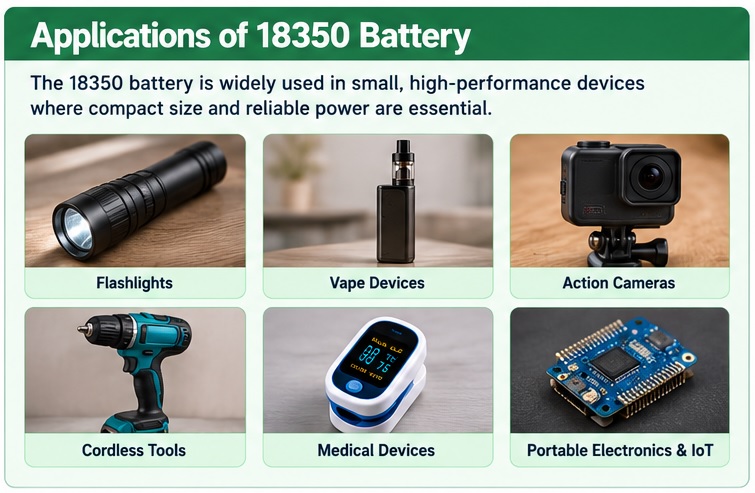
18350 batteries are used for different devices due to their small size and power supply. either 35 mm in length, so connected in a limited space, and where high energy is needed.
So it is used in LEDs and flashlights, where high recharging power is needed. It is also used for tactical flashlights and lighting systems since it offers high-drain discharge capacity.
Why is the 18350 battery used for flashlights?
Compact Size
18350 is a small size, so it is part of flashlights and other small devices. The 18350 dimensions are 18 mm by 35 mm.
So used in different tools; it is used for headlamps and watches. The low weight (24 grams) makes it easy to use.
High Discharge Rates
18350 is used for flashlights since it provides bright light. The battery has a high discharge rate that provides high power. When using high discharge, it is used for flashlights and provides steady power.
It provides power during the highest setting of light. battery offers a strong burst up to 15A. It functions with a steady 10A
Flashlights
18350 batteries are used for different devices due to their small size and power supply. either 35 mm in length, so connected in a limited space, and where high energy is needed.
So it is used in LEDs and flashlights, where high recharging power is needed. It is also used for tactical flashlights and lighting systems since it offers high-drain discharge capacity.
Why is the 18350 battery used for flashlights?
Compact Size
18350 is a small size, so it is part of flashlights and other small devices. The 18350 dimensions are 18 mm by 35 mm.
So used in different tools; it is used for headlamps and watches. The low weight 24 grams) makes it easy to use.
High Discharge Rates
18350 is used for flashlights since it provides bright light. The battery comes with a high discharge rate that provides high power. When using high discharge, it is used for flashlights and provides steady power.
It provides power during the highest setting of light. battery offers a strong burst up to 15A. It functions with a steady 10A.
Conclusion
The 18350 battery is the best for high-drain and compact devices since it has recharging features that offer good size, capacity, and voltage features that are helpful for flashlights, laser tools, and electronic devices having compact space. The 18350 battery is high performance with a small size
FAQs
How much time does an 18350 battery last on a single charge?
Battery life depends on power usage for low-drain devices where work is for many hours, but flashlights drain fast
Can an 18650 battery be replaced with an 18350 battery?
Yes, if devices have compatibility to work with these two batteries. Since 18350 is a small dimension, devices need an adapter for connection.
What is the voltage of an 18350 lithium battery?
A normal 18350 lithium-ion battery comes with a voltage of 3.6V or 3.7V, and is 4.2V when fully charged.
How many charge cycles does the 18350 rechargeable battery have?
A quality 18350 rechargeable battery provides 300 to 500 full charge cycles, but real working life is based on charging and use.
Can 2 18350 be used in place of 18650?
No, it is not recommended to use two 18350 batteries instead of a single 18650, which increases the voltage level to a high value that can damage devices and batteries. So use device requirements features
What does a ‘protected’ 18350 battery mean?
The protected 18350 battery comes with an electronic circuit. That circuit is used to prevent short circuits and overcharging. If a battery is not protected, it can cause damage. So an unprotected battery needs more precautions for safe functioning.
How to dispose of an 18350 battery?
Do not throw the battery in the bin, since it can cause damage to landfills. So recycle batteries properly. Some stores offer services for battery disposal.
Why does the new 18350 battery not have full charging?
18350 batteries: the new model comes with partial charging for safety purposes. Normally, it comes with 3.6V to 3.7V.
So, do full charging of the new battery before practical use