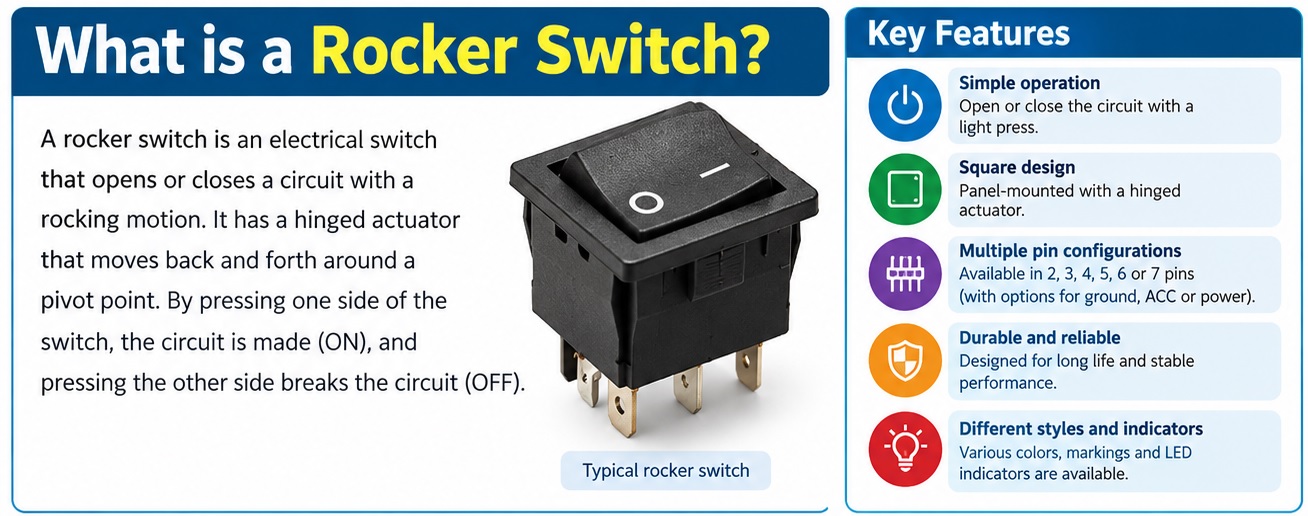
The rocker switch is an on/off switch; it is either open or closed. The circuit is one-sided compared to the other. It is square-shaped, having a hinged actuator that is configured over an axis. By pressing one part, an electrical connection is made at one contact.
Rocker switches come with different pin configurations, such as 2, 3, 5, 6 or 7. Some come with a ground, ACC or power pin. In this tutorial, we will detail the features of its pins and related features. So let’s get started
What is a Rocker Switch?
A rocker switch is basically an electrical switch that opens or closes a circuit with the following rocking motion. Its uses are for current flow in circuits. Its back-and-forth motion causes the circuit to open or close; that’s why it’s known as a rocker switch.
The rocker switch is square-shaped, having a pivot point in the center where it causes back-and-forth motion. It is panel-mounted and functions with one side pressed for the circuit to work and the other side off for the circuit.
A rocker switch comes with two or more positions for functioning, which are on/off or multiple on/off positions, and with that comes a momentary function that restores the switch to its real positions when released.
This switch has a different design, structure, and color, with different markings for functioning.
Rocker Switch Working
The working of the rocker switch is simple since it works with a small press on one side of the switch to get the required position. It’s working compared to the toggle switch since it needed short force for switching positions.
According to its positions and manufacturing process, rocker switches face sticking between positions. To handle this, the switch design comes with a spring-loaded configuration that helps to get neutral positions automatically when not pressed.
Rocker switch functioning is as
When the switch is off, the main circuit is open, and there is zero current flow.
When the switch is in the on condition, the circuit is closed and current flows
When we press a rocker switch, it is in that position; these conditions are known as latching rocker switches.
When it gets to its original position, it is released; these are called momentary rocker switches.

Parts of a Rocker Switch
The main components of a rocker switch are
Actuator / Rocker
This part of the switch is used for on/off circuits.
Housing
It is the external structure of the switch that protects the internal assembly.
Contacts
It is a metallic component that makes or closes a circuit.
Springs
These components provide the switch latch or shift the switch in its original position.
Terminals
These pins of rocker switches are externally connected.
LED indicator
It shows the switch’s working status

Rocker Switch Pins
Rocker switches come with different pin configurations, and each has certain functions.
2-Pin Rocker Switch
It is a simple rocker switch type that has two pins.
PIN1=input power
PIN2 = output
This switch controls the positive wire of the load. If the switch is in the on state, power goes to the first pin, then to pin 2. When it’s off, it means the circuit is open. This switch is basically used for on/off basic circuits, such as LEDs.
3-Pin Rocker Switch
This switch, part of vehicles and used for power control, comes with three pins:
PWR = input power
ACC=load
GND = ground pin
This switch is used for regulating power between ACC and PWR pins. A ground pin is employed in the LED built-in circuit. It’s commonly used for controlling LED lights, pumps,
4-Pin Rocker Switch
The 4-pin rocker switch is a DPST switch of the rocker type. that regulate two different circuits once. Its main four pins are
pin1=circuit 1 power input
pin2 = load output circuit1
pin3=ciruucit2 power input
pin4 = load output circuit 2
This switch is best for controlling two wires at the same time, like live and neutral or two different low-voltage circuits.
5-Pin Rocker Switch
The 5-pin rocker switch comes with 5 pins that are
pin=12V power input
pin2= load output
pin7 = ground
Pin 6 = backlight power
pin8= led ground
These PINs can differ according to manufacturers, such as 2, 3, 6, 7, 8, or 1, 2, 3, 6, 7. This switch comes with 2 lights: a lower light for the switch location at night and a top light for indication of active status.
Its common uses are in work lights, dash panels, and off-road lights
6-Pin Rocker Switch
The 6-pin rocker switch is a DPDT switch. Its uses are in projects where reverse polarity is needed, such as small DC motors.
Main pins are
pin1=input
pin2=output1A
PIN3=OUTPUT1B
pin4=circuit 2 input
pin5=output2A
pin6=output2b
This switch is part of the direction control circuit of the motor
Types of Rocker Switches
There are different types of rocker switches, and each performs certain functions. Types of rocker switches are
SPST Rocker Switch
The SPST full form is single pole single throw, which is a common type of switch that is used for controlling a single switch through two positions, ON and OFF.
This rocker switch has 2 or 3 pins. The two-pin type provides in and out power, and the three-pin has a ground pin that is used for the indicator light.
The main uses of SPST rocker switches are pumps, LED lights, and power strips.
SPDT Rocker Switch
The SPDT switch full form is Single Pole Double Throw. It is used for controlling one circuit but has two inputs. such as ON-ON or ON-OFF-ON positions.
It comes with three pins and is used when we need option selection between two, for example, two input powers and two lights
DPST Rocker Switch
DPST’s full form is Double Pole Single Throw. This switch is used for controlling two distinct circuits, such as circuits that turn ON or OFF together.
These switches have 4 pins, so they are used for AC power supplies and dual circuit control.
DPDT Rocker Switch
DPDT stands for Double Pole Double Throw. It is an advanced rocker switch that works like two SPDT switches in a single place. This switch is helpful for controlling two circuits.
It has 6 pins and makes useful connections for DC motor reversing and polarity reversal electrical wiring
How to Test a Rocker Switch
Normally, the rocker switch test is performed using a multimeter, and these tests
Continuity Test
For this test, remove the switch from powersuppy to start testing, then set the meter to continuity mode. Now connect one probe to the power input pin and the 2nd probe to the output pin.
If the switch is in the off condition, the meter shows an open circuit, and when the switch is in the on state, the meter shows
When the switch is OFF, the meter should show an open circuit. very low resistance. If measurements vary when the switch is moving, the connection can be damaged.
Voltage Test
Now set the meter to DC voltage in a 12V circuit; for powering the circuit, power to ground gives battery voltage. ACC to ground value is zero volts during off conditions.
ACC to ground gives battery voltage in ON conditions.
PWR comes with voltage when ACC not in on state; the switch is an error. If ACC is connected to voltage but the device does not function, check the ground
When to Replace a Rocker Switch
Some factors must be considered that cause replacement and repair of a rocker switch. such as
If the switch casing is damaged, the actuator is loose.
Switch temperature is high; internal connections are damaged.
Switch is discolored
How to Select a Rocker Switch
Read more; What is an SPST Switch, Features, uses, & Working
Some factors considered before choosing a rocker switch include
Rating
The rating of a rocker switch shows current capacity and highest voltage. ,Supply voltage, current flowing through the load, and inrush current at the time of starting are important factors
Circuit design
A rocker switch comes in different types and designs, such as SPD, SPST, DPST, and ordpdt, which are used for finding the number of poles and the position of the switch
Working
Working and the function of the rocker switches are also important factors, such as the entry switch on/off switch or a multi-position switch. These factors are helpful for using the right switch according to requirements.
Mounting:
It comes with different mounting processes that help for using the right switch: snap-in, screw-in, or PCB mounting.
Dimensions:
Switch shape and dimensions are also important for proper fitting according to space length, width, and height.
Environmental factor
The rocker switch must have features for easy operation in dust, humidity, moisture, etc.
Quality
Different factors, such as material and manufacturing process, are important for safe assembly and uses
Certification:
The switch must follow different regulations or certifications, such as UL, CE, or RoHS compliance.
Errors for Installing Rocker Switches
Read more What is DPDT Relay: How does a DPDT Relay Work? its Applications
Different errors occur during installations that must be avoided
Sometimes fuses are not used; that is important, so install an inline fuse near the power supply. When a short circuit occurs, fuse can damage or blow before the wire heats up
Using faulty wiring, such as thin wire that becomes overheated, can cause the fuse to blow; use the required wire gauge according to the device’s current requirement
Mistaking, reversing, or mixing power and acc pins causes the switch to work incorrectly, and that LED circuit starts dimming
Faulty grounding results in LED dimming, so use a proper connector and make a strong connection
Rocker Switch vs Toggle Switch vs Push Button Switch
Technical Feature | Rocker Switch | Toggle Switch | Push Button Switch |
| Operating Mechanism | Presses and rocks between positions | Moves a lever to change contacts | Presses a button to operate contacts |
| Contact Configuration | SPST, SPDT, DPST, DPDT | SPST, SPDT, DPST, DPDT | SPST, SPDT, DPST, DPDT, depending on model |
| Rated Voltage | 12–24 V DC or 125–250 V AC, model-dependent | 12–24 V DC or 125–250 V AC, model-dependent | Low-voltage control and mains-rated versions are available |
| Rated Current | low-current ratings to 10–20 A or higher in specialized models | low-current ratings to 10–20 A or higher in specialized models | low-current signal switching to high-current power switching in suitable models |
| Switching Action | maintained ON/OFF | maintained ON/OFF; momentary types also exist | momentary; latching types are also available |
| Mechanical Life | 10,000–100,000 operations | 10,000–100,000 operations | 100,000–1,000,000 operations for suitable control models |
| Mounting Type | Rectangular panel cutout or PCB | Threaded panel bushing or PCB | Panel hole, PCB, or surface mounting |
| Actuator Design | Flat or curved rocking paddle | Projecting lever | Round, square, or illuminated button |
| Electrical Terminals | Quick-connect, solder, screw, or PCB terminals | Screw, solder lug, quick-connect, or PCB terminals | Screw, solder, quick-connect, or PCB terminals |
| Applications | Household appliances, power supplies, automotive dashboards | Industrial machinery, test equipment, control panels | Start/stop controls, doorbells, reset circuits, and machine interfaces |
| Advantage | Compact design and convenient operation | Positive lever feedback and easy identification of position | Quick activation and convenient momentary control |
| Limitation | panel cutout | Lever needs movement clearance | Momentary types can require |
conclusion
A rocker switch is an important wiring system whose terminal identification is the main factor for use based on wire gauge, and it is protected with correct fuse installation. The rocker switch is also an important factor that must follow certain conditions for preventing error and accurate working
FAQs
Read What Is Double Pole Single Throw Switch – Working & Its Applications
Define rocker switch?
rocker switch as a switch type that functions back and forth for opening and closing circuits. It functions through one side to make it on/off.
What are the main types of rocker switches?
SPST (Single Pole Single Throw)
SPDT (Single Pole Double Throw)
DPST (Double Pole Single Throw)
DPDT (Double Pole Double Throw).
Where are uses of rocker switches?
Its common uses are in industries, power supplies, the marine industry, and vehicles
What’s the difference between toggle and rocker switches?
Technical Feature | Toggle Switch | Rocker Switch |
| Rated Voltage | 12–24 V DC and 125–250 V AC, depending on model | 12–24 V DC and 125–250 V AC, depending on model |
| Rated Current | milliamps to 10–20 A or higher for specialized models | milliamps to 10–20 A or higher for specialized models |
| Contact Configuration | SPST, SPDT, DPST, DPDT | SPST, SPDT, DPST, DPDT |
| Mechanical Life | 10,000–100,000 operations | 10,000–100,000 operations |
| Electrical Life | 5,000–50,000 operations, depending on load | 5,000–50,000 operations, depending on load |
| Operating Temperature | −20°C to +85°C, depending on model | −20°C to +85°C, depending on model |
| Mounting Type | Threaded panel mounting or PCB mounting | Rectangular panel cutout or PCB mounting |
What is the wiring process of a rocker switch?
The rocker switch design is helpful for wiring switches. Make a connection of the pin of the SPST switch with the supply and the other pin 2 load. Different connections are needed for DPDT switches
For a normal 3-pin rocker switch, make the connection of the power pin to the power ACC pin with the device and the ground pin with ground.
How many pinouts of a rocker switch?
The rocker switch comes with 2, 3, 4, 5, 6, or 7 pins, depending on the circuit. Vehicles usually use 3-pin and 5-pin rocker switches.
Can we use a rocker switch without a relay?
Yes, you can use it when the device current is within the switch rating range. For applications where high current is used, a relay is used to switch control current rather than the full load
Why is the rocker switch LED not turning on?
The common reasons are faulty polarity, missing LED ground, and zero backlight.
What is IP67 mean on a rocker switch?
It means the switch is dust-tight and offers protection from water, and is best used in open systems, vehicles, and marine uses