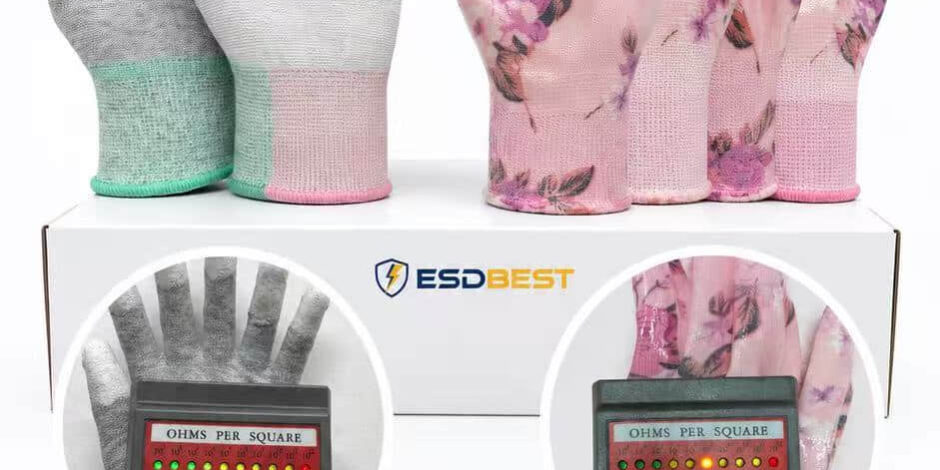
How the Right Hand Protection Supports Static Control, Product Cleanliness and Reliable Electronics Assembly
Printed circuit boards are handled many times before becoming the final product assembly. Operators connect components during different processes such as kitting, manual insertion, inspection, rework, testing, cleaning, and packaging. At each phase, the hands are a source of electrostatic charge, contamination, or mechanical damage.
Due to this cause, gloves are commonly part of electronics manufacturing, as not every glove in the factory is ESD, and not each product shown as “anti-static” is best for handling electrostatic-discharge-sensitive devices.
The glove can have a clear design, easily fit, avoid fingerprints, and provide proper control over electrostatic charge. While a glove can have the best electrostatic characteristics, causing extra particles, it minimizes dexterity with the operator’s grounding system.
Choosing an accurate glove needs more than a section to have knowledge of material or buying the lowest-cost consumable.
ESD gloves should be defined as one part of a complete electrostatic-discharge control program that also comes with personnel grounding, work surfaces, flooring, packaging, ionization, training, and compliance verification.
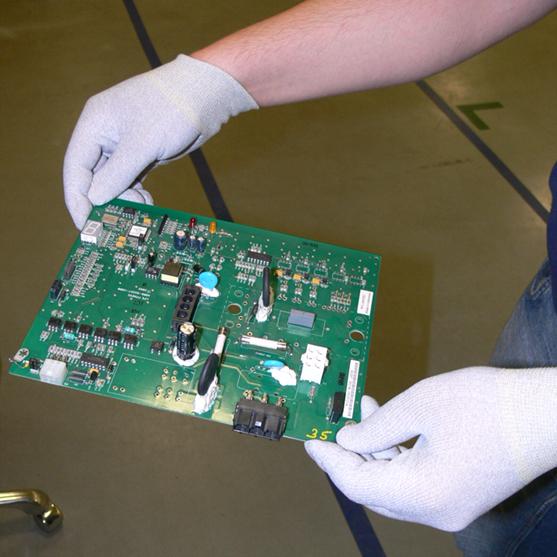
This tutorial defines why gloves matter in the PCB manufacturing process, how different glove constructions behave, and what manufacturers should ensure before approving a glove for production use.
PCB Assemblies Are Vulnerable Long Before Final Testing
Modern circuit boards are damaged with electrostatic occurrences that can vary for a person’s feeling. person may not notice static discharge until voltage gets a high value. sensitive electronic devices, affected at low levels
Some vulnerable components are
- MOSFETs
- Microcontrollers
- Memory devices
- Sensors
- RF components
- Light-emitting devices
- Communication modules
- Precision analog devices
- Power-management integrated circuit
- Fine-pitch semiconductor packages
- Damage can occur in different ways.
High damage
Components instantly fail, the board does not get power on, or it can fail functional testing.
Latent damage
Devices continuously operate but become weakened. The product can be damaged during the testing process, transportation, or customer use.
Parametric change
Device in working conditions, but one or more electrical features shift externally in a certain range. due to latent and parametric affect not easiy visbie during starting inspection, a static control process is based on contrasting exposure compared to final testing for identifying damage.
Why Hands Cause Risk in Electronics Manufacturing
Personnel movement can cause electrostatic charge through contact and separation between different materials.
- Examples include:
- Walking across a floor
- Moving on a chair
- Removing packaging
- Handling plastic containers
- Putting on or removing clothing
- Touching work surfaces
- Picking up and placing components
The charge assembled on the body is based on different factors, such as:
- Clothing
- Footwear
- Flooring
- Relative humidity
- Movement
- Materials in the environment
- Grounding effectiveness
When a charged person touches a conductive object or an ESD-sensitive assembly, charge can transfer rapidly.
Gloves can affect that risk, but their importance is needed correctly.
ESD gloves do not replace wrist straps, ESD footwear or other approved personal grounding techniques. It does not automatically make an uncontrolled workstation safe.
that role comprises safe handling through offering controlled interfacing between operator and product during meetings on electrical, cleanliness and physical requirements of the process.
Ordinary Gloves Are Not Automatically ESD-Safe
Electronics factories use different types of gloves:
- Cotton gloves
- Polyester gloves
- Nylon gloves
- Latex gloves
- Nitrile gloves
- Polyurethane-coated gloves
- Disposable examination gloves
- Cleanroom gloves
- Cut-resistant gloves
Each type comes with suitable and unsuitable products.
A standard cleanroom glove, for example, controls particles but is not verified for static-dissipative operations. A disposable nitrile glove offers chemical resistance and cleanliness but is electrically insulating according to formulation.
Likewise, a glove described as “anti-static” has no documented resistance range, no lot-testing details, and no evidence that its performance remains stable during use.
A manufacturer should therefore prevent approving gloves based only on:
- Product col
- Packaging claims
- Supplier descriptions
- Material name
- Visual appearance
- A single unverified resistance reading
The assumption that all gloves of one type perform similarly
The correct question is not simply:
Is this an ESD glove?
The better question is:
Does this glove perform appropriately within our specific ESD control system and manufacturing process?
Functions of an ESD Glove
In PCB manufacturing, gloves offered three overlapping purposes.
Static-control support
glove not add unacceptable insulating separation between operator and the product. Based on process and glove structure, this helps charge movement in a regulated way compared to allowing charge accumulation over the glove surface.
Contamination control
Gloves can minimize the transfer of:
Skin oils
Perspiration
Fingerprints
Dust
Particles
Ionic contamination
Other residues
This is important when handling bare boards, metal contacts, optical surfaces, and sensitive components.
Mechanical protection and grip
Gloves can provide strong grip and protection for both product and operator from:
Sharp leads
Board edges
Abrasion
Minor chemical exposure
Slippage during handling
A proper glove balances these features without minimizing dexterity or encouraging unsafe handling features
ESD Glove Constructions
Different glove structures are commonly used in electronics production.
Carbon-Fiber or Conductive-Yarn Knitted Gloves

These gloves are constructed from nylon, polyester, or another synthetic fiber with conductive yarn.
The conductive component is distributed through the glove in a grid, stripe or mixed-fiber structure.
Potential advantages are
- Reusability
- Breathability
- Flexibility
- Good dexterity
- Lower particle production than some ordinary textile gloves
- Controlled electrical performance when properly designed
- They are often used for:
- PCB handling
- Inspection
- Light assembly
- Component sorting
- Packaging
- General work inside an EPA
- Possible limitations include:
- Reduced grip on smooth components
- Contamination after repeated use
- Performance changes after incorrect washing
- Fraying or wear
- Inconsistent contact if the glove fit is poor
These gloves need inspection and a controlled laundering or replacement program.
PU-Coated ESD Gloves
Polyurethane-coated ESD gloves mix a conductive or static dissipative knitted liner with PU coating used to fingertips or palm.
Common types are
- Fingertip-coated gloves
- Palm-coated gloves
- Full-coated gloves
Fingertip-coated types
These give strong grip at points that shoud connection components and maintain breathability over the rest of the hand.
They are preferred for
- SMT assembly
- Component placement
- Inspection
- Fine manual work
- PCB handling
Palm-coated versions
These give strong grip and protection over the palm.
Their uses are:
- Larger parts are handled
- Repeated lifting is required
- More abrasion resistance is needed
- Operators need additional grip
Main advantages of PU-coated ESD gloves are
- High dexterity
- Good grip
- Thin coating
- Low bulk
- Suitability for repetitive handling
- Reduced fingerprint transfer
- Possible limitations include
- Coating wear
- Variation between production lots
- Contamination after repeated use
- Reduced breathability in fully coated styles
- Electrical performance that depends on the liner and coating formulation
A black, gray or white PU coating does not by itself offer ESD performance. The electrical characteristics of the complete glove must be verified.
Nitrile-Coated ESD Gloves
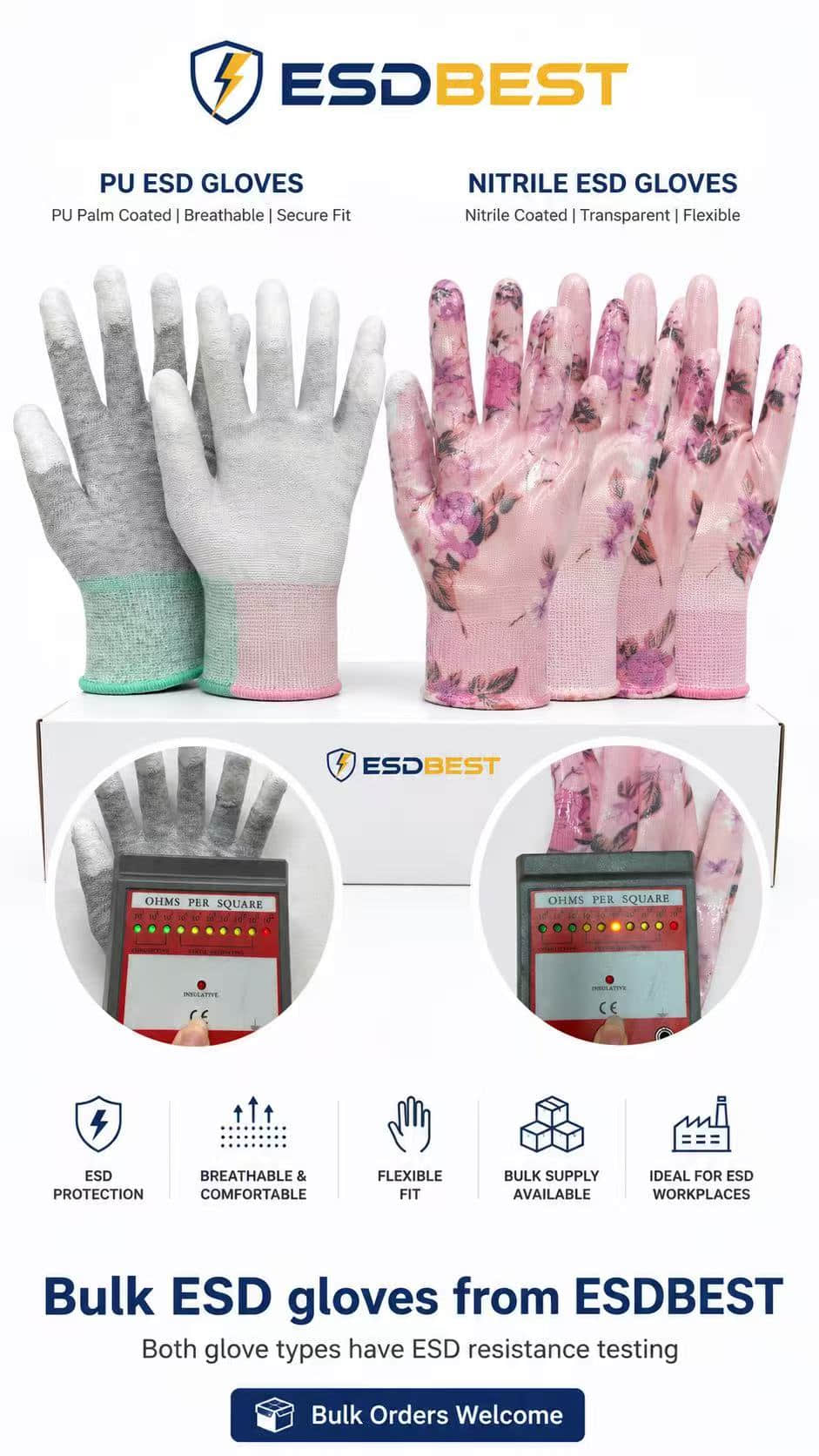
Nitrile-coated ESD gloves used for operating needing high strenght grip, also resistance for oil
They may be best for
- Equipment maintenance
- Handling metal components
- Heavy assembly
- Tool use
- Processes involving oil or light chemical contact
- Compared with a thin PU coating, nitrile coatings often provide:
- Stronger grip
- Better durability
- Greater abrasion resistance
- Improved performance in oily environments
- However, they may also be:
- Thicker
- Less breathable
- Less suitable for very fine component handling
- More likely to reduce tactile sensitivity
As with PU-coated products, the coating and liner should be evaluated together.
An ordinary nitrile work glove should not be supposed to be ESD-safe merely because it is used in an electronics factory.
Disposable Nitrile Gloves
Disposable nitrile gloves are part of cleanrooms, laboratories, and electronics production.
They can offer:
- Clean handling
- Chemical splash protection
- Resistance to skin oils and contamination
- Convenience for short-duration tasks
However, disposable nitrile gloves differ significantly in electrical behavior.
Some come with static-dissipative features, while others are highly insulating. Performance can be affected by:
- Thickness
- Formulation
- Surface treatment
- Humidity
- Powder or additives
- Manufacturing variation
- Fit
- Condition during use
Cotton Gloves
Cotton gloves are easy to use and less costly, but are not the best for defualt choice for sensitive electronics handling.
Potential problems are
- Particle generation
- Fiber shedding
- Moisture absorption
- Variable electrical behavior
- Poor grip
- Contamination
- Rapid wear
they arebest for certain handling tasks but are not used as an equivalent to verified ESD gloves.
Resistance Without Oversimplifying It
ESD glove features comes with include resistance values.
These are defined as
- Surface resistance
- Volume resistance
- Resistance through the glove
- Resistance from the operator through the glove
System resistance comes with the glove, person, and grounding method
A resistance value alone does not tell the complete story.
The result is based on:
- Test method
- Electrode configuration
- Applied voltage
- Relative humidity
- Temperature
- Contact area
- Glove condition
Whether the glove is being worn
- Skin moisture
- Instrument accuracy
- Sample conditioning
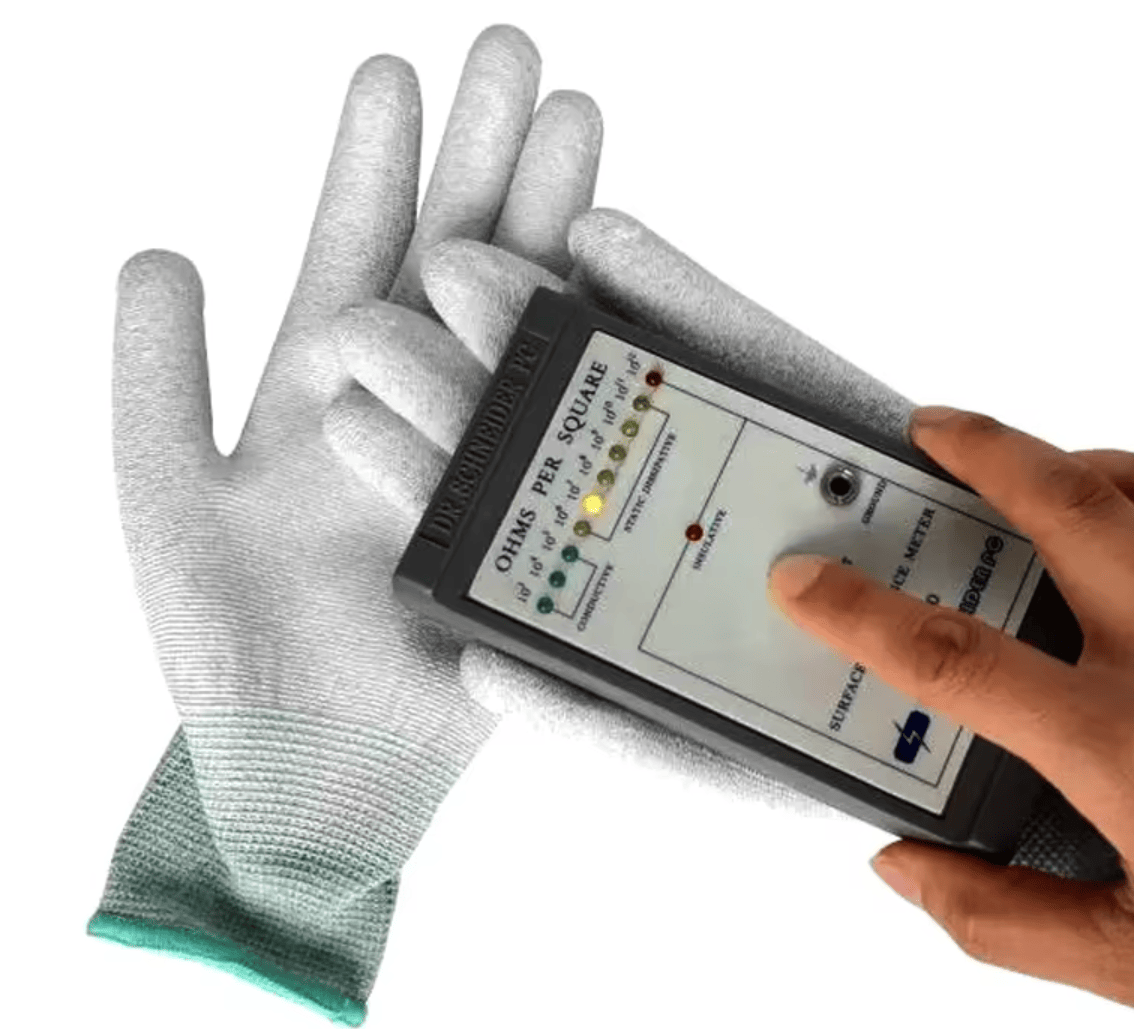
Manufacturers make comparsion products using a simple handheld meter and then set the lowest value is always best.
That approach can be distracting
A glove should not be selected since it makes the fastest discharge under one informal test. The objective is controlled charge dissipation and process compatibility.
The acceptance range is defined in the facility’s ESD control plan according to:
- Product sensitivity
- Personnel-grounding method
- Workstation design
- Customer requirements
- Applicable standards
- Internal risk assessment
Gloves Must Work With the Personnel-Grounding System
The important practical point is that gloves do not operate independently.
Follow seated operator wearing a wrist strap.
The intended grounding path normally runs with operator’s skin through the wristband and cord to an approved grounding point. The glove should not be affected by safe product handling, but it is not the basic grounding path.
Now follow a standing operator with use of ESD footwear and flooring.
The grounding path is based on the combined resistance of:
- The person
- Footwear
- Floor
- Ground connection
The glove still affects operator contact with the product, but the complete system must be evaluated.
If the glove is insulating, charge could be on the glove surface or affect contact features also if the operator’s body is grounded.
If the glove is conductive but the operator and workstation are not accurately grounded, still risk
For this reason, glove qualification should be done together with the surrounding control system.
Importance of Fit and Dexterity
A technically preferred glove fails during operations if users do not wear gloves.
- Poor fit can lead to:
- Reduced dexterity
- Dropped components
- Finger fatigue
- Incorrect handling
- Workers removing gloves
- Workers cutting glove fingertips
- Reuse beyond the intended service life
- Low compliance with the procedure
Gloves should come in proper sizes.
The selection process should come with actual operator trials involving:
- Fine component handling
- Connector insertion
- Tool use
- Inspection
- Labeling
- Rework
- Packaging
Feedback should be noted, but comfort should not override technical features. The objective is to identify the product that satisfies both.
Cleanliness and Particle Requirements
In different electronics processes, contamination control is as important as static control.
PCB surfaces affected with
- Fingerprints
- Skin oils
- Salts
- Fibers
- Dust
- Coating residue
- Cleaning chemicals
- Glove powder
A glove best for basic PCB assembly not preferred for:
- Semiconductor handling
- Optical assemblies
- Medical electronics
- High-reliability products
- Cleanroom production
- Conformal-coating preparation
- Precision sensor manufacturing
The glove selection process should therefore consider:
- Particle generation
- Extractable residue
- Ionic contamination
- Silicone content
- Powder content
- Laundering process
- Packaging cleanliness
Cleanroom classification where applied
A factory should not use “cleanroom glove” as a replacement for actual qualification.
Grip, Abrasion and Product Damage
Grip affects productivity.
- Apply high pressure
- Hold a board by sensitive components
- Drop assemblies
- Touch solderable surfaces
- Use both hands in unsafe positions
- Reposition the product repeatedly
A thick coating provides high grip but reduces tactile feedback.
The correct balance based on the operations
For sensitive SMT components, a thin fingertip-coated PU glove is highly suitable. For handling larger metal fixtures or production equipment, a nitrile-coated glove offers good durability.
The glove should also be monitored for features that can damage the product, such as
- • Rough seams
- • Exposed fibers
- • Hardened coating
- • Embedded contamination
- • Damaged fingertips
- • Sharp debris
Glove-Qualification Process
A proper qualification process can be defined into 8 steps.
Define the operations
Document needed
- What is being handled
- Whether the assembly is exposed
- How sensitive the components are
- Whether chemicals are present
- Whether cleanliness requirements apply
- Whether fine dexterity is required
- How long the glove will be worn
Define the technical requirements
These can be are:
- Electrical performance
- Particle limits
- Grip
- Coating type
- Abrasion resistance
- Chemical compatibility
- Cleanroom compatibility
- Size range
- Reusability
- Laundering requirements
supplier documentation
Request:
- Product specification
- Test method
- Resistance data
- Lot-control information
- Material composition
- Cleanliness data where needed
- Storage conditions
- Shelf life
- Washing instructions
- Traceability information
Verify samples
Do not base completely on supplier data.
Evaluate samples with the help of the factory’s own method or a qualified external laboratory.
Conduct operator trials
Observe actual work.
Check:
- Fit
- Grip
- Dexterity
- Fatigue
- Heat buildup
- Product handling
- Compliance
Evaluate system compatibility
Confirm that the glove works with:
- Wrist straps
- Footwear-floor grounding
- Work surfaces
- Packaging
- Cleanroom garments
- Process chemicals
Define replacement criteria
Define when gloves need to be replaced because of:
- Coating damage
- Holes
- Contamination
- Loss of grip
- Failed electrical verification
- Excessive laundering
- Visible wear
Maintain records
Keep:
- Approved model numbers
- Supplier information
- Qualification data
- Lot checks
- Training records
- Change-control records
- Nonconformance reports
Mistakes When Selecting ESD Gloves
Choosing by color
- black or grey gloves are considered conductive since they contain carbon. color not show electrical performance.
Assuming all nitrile gloves are ESD-safe
- nitrile shows material type, not verified static-control working
Using one resistance result as complete proof
A single test does not show the glove working during actual wear.
Ignoring the operator-grounding method
glove not correct, failure of wrist strap, or ineffective footwear-floor system.
Reusing contaminated gloves indefinitely
Using gloves needing defined cleaning and replacement controls.
Approving the cheapest product without process trials
Low unit cost is offset with dropped boards, worker discomfort, high-speed wear, or inconsistent working.
using gloves as the complete ESD solution
Gloves are one control product in EPA.
Gloves in Production Verification
After approval, ongoing verification is required.
The frequency is based on using one resistance result as complete proof.
A single test does not show the glove working during actual wear.
Ignoring the operator-grounding method
glove not correct, failure of wrist strap, or ineffective footwear-floor system.
Reusing contaminated gloves indefinitely
Using gloves needing defined cleaning and replacement controls.
Approving the cheapest product without process trials
Low unit cost is offset with dropped boards, worker discomfort, high-speed wear, or inconsistent working.
using gloves as the complete ESD solution
Gloves are one control product in EPA.
Gloves in Production Verification
After approval, ongoing verification is required.
The frequency based on
- Product sensitivity
- Supplier consistency
- Glove type
- Reuse
- Laundering
- Customer requirements
- Internal risk level
- Possible checks include:
- Incoming inspection
- Lot sampling
- Visual inspection
- Resistance verification
- Fit inspection
- Coating inspection
- Contamination review
- Supplier certificate review
Reusable gloves should be configured through their service life.
A product that passed initial qualification can no longer perform correctly after:
- Repeated washing
- Exposure to chemicals
- Surface wear
- Heat
- Improper storage
- Contamination
Role of ESDBEST ESD Gloves
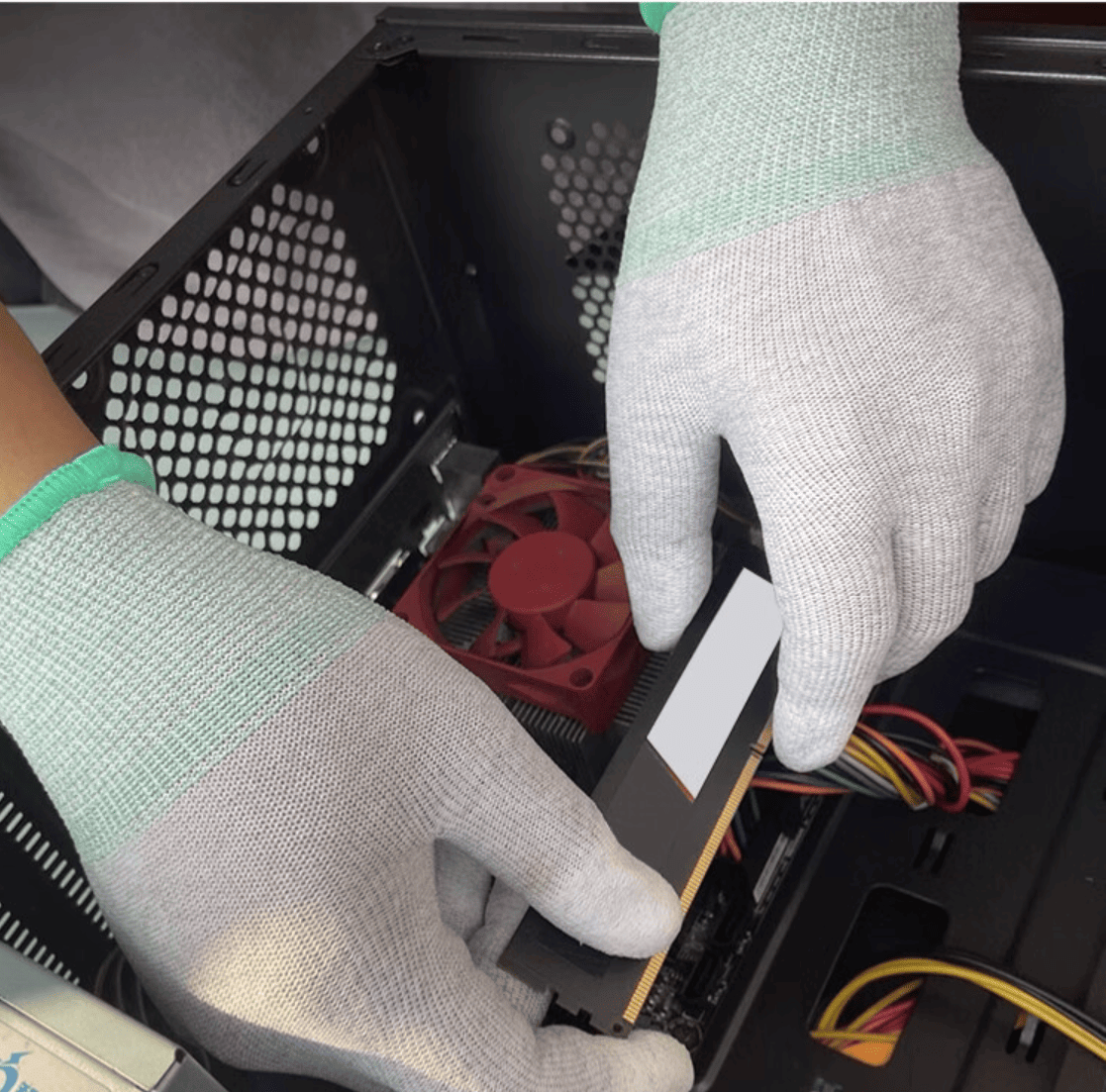
ESDBEST provides ESD glove options for electronics manufacturing, PCB handling, SMT assembly, inspection, and related industrial applications.
Available constructions come with
- Conductive-yarn knitted gloves
- PU fingertip-coated ESD gloves
- PU palm-coated ESD gloves
- Nitrile-coated ESD gloves
Process-specific handling gloves
The objective is not to prefer one glove for every workstation.
A best selection based on manufacturing process, cleanliness demand, product sensitivity, operator comfort, and the facility’s overall ESD control plan.
For projects using fine PCB handling, thin PU-coated gloves provide the best balance of dexterity, grip, and static-control performance.
For highly demanding handling environments, nitrile-coated options give stronger grip and abrasion resistance.
Before manufacturing approval, each glove model should be evaluated under the customer’s actual process conditions.
Additional product details are available from the ESDBEST ESD glove range.’
Example Application: SMT Manual Assembly
Consider an operator performing manual insertion after the reflow process.
The functions come with:
- Picking up assembled boards
- Inserting connectors
- Handling small through-hole components
- Moving boards into fixtures
- Performing visual inspection
- the glove selected for this task should provide:
- Fine dexterity
- Low bulk
- Suitable electrical performance
- Low contamination risk
- Sufficient grip
- Comfortable long-term wear
A thick general-purpose nitrile-coated work glove reduces dexterity.
An ordinary cotton glove make fibers and provides inconsistent grip.
A thin PU fingertip-coated ESD glove is highly effective and appropriate,
Its resistance features have been verified
It is used with the required personnel-grounding system
It fulfill contamination requirements
It is replaced when worn or contaminated
This example defines why glove selection should be based on operations analysis rather than material name alone.
Example: PCB Inspection
During inspection, operators can repeatedly manage boards under magnification.
The main features are
- Fingerprint prevention
- Fine control
- Low particle generation
- Compatibility with wrist-strap grounding
- Minimal hand fatigue
In this conditons, a lightweight knitted ESD glove or thin fingertip-coated glove is preferred
However, if the glove becomes contaminated with flux residue, dust, or skin oil, it can transfer contamination from one assembly to another.
The inspection process comes with glove replacement and cleanliness rules.
Maintenance and Equipment Setup
maintenance personal enter the EPA for adjusting machinery, test fixtures, or SMT equipment.
Their tasks come with
- Tools
- Metal frames
- Lubricants
- Sharp edges
- Larger mechanical parts
The glove used for this work can be different from the glove used by an SMT operator.
A nitrile-coated ESD glove offers better abrasion resistance and grip, but it should still be evaluated for electrical features and compatibility with the task.
Maintenance staff should also follow EPA entry and grounding features. Wearing an ESD glove does not exempt them from the control process
Manufacturing Glove Requirements Into the ESD Control Plan
The ESD control plan should find where gloves are required and why.
It may specify:
- Approved glove types
- Approved suppliers
- Permitted work areas
- Replacement frequency
- Inspection method
- Laundering procedure
- Lot-verification method
- Storage conditions
- Prohibited substitutions
- Responsible department
The document should distinguish between:
- Gloves required for static-control support
- Gloves required for cleanliness
- Gloves required for operator safety
- Gloves serving multiple purposes
This prevents purchasing or manufacturing staff from substituting an apparently similar glove without technical review.
Training Operators to Use Gloves Correctly
Operator training should cover more than simply putting gloves on.
Employees should understand:
- Why the glove is required
- Which glove is approved for the task
- How to inspect it before use
- When it must be replaced
- Why ordinary gloves cannot be substituted
- How the glove interacts with grounding controls
- How to avoid touching contaminated surfaces
Where used gloves should be stored or discarded
How to report defects. Common poor practices are
- Wearing gloves outside the controlled area
- Touching phones or personal items and returning to work
- Reusing disposable gloves
- Cutting off fingertips
- Wearing damaged gloves
- Mixing clean and contaminated gloves
- Storing gloves on an unclean surface
- Training should address these actual behaviors.
Cost Should Be Evaluated Per Process, Not Per Pair
A glove with the lowest purchase cost is not always the lowest-cost solution.
Total cost may include
- Replacement frequency
- Laundering
- Operator productivity
- Defect risk
- Product contamination
- Dropped components
- Training
- Inventory control
- Supplier inconsistency
For example, a very low-cost glove that wears out twice as quickly and costs more over time.
A glove that minimizes dexterity can increase handling time or rework.
A technically stable glove that work longer and enhances operator compliance can geneated a better overall result despite a higher unit price.
Procurement decisions should be quality, engineering and production input.
Questions to Ask an ESD Glove Supplier
Before approval, manufacturers should ask:
- What is the glove’s complete material construction?
- Which part provides the static-dissipative or conductive function?
- What resistance test method was used?
- At what voltage was the test performed?
- Under what humidity and temperature conditions?
- Is the data based on the glove material or the complete glove?
- Is lot-level testing available?
- How does laundering affect performance?
- What is the expected service life?
- Is the glove suitable for cleanroom use?
- Does it contain silicone, powder or other process-sensitive substances?
- What size range is available?
- Is traceability maintained?
- Can production samples be provided?
- What process applications are recommended?
A responsible supplier should has features for offering more than a general claim that the glove is “anti-static.”
Larger Lesson
ESD gloves important because hands are used in nearly every phase of PCB manufacturing.
But gloves are effective only when they are properly used, verified, and integrated into the wider control system.
The best glove for one workstation can be unsuitable for another.
A fine-assembly operator needs a thin PU fingertip-coated glove. A maintenance worker requires a durable nitrile-coated option. A cleanroom process needed strict particle and contamination specifications in addition to electrical performance.
The selection process should connect:
- Product sensitivity
- Operator grounding
- Workstation controls
- Cleanliness
- Grip
- Comfort
- Verification
- Training
- Replacement
When these factors are considered together, gloves help protect both the product and the manufacturing process.
Conclusion
PCB manufacturing based on controlled, repeatable handling. The ESD glove does not work as a cosmetic instrument or consumable. That is a process component that affects charge features, contamination, grip operator compliance, and product quality.
Manufacturers should fulfill glove performance compared to relying on labels, material name, or color. It must also be considered that no glove can replace a complete ESD control program.
Personnel grounding, work surfaces, flooring, ionization, packaging, training, and verification are needed to work together.
When selected based on process requirements, ESD gloves can offer an effective interface between the operator and the sensitive electronic product—supporting safe handling from component preparation through final inspection.
About the Author
Rachel Zhong works with the technical team at ESDBEST, a manufacturer and supplier of ESD control products for PCB assembly, electronics manufacturing, SMT production, cleanrooms and industrial environments.
The ESDBEST product range includes ESD Gloves. work surfaces, personnel-grounding products, ionizers, footwear and related static-control solutions.