METAL gauge thickness was used worldwide before the introduction of thickness measuring units. That thickness measurement of material through density. The thickness of material for sheet metal is measured in gauge. In this tutorial, we cover details about metal gauge thickness and make a chart for further details, so let’s get started.
Gauge System of Sheet Metal
Compared to the standard metric measuring system that shows sheet thickness in millimetres and gauge numbers, it shows thickness according to the drawing function.
A low value of gauge number indicates a thick sheet, and a larger number indicates a thin sheet.
Such a three-metal sheet is 6.07 mm thick and varies for different sheets.
Based on the application, different sheet metal gauges are used, so use them properly during the design process. such as a 10-gauge metal sheet, is best for performing heavy-duty projects.
What Is a Sheet Metal Gauge Chart?
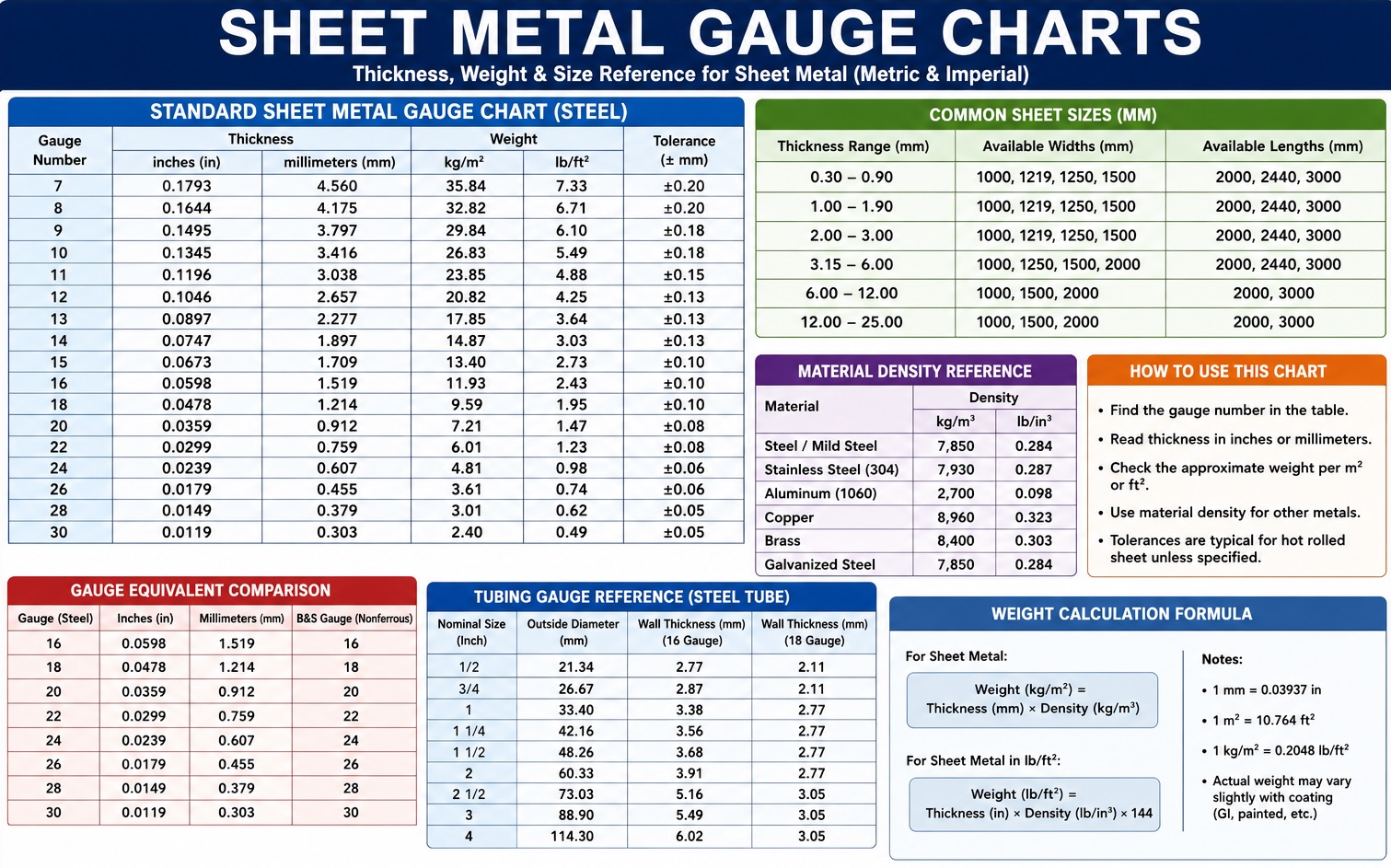
The sheet metal gauge chart defines metallic sheet thickness according to the gauge number. Gauge is not linear and can be different for each material.
A gauge chart converts a gauge into measuring values, like millimetres or inches. But for sheet metal gauge, millimetres are the unit used.
Gauge Thickness of Sheet Metal vs Measured Thickness
Sheet metal gauge thickness: best techniques for finding thickness. Gauge thickness and measured thickness look the same but are different.
Both provide standard calculations defining a metallic sheet with different numbers and calculations.
For the metric system, the base calculation is ten; that means 10 mm equals one centimetre. In gauge thickness, the base value is drawing functions.
Based on constant variations of thickness, 3-gauge to 4-gauge stainless is 0.016″ and 0.003” for 24- to 25-gauge stainless. It’s based on materials’ features.
Sheet Metal Gauge Charts in Millimetres
Here we have made charts for commonly used sheet metal materials, each giving gauge numbers with thickness in millimetres.
Standard Steel Gauge Chart (Metric)
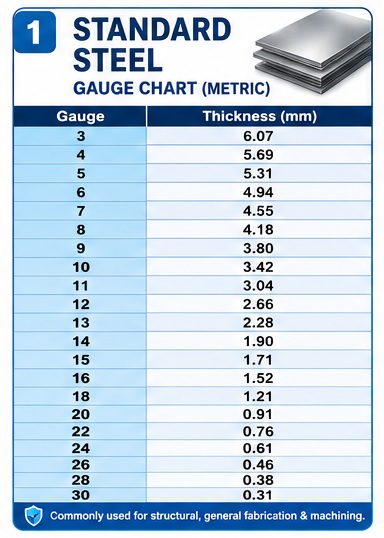
| Gauge | Thickness (mm) |
| 3 | 6.07 |
| 4 | 5.69 |
| 5 | 5.31 |
| 6 | 4.94 |
| 7 | 4.55 |
| 8 | 4.18 |
| 9 | 3.8 |
| 10 | 3.42 |
| 11 | 3.04 |
| 12 | 2.66 |
| 13 | 2.28 |
| 14 | 1.9 |
| 15 | 1.71 |
| 16 | 1.52 |
| 18 | 1.21 |
| 20 | 0.91 |
| 22 | 0.76 |
| 24 | 0.61 |
| 26 | 0.46 |
| 28 | 0.38 |
| 30 | 0.31 |
Galvanized Steel Gauge Chart (Metric)
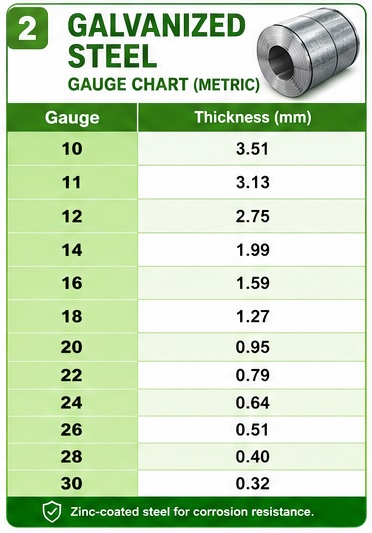
| Gauge | Thickness (mm) |
| 10 | 3.51 |
| 11 | 3.13 |
| 12 | 2.75 |
| 14 | 1.99 |
| 16 | 1.59 |
| 18 | 1.27 |
| 20 | 0.95 |
| 22 | 0.79 |
| 24 | 0.64 |
| 26 | 0.51 |
| 28 | 0.4 |
| 30 | 0.32 |
Stainless Steel Gauge Chart (Metric)
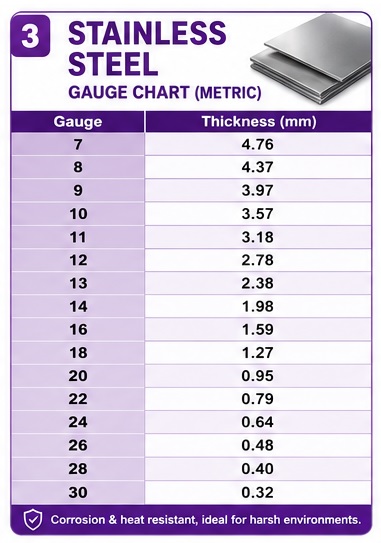
| Gauge | Stainless Steel Gauge Chart(mm) |
| 7 | 4.76 |
| 8 | 4.37 |
| 9 | 3.97 |
| 10 | 3.57 |
| 11 | 3.18 |
| 12 | 2.78 |
| 13 | 2.38 |
| 14 | 1.98 |
| 16 | 1.59 |
| 18 | 1.27 |
| 20 | 0.95 |
| 22 | 0.79 |
| 24 | 0.64 |
| 26 | 0.48 |
| 28 | 0.4 |
| 30 | 0.32 |
Carbon Steel Gauge Chart (Metric)
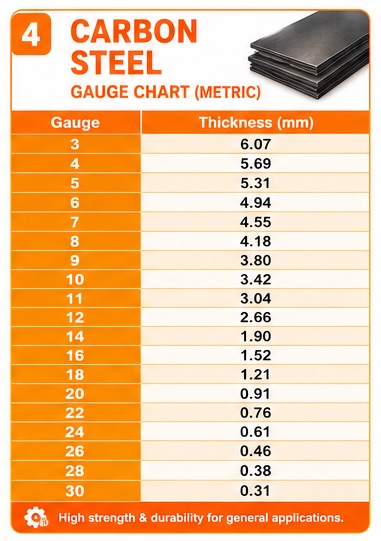
| Gauge | Thickness (mm) |
| 3 | 6.07 |
| 4 | 5.69 |
| 5 | 5.31 |
| 6 | 4.94 |
| 7 | 4.55 |
| 8 | 4.18 |
| 9 | 3.8 |
| 10 | 3.42 |
| 11 | 3.04 |
| 12 | 2.66 |
| 14 | 1.9 |
| 16 | 1.52 |
| 18 | 1.21 |
| 20 | 0.91 |
| 22 | 0.76 |
| 24 | 0.61 |
| 26 | 0.46 |
| 28 | 0.38 |
| 30 | 0.31 |
Aluminum Gauge Chart (Metric)
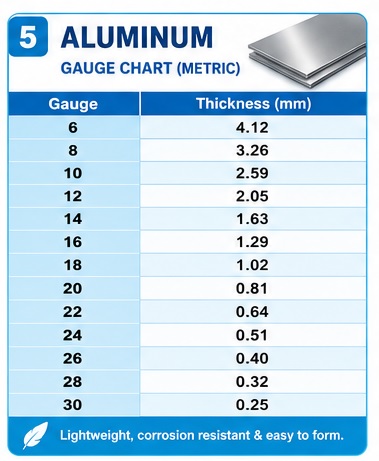
| Gauge | Thickness (mm) |
| 6 | 4.12 |
| 8 | 3.26 |
| 10 | 2.59 |
| 12 | 2.05 |
| 14 | 1.63 |
| 16 | 1.29 |
| 18 | 1.02 |
| 20 | 0.81 |
| 22 | 0.64 |
| 24 | 0.51 |
| 26 | 0.4 |
| 28 | 0.32 |
| 30 | 0.25 |
Brass Gauge Chart (Metric)
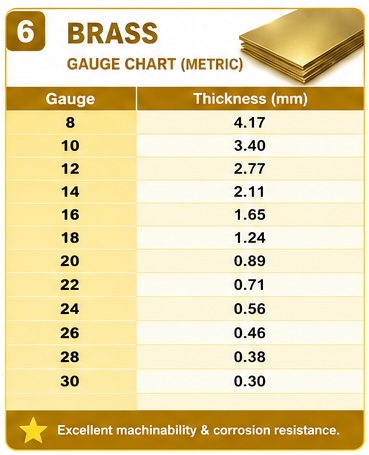
| Gauge | Thickness (mm) |
| 8 | 4.17 |
| 10 | 3.4 |
| 12 | 2.77 |
| 14 | 2.11 |
| 16 | 1.65 |
| 18 | 1.24 |
| 20 | 0.89 |
| 22 | 0.71 |
| 24 | 0.56 |
| 26 | 0.46 |
| 28 | 0.38 |
| 30 | 0.3 |
Copper Gauge Chart (Metric)
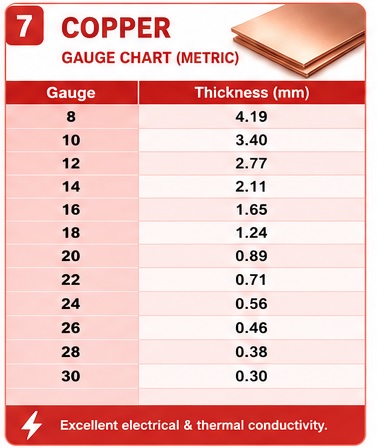
| Gauge | Thickness (mm) |
| 8 | 4.19 |
| 10 | 3.4 |
| 12 | 2.77 |
| 14 | 2.11 |
| 16 | 1.65 |
| 18 | 1.24 |
| 20 | 0.89 |
| 22 | 0.71 |
| 24 | 0.56 |
| 26 | 0.46 |
| 28 | 0.38 |
| 30 | 0.3 |
Zinc Gauge Chart (Metric)
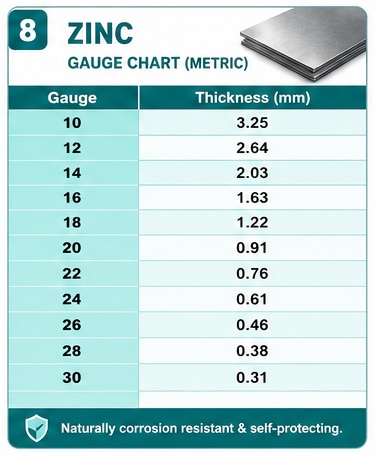
| Gauge | Thickness (mm) |
| 10 | 3.25 |
| 12 | 2.64 |
| 14 | 2.03 |
| 16 | 1.63 |
| 18 | 1.22 |
| 20 | 0.91 |
| 22 | 0.76 |
| 24 | 0.61 |
| 26 | 0.46 |
| 28 | 0.38 |
| 30 | 0.31 |
Nonferrous Sheet, Strip & Tubing Gauge Chart (B&S Gauge) – Metric
| Gauge | Thickness (in) | Thickness (mm) | Thickness (µm) |
| 0 | 0.58 | 14.732 | 14,732 |
| 0 | 0.5165 | 13.119 | 13,119 |
| 0 | 0.46 | 11.684 | 11,684 |
| 0 | 0.4096 | 10.404 | 10,404 |
| 0 | 0.3648 | 9.266 | 9,266 |
| 0 | 0.3249 | 8.252 | 8,252 |
| 1 | 0.2893 | 7.348 | 7,348 |
| 2 | 0.2576 | 6.543 | 6,543 |
| 3 | 0.2294 | 5.827 | 5,827 |
| 4 | 0.2043 | 5.189 | 5,189 |
| 5 | 0.1819 | 4.62 | 4,620 |
| 6 | 0.162 | 4.115 | 4,115 |
| 7 | 0.1443 | 3.665 | 3,665 |
| 8 | 0.1285 | 3.264 | 3,264 |
| 9 | 0.1144 | 2.906 | 2,906 |
| 10 | 0.1019 | 2.588 | 2,588 |
| 11 | 0.0907 | 2.304 | 2,304 |
| 12 | 0.0808 | 2.052 | 2,052 |
| 13 | 0.072 | 1.829 | 1,829 |
| 14 | 0.0641 | 1.628 | 1,628 |
| 15 | 0.0571 | 1.45 | 1,450 |
| 16 | 0.0508 | 1.291 | 1,291 |
| 17 | 0.0453 | 1.151 | 1,151 |
| 18 | 0.0403 | 1.024 | 1,024 |
| 19 | 0.0359 | 0.912 | 912 |
| 20 | 0.032 | 0.813 | 813 |
| 21 | 0.0285 | 0.724 | 724 |
| 22 | 0.0253 | 0.643 | 643 |
| 23 | 0.0226 | 0.574 | 574 |
| 24 | 0.0201 | 0.511 | 511 |
| 25 | 0.0179 | 0.455 | 455 |
| 26 | 0.0159 | 0.404 | 404 |
| 27 | 0.0142 | 0.361 | 361 |
| 28 | 0.0126 | 0.32 | 320 |
| 29 | 0.0113 | 0.287 | 287 |
| 30 | 0.01 | 0.254 | 254 |
| 31 | 0.0089 | 0.226 | 226 |
| 32 | 0.008 | 0.203 | 203 |
| 33 | 0.0071 | 0.18 | 180 |
| 34 | 0.0063 | 0.16 | 160 |
| 35 | 0.0056 | 0.142 | 142 |
| 36 | 0.005 | 0.127 | 127 |
Sheet Metal Gauge Uses
Gauges help measure sheet metal thickness and are not imperial; values are not based on a measuring system. A gauge conversion chart helps to find the real thickness of sheet metal in millimetres or inches.
such as 14-gauge steel thickness of 1.897 mm, while 14-gauge aluminium is 1.628 mm. Due to different thicknesses, it’s best to use a gauge thickness chart for practical projects.
FAQs of Sheet Metal Gauges
Is 16 gauge the same as thickness?
No, different materials like stainless steel, aluminum or steel come with different thicknesses for the same gauge value.
What’s the proper method for reading sheet thickness?
Follow millimetres and get a gauge for reference purposes
Do gauge charts comply with international standards?
Not, since you need to confirm the system with the supplier normally for global sourcing.
Are there gauges used based on specific metal types?
There is a limit to how thin sheet metals can get before not using them; normally, sheet metals come with low values of 0.5 mm and high values of 6 mm, based on the materials used.
Is the gauge affected by corrosion resistance?
It can or cannot; a thick gauge does not show that sheet metal has high corrosion resistance. That works for material, getting a longer time for corroding, and is highly durable compared to thin-gauge metal.
Why Are Gauges Different for Different Metals?
Material gauge based on density gauge size defined on sheet metal weight that is different from material type.
What thickness limit defines metal as a sheet?
The low limit is 0.5 mm and the high limit is 6 mm. Metal thickness higher than 6 mm is not sheet metal, but it is a metallic plate. These limits can differ according to regions.