The use of a proper oxygen tank is important for proper, uninterrupted oxygen therapy and also for industrial uses. Oxygen cylinders have different size options, like small portable tanks that easily fit in a carrying bag and larger static cylinders that are commonly used in the welding industry, hospitals, and for manufacturing purposes. Each cylinder size comes with different oxygen capacity, dimensions, weight, and oxygen supply with different flow rates.
This detailed article will cover different oxygen tank size charts for cylinder sizes, capacity, and weight, as well as dimensions. So let’s get started.
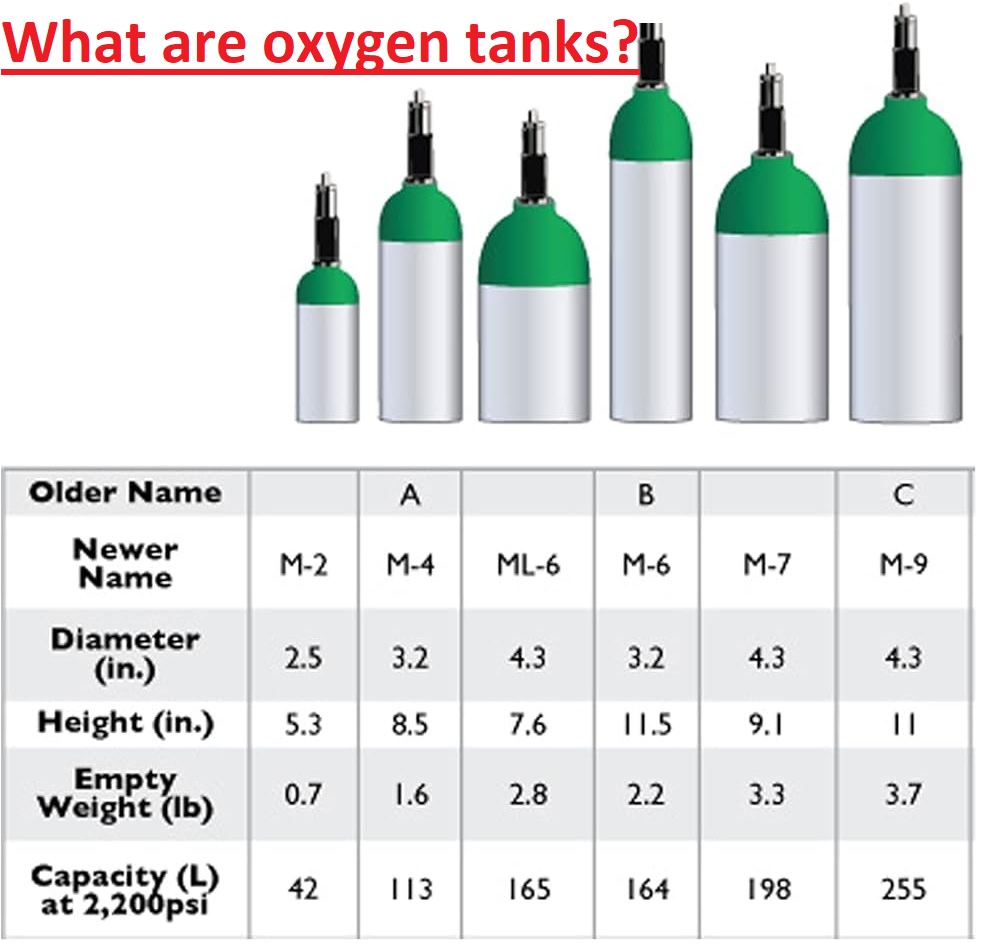
What are oxygen tanks?
Oxygen tanks are metallic cylinders that store oxygen or compressed air. It is used for oxygen therapy. Oxygen tanks are best used for lung conditions and also make breathing easy for proper body functioning.
Oxygen comes in gas or liquid form; further, tanks come in different sizes, such as larger sizes, but their shifting is difficult; that is used at hospitals or homes.
Others are small-sized and can be easily carried; we can also get oxygen through a plastic mask fitted on the mouth and nose.
Different oxygen tanks types
Oxygen tanks come in different types, and each has its own features.
Compressed oxygen
We breathe atmospheric air that comes with 20 per cent oxygen. The remaining part has nitrogen, with a small quantity of different gases.
Compressed oxygen gas has 99.5% oxygen. The oxygen tank comes with a gauge on the upper side that indicates the amount of gas remaining in it.
A regulator helps to breathe through compressed oxygen during inhalation and stops when exhaling.
Liquid oxygen
Liquid oxygen comes with 100 per cent oxygen in the form of cold liquid. Oxygen is converted into liquid at -297 degrees Fahrenheit.
Manufacturers compress it into a liquid oxygen tank, which releases oxygen from the tank, converted into gas. We should be careful with liquid oxygen. Mistakenly exposing the result of cryogenic burning
Oxygen concentrator
This oxygen cylinder provides purified air by separating polluted air, compressing oxygen, and removing nitrogen. It works over electric power that connects to a wall or employs batteries.
Compared to compressed oxygen or liquid oxygen, not require a refill tank to get oxygen
Standard Oxygen Tank Size Chart
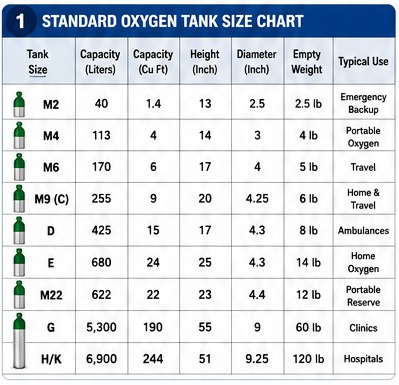
| Tank Size | Capacity (Liters) | Capacity (Cu Ft) | Height | Diameter | Empty Weight | Use |
| M2 | 40 L | 1.4 cu ft | 13 in | 2.5 in | 2.5 lb | Emergency backup |
| M4 | 113 L | 4 cu ft | 14 in | 3 in | 4 lb | Portable oxygen |
| M6 | 170 L | 6 cu ft | 17 in | 4 in | 5 lb | Travel |
| M9 (C) | 255 L | 9 cu ft | 20 in | 4.25 in | 6 lb | Home & travel |
| D | 425 L | 15 cu ft | 17 in | 4.3 in | 8 lb | Ambulances |
| E | 680 L | 24 cu ft | 25 in | 4.3 in | 14 lb | Home oxygen |
| M22 | 622 L | 22 cu ft | 23 in | 4.4 in | 12 lb | Portable reserve |
| G | 5,300 L | 190 cu ft | 55 in | 9 in | 60 lb | Clinics |
| H/K | 6,900 L | 244 cu ft | 51 in | 9.25 in | 120 lb | Hospitals |
Oxygen Tank Dimensions Chart
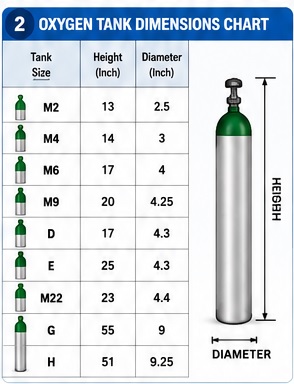
| Tank Size | Height | Diameter |
| M2 | 13 in | 2.5 in |
| M4 | 14 in | 3 in |
| M6 | 17 in | 4 in |
| M9 | 20 in | 4.25 in |
| D | 17 in | 4.3 in |
| E | 25 in | 4.3 in |
| M22 | 23 in | 4.4 in |
| G | 55 in | 9 in |
| H | 51 in | 9.25 in |
Oxygen Tank Capacity Chart
| Tank Size | Oxygen Capacity (L) | Cubic Feet |
| M2 | 40 | 1.4 |
| M4 | 113 | 4 |
| M6 | 170 | 6 |
| M9 | 255 | 9 |
| D | 425 | 15 |
| E | 680 | 24 |
| M22 | 622 | 22 |
| G | 5,300 | 190 |
| H | 6,900 | 244 |
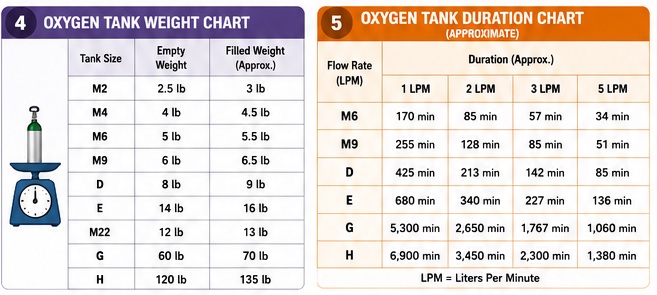
Oxygen Tank Duration Chart
| Tank Size | 1 LPM | 2 LPM | 3 LPM | 5 LPM |
| M6 | 170 min | 85 min | 57 min | 34 min |
| M9 | 255 min | 128 min | 85 min | 51 min |
| D | 425 min | 213 min | 142 min | 85 min |
| E | 680 min | 340 min | 227 min | 136 min |
| G | 5,300 min | 2,650 min | 1,767 min | 1,060 min |
| H | 6,900 min | 3,450 min | 2,300 min | 1,380 min |
Oxygen Cylinder Pressure Chart
| Status | Pressure (PSI) |
| Empty | 0–200 |
| Low | 200–500 |
| Half Full | 1,000 |
| Three-Quarter Full | 1,500 |
| Full | 2,000–2,200 |
Oxygen Tank Size vs Weight
| Tank Size | Capacity | Weight |
| M2 | 40 L | 2.5 lb |
| M6 | 170 L | 5 lb |
| M9 | 255 L | 6 lb |
| D | 425 L | 8 lb |
| E | 680 L | 14 lb |
| G | 5,300 L | 60 lb |
| H | 6,900 L | 120 lb |
US vs International Oxygen Cylinder Sizes
| US Size | International Equivalent |
| M2 | 0.4 L cylinder |
| M4 | 1 L cylinder |
| M6 | 1.5 L cylinder |
| M9 | 2 L cylinder |
| D | 2.5–3 L cylinder |
| E | 4–5 L cylinder |
| G | 40 L cylinder |
| H | 47–50 L cylinder |
Oxygen Tank Selection Guide
| Need | Recommended Tank |
| Emergency backup | M2 |
| Walking | M4 |
| Travel | M6 |
| Daily portable use | M9 |
| Ambulance | D |
| Home oxygen therapy | E |
| Hospital ward | G |
| Continuous high-demand use | H |