We commonly use ceiling fans as electrical devices in our homes, schools, and buildings. The selection of a fan is important based on the size requirement of the room where the fan needs to be installed. This post will cover details about ceiling fan sizes and help you learn which is best for your home. So let’s get started.
What is ceiling fan airflow?
Airflow is defined as air delivered by a ceiling fan. Ceiling fan airflow is calculated in CFM, whose full form is cubic feet per minute.
A minimum of 75 cfm/w is an effective value for cfm. To get the required CFM for a ceiling fan, follow the ceiling fan having a preferred CFM for your fan; check that ceiling fan with speed values in the range of 4000 to 5000. The normal quality range is 5000 and 6000, and high-quality CFM for a ceiling fan is more than 6000.
Importance of Fan Size
Ceiling fans do not have a constant fitting size; blade width is important for working in the required space. A small-sized fan does not normally provide the required air in rooms having high ceilings with less airflow.
A fan with a larger size causes a poorer draft.
Low Profile Ceiling Fan
low-profile ceiling fan is installed without a downrod close to the ceiling. So the best room has a ceiling about 8 feet high; bedrooms are clean and small locations such as hallways, laundry rooms, and walk-in closets.
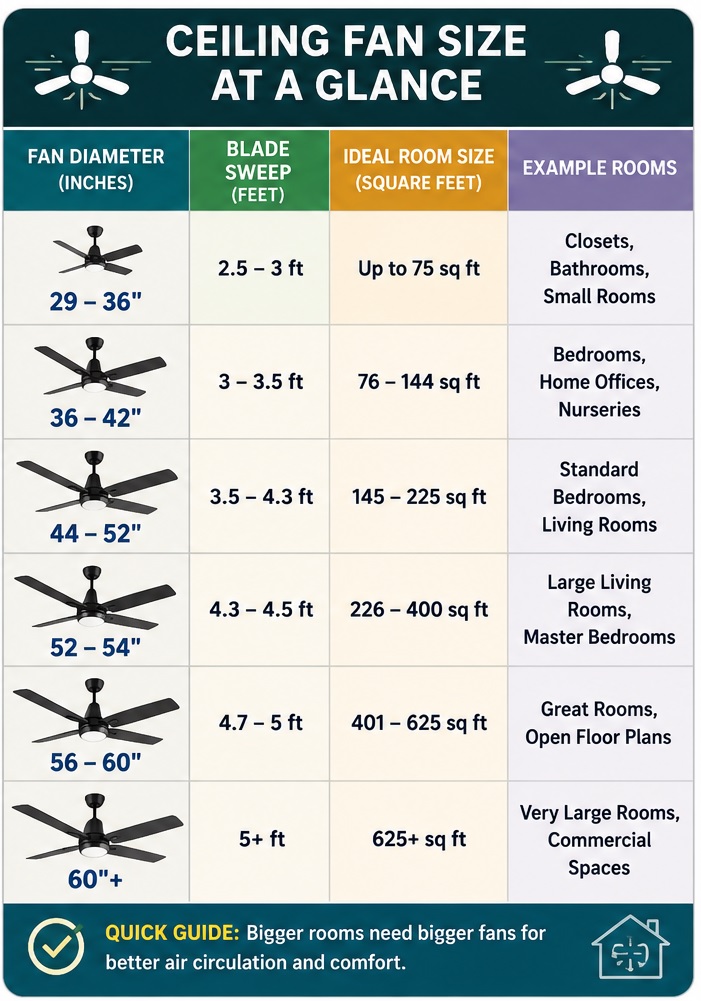
Ceiling Fan Size by Room Size Chart
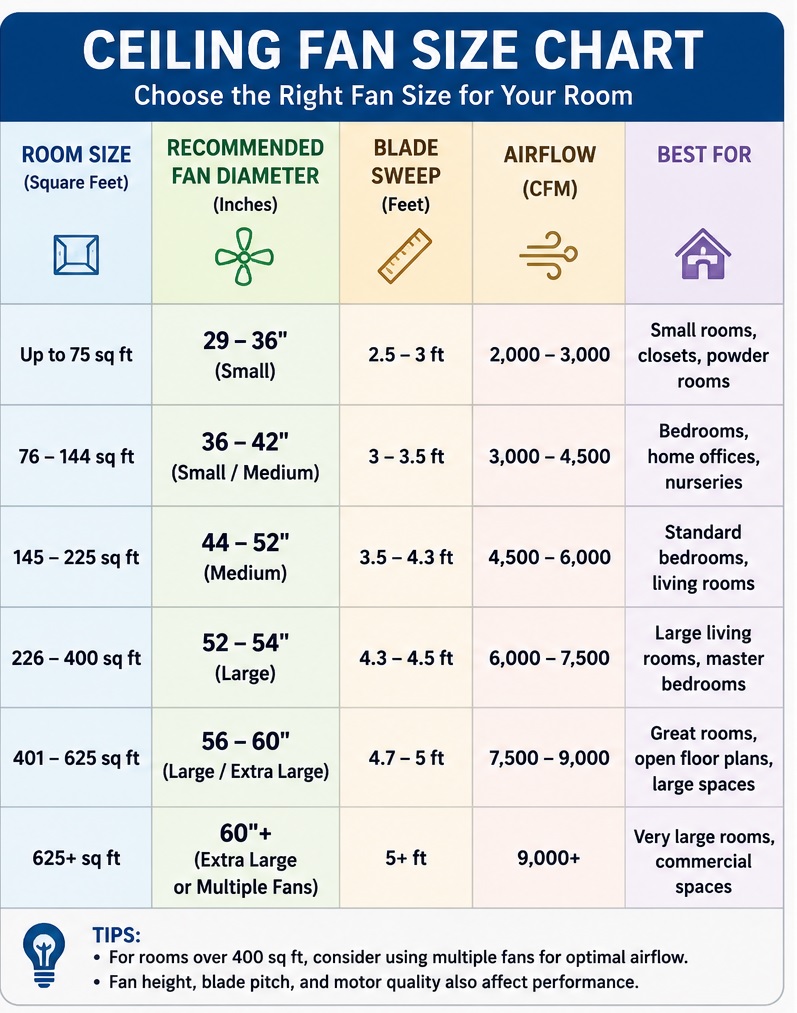
| Room Size (sq ft) | Room Dimensions (Approx.) | Recommended Fan Size | Recommended Airflow (CFM) |
| Up to 75 | 8 × 8 ft | 29–36 inches | 1,500–3,000 |
| 76–144 | 10 × 10 ft | 36–42 inches | 2,000–4,000 |
| 145–225 | 12 × 12 ft | 44–48 inches | 3,000–5,000 |
| 226–400 | 15 × 15 ft | 50–54 inches | 4,000–6,500 |
| Over 400 | 20 × 20 ft or larger | 60–72 inches | 6,000–9,000+ |
Ceiling Fan Size vs Room Dimensions Chart
| Room Dimensions | Room Area | Fan Size |
| 8 × 8 ft | 64 sq ft | 29–36 in |
| 9 × 9 ft | 81 sq ft | 36 in |
| 10 × 10 ft | 100 sq ft | 36–42 in |
| 10 × 12 ft | 120 sq ft | 42 in |
| 12 × 12 ft | 144 sq ft | 44–48 in |
| 12 × 15 ft | 180 sq ft | 48 in |
| 14 × 14 ft | 196 sq ft | 48–52 in |
| 15 × 15 ft | 225 sq ft | 52 in |
| 16 × 18 ft | 288 sq ft | 52–56 in |
| 20 × 20 ft | 400 sq ft | 60 in |
| 24 × 24 ft | 576 sq ft | 72 in |
Ceiling Fan Airflow (CFM) Chart
| Fan Size | Airflow (CFM) | Best For |
| 29 in | 1,500–2,000 | Small rooms |
| 36 in | 2,000–3,000 | Bedrooms |
| 42 in | 3,000–4,000 | Medium bedrooms |
| 48 in | 4,000–5,000 | Dining rooms |
| 52 in | 5,000–6,000 | Living rooms |
| 56 in | 5,500–6,500 | Large bedrooms |
| 60 in | 6,000–7,500 | Great rooms |
| 72 in | 7,000–9,000+ | Large open spaces |
Ceiling Fan Blade Span Chart
| Fan Size | Blade Span |
| 29 in | 74 cm |
| 36 in | 91 cm |
| 42 in | 107 cm |
| 44 in | 112 cm |
| 48 in | 122 cm |
| 52 in | 132 cm |
| 56 in | 142 cm |
| 60 in | 152 cm |
| 72 in | 183 cm |
| 84 in | 213 cm |
Ceiling Fan Downrod Length Chart
| Ceiling Height | Recommended Downrod |
| 8 ft | Flush Mount |
| 9 ft | 6 in |
| 10 ft | 12 in |
| 11 ft | 18 in |
| 12 ft | 24 in |
| 13 ft | 36 in |
| 14 ft | 48 in |
| 15 ft | 60 in |
| 16 ft | 72 in |
Ceiling Fan Installation Height Chart
| Ceiling Height | Fan Height Above Floor |
| 8 ft | 7 ft |
| 9 ft | 8 ft |
| 10 ft | 8–9 ft |
| 11 ft | 9 ft |
| 12 ft | 9–10 ft |
| 13+ ft | 9–10 ft |
Ceiling Fan Wattage Chart
| Fan Size | Standard AC Motor | DC Motor |
| 36 in | 30–45 W | 15–20 W |
| 42 in | 40–55 W | 18–25 W |
| 48 in | 45–60 W | 20–30 W |
| 52 in | 55–75 W | 25–35 W |
| 56 in | 60–80 W | 30–40 W |
| 60 in | 70–90 W | 35–45 W |
| 72 in | 80–100 W | 40–55 W |
Ceiling Fan RPM Chart
| Fan Size | High Speed RPM |
| 29 in | 320–380 |
| 36 in | 250–330 |
| 42 in | 220–300 |
| 48 in | 180–260 |
| 52 in | 150–230 |
| 56 in | 130–200 |
| 60 in | 100–180 |
| 72 in | 80–150 |
Ceiling Fan Energy Consumption Chart
| Daily Usage | 35W DC Fan | 75W AC Fan |
| 2 Hours | 0.07 kWh | 0.15 kWh |
| 4 Hours | 0.14 kWh | 0.30 kWh |
| 6 Hours | 0.21 kWh | 0.45 kWh |
| 8 Hours | 0.28 kWh | 0.60 kWh |
| 10 Hours | 0.35 kWh | 0.75 kWh |
| 12 Hours | 0.42 kWh | 0.90 kWh |
Ceiling Fan Size Comparison Chart
| Fan Size | Best Room Size | Airflow | Use |
| 29 in | Up to 75 sq ft | Low | Closets |
| 36 in | 76–144 sq ft | Moderate | Small bedrooms |
| 42 in | Up to 144 sq ft | Moderate | Bedrooms |
| 48 in | 145–225 sq ft | High | Dining rooms |
| 52 in | 226–400 sq ft | Very High | Living rooms |
| 56 in | 250–450 sq ft | Very High | Family rooms |
| 60 in | 300–500 sq ft | Excellent | Great rooms |
| 72 in | 500+ sq ft | Maximum | Commercial spaces |
| 84 in | 700+ sq ft | Industrial | Warehouses |
Indoor vs Outdoor Ceiling Fan Size Chart
| Location | Fan Size | Moisture Rating |
| Bedroom | 42–52 in | Dry Rated |
| Living Room | 52–60 in | Dry Rated |
| Kitchen | 42–48 in | Damp Rated |
| Bathroom | 36–42 in | Damp Rated |
| Covered Patio | 52–60 in | Damp Rated |
| Open Patio | 52–72 in | Wet Rated |
| Gazebo | 52–60 in | Wet Rated |
Residential vs Commercial Ceiling Fan Size Chart
| Application | Fan Size |
| Bedroom | 42–48 in |
| Living Room | 52–60 in |
| Dining Room | 48–52 in |
| Office | 52–60 in |
| Restaurant | 60–72 in |
| Gym | 72–96 in |
| Warehouse | 96–144 in |
| Factory | 120–288 in (HVLS Fans) |
Ceiling Fan Size measrment steps
For selection of a ceiling fan, there are three main factors for ceiling fan selection that are blade span, ceiling fan height, and tie rod length.
Find these three points for measuring ceiling fan size that are
Blade Span
• The ceiling fan blade span is an important point. The circle made during fan rotation and circle diameter is called blade span.
Fan width is the blade span equivalent, not the distance between the tips of two fan blades. With calculating span size, we can find it is easily connected in the required space.
Fan Height
fan height basiclly completefan height so check ceiling fan height for flfill height space
Tie rod length
Tie rod length is also an important factor. A long-rod ceiling fan is best in rooms having A long-rod ceiling fan is not a low ceiling. Flush-mount ceiling Fans are applied.
Right ceiling fan size selection factor
Ceiling Fan Sizes
In our homes, we have different room sizes, like bedrooms, living rooms, etc., and each comes with different sizes. Using an accurately sized ceiling fan is the best option.
If a small bedroom exists, use fan size accordingly. If large, European-sized ones become crowded, the best large If you have a larger living room, a ceiling fan with 3 or 5 blades is best to use.
Ceiling Fan Height According to Ceiling Height
• The best lower height of a ceiling fan from the ground is 7.5 feet or larger. That saves fan blades from colliding with us and also provides circulation.
A fan height of more than 8.8 feet is good for standard rods. If higher than this value, select a larger fan with a longer bar to eight inches for safety and good effect.
If the ceiling is less than .8 feet, it’s best to use a short-pole ceiling fan.
Ceiling Design
Ceiling design is also a main factor; if the ceiling is sloped, select the required ceiling fan size. If fan size is larger and blades tip close to the wall, that is normal size. During size selection, focus on the gap and blade length not being longer. The blades’ tips of the fan must be about an 18-inch distance from the wall. For accurate fan working, we also consider proper ceiling fan cirucit wiring
CFM importance
Normally, the number of blades is three to five; the airflow of a ceiling fan is not defined by the number of blades, but CFM is an important factor. A ceiling fan that is highly efficient, having a high CFM, comes with 3 blades that cause proper air circulation compared to a high blade number.
Here are some points explained for selecting an accurate ceiling fan size according to CFM.
| Room Size | Recommended Airflow (CFM) | Fan Size | Used for |
| Small Rooms (≤150 sq ft) | 3,000–4,000 CFM | 36–42 inches | Bedrooms, home offices, nurseries |
| Medium Rooms (150–300 sq ft) | 4,000–6,000 CFM | 44–54 inches | Living rooms, dining rooms, kitchens |
| Large Spaces (≥300 sq ft) | 7,000+ CFM | 56–72 inches or dual fans | Open floor plans, great rooms, vaulted ceilings |
Types of Ceiling Fans
There are different types of ceiling fans.
Designer Fans
Designer fans are best for offering good working performance. These fans’ good-looking design is powered with a copper motor that makes it efficient. It is the best option for a living space.
Silent Fans:
These fans are used in studies and bedrooms where less noise is needed. These fans provide high air delivery with comfort.
Ceiling Fans with Chandeliers
This fan comes with good functionality, comes with quality crystals and a complicated design, and comes with retractable blades that are configured to a chandelier when not in use.
Ceiling Fans with Light:
This fan is dual-purpose and comes with multicolor lighting that sets different moods. With five speed controls and a timer, these fans are so practical and used at homes.
Remote control ceiling fans
Now, free-switchboard fans exist that provide easy usability, either with speed adjustment or on/off lights, and remote control easily controlled
Smart Fans:
Some fans are IoT-operated and controlled with voice signals or apps, offering good cooling features. Smart fans are best for homes that have home automations
BLDC Fans
BLDC fans are energy-saving options. that uses forty percent low power and also reduce bills annually.
Ceiling fan installations for higher rooms
• A high ceiling uses larger ceiling fans to provide enough airflow in the complete room. That offer required air flow. CFM features for ceiling fans are higher, with 1.25 percent for a single foot more than eight feet.
Ceiling Fan for Outdoor Spaces
Ceiling fans in outdoor locations are important since they give high airflow and stop mosquito movement. Fan size can be different according to the outdoor space. We needed to install a fan.
FAQs
Is a 52-inch fan a good fit for a 12×12 room?
It is not an accurate size; a 54-inch fan is best to use for a 12×12 room. That size offers airflow with comfort features.
What happens if that ceiling fan’s airflow is larger than the room?
Different issues occur, such as
Oversized ceiling fans cause high power to affect visual assembly and cause airflow disruption. that show safety hazards or noise faults for larger blades moving closer to walls
Is it cheaper to run the AC or a ceiling fan?
• A ceiling fan uses a low current compared to a central AC system. With fans, he helps to arrange the roster, high minimizines ac time with low cost.
Is a 52-inch fan larger for a 12×12 room?
A 52-inch fan, not a larger size, for a 12×12 room that offers accurate airflow and a comfortable environment without overpowering
What size fan for a 12×15 room?
For a 12×15 room, a fan having a sweep size of 1400 is best to use. that offer proper cooling and provide larger area