Screws, small-sized components whose size is important, but using the wrong size can damage our project. Like for shelf assembly, house construction, or machine repairing, an accurate screw size is important for fitting and proper alignment. In this tutorial, we will cover details about screw size charts and their practical importance for different applications. So let’s get started.
Introduction to Screw Sizes
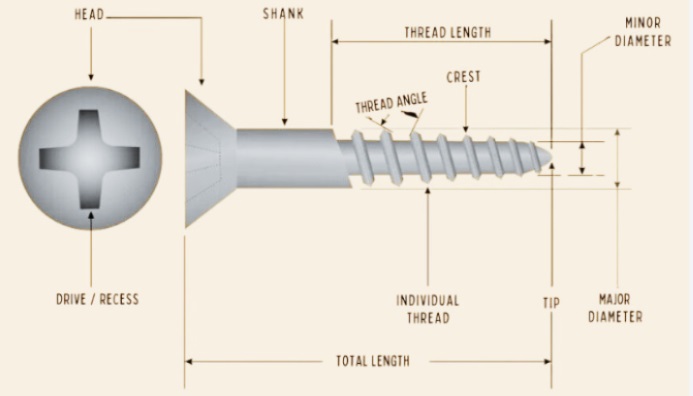
Screw size is the standard method for explaining different parameters of screws, such as length or thread pitch. These parameters are technical parameters that explain the working of the screw. Let’s explain each.
Diameter:
It is the shaft screw width that enhances strength and fitting.
Length:
Length measured from tip to head top that shows deep penetration of the screw.
Thread Pitch/TPI:
It is the space between threads or the number of threads per inch that manages screw grip and compatibility.
What are the differences between Metric vs. Imperial Screw Sizes
The screw comes with two main systems: the first one is metric, and the second is imperial. that define certain sizing values and applications. Let’s find their differences.
Metric Screw Size
Metric screw sizes are taken in millimeters, denoted with M, with diameters like M8 = 8 mm. The value of thread pitch taken in millimeters, such as M8-1.25, is a 1.25 mm pitch.
Normally used metric screw sizes are M3, M4, M5, M6, M8, and M10. These sized screws are employed in vehicles, machines, electronics, etc.
These screws are globally accepted and accurate and are also employed in countries other than the USA.
Imperial Screw Size
Imperial screw size commonly used in the USA that measures in inches and the gauge system. Different gauge numbers taken in #6 and #10 show a larger diameter, meaning the screw is wider. TPI means thread density.
Common sizes for this assembly are #4, #6, #8, #10, and #12. that employed for construction, furniture and woodworking
Screw Size Chart
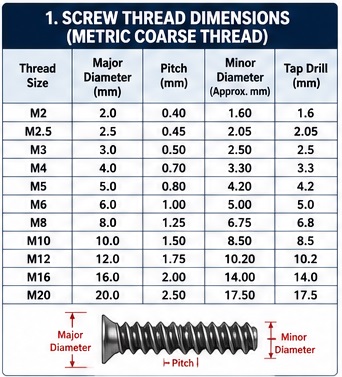
Screw Thread Dimensions (Metric Coarse Thread)
| Thread Size | Major Diameter (mm) | Pitch (mm) | Minor Diameter ( mm) | Tap Drill (mm) |
| M2 | 2 | 0.4 | 1.6 | 1.6 |
| M2.5 | 2.5 | 0.45 | 2.05 | 2.05 |
| M3 | 3 | 0.5 | 2.5 | 2.5 |
| M4 | 4 | 0.7 | 3.3 | 3.3 |
| M5 | 5 | 0.8 | 4.2 | 4.2 |
| M6 | 6 | 1 | 5 | 5 |
| M8 | 8 | 1.25 | 6.75 | 6.8 |
| M10 | 10 | 1.5 | 8.5 | 8.5 |
| M12 | 12 | 1.75 | 10.2 | 10.2 |
| M16 | 16 | 2 | 14 | 14 |
| M20 | 20 | 2.5 | 17.5 | 17.5 |
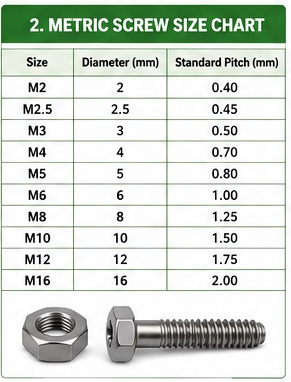
Metric Screw Size Chart
| Size | Diameter (mm) | Standard Pitch (mm) |
| M2 | 2 | 0.4 |
| M2.5 | 2.5 | 0.45 |
| M3 | 3 | 0.5 |
| M4 | 4 | 0.7 |
| M5 | 5 | 0.8 |
| M6 | 6 | 1 |
| M8 | 8 | 1.25 |
| M10 | 10 | 1.5 |
| M12 | 12 | 1.75 |
| M16 | 16 | 2 |
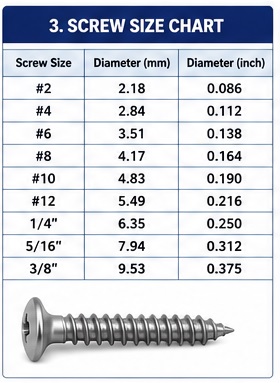
Screw Sizes Chart
| Screw Size | Diameter (mm) | Diameter (inch) |
| #2 | 2.18 | 0.086 |
| #4 | 2.84 | 0.112 |
| #6 | 3.51 | 0.138 |
| #8 | 4.17 | 0.164 |
| #10 | 4.83 | 0.19 |
| #12 | 5.49 | 0.216 |
| 1/4″ | 6.35 | 0.25 |
| 5/16″ | 7.94 | 0.312 |
| 3/8″ | 9.53 | 0.375 |
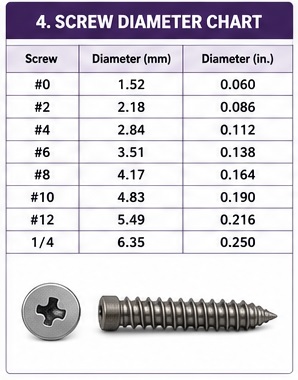
Screw Diameter Chart
| Screw | Diameter (mm) | Diameter (in.) |
| #0 | 1.52 | 0.06 |
| #2 | 2.18 | 0.086 |
| #4 | 2.84 | 0.112 |
| #6 | 3.51 | 0.138 |
| #8 | 4.17 | 0.164 |
| #10 | 4.83 | 0.19 |
| #12 | 5.49 | 0.216 |
| 1/4 | 6.35 | 0.25 |
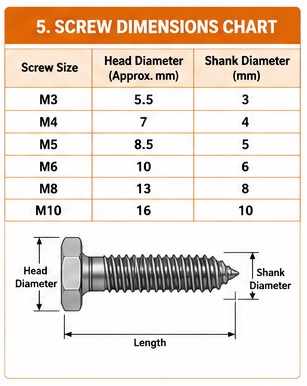
Screw Dimensions Chart
| Screw Size | Head Diameter (Approx. mm) | Shank Diameter (mm) |
| M3 | 5.5 | 3 |
| M4 | 7 | 4 |
| M5 | 8.5 | 5 |
| M6 | 10 | 6 |
| M8 | 13 | 8 |
| M10 | 16 | 10 |
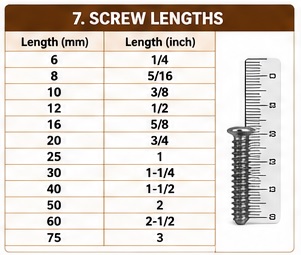
Screw Lengths
| Length (mm) | Length (inch) |
| 6 | 1/4 |
| 8 | 5/16 |
| 10 | 3/8 |
| 12 | 1/2 |
| 16 | 5/8 |
| 20 | 3/4 |
| 25 | 1 |
| 30 | 1-1/4 |
| 40 | 1-1/2 |
| 50 | 2 |
| 60 | 2-1/2 |
| 75 | 3 |
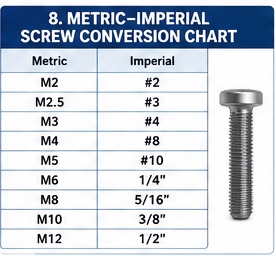
Metric–Imperial Screw Conversion Chart
| Metric | Imperial |
| M2 | #2 |
| M2.5 | #3 |
| M3 | #4 |
| M4 | #8 |
| M5 | #10 |
| M6 | 1/4″ |
| M8 | 5/16″ |
| M10 | 3/8″ |
| M12 | 1/2″ |
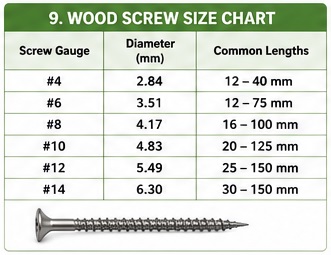
Wood Screw Size Chart
| Screw Gauge | Diameter (mm) | Lengths |
| #4 | 2.84 | 12–40 mm |
| #6 | 3.51 | 12–75 mm |
| #8 | 4.17 | 16–100 mm |
| #10 | 4.83 | 20–125 mm |
| #12 | 5.49 | 25–150 mm |
| #14 | 6.3 | 30–150 mm |
Screw Standards Threads
| Standard | Details |
| ISO Metric | M Threads |
| UNC | Unified National Coarse |
| UNF | Unified National Fine |
| BSW | British Standard Whitworth |
| BSF | British Standard Fine |
| BSP | British Standard Pipe |
| ACME | Power Transmission Thread |
| NPT | National Pipe Thread |
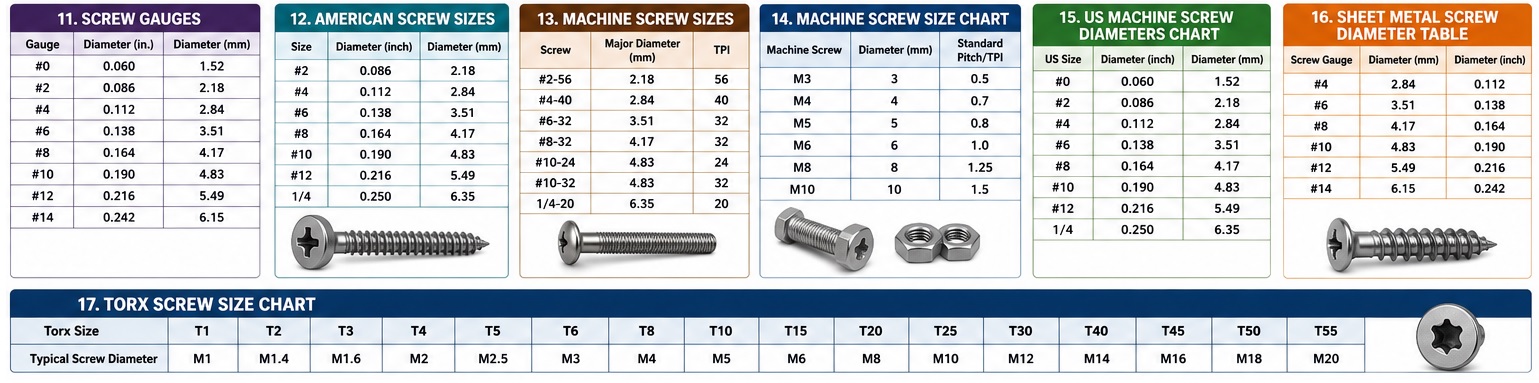
Screw Gauges
| Gauge | Diameter (in.) | Diameter (mm) |
| #0 | 0.06 | 1.52 |
| #2 | 0.086 | 2.18 |
| #4 | 0.112 | 2.84 |
| #6 | 0.138 | 3.51 |
| #8 | 0.164 | 4.17 |
| #10 | 0.19 | 4.83 |
| #12 | 0.216 | 5.49 |
| #14 | 0.242 | 6.15 |
American Screw Sizes
| Size | Diameter (inch) | Diameter (mm) |
| #2 | 0.086 | 2.18 |
| #4 | 0.112 | 2.84 |
| #6 | 0.138 | 3.51 |
| #8 | 0.164 | 4.17 |
| #10 | 0.19 | 4.83 |
| #12 | 0.216 | 5.49 |
| 1/4 | 0.25 | 6.35 |
Machine Screw Sizes
| Screw | Major Diameter (mm) | TPI |
| #2-56 | 2.18 | 56 |
| #4-40 | 2.84 | 40 |
| #6-32 | 3.51 | 32 |
| #8-32 | 4.17 | 32 |
| #10-24 | 4.83 | 24 |
| #10-32 | 4.83 | 32 |
| 1/4-20 | 6.35 | 20 |
Machine Screw Size Chart
| Machine Screw | Diameter (mm) | Standard Pitch/TPI |
| M3 | 3 | 0.5 |
| M4 | 4 | 0.7 |
| M5 | 5 | 0.8 |
| M6 | 6 | 1 |
| M8 | 8 | 1.25 |
| M10 | 10 | 1.5 |
US Machine Screw Diameters Chart
| US Size | Diameter (inch) | Diameter (mm) |
| #0 | 0.06 | 1.52 |
| #2 | 0.086 | 2.18 |
| #4 | 0.112 | 2.84 |
| #6 | 0.138 | 3.51 |
| #8 | 0.164 | 4.17 |
| #10 | 0.19 | 4.83 |
| #12 | 0.216 | 5.49 |
| 1/4 | 0.25 | 6.35 |
Sheet Metal Screw Diameter Table
| Screw Gauge | Diameter (mm) | Diameter (inch) |
| #4 | 2.84 | 0.112 |
| #6 | 3.51 | 0.138 |
| #8 | 4.17 | 0.164 |
| #10 | 4.83 | 0.19 |
| #12 | 5.49 | 0.216 |
| #14 | 6.15 | 0.242 |
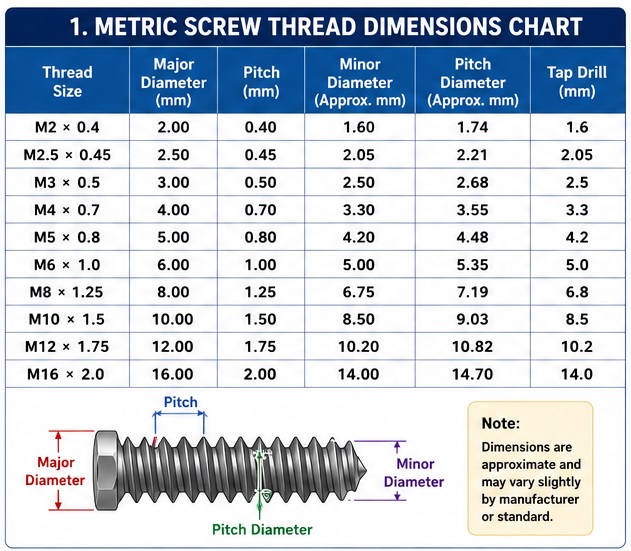
Metric Screw Thread Dimensions Chart
| Thread Size | Major Diameter (mm) | Pitch (mm) | Minor Diameter (Approx. mm) | Pitch Diameter (Approx. mm) | Tap Drill (mm) |
| M2 × 0.4 | 2 | 0.4 | 1.6 | 1.74 | 1.6 |
| M2.5 × 0.45 | 2.5 | 0.45 | 2.05 | 2.21 | 2.05 |
| M3 × 0.5 | 3 | 0.5 | 2.5 | 2.68 | 2.5 |
| M4 × 0.7 | 4 | 0.7 | 3.3 | 3.55 | 3.3 |
| M5 × 0.8 | 5 | 0.8 | 4.2 | 4.48 | 4.2 |
| M6 × 1.0 | 6 | 1 | 5 | 5.35 | 5 |
| M8 × 1.25 | 8 | 1.25 | 6.75 | 7.19 | 6.8 |
| M10 × 1.5 | 10 | 1.5 | 8.5 | 9.03 | 8.5 |
| M12 × 1.75 | 12 | 1.75 | 10.2 | 10.82 | 10.2 |
| M16 × 2.0 | 16 | 2 | 14 | 14.7 | 14 |
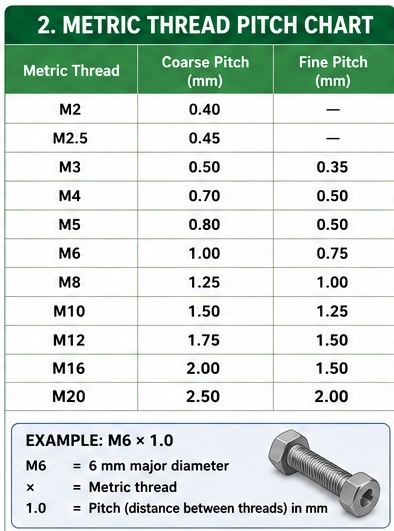
Metric Thread Pitch Chart
| Metric Thread | Coarse Pitch (mm) | Fine Pitch (mm) |
| M2 | 0.4 | — |
| M2.5 | 0.45 | — |
| M3 | 0.5 | 0.35 |
| M4 | 0.7 | 0.5 |
| M5 | 0.8 | 0.5 |
| M6 | 1 | 0.75 |
| M8 | 1.25 | 1 |
| M10 | 1.5 | 1.25 |
| M12 | 1.75 | 1.5 |
| M16 | 2 | 1.5 |
| M20 | 2.5 | 2 |
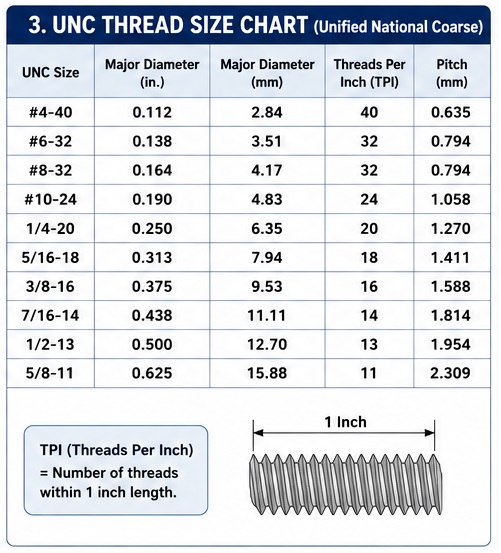
UNC Thread Size Chart
| UNC Size | Major Diameter (in.) | Major Diameter (mm) | Threads Per Inch (TPI) | Pitch (mm) |
| #4-40 | 0.112 | 2.84 | 40 | 0.635 |
| #6-32 | 0.138 | 3.51 | 32 | 0.794 |
| #8-32 | 0.164 | 4.17 | 32 | 0.794 |
| #10-24 | 0.19 | 4.83 | 24 | 1.058 |
| 1/4-20 | 0.25 | 6.35 | 20 | 1.27 |
| 5/16-18 | 0.313 | 7.94 | 18 | 1.411 |
| 3/8-16 | 0.375 | 9.53 | 16 | 1.588 |
| 7/16-14 | 0.438 | 11.11 | 14 | 1.814 |
| 1/2-13 | 0.5 | 12.7 | 13 | 1.954 |
| 5/8-11 | 0.625 | 15.88 | 11 | 2.309 |
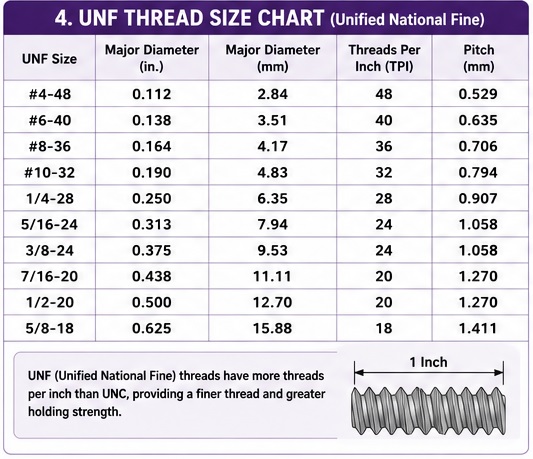
UNF Thread Size Chart
| UNF Size | Major Diameter (in.) | Major Diameter (mm) | Threads Per Inch (TPI) | Pitch (mm) |
| #4-48 | 0.112 | 2.84 | 48 | 0.529 |
| #6-40 | 0.138 | 3.51 | 40 | 0.635 |
| #8-36 | 0.164 | 4.17 | 36 | 0.706 |
| #10-32 | 0.19 | 4.83 | 32 | 0.794 |
| 1/4-28 | 0.25 | 6.35 | 28 | 0.907 |
| 5/16-24 | 0.313 | 7.94 | 24 | 1.058 |
| 3/8-24 | 0.375 | 9.53 | 24 | 1.058 |
| 7/16-20 | 0.438 | 11.11 | 20 | 1.27 |
| 1/2-20 | 0.5 | 12.7 | 20 | 1.27 |
| 5/8-18 | 0.625 | 15.88 | 18 | 1.411 |
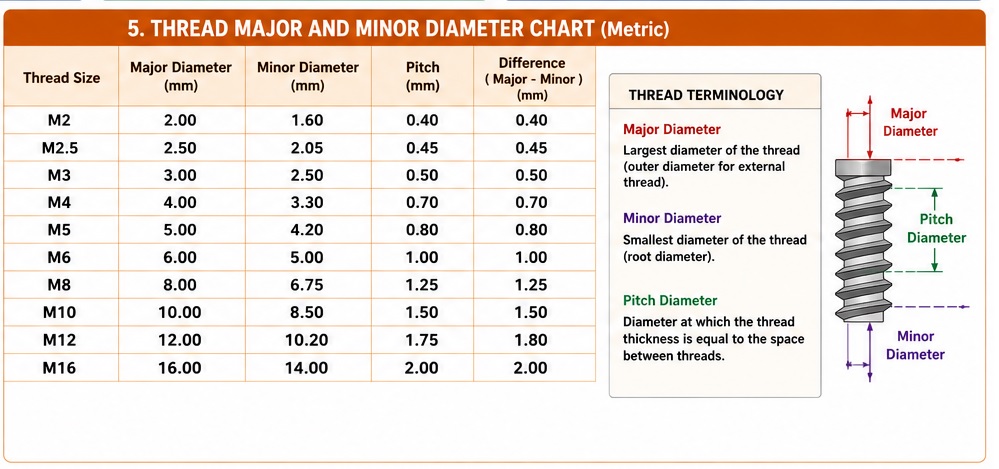
Thread Major and Minor Diameter Chart
| Thread Size | Major Diameter (mm) | Minor Diameter (mm) | Difference (mm) |
| M2 | 2 | 1.6 | 0.4 |
| M2.5 | 2.5 | 2.05 | 0.45 |
| M3 | 3 | 2.5 | 0.5 |
| M4 | 4 | 3.3 | 0.7 |
| M5 | 5 | 4.2 | 0.8 |
| M6 | 6 | 5 | 1 |
| M8 | 8 | 6.75 | 1.25 |
| M10 | 10 | 8.5 | 1.5 |
| M12 | 12 | 10.2 | 1.8 |
| M16 | 16 | 14 | 2 |
Torx Screw Size Chart
| Torx Size | Typical Screw Diameter |
| T1 | M1 |
| T2 | M1.4 |
| T3 | M1.6 |
| T4 | M2 |
| T5 | M2.5 |
| T6 | M3 |
| T8 | M4 |
| T10 | M5 |
| T15 | M6 |
| T20 | M8 |
| T25 | M10 |
| T30 | M12 |
| T40 | M14 |
| T45 | M16 |
| T50 | M18 |
| T55 | M20 |
How to determine Screw Size
Before getting details for screw sizes, follow these points. Commonly used tools for finding screw sizes are
Tape Measure
Caliper:
Thread Gauge:
Detailed Step
Diameter calculation:
First of all, use a caliper for calculating the width of the shaft, just
if finding a calculation in metric measure in millimeters, like M5.
Imperial follows the gauge chart
Length:
Use a ruler from the tip towards the head to measure length. In the case of a countersunk screw, take measurements from the top of the head to the tip.
Thread pitch calculation:
With the help of a thread gauge, find the pitch or count threads per inch.
Different Screw Sizes and Their Uses
Screw sizes vary by project, material, and load. Here’s a rundown of common screw sizes and their practical applications.
| Types | Screw Size | Diameter (inches) | Metric Equivalent | Uses | Example Applications / Real-World |
| Small Screws | #4 | 0.112″ | M3 | Electronics, eyeglass repair, small hinges | circuit board securing or toy assembly; best for electronic components |
| Small Screws | #6 | 0.138″ | M3.5 | Light woodworking, cabinetry, plastic fixtures | Assembling IKEA furniture |
| Medium Screws | #8 | 0.164″ | M4 | Furniture frames, shelving, light decking | bookshelf or attaching drywall is recommended for softwoods like pine |
| Medium Screws | #10 | 0.190″ | M5 | Heavy woodworking, construction, automotive | Fastening joists or securing engine parts; best for hardwoods like oak and load-bearing construction |
| Large Screws | #12 | 0.216″ | M6 | Structural framing, outdoor projects, machines | Constructing a pergola or mounting heavy equipment, best for load-bearing beams |
FAQs
What is the size value of a #10 screw?
10 #screws come with a diameter of about 0.190 inches that is normally used in medium-duty connections such as shelves or the connection of heavy brackets
What is the meaning of these numbers #4, #6, or #8?
These numbers show screw diameter since a high number means a larger diameter.
What is the difference between coarse and fine threads?
Coarse-thread fasteners provide fast installation and are employed for different applications. Fine thread fasteners come with a larger number of threads per inch and are employed for providing high setting accuracy with strong holding features.
Can a screw size chart be used for bolts too?
Yes, small fasteners defined with screw numbers and larger diameters are mentioned in fractions, for example, 1/4″, 5/16″, or 3/8″.
How to measure thread pitch?
Thread pitch in US fasteners is measured in threads per inch. We can calculate it with a thread pitch gauge or make a comparison with the reference chart seen above.
Why was #10 added to #10-24 and #10-32 fasteners?
#10 defines just the diameter; both #10-24 and #10-32 employ a similar diameter with different thread pitches.
What are the best outdoor fastener materials?
Material that offers good corrosion resistance, like stainless steel, is used in external conditions, and an accurately coated steel fastener is also used
Is #8 or #10 larger?
A larger number means the screw is thicker; that means a #10 screw is thicker than a #8 screw.
How do I measure a screw?
Length measured from
upper side of head to tip for flat-screw conditions. Below, head to the tip for pan or hex heads.
Caliper used for measuring thread diameter
Can metallic screws be used in wood?
Yes, it can be used but is not recommended; a metallic screw comes with fine threads that do not strongly grip wood fiber properly. Wood screws with coarser threads are used for high-strength holding.
What’s the common screw size?
#8 x 1-1/4″ is commonly used in house applications; it’s best to use for furniture, cabinets, and frames.
Are screw threads important?
Coarse threads are best to use for wood and plastic materials. Fine threads are best for metallic or high-density woods that grip strongly.
Final Words!
Selection of proper screw size is easy when we know the material, so we need to make accurate measurements with that reference chart used. This tutorial provides us detailed screw charts and their details for practical applications.