Cable ties’ other names are zip ties or wire ties, which are commonly used for the connection of components in construction industries and electrical industries. Either they commonly use a selection of ties, which is important since the wrong cable tie causes high-cost damage.
If the selected cable tie is not accurate, it affects the wiring harness for loose connections. Selection of faulty material for outdoor installation results in UV-induced cracking. Use of a standard nylon tie for the high-temperature engine bay results in damage and safety hazards.
This tutorial is best for engineers, electrical contractors, and OEM product designers who need to make informed, technically proper cable ties used for their specific applications. In this tutorial, we will cover detailed features, selection features, and installation techniques. Let’s begin.
|
 Pro Tip: Cable ties may seem like a minor component — but in critical wiring installations, the right tie is the difference between a 20-year system and a 2-year failure.
Types of Cable Ties and Uses
All cables are differently structured, and we will cover detailed features for cable ties and their uses.
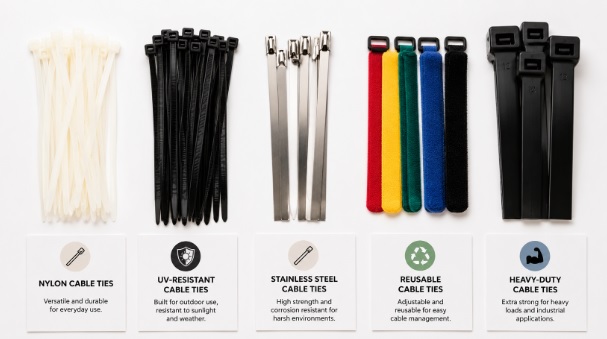
Nylon (PA66) Cable Ties: Standard Electrical Use
A commonly used cable type that is constructed with Nylon 66 (polyamide PA66), this tie offers good tensile strength and a flexible design with flame-retardant features. This tie is used for indoor electrical panels, PCB assemblies, junction boxes, and bundling purposes. Some of its technical features are
| Property | Specification |
| Temperature Range | -40°C to +85°C |
| Flame Rating | UL 94V-2 |
| Tensile Strength | 18 lbs to 120 lbs (depending on size) |
| Available Colors | Natural (White), Black |
UV-Resistant Black Cable Ties: Outdoor Applications
These cable ties provide a stable design from the effects of ultraviolet radiation. Carbon black pigmentation offers good outdoor performance. It is used for solar panel installations, telecom towers, rooftop wiring, and installations where direct sunlight affects
UV stabilizer additive for protection of PA66 from photodegradation
Recommended for any outdoor exposure for more than 6 months
Solar farms, EV charging stations, and construction sites
Stainless Steel Cable Ties: Harsh Environments
These ties are constructed with 304 or 316 stainless steel in uses where nylon is not preferred, such as high heat, chemicals, marine conditions, or offshore industries. Since it easily faces about 538°C.
316 SS is recommended for saltwater/marine environments.
304 SS for general industrial high-temperature use
Tensile strength: 150 lbs and above
Reusable / Releasable Cable Ties
These ties are used for projects where cable reconfiguration is made frequently. The release tab helps tie it to be reused and unfastened when needed. These are best for testing conditions, data centers, temporary installations, and maintenance-heavy systems.
Heavy Duty Cable Ties
Larger cross-section ties for bundling of thick cable harnesses and conduit pipes. high tensile rating is best for industrial machines, vehicle assembly line and structural cable management.
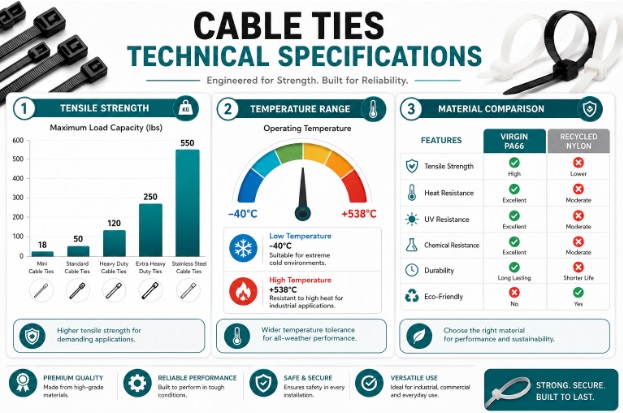
Technical Specifications
Before using a cable tie, you must consider some technical parameters before fulfilling their requirements.
| Specification | Details | Range |
| Tensile Strength | Maximum pull force before the locking tab fails | 18 – 550 lbs |
| Temperature Range | Safe operating temperature limits | -40°C to +538°C |
| Flame Rating | UL 94V-2 = self-extinguishing | V-0 / V-2 |
| Bundle Diameter | The maximum cable bundle the tie can wrap | 20mm – 200mm |
| Material Grade | Virgin PA66 vs recycled nylon | PA66 (DuPont) |
| UV Stability | Resistance to solar degradation | Standard / UV+ |
| Certifications | CE, RoHS, UL, ISO compliance | CE / RoHS / UL |
Virgin PA66 vs. Recycled Nylon: Importance
The main overlooked feature is raw material grade. Virgin nylon 66 (PA66), gotten from different manufacturers such as DuPont or Ascend Performance Materials, offers constant mechanical features, good tensile strength, and flame retardancy.
Recycled or reprocessed nylon comes with different batch-to-batch tensile strengths, surface finishes, and thermal-stable features.
For electrical wiring, specifying virgin PA66 is strongly preferred.
|
Application-Based Selection Factor:
proper cable tie based on applications and installation factors. Some applications are as
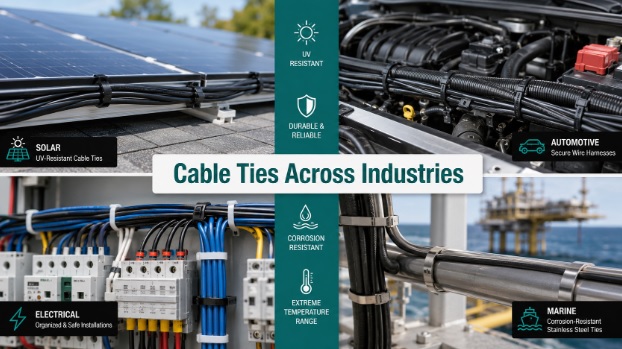
Electrical Panels and Junction Boxes
Under indoor temperature-controlled conditions, standard PA66 nylon ties with a UL 94V-2 flame rating are best to use. Use width and tensile strength according to wire bundle diameter.
| Property | Specification |
| Recommended Material | Standard PA66 |
| Available Colors | Natural (White), Black |
| Flame Rating | UL 94V-2 (Mandatory) |
| Typical Length Sizes | 150 mm to 300 mm |
PCB and Electronics Assembly
Precision environments needing non-abrasive, low-profile solutions. Smaller cable ties (100-150 mm) with a smooth locking head avoid damage to sensitive PCB traces or connector housings.
Recommended: Small-diameter PA66, low-profile head
Consider: Reusable ties for prototype/rework stages
Automotive Wire Harnesses
High vibration, chemical exposure, and heat: selection of heat-stabilized PA66 or specialty automotive-grade ties.
Engine bay temperature crosses standard PA66 limits; verify thermal before specifying.
Recommended: Heat-stabilized PA66 or nylon 12 (PA12) for high temps.
Consider vibration-resistant serrated head designs.
Solar and Renewable Energy Installations
Continuous outdoor UV exposure offered UV-stabilized black cable ties, which are important. Roof installations face high thermal cycling. Standard white PA66 ties will last between 12-24 months in direct sunlight.
Mandatory: UV-resistant black ties for all outdoor solar use
Recommended: -40°C to +85°C rated for thermal cycling
Consider: Stainless steel for rooftop structural wire anchoring
Marine and Offshore Applications
Humidity, saltwater, and chemical exposure reduce standard nylon’s best option. 316 stainless steel cable ties are a professional standards to use for marine wire requirements since they offer high corrosion resistance during the complete vessel lifespan.
Mandatory: 316 stainless steel in saltwater environments
Alternative: UV-stabilized PA66 for non-saltwater marine interiors
Why is sourcing from a reliable cable ties manufacturer important?
The features may look good on paper, but they do not guarantee that the manufacturing quality will be consistently upheld in real-world applications. Engineering and procurement professionals define cable ties for large and safety-based installations, and manufacturing selection is best for product selection.
A professional cable tie manufacturer ensures consistent batch-to-batch quality through proper testing protocols such as tensile testing, insertion force testing, moisture resistance testing, and visual inspection for production.
What to Look for in a Cable Ties Manufacturer
Raw material transparency: Does the supplier confirm 100% virgin PA66?
Certifications: CE, RoHS, UL, and ISO 9001:2015 are non-negotiable for industrial use.
Testing protocols: Tensile, insertion, moisture, and visual inspection per batch
Production capacity: Large facilities (30,000+ sqm) enable a consistent supply
Application engineering support: Can they recommend the right product for your specific installation?
Global delivery track record: DDP shipping, customs documentation, and reliable lead times
DIFVAN — Factory-Direct Cable Ties with 25+ Years of Manufacturing Experience
DIFVAN is a China-based cable ties and wiring accessories manufacturer supplying distributors, OEMs, electrical contractors, and industrial buyers in 50+ countries since 1997. Their 35,000 sqm facility in Wenzhou is constructing millions of cable ties monthly using 100% virgin PA66 sourced exclusively from DuPont and Ascend Performance Materials.
All DIFVAN cable ties are made to CE, RoHS, UL, and ISO 9001:2015 standards with batch-level testing documentation. The factory offers factory-direct pricing with no distributor markups, making it a preferred sourcing partner for large-scale electrical contractors and international distributors.
Bulk Buying Guide for Contractors and Distributors
For contractors handling many electrical projects or distributors offering trades, buying cable ties in bulk wholesale quantities from a factory-direct source provides significant operational and financial advantages.
When Does Bulk Purchasing Make Sense?
Projects where 10,000+ pieces for multiple size/color variants
Distributors maintaining stock for electrical contractor customers
Solar EPC companies managing large-scale panel farm installations
Vehicle OEMs with ongoing wire harness assembly need
Facilities management teams maintain consistent cable-tie stock
Cost Features of Factory-Direct Bulk Orders
The cost for a single component difference for retail and factory-direct wholesale is important; provide 40 to 70 percent lower for orders of more than 50,000 pieces. Other than unit cost, factory-direct buying also reduces distributor lead time variations, helps features of custom size and color not get to retail, and offers private labeling and packaging for reselling.
Bulk order cable ties direct from a China factory like DIFVAN normally means an MOQ starting at 10,000 pcs with mix-and-match size and color options; multiple cost tiers based on volume; DDP shipping to the USA, EU, UK, Australia, and 50+ countries; and complete documentation including RoHS/REACH declarations, CO, and packing lists.
Questions to Ask Your Bulk Supplier
What is your MOQ and can I mix sizes within one order?
Is pricing tiered based on volume, and what are the thresholds?
Do you offer DDP shipping with full customs documentation?
Can you provide private label packaging or custom branding?
What is your lead time for standard vs custom orders?
Do you provide a certificate of conformance or test report per batch?
Installation Best Techniques
Accurate installation is an important factor for accurate product selection. Improper tensioning, faulty spacing, or bad routing causes reliability faults irrespective of cable tie quality.
Proper Tensioning
Cable ties need to be tensioned properly to control bundle motion without deforming cable insulation. Over-tightening affects cable jackets, causes high conductor resistance, or causes stress concentration that results in insulation cracking.
Using a cable tie tensioning and cutting tool for consistent outcomes over high-volume installations.
Target: Snug without deforming the cable jacket
Always trim flush with the locking head to prevent snagging hazards.
Use a certain tie gun tool for constant torque on large projects
Spacing Guidelines
for proper wiring harness control, cable time accurately spaced with proper intervals for cable bundle weight and routing conditions
Horizontal runs: 300–600mm based on cable weight
Vertical runs: 600–900 mm or per relevant electrical code
Near connectors and terminations: extra tie within 50-75 mm of the connector
Installation limitations
Use of standard PA66 ties outdoors without UV stabilization
Over-tightening around sensitive control cables or signal wiring
Using ties too short for the bundle diameter causes head stress.
Failing to confirm temperature ratings opposite the application environment
Mixing uncertified economy components with certified components in safety-rated assemblies
Conclusion
Cable tie selection is not an easy decision; that is an engineering specification. The right combination of material, temperature resistance, tensile rating, UV stability, and certification provides longer, reliable features and safety compliance for electrical and industrial installations.
Engineers and procurement teams should evaluate cable ties in relation to the full application environment, not just the low available price. Material grade, manufacturer certifications, and batch testing consistency directly define whether a cable tie works for 20 years or fails within 20 months.
For large-scale projects and ongoing procurement, sourcing factory-direct from a famous manufacturer with a proven quality management system offers the best combination of technical reliability, supply consistency, and total cost of ownership
|
About DIFVAN DIFVAN is a factory-direct manufacturer of cable ties and wiring accessories based in Wenzhou, China. With 25+ years of manufacturing experience, DIFVAN supplies distributors, OEMs, electrical contractors, and industrial buyers in 50+ countries. Products include nylon cable ties, stainless steel cable ties, UV-resistant ties, wire terminals, cable glands, heat shrink connectors, and terminal blocks — all manufactured from 100% virgin PA66 and certified to CE, RoHS, UL, and ISO 9001:2015 standards. MOQ from 10,000 pcs with DDP shipping worldwide. Email: [email protected] | WhatsApp: +86 139 8977 1240 |